Your Battery vs. Winter
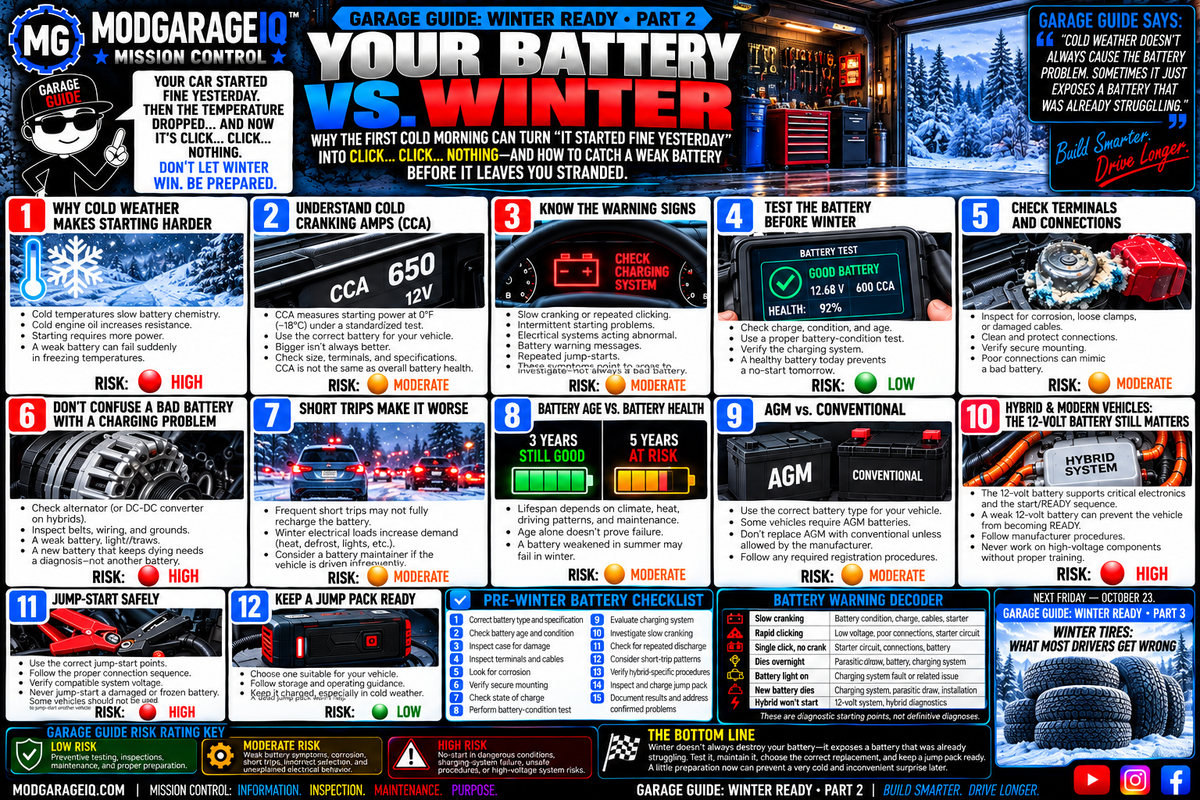
Why the First Cold Morning Can Turn “It Started Fine Yesterday” Into Click… Click… Nothing—and How to Catch a Weak Battery Before It Leaves You Stranded.
MODGARAGEIQ • MISSION CONTROL • GARAGE GUIDE: WINTER READY • PART 2
Your vehicle started perfectly yesterday.
No warning lights.
No obvious problems.
Nothing seemed unusual.
Then overnight, the temperature dropped.
You get into the car, turn the key or press the Start button, and suddenly the engine barely cranks.
Or worse.
Nothing happens.
Here’s the important part:
Cold weather doesn’t always cause the original battery problem. Sometimes it exposes a battery that was already struggling.
And understanding why that happens can save you from replacing perfectly good parts—or getting stranded with a battery that should have been tested weeks ago.
Let’s break it down.
1. Why Cold Weather Makes Starting Harder
Your 12-volt battery relies on chemical reactions to store and deliver electrical energy.
As temperatures fall, those reactions slow.
That can reduce the battery’s ability to deliver the high current needed to crank an engine.
At the same time, cold engine oil and increased mechanical resistance can make starting more demanding.
So you’re dealing with two problems:
- The battery may deliver less starting power.
- The engine may require more effort to crank.
A battery that was barely keeping up in warm weather can suddenly fall short.
🔴 Garage Guide Risk Rating: HIGH
A no-start can become a serious safety issue if you’re stranded in extreme conditions.
Garage Guide Says:
“Winter doesn’t have to destroy your battery. Sometimes it just asks for more power than the battery has left.”
2. Understand Cold Cranking Amps (CCA)
You’ve probably seen a number on a battery label followed by CCA.
That stands for Cold Cranking Amps.
It’s a standardized measure of a battery’s ability to supply starting current under cold conditions.
For conventional automotive starting batteries, the CCA rating describes current delivery at 0°F (−18°C) under a defined test.
Generally, a battery with an appropriate CCA rating is better suited to the starting requirements of its intended vehicle.
But bigger numbers aren’t automatically the answer.
Battery selection must also consider:
- Correct group size
- Physical fitment
- Terminal arrangement
- Manufacturer specifications
- Battery chemistry
- Electrical-system requirements
- Required registration or initialization procedures, if applicable
And remember: CCA is not the same as battery capacity or overall battery health.
🟡 Garage Guide Risk Rating: MODERATE
Garage Guide Says:
“Don’t buy the biggest CCA number on the shelf. Buy the correct battery for the vehicle.”
3. Learn the Warning Signs of a Weak Battery
A weak battery often gives clues before complete failure.
Watch for:
- Slow engine cranking
- Intermittent starting difficulty
- Repeated clicking when attempting to start
- Electrical systems behaving abnormally
- Low-voltage messages
- A battery that repeatedly needs jump-starting
- Battery test results indicating deterioration
But here’s where owners get fooled.
A vehicle may start normally one day and fail the next.
And these symptoms can also result from bad connections, starter faults, charging problems, or other electrical issues.
Symptoms tell you where to investigate—not automatically what to replace.
🟡 Garage Guide Risk Rating: MODERATE
Garage Guide Says:
“If the starter sounds tired every morning, don’t wait until it decides to take the day off.” 😂
4. Test the Battery Before Winter
This is one of the smartest preventive steps you can take.
A proper battery evaluation may include:
- Battery type and age
- State of charge
- Open-circuit voltage
- Battery condition testing
- Load or conductance testing
- Terminal inspection
- Cable condition
- Charging-system evaluation
For a conventional 12-volt lead-acid battery, approximately 12.6–12.8 volts at rest often indicates a fully charged battery, depending on chemistry, temperature, and test conditions.
But voltage alone doesn’t prove a battery is healthy.
A weak battery can show reasonable voltage and still fail when asked to deliver starting current.
That’s why a suitable battery-condition test matters.
🟢 Garage Guide Risk Rating: LOW
Testing is preventive; leaving a known weak battery unaddressed can create greater risk.
Garage Guide Says:
“A battery test in October is a lot more convenient than a jump-start in January.”
5. Check the Battery Terminals and Connections
Sometimes the battery isn’t the only problem.
Poor connections can restrict current flow and create starting problems.
Inspect:
- Positive terminal
- Negative terminal
- Cable connections
- Ground connections
- Corrosion
- Loose clamps
- Damaged cables
- Battery mounting
Look for white, blue, or green corrosion deposits around connections.
If cleaning or repairing terminals, follow the correct procedure for your vehicle, use appropriate protection, and avoid shorting the battery.
Some vehicles have sensitive battery-management systems or specific disconnection procedures.
Don’t assume every battery can be disconnected without consequences.
🟡 Garage Guide Risk Rating: MODERATE
Garage Guide Says:
“A good battery connected through bad cables can still act like a bad battery.”
6. Don’t Confuse a Bad Battery With a Charging Problem
Here’s an expensive mistake.
The battery goes dead.
The owner buys a new battery.
Two days later?
Dead again.
Why?
Because the original problem may have been the charging system, a parasitic electrical draw, or another fault.
On conventional gasoline vehicles, investigate applicable:
- Alternator output
- Drive belt
- Wiring
- Ground connections
- Battery-management operation
- Parasitic current draw
Modern charging systems can vary voltage intentionally, so a single voltage reading isn’t always a complete diagnosis.
Hybrid and electric vehicles may use DC-DC converters rather than conventional alternators to maintain their 12-volt systems.
Diagnose the system your vehicle actually has.
🔴 Garage Guide Risk Rating: HIGH
Garage Guide Says:
“If the new battery keeps dying, stop blaming the battery and find out who’s draining it.”
7. Short Trips Can Make Winter Battery Problems Worse
Winter driving often creates a challenging combination.
You start the car.
Drive a few minutes.
Park.
Repeat.
Starting consumes electrical energy.
And short trips may not provide enough opportunity to replenish the battery, especially when electrical loads and charging conditions are unfavorable.
Common winter loads include:
- Headlights
- Rear defroster
- Heated seats
- Heated steering wheel
- Blower motor
- Wipers
- Other electrical accessories
A healthy charging system is designed to support normal vehicle operation, but a weak battery or unsuitable driving pattern can still lead to a low state of charge.
If the vehicle is driven infrequently, an appropriate smart battery maintainer may help.
Use only equipment compatible with the battery and vehicle.
🟡 Garage Guide Risk Rating: MODERATE
Garage Guide Says:
“Five-minute trips and freezing temperatures aren’t always a great relationship for an aging battery.”
8. Know the Difference Between Battery Age and Battery Health
How old is too old?
There’s no universal expiration date.
Battery lifespan depends on:
- Climate
- Heat exposure
- Charging conditions
- Driving patterns
- Battery quality
- Electrical loads
- Maintenance
- Vehicle design
Heat can accelerate battery deterioration, while cold often exposes reduced performance.
That means a battery weakened during hot summer months may finally show symptoms during winter.
If your battery is several years old, testing before winter is sensible.
But age alone doesn’t prove failure.
🟡 Garage Guide Risk Rating: MODERATE
Garage Guide Says:
“Summer may have done the damage. Winter just showed you the receipt.” 😂
9. Understand AGM vs. Conventional Flooded Batteries
Not all 12-volt automotive batteries are interchangeable.
Common types include:
Flooded lead-acid batteries
Traditional starting batteries used in many vehicles.
AGM batteries
Absorbent Glass Mat batteries designed for particular electrical and operating requirements.
Some vehicles with stop-start systems or sophisticated electrical management require specific battery technologies.
Don’t replace an AGM battery with a conventional flooded battery unless the vehicle manufacturer explicitly allows it.
Likewise, changing battery technology or capacity may require vehicle-specific procedures.
The correct replacement depends on the vehicle—not the battery salesperson’s favorite upgrade.
🟡 Garage Guide Risk Rating: MODERATE
Garage Guide Says:
“A battery isn’t an upgrade just because it costs more. Compatibility comes first.”
10. Hybrid Owners: Your 12-Volt Battery Still Matters
This one surprises people.
A hybrid vehicle has a high-voltage traction battery.
So why does it also need a 12-volt battery?
Because the low-voltage electrical system supports critical electronics and the vehicle’s startup/READY sequence.
A weak 12-volt battery can prevent some hybrids from becoming READY even when the high-voltage traction battery is healthy.
But hybrid architectures vary.
Don’t assume the 12-volt battery performs the same functions as in a conventional gasoline vehicle.
And never attempt to jump-start or service high-voltage traction components using ordinary 12-volt procedures.
Follow the manufacturer’s instructions.
🔴 Garage Guide Risk Rating: HIGH
Garage Guide Says:
“Having a giant hybrid battery doesn’t mean the little 12-volt battery gets to retire.” 😂
11. Learn How to Jump-Start Safely
A jump-start can get you moving when the 12-volt battery is discharged.
But incorrect procedures can damage equipment or create hazards.
Before attempting one:
- Consult the owner’s manual
- Identify the correct jump-start terminals
- Verify compatible system voltage
- Inspect the battery for damage
- Use properly rated equipment
- Keep clamps away from moving components
- Follow the manufacturer’s connection and disconnection sequence
Never attempt to jump-start a frozen, damaged, leaking, or visibly swollen battery.
Some vehicles have designated remote jump points.
Some hybrids have special procedures.
And some vehicles should not be used to jump-start another vehicle.
If you’re uncertain, use roadside assistance.
🔴 Garage Guide Risk Rating: HIGH
Garage Guide Says:
“A jump pack is useful. Knowing where to connect it is even more useful.”
12. Keep a Jump Pack Ready—And Charged
A portable jump starter can be a valuable emergency tool.
Choose one appropriate for your vehicle and follow its operating instructions.
Consider:
- Vehicle compatibility
- Starting capability
- Battery technology
- Safety protections
- Cable quality
- Storage-temperature limits
- Charging requirements
And here’s the part people forget:
Recharge it periodically.
Cold temperatures can reduce the performance of many portable lithium-based jump starters.
Follow the manufacturer’s storage and operating guidance, and avoid leaving equipment in conditions outside its specified limits.
A dead jump pack isn’t much help.
🟢 Garage Guide Risk Rating: LOW
Garage Guide Says:
“A jump pack with no charge is just a very expensive paperweight in your trunk.”
13. Know When Replacement Actually Makes Sense
Garage Guide doesn’t want you buying batteries unnecessarily.
But he also doesn’t want you gambling on a battery that has already failed a proper test.
Replacement may be appropriate when:
- Testing confirms inadequate condition
- The battery has an internal fault
- It cannot reliably retain charge after proper evaluation
- It is physically damaged
- It repeatedly fails to perform despite a healthy charging system
- It no longer meets the vehicle’s requirements
Before installing a replacement, verify:
- Correct specification
- Correct physical fit
- Correct terminals
- Correct chemistry
- Required venting, if applicable
- Vehicle-specific registration or initialization requirements
And recycle the old battery properly.
🟡 Garage Guide Risk Rating: MODERATE
Garage Guide Says:
“Replace a battery because the evidence says it’s failing—not because winter has you nervous.”
14. Don’t Ignore a Battery That Keeps Going Dead
A battery that repeatedly discharges is telling you something.
Potential causes include:
- Battery deterioration
- Charging-system faults
- Excessive parasitic draw
- Poor connections
- Incorrect replacement battery
- Battery-management problems
- Frequent short trips
- Electrical accessories remaining active
Replacing the battery repeatedly without diagnosing the underlying issue can become expensive.
And if a battery has been deeply discharged, it may require proper recharging and retesting before its condition can be evaluated accurately.
🟡 Garage Guide Risk Rating: MODERATE
Garage Guide Says:
“If the battery keeps dying, the car isn’t asking for another battery. It’s asking for a diagnosis.”
15. Build a Pre-Winter Battery Routine
Here’s Garage Guide’s practical checklist.
Pre-Winter Battery Checklist
15 checks
0 of 15 completed
Reset
Identify the correct battery type
Check battery age and condition
Inspect the battery case
Inspect terminals and cables
Look for corrosion
Verify secure mounting
Check state of charge
Perform a suitable battery-condition test
Evaluate the charging system
Investigate slow cranking
Check for repeated discharge
Consider short-trip driving patterns
Verify hybrid-specific procedures if applicable
Inspect and charge your jump pack
Document results and address confirmed problems
Copy checklist
Garage Guide’s Battery Warning Decoder
|
Symptom |
What to investigate |
|
Slow cranking |
Battery condition, charge, cables, starter |
|
Rapid clicking |
Low voltage, poor connections, starter circuit |
|
Single click, no crank |
Starter circuit, connections, battery, control system |
|
Battery dies overnight |
Parasitic draw, battery condition, charging history |
|
Battery warning light while driving |
Charging-system fault or related electrical problem |
|
New battery repeatedly dies |
Charging system, parasitic draw, installation and battery compatibility |
|
Hybrid won’t enter READY |
12-volt system, hybrid fault codes and manufacturer-specific diagnostics |
These are diagnostic starting points, not definitive diagnoses.
Garage Guide Risk Rating
🟢 LOW RISK
Preventive battery testing, visual inspections, maintaining a properly rated jump pack, and keeping service records.
🟡 MODERATE RISK
Weak battery symptoms, corrosion, repeated short-trip discharge, incorrect battery selection, and unexplained intermittent electrical behavior.
🔴 HIGH RISK
A no-start in dangerous winter conditions, serious charging-system failure, damaged or frozen batteries, unsafe jump-start procedures, and unqualified work around high-voltage systems.
The Bottom Line
Winter doesn’t always give you a warning before a battery fails.
But a little preparation can greatly reduce the chances of being surprised.
Know your battery.
Test its condition.
Inspect the terminals.
Verify the charging system.
Understand your driving habits.
Choose the correct replacement when necessary.
Keep your jump pack ready.
And don’t confuse a weak battery with an entirely different electrical problem.
Because replacing parts without diagnosing the cause isn’t preparation.
It’s guessing with a receipt. 😂
The best time to discover a weak battery is when you’re standing in a warm garage with a battery tester.
Not when you’re standing in a freezing parking lot wondering why the car won’t start.
Garage Guide Says:
“Don’t wait for winter to test your battery. Test your battery so winter doesn’t get to test your patience.”
Build Smarter. Drive Longer.
NEXT FRIDAY — OCTOBER 23
GARAGE GUIDE: WINTER READY — PART 3
Winter Tires: What Most Drivers Get Wrong
Winter vs. all-season vs. all-weather tires, cold-weather grip, tread depth, tire pressure, and why AWD isn’t a substitute for traction.
#ModGarageIQ #GarageGuide #WinterReady #CarBattery #BatteryMaintenance #ColdWeather #WinterCarCare #Winterization #ChargingSystem #JumpStarter #CarMaintenance #VehicleReliability #WinterDriving #AutomotiveEducation #MissionControl #BuildSmarterDriveLonger