Best Build Paths for the Dodge Charger & Challenger
From Reliable Daily Drivers and Clean OEM+ Builds to Street Muscle, Handling, Drag-Strip Machines, and Long-Term Keepers—Here’s How to Build the Right Mopar Without Sacrificing Reliability, Safety, or Your Entire Bank Account.
MODGARAGEIQ OWNER’S GUIDE • DODGE CHARGER & CHALLENGER • PART 4 OF 4 • OCTOBER 22, 2026
There’s something beautiful about the Dodge Charger and Challenger platforms.
Two owners can start with similar cars and build completely different machines.
One wants a comfortable daily driver.
Another wants a clean, factory-inspired cruiser.
Somebody else wants a 392 that sounds incredible and handles better.
And somewhere out there, a Hellcat owner is looking at the factory horsepower rating and thinking:
“That’s a good starting point.” 😂
Garage Guide understands.
But here’s where things get interesting.
The best build isn’t necessarily the fastest, loudest, lowest, or most expensive.
It’s the build that matches the vehicle, its condition, your driving needs, and your budget.
A Charger used for a long commute shouldn’t automatically receive the same modifications as a Challenger built for sanctioned drag racing.
A 3.6L Pentastar doesn’t need to pretend it’s a 6.2L supercharged HEMI.
And a 392 doesn’t need to be pushed beyond its intended purpose to be enjoyable.
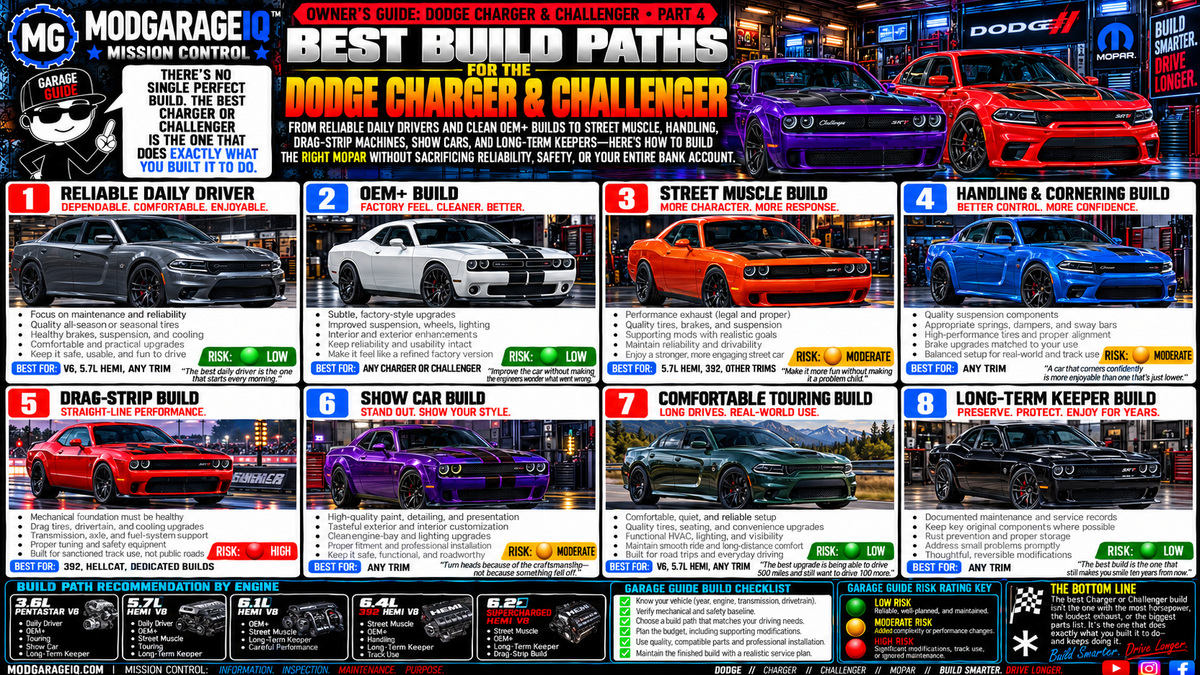
Today, we’re looking at eight different build paths.
We’ll focus primarily on modern HEMI-era Chargers and Challengers, including V6 models, while recognizing that model years, transmissions, drivetrains, and factory equipment differ.
Before choosing a path, remember one thing:
Maintenance is the foundation. Modifications are the direction.
Let’s build.
1. The Reliable Daily Driver Build
🟢 LOW RISK
The Mission: Make your Charger or Challenger dependable, comfortable, safe, and enjoyable for everyday use.
This is arguably the most underrated build path.
Because a car that starts every morning, drives comfortably, handles bad weather appropriately, and doesn’t constantly demand repairs is a very successful build.
What I’d prioritize
- Correct engine oil and scheduled maintenance.
- Properly selected tires for your climate.
- Healthy brakes and suspension.
- Cooling-system reliability.
- Battery and charging-system health.
- Transmission and drivetrain maintenance according to the applicable schedule.
- Good wipers, lighting, and visibility.
- Repairing existing problems before adding accessories.
What I’d avoid
- Excessively stiff suspension.
- Inappropriate tire compounds.
- Unnecessary engine tuning.
- Extremely loud exhaust systems.
- Modifications that reduce everyday usability.
Best suited for
Pentastar V6, 5.7L HEMI, and owners of other trims who prioritize daily usability.
Garage Guide Says:
“The most impressive daily driver isn’t the one that makes the biggest dyno number. It’s the one you can depend on every single morning.”
2. The OEM+ Build
🟢 LOW RISK
The Mission: Make the vehicle feel like a carefully refined factory version of itself.
OEM+ means improving selected details without losing the character, reliability, or usability of the original car.
Think subtle.
Clean.
Purposeful.
Not every modification needs to announce itself from three blocks away.
What I’d prioritize
- Quality replacement suspension components.
- Correctly fitted wheels and tires.
- Factory-compatible cosmetic enhancements.
- Interior restoration or tasteful upgrades.
- Improved lighting using legal, compatible components.
- Proper alignment.
- Brake improvements suited to the existing system.
- Carefully selected exhaust changes where legal and appropriate.
What I’d avoid
- Fake performance badges.
- Poorly fitted body panels.
- Questionable aftermarket electronics.
- Excessively large wheels that compromise ride quality.
- Cosmetic changes that interfere with cooling or safety systems.
Best suited for
Almost any Charger or Challenger trim.
This is an especially strong path for owners who like the factory design but want something a little more personal.
Garage Guide Risk Rating: 🟢 LOW, provided modifications are compatible and professionally executed where necessary.
Garage Guide Says:
“OEM+ is what happens when you improve the car without making the engineers wonder what went wrong.” 😂
3. The Street Muscle Build
🟡 MODERATE RISK
The Mission: Create a responsive, enjoyable street-oriented muscle car without turning it into an unreliable project.
This is where many HEMI owners naturally gravitate.
You want a little more character.
A little more response.
Maybe a better exhaust note.
But you still want to drive the car regularly.
What I’d prioritize
- A verified healthy engine.
- High-quality, appropriate performance tires.
- Healthy brakes.
- Suspension components that support controlled handling.
- Correct engine and transmission maintenance.
- A legal, properly installed exhaust system.
- Compatible upgrades with realistic performance expectations.
What I’d avoid
- Aggressive tuning on an unhealthy engine.
- Poorly matched performance components.
- Excessively loud or illegal exhaust changes.
- Removing emissions equipment.
- Modifications that make traction worse.
- Spending everything on engine output while ignoring the drivetrain.
Best suited for
5.7L HEMI and 392 owners, although other trims can benefit from a sensible street-oriented setup.
The goal isn’t maximum horsepower.
It’s usable performance.
Garage Guide Says:
“A street muscle build should make you enjoy the drive—not make you nervous every time the temperature gauge moves.”
4. The Handling and Cornering Build
🟡 MODERATE RISK
The Mission: Improve steering response, body control, braking consistency, and overall handling.
Here’s something people forget.
Chargers and Challengers aren’t lightweight sports cars.
But that doesn’t mean they can’t benefit from a well-planned handling setup.
The key is balance.
What I’d prioritize
- Suitable performance tires.
- Correct alignment.
- Healthy suspension bushings.
- Quality dampers.
- Springs compatible with the dampers and intended use.
- Appropriate sway-bar upgrades where beneficial.
- Brake components matched to the driving environment.
- Wheel sizing that preserves proper clearances and load ratings.
What I’d avoid
- Lowering solely for appearance.
- Excessively stiff springs.
- Cheap, poorly engineered coilovers.
- Incorrect wheel offsets.
- Removing necessary suspension travel.
- Ignoring tire temperatures and brake demands during controlled performance driving.
Best suited for
Owners who enjoy responsive street driving or appropriate track-oriented activities.
Different factory trims may already include substantial performance suspension equipment, so evaluate what the car actually needs before changing it.
Garage Guide Says:
“A car that corners confidently is a lot more enjoyable than one that’s simply lower in the parking lot.”
5. The Drag-Strip Build
🔴 HIGH RISK
The Mission: Build a vehicle for repeatable, controlled acceleration at a properly operated drag strip.
This is where the Charger and Challenger platforms have a serious performance heritage.
And this is where build planning becomes especially important.
Because improving acceleration isn’t just about increasing horsepower.
It’s about managing traction, heat, drivetrain loads, and safety.
What I’d prioritize
- A comprehensive mechanical inspection.
- Tires appropriate for sanctioned drag-strip use.
- Drivetrain and axle condition.
- Transmission or clutch health.
- Cooling-system performance.
- Properly matched suspension components.
- Reliable fuel delivery.
- Appropriate calibration where modifications require it.
- Compliance with track safety rules and equipment requirements.
What I’d avoid
- Launching a mechanically questionable car.
- Installing power upgrades without supporting hardware.
- Using worn or unsuitable tires.
- Assuming factory drivetrain components have unlimited capacity.
- Ignoring track-specific safety requirements.
- Performing drag-strip activities on public roads.
Best suited for
Owners committed to controlled motorsports use, especially those starting with a healthy performance-oriented trim.
A purpose-built drag car may require a substantial budget and compromises in street comfort.
Garage Guide Says:
“A drag build isn’t just about making horsepower. It’s about making the entire car survive delivering that horsepower.”
6. The Show Car Build
🟡 MODERATE RISK
The Mission: Build a visually distinctive Charger or Challenger while preserving safety, functionality, and craftsmanship.
Not every build needs to chase lap times or quarter-mile records.
Some owners simply love the design.
And that’s a perfectly legitimate direction.
What I’d prioritize
- Paint correction and preservation.
- High-quality detailing.
- Properly fitted wheels.
- Tasteful exterior styling.
- Interior restoration or customization.
- Well-installed lighting where legal.
- Clean engine-bay presentation.
- Professional wiring and secure mounting.
- Maintaining adequate ground clearance.
What I’d avoid
- Unsafe wheel fitments.
- Lighting that violates road regulations.
- Poorly secured cosmetic components.
- Wiring that creates electrical hazards.
- Modifications that obstruct visibility.
- Sacrificing necessary maintenance for appearance.
Best suited for
Any trim, provided the build respects the vehicle’s mechanical and safety requirements.
Garage Guide Says:
“A show car should turn heads because of the craftsmanship—not because something fell off on the highway.” 😂
7. The Comfortable Touring Build
🟢 LOW RISK
The Mission: Turn your Charger or Challenger into an enjoyable long-distance cruiser.
This is an excellent path for owners who appreciate the size, comfort, styling, and highway character of these cars.
A touring build prioritizes the complete driving experience.
What I’d prioritize
- Quiet, suitable tires.
- Healthy suspension and alignment.
- Comfortable seating.
- Functional HVAC.
- Reliable charging and electrical systems.
- Good headlights and visibility.
- Properly maintained brakes.
- Cooling-system reliability.
- Reasonable cabin-noise levels.
- Convenient, safely installed accessories.
What I’d avoid
- Extremely loud exhaust systems.
- Excessively firm suspension.
- Unnecessary performance tuning.
- Tires that are poorly suited to changing weather.
- Modifications that reduce passenger comfort.
Best suited for
V6, 5.7L HEMI, and other trims whose owners enjoy longer drives.
Garage Guide Says:
“Sometimes the best performance upgrade is being able to drive 500 miles and still want to drive another 100.”
8. The Long-Term Keeper Build
🟢 LOW RISK
The Mission: Preserve the vehicle’s condition, originality where desired, and long-term mechanical health.
This is a particularly interesting path for owners who intend to keep their Charger or Challenger for many years.
Some want to preserve a special trim.
Others simply love the vehicle and have no intention of selling it.
Either way, long-term ownership rewards consistency.
What I’d prioritize
- Documented maintenance.
- Proper fluid specifications.
- Rust prevention.
- Regular underbody inspections.
- Paint and interior preservation.
- Repairing small problems promptly.
- Keeping original parts where practical.
- Careful storage procedures.
- Battery maintenance during extended storage.
- Appropriate tire care.
- Maintaining records of repairs and modifications.
What I’d avoid
- Irreversible modifications without a clear purpose.
- Neglecting corrosion.
- Leaving the car unused for long periods without preparation.
- Cheap replacement components.
- Ignoring developing mechanical problems.
Best suited for
Any Charger or Challenger with an owner committed to long-term care.
Garage Guide Says:
“The best long-term build is the one that still makes you smile ten years after you bought it.”
9. Match the Build to Your Engine
Here’s where we stop treating every Mopar like the same machine.
3.6L Pentastar V6
Recommended directions: Daily Driver, OEM+, Touring, Show Car, or Long-Term Keeper.
Focus on reliability, ride quality, appropriate tires, braking, and tasteful personalization.
A healthy V6 can be an excellent car without expensive attempts to imitate a factory V8 performance trim.
5.7L HEMI V8
Recommended directions: OEM+, Street Muscle, Daily Driver, Touring, or Long-Term Keeper.
This is a versatile platform for owners who want traditional V8 character without necessarily pursuing extreme performance.
Maintain the engine and drivetrain before making performance changes.
6.1L HEMI V8
Recommended directions: OEM+, Street Muscle, Long-Term Keeper, or carefully planned performance use.
Pay close attention to age, parts compatibility, maintenance history, and the specific vehicle’s condition.
Preserving a healthy example may be more rewarding than pursuing aggressive modifications.
6.4L / 392 HEMI V8
Recommended directions: Street Muscle, OEM+, Handling, Long-Term Keeper, or appropriately prepared motorsports use.
The 392 already offers substantial naturally aspirated performance.
Tires, brakes, suspension condition, and drivetrain reliability may deliver more useful improvements than chasing additional peak horsepower.
Supercharged 6.2L HEMI V8
Recommended directions: Street Muscle, OEM+, Long-Term Keeper, or properly engineered Drag-Strip builds.
These vehicles already have enormous factory performance potential.
Before changing boost-related hardware or calibration, evaluate the engine, fuel system, cooling, drivetrain, and applicable safety requirements.
Don’t assume increasing boost is a simple standalone upgrade.
Garage Guide Says:
“Build for the engine you own—not the engine somebody on the internet thinks you should have bought.”
10. Build the Foundation Before the Performance
Regardless of which path you choose, your foundation comes first.
Before significant modifications, verify:
- Engine condition.
- Correct lubrication.
- Cooling-system health.
- Transmission behavior.
- Differential and axle condition.
- Brake performance.
- Tire suitability.
- Steering and suspension condition.
- Electrical reliability.
- Outstanding safety recalls.
- Previous modifications.
- Appropriate service history.
A modification cannot compensate for a neglected vehicle.
Garage Guide Risk Rating: 🔴 HIGH if serious mechanical or safety problems are ignored.
Garage Guide Says:
“You don’t build a strong Mopar by stacking expensive parts on top of unresolved problems.”
11. Choose Modifications That Work Together
This is where a lot of builds succeed—or fall apart.
A good build is a system.
Tires influence traction.
Suspension affects how the vehicle uses that traction.
Brakes determine how consistently it can slow down.
Cooling influences performance under load.
The drivetrain must handle the demands placed on it.
And the engine calibration must be appropriate for the installed hardware.
A collection of expensive parts isn’t automatically a balanced build.
The smarter approach: Choose modifications that support the same mission.
Garage Guide Risk Rating: 🟡 MODERATE
Garage Guide Says:
“The best parts aren’t always the most expensive ones. They’re the ones that work together.”
12. Understand the True Cost of a Build
A modification’s purchase price isn’t necessarily its final cost.
Consider:
- Installation labor.
- Supporting components.
- Alignment.
- Diagnostic work.
- Additional maintenance.
- Replacement consumables.
- Insurance implications.
- Emissions and inspection compliance.
- Warranty implications.
- Potential effects on resale value.
A seemingly affordable suspension kit might require additional components and alignment work.
A power upgrade may require supporting fuel, cooling, or drivetrain improvements.
A wheel change may require different tires and careful fitment verification.
Garage Guide Risk Rating: 🟡 MODERATE
Garage Guide Says:
“If the part costs $500 but needs another $1,500 to work correctly, that’s not a $500 modification.”
13. Build for Your Actual Driving Conditions
A Charger in a warm, dry climate may have different needs than one used through freezing temperatures, road salt, and snow.
Consider:
- Typical temperatures.
- Rain and snow exposure.
- Road conditions.
- Daily mileage.
- Parking and storage.
- Passenger needs.
- Highway versus city use.
- Access to suitable service facilities.
A tire that’s excellent for warm-weather performance may be inappropriate for freezing conditions.
A lowered car may be inconvenient on rough roads.
And a track-oriented setup may be unnecessarily harsh for commuting.
Garage Guide Risk Rating: 🟡 MODERATE
Garage Guide Says:
“Build for the roads you actually drive—not just the roads in the videos you watch.”
14. Know When to Leave It Stock
Here’s something that doesn’t get said enough.
A healthy factory Charger or Challenger can already be a great car.
You don’t need to modify it simply because aftermarket parts exist.
Especially if you own a vehicle with a desirable factory configuration.
Keeping the car stock can offer benefits such as:
- Predictable maintenance.
- Factory-engineered system compatibility.
- Easier troubleshooting.
- Potentially fewer modification-related problems.
- Preservation of original components.
- Simpler long-term ownership.
That doesn’t mean stock is always better.
It means stock is a valid build decision.
Garage Guide Risk Rating: 🟢 LOW
Garage Guide Says:
“Sometimes the smartest modification is deciding the factory got it right.”
15. Garage Guide’s Build Selection Checklist
Before choosing a build path, answer these questions.
1. WHAT IS MY VEHICLE?
Year, engine, transmission, drivetrain, trim, and current mechanical condition.
2. HOW DO I USE IT?
Daily driving, weekend cruising, long-distance travel, shows, or sanctioned motorsports.
3. WHAT DO I WANT TO IMPROVE?
Reliability, appearance, handling, comfort, acceleration, or preservation.
4. WHAT CAN I REALISTICALLY AFFORD?
Parts, labor, supporting upgrades, maintenance, and a repair reserve.
5. WHAT AM I WILLING TO SACRIFICE?
Ride comfort, fuel economy, cabin noise, originality, or other ownership characteristics.
6. IS THE MODIFICATION COMPATIBLE?
Verify fitment, supporting components, safety, and applicable legal requirements.
7. CAN I MAINTAIN THE FINISHED BUILD?
Consider long-term consumables, repairs, and service access.
If you can answer those questions clearly, you’re already ahead of a lot of project-car owners.
Garage Guide’s Recommended Build Order
No matter which path you choose, here’s the sequence I’d follow.
STEP 1 — INSPECT
Establish the mechanical and safety baseline.
STEP 2 — MAINTAIN
Complete required maintenance and repair confirmed defects.
STEP 3 — DEFINE THE MISSION
Choose Daily Driver, OEM+, Street Muscle, Handling, Drag Strip, Show Car, Touring, or Long-Term Keeper.
STEP 4 — PLAN THE BUDGET
Include parts, installation, supporting upgrades, and reserves.
STEP 5 — PRIORITIZE TIRES, BRAKES, AND CHASSIS HEALTH
Make sure the car can safely use its existing performance.
STEP 6 — INSTALL COMPATIBLE MODIFICATIONS
Choose quality components that support the same goal.
STEP 7 — VERIFY THE RESULTS
Inspect the installation, check for faults, and evaluate the vehicle safely.
STEP 8 — MAINTAIN THE FINISHED BUILD
Update your maintenance plan to reflect the vehicle’s actual use and modifications.
Garage Guide Risk Rating Summary
🟢 LOW RISK
Reliable Daily Driver, OEM+, Comfortable Touring, Long-Term Keeper, and preserving a healthy factory configuration.
🟡 MODERATE RISK
Street Muscle, Handling, Show Car, and other builds involving meaningful changes to suspension, exhaust, appearance, or performance.
🔴 HIGH RISK
Dedicated Drag-Strip builds, major power increases, extensive drivetrain modifications, and poorly planned changes that compromise safety, reliability, or compliance.
Important: These ratings assume the vehicle is mechanically healthy and the work is properly planned. Even a seemingly simple modification can become high risk if it is installed incorrectly or creates a safety problem.
The Bottom Line
There is no single perfect Dodge Charger or Challenger build.
And that’s exactly what makes these cars interesting.
A well-maintained Pentastar daily driver can be a smart build.
A clean 5.7L R/T with tasteful upgrades can be a fantastic street cruiser.
A balanced 392 can deliver incredible naturally aspirated performance without chasing extreme modifications.
A carefully preserved Hellcat can be just as impressive as a heavily modified one.
And a properly engineered drag-strip car can be a rewarding project for an owner who understands its demands.
The secret isn’t buying the most expensive parts.
It’s choosing a mission.
Understanding the platform.
Protecting the mechanical foundation.
Selecting compatible upgrades.
And knowing when enough is enough.
Build the car for the life you actually live—not the approval of strangers on the internet.
Garage Guide Says:
“The best Charger or Challenger build isn’t the one with the most horsepower, the loudest exhaust, or the biggest parts list. It’s the one that does exactly what you built it to do—and keeps doing it.”
Build Smarter. Drive Longer.
🏁 DODGE CHARGER & CHALLENGER OWNER’S GUIDE — COMPLETE!
Four parts. Four missions. One foundation-first philosophy.
COMING FRIDAY, OCTOBER 23
GARAGE GUIDE: WINTER READY — PART 3
Winter Tires: What Most Drivers Get Wrong
All-Season vs. All-Weather vs. Winter Tires, Cold-Weather Grip, Tread Depth, Tire Pressure, and Why AWD Doesn’t Replace Traction.
#ModGarageIQ #GarageGuide #DodgeCharger #DodgeChallenger #Mopar #HEMI #Pentastar #ScatPack #392HEMI #Hellcat #AmericanMuscle #CarBuilds #OEMPlus #StreetMuscle #PerformanceCars #CarMaintenance #AutomotiveEducation #OwnersGuide #BuildSmarterDriveLonger