I Just Bought a Dodge Charger or Challenger… Now What?
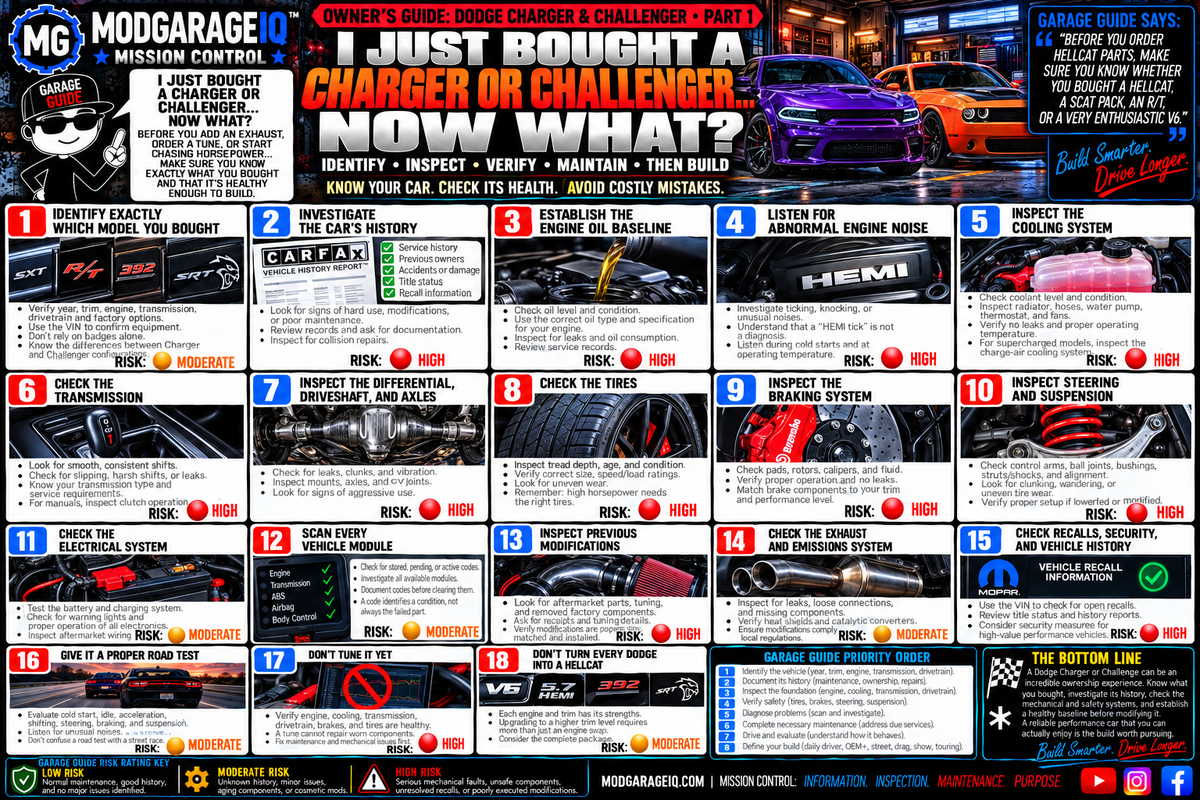
Before You Add an Exhaust, Order a Tune, Install Bigger Wheels, or Start Chasing Horsepower—Find Out Exactly Which Mopar You Bought and Make Sure It’s Healthy Enough to Build.
MODGARAGEIQ OWNER’S GUIDE • DODGE CHARGER & CHALLENGER • DAY 1 OF 4 • OCTOBER 19, 2026
There’s something about bringing home a Dodge Charger or Challenger.
Maybe it’s the sound.
Maybe it’s the styling.
Maybe it’s the HEMI badge.
Maybe it’s knowing you’ve got a big, comfortable American performance car sitting in the driveway.
And if you bought a Hellcat?
Garage Guide would like to remind you that the accelerator is not an on/off switch. 😂
But here’s the problem.
A Charger or Challenger can be an outstanding ownership experience.
It can also become a very expensive lesson in buying a performance car without understanding its history.
Because not every Charger is a V8.
Not every Challenger is a Hellcat.
Not every HEMI has the same maintenance requirements.
And not every previous owner treated the car gently.
Before you build the car you want, understand the car you actually bought.
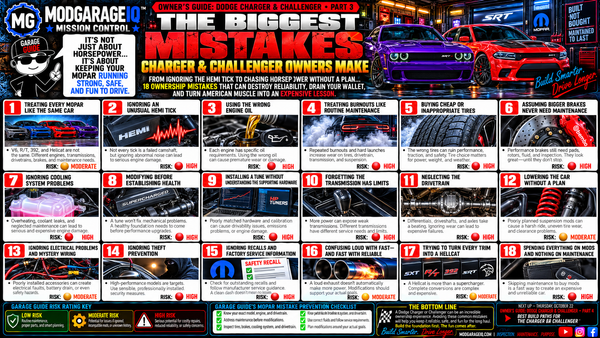
For this Owner’s Guide, we’re focusing primarily on the modern, HEMI-era Charger and Challenger, including their V6 and V8 variants, with model-year and trim differences noted where important.
Let’s get into it.
1. Identify Exactly Which Charger or Challenger You Bought
This sounds obvious.
It isn’t.
Across modern Charger and Challenger generations, you’ll find different engines, transmissions, drivetrains, suspension packages, brakes, and performance equipment.
Depending on model year and configuration, you might have:
- 3.6L Pentastar V6
- 5.7L HEMI V8
- 6.1L HEMI V8
- 6.4L / 392 HEMI V8
- Supercharged 6.2L HEMI V8
- Rear-wheel drive
- All-wheel drive on certain Charger and Challenger configurations
- Different automatic transmissions
- Manual transmissions on certain Challengers
- Standard, performance, and high-performance brake packages
And here’s an important distinction:
The Charger and Challenger share some mechanical architecture, but they’re not identical vehicles.
Body styles, equipment, model years, and available configurations matter.
Before ordering anything, document:
- Year and trim
- Engine
- Transmission
- Drivetrain
- Mileage
- VIN
- Factory options
- Previous modifications
- Service history
For performance trims, verify the vehicle’s identity and equipment using its VIN and appropriate factory documentation rather than relying on badges alone.
Garage Guide Risk Rating: 🟡 MODERATE
Garage Guide Says:
“Before you order Hellcat parts, make sure you know whether you bought a Hellcat, a Scat Pack, an R/T, or a very enthusiastic V6.” 😂
2. Investigate the Car’s Previous Life
A used performance car deserves a little extra detective work.
Why?
Because the previous owner may have enjoyed the vehicle exactly as Dodge intended.
And sometimes a little more than Dodge intended. 😂
Look for evidence of:
- Repeated hard launches
- Drag-strip use
- Burnouts
- Aggressive driving
- Collision repairs
- Poorly installed modifications
- Previous tuning
- Missing factory components
- Inconsistent maintenance
- Unexplained drivetrain repairs
None of those automatically proves the vehicle is damaged.
But they tell you where to investigate.
Inspect tire wear, rear suspension, differential mounts, drivetrain components, and any aftermarket equipment.
Garage Guide Risk Rating: 🔴 HIGH
Garage Guide Says:
“A performance car isn’t automatically a bad purchase because somebody enjoyed it. The problem is when they enjoyed it and forgot to maintain it.”
3. Establish the Engine Oil Baseline
Whether you bought a Pentastar V6, naturally aspirated HEMI, or supercharged HEMI, engine lubrication matters.
Start by verifying:
- Oil level
- Correct viscosity and specification
- Filter condition
- Service records
- Oil leaks
- Oil consumption
- Abnormal engine noise
Different engines and model years can require different oil specifications.
Don’t assume the oil used in one HEMI belongs in every HEMI.
And don’t select engine oil based entirely on what someone in a forum uses.
Follow the correct requirements for your engine.
Garage Guide Risk Rating: 🔴 HIGH
Garage Guide Says:
“The HEMI badge doesn’t make the engine immune to running out of oil.”
4. Listen for Abnormal Engine Noise
This is especially important when evaluating a used V8 performance car.
Owners often talk about the infamous “HEMI tick.”
But that phrase is not a diagnosis.
Different noises can come from different causes, including:
- Exhaust leaks
- Valvetrain concerns
- Lifter or camshaft problems
- Injector operation
- Accessory-drive components
- Other mechanical issues
A ticking sound does not automatically mean a failed camshaft.
And a quiet engine doesn’t automatically mean every internal component is perfect.
Listen during cold starts and at operating temperature, and have persistent or abnormal noises properly diagnosed.
Garage Guide Risk Rating: 🔴 HIGH for suspected internal mechanical faults.
Garage Guide Says:
“Not every tick is a dead camshaft. But pretending every tick is normal isn’t diagnosis either.”
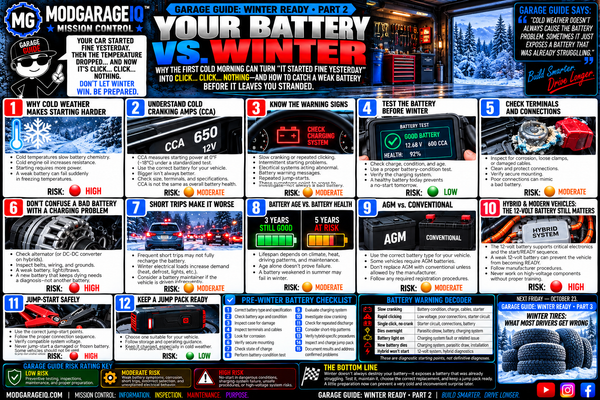
5. Inspect the Cooling System
Performance engines generate heat.
Supercharged engines can place additional demands on their cooling and charge-air temperature-management systems.
Inspect applicable:
- Coolant level and condition
- Radiator
- Water pump
- Thermostat
- Hoses
- Reservoir
- Cooling fans
- Leaks
- Operating temperatures
- Charge-air cooling system on supercharged models
Never open a hot, pressurized cooling system.
If the vehicle has a history of overheating, investigate before driving it aggressively or adding performance modifications.
Garage Guide Risk Rating: 🔴 HIGH
Garage Guide Says:
“Horsepower makes heat. Your cooling system needs to be ready for the horsepower you already have.”
6. Inspect the Transmission
Modern Chargers and Challengers have used several transmission configurations over the years.
That means maintenance and inspection requirements vary.
Look for:
- Delayed engagement
- Harsh or inconsistent shifts
- Slipping
- Abnormal noises
- Fluid leaks
- Overheating symptoms
- Previous transmission work
For manual Challengers, also inspect clutch operation, engagement, and signs of abuse.
Don’t assume every automatic transmission has the same fluid specification or service procedure.
And don’t authorize a transmission flush without understanding the exact transmission and its condition.
Garage Guide Risk Rating: 🔴 HIGH
Garage Guide Says:
“A strong engine with a failing transmission is just an expensive way to make noise in the driveway.”
7. Inspect the Differential, Driveshaft, and Axles
Rear-wheel-drive performance cars put significant loads through their drivetrains.
Inspect applicable:
- Differential
- Differential mounts
- Driveshaft
- Driveshaft couplings
- Axles
- CV joints
- Related bushings
- Fluid leaks
Listen for clunks when transitioning between acceleration and deceleration.
Investigate vibration under load.
If the car has been heavily modified or frequently launched, pay additional attention to drivetrain condition.
Garage Guide Risk Rating: 🔴 HIGH
Garage Guide Says:
“The engine makes the power. The drivetrain has to survive delivering it.”
8. Check the Tires Before Testing the Horsepower
This is where Garage Guide gets serious.
Some Charger and Challenger models produce substantial horsepower and torque.
And the tires are responsible for translating that performance into usable grip.
Inspect:
- Tread depth
- Tire age
- Sidewall condition
- Correct sizing
- Speed and load ratings
- Uneven wear
- Proper inflation
- Matching tire setup
High-performance summer tires may be unsuitable for cold temperatures, snow, or ice.
Follow the tire manufacturer’s temperature and storage guidance.
Don’t assume wide tires automatically mean good traction.
And don’t perform aggressive acceleration tests on public roads.
Garage Guide Risk Rating: 🔴 HIGH
Garage Guide Says:
“Seven hundred horsepower means nothing when the tires are negotiating with the pavement.”
9. Inspect the Braking System
A heavy, powerful car needs a healthy braking system.
Depending on trim and options, your Charger or Challenger may have different brake hardware.
Inspect:
- Pads
- Rotors
- Calipers
- Brake lines
- Hoses
- Fluid condition
- ABS operation
- Parking brake
- Pedal feel
Don’t assume every performance trim uses the same replacement parts.
And don’t confuse having large brake calipers with having a properly maintained braking system.
Garage Guide Risk Rating: 🔴 HIGH
Garage Guide Says:
“If the car can accelerate like a missile, the brakes need to be more than decoration.”
10. Inspect the Steering and Suspension
These are large vehicles.
Their suspension systems play a major role in keeping them controlled and predictable.
Inspect applicable:
- Control arms
- Ball joints
- Tie rods
- Bushings
- Struts and shocks
- Sway-bar links
- Wheel bearings
- Alignment
- Suspension mounts
Watch for:
- Clunking
- Wandering
- Excessive bouncing
- Uneven tire wear
- Vibration
- Poor steering response
If the vehicle has been lowered, verify the suspension components, alignment, and tire clearances.
Garage Guide Risk Rating: 🔴 HIGH
Garage Guide Says:
“Big horsepower is fun. Knowing where the car is going is even better.”
11. Inspect the Electrical System
Modern Chargers and Challengers rely on extensive electronics.
Check:
- Battery condition
- Charging-system performance
- Terminal connections
- Warning lights
- Instrument cluster
- Infotainment
- Power accessories
- Lighting
- Starting behavior
If aftermarket lighting, audio, or security systems have been installed, inspect their wiring quality.
Poorly executed electrical modifications can create difficult diagnostic problems.
Garage Guide Risk Rating: 🟡 MODERATE
Garage Guide Says:
“If the previous owner installed twelve accessories with seventeen mystery wires, we have some investigating to do.” 😂
12. Scan Every Available Vehicle Module
A basic code reader can be helpful.
But it may not tell the whole story.
Depending on the vehicle and scan tool, investigate:
- Engine faults
- Transmission faults
- ABS
- Stability control
- Airbag systems
- Body control modules
- Performance-related control systems
Document codes before clearing them.
Pay attention to stored, pending, and recurring faults.
And remember:
A diagnostic trouble code identifies a detected condition—not necessarily the component that needs replacement.
Garage Guide Risk Rating: 🟡 MODERATE
Garage Guide Says:
“The scan tool starts the conversation. Proper diagnosis finishes it.”
13. Inspect Previous Modifications and Tuning
This is one of the biggest ownership considerations for used muscle cars.
Look for:
- Aftermarket intakes
- Exhaust modifications
- Headers
- Supercharger changes
- Pulley modifications
- Fuel-system upgrades
- Suspension modifications
- Nonfactory wheels
- Aftermarket engine calibrations
- Removed emissions equipment
- Altered wiring
Ask for receipts, part numbers, and tuning documentation.
A modified car isn’t automatically unreliable.
But a poorly matched combination of parts and calibration can create serious problems.
For supercharged models, verify that any hardware changes are supported by the correct calibration and supporting systems.
Do not assume a car is mechanically stock just because its appearance is.
Garage Guide Risk Rating: 🔴 HIGH
Garage Guide Says:
“The scariest modification isn’t always the biggest one. Sometimes it’s the one nobody told you was installed.”
14. Check the Exhaust and Emissions Systems
A performance exhaust can sound fantastic.
But inspect the system before assuming every loud noise is intentional.
Look for:
- Exhaust leaks
- Loose connections
- Damaged hangers
- Missing heat shields
- Improper repairs
- Altered catalytic converters
- Noncompliant modifications
An exhaust leak can affect noise, emissions, and occupant safety.
Make sure modifications comply with applicable regulations.
Garage Guide Risk Rating: 🟡 MODERATE, potentially 🔴 HIGH for dangerous exhaust leaks.
Garage Guide Says:
“Loud doesn’t automatically mean healthy. Sometimes it just means something’s leaking.”
15. Check Recalls, Security, and Vehicle History
Before spending money on upgrades, verify the basics.
Use the VIN to investigate:
- Outstanding safety recalls
- Vehicle history
- Title status
- Reported collision damage
- Service records
- Previous ownership
- Applicable theft-related security concerns
High-value performance vehicles can attract theft, so evaluate practical security measures appropriate to the vehicle.
Security improvements should not compromise safety or normal vehicle operation.
And don’t assume a clean vehicle-history report guarantees an accident-free past.
Garage Guide Risk Rating: 🔴 HIGH for unresolved safety defects.
Garage Guide Says:
“Before protecting the horsepower, make sure you’re protecting the whole car.”
16. Give It a Proper Road Test
Once the car is confirmed safe to drive, evaluate it under normal road conditions.
Pay attention to:
- Cold start
- Idle
- Engine temperature
- Transmission behavior
- Steering
- Braking
- Suspension
- Drivetrain vibration
- HVAC
- Warning lights
- Unusual noises
Don’t confuse a road test with a street race.
You don’t need to perform a burnout to determine whether the vehicle is mechanically healthy.
And if a serious symptom appears, stop the test and investigate.
Garage Guide Risk Rating: 🟡 MODERATE
Garage Guide Says:
“You can learn a lot about a performance car without ever flooring it.”
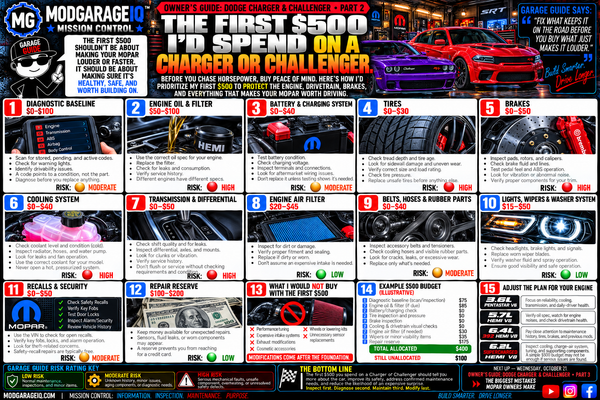
17. Don’t Tune It Yet
Garage Guide knows.
The temptation is strong.
Especially when you see videos of Chargers and Challengers making enormous power.
But before modifying engine calibration or increasing output, verify:
- Engine health
- Cooling-system performance
- Fuel-system condition
- Transmission health
- Drivetrain condition
- Tire suitability
- Brake performance
- Supporting hardware
- Legal compliance
A tune cannot repair worn mechanical components.
And more horsepower can make existing weaknesses more expensive.
Garage Guide Risk Rating: 🔴 HIGH for poorly planned performance modifications.
Garage Guide Says:
“Put the laptop down until the car proves it deserves more horsepower.” 😂
18. Don’t Try to Turn Every Dodge Into a Hellcat
This one might upset a few people. 😂
But hear Garage Guide out.
A V6 Charger can be an excellent daily driver.
A 5.7L HEMI R/T can be a fantastic street car.
A 392 Scat Pack offers serious naturally aspirated performance.
A Hellcat is an entirely different level of factory-engineered performance.
Each configuration has its strengths.
Trying to recreate a higher trim with mismatched parts can become more expensive than expected.
And some upgrades require far more than an engine or supercharger swap.
Consider the complete package:
- Drivetrain
- Cooling
- Brakes
- Suspension
- Electronics
- Fuel system
- Calibration
- Reliability
Garage Guide Risk Rating: 🟡 MODERATE, potentially 🔴 HIGH for major poorly engineered conversions.
Garage Guide Says:
“You don’t have to turn every Mopar into a Hellcat to build something worth driving.”
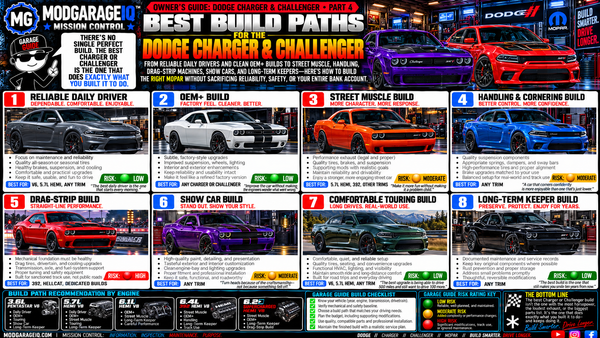
Garage Guide’s Mopar Priority Order
Before buying your first modification, follow this sequence.
1. IDENTIFY THE VEHICLE
Know the year, trim, engine, transmission, and factory equipment.
2. DOCUMENT ITS HISTORY
Review maintenance, ownership, repairs, and previous modifications.
3. INSPECT THE FOUNDATION
Evaluate the engine, cooling system, transmission, and drivetrain.
4. VERIFY SAFETY
Inspect tires, brakes, steering, and suspension.
5. DIAGNOSE PROBLEMS
Scan the vehicle and investigate abnormal behavior.
6. COMPLETE NECESSARY MAINTENANCE
Address due services and confirmed faults.
7. DRIVE AND EVALUATE
Understand how the vehicle behaves in healthy, factory-like condition.
8. DEFINE YOUR BUILD
Daily driver? OEM+? Street muscle? Drag strip? Touring? Long-term keeper?
Choose the mission before choosing the parts.
Garage Guide Risk Rating
🟢 LOW RISK
Documenting service history, inspecting the vehicle, performing appropriate routine maintenance, and planning sensible upgrades.
🟡 MODERATE RISK
Unknown maintenance history, minor leaks, weak batteries, aging suspension, and poorly documented cosmetic modifications.
🔴 HIGH RISK
Unsafe tires or brakes, serious drivetrain defects, overheating, critical lubrication problems, unverified performance tuning, major mechanical faults, and unresolved safety issues.
The Bottom Line
Buying a Dodge Charger or Challenger should be exciting.
And it absolutely can be.
But the smartest owners understand that performance comes with responsibility.
Know exactly what you bought.
Investigate the history.
Check the oil.
Inspect the cooling system.
Evaluate the transmission and drivetrain.
Buy appropriate tires.
Maintain the brakes.
Inspect the suspension.
Scan the electronics.
Verify previous modifications.
And resist the urge to chase horsepower before establishing a healthy baseline.
Because a powerful car that’s constantly broken isn’t much fun.
And a reliable performance car that you can actually enjoy?
That’s the build worth pursuing.
Garage Guide Says:
“The smartest first modification for a Charger or Challenger isn’t an exhaust, a tune, or a supercharger pulley. It’s turning an unknown performance car into a known, healthy foundation.”
Build Smarter. Drive Longer.
COMING TUESDAY, OCTOBER 20
The First $500 I’d Spend on a Dodge Charger or Challenger
Where to spend your first maintenance dollars before the horsepower starts asking for more. 😎
#ModGarageIQ #GarageGuide #DodgeCharger #DodgeChallenger #Mopar #HEMI #ChargerRT #ChallengerRT #ScatPack #392HEMI #Hellcat #AmericanMuscle #CarMaintenance #UsedPerformanceCars #OwnersGuide #MissionControl #BuildSmarterDriveLonger