The First $500 I’d Spend on a Dodge Charger or Challenger
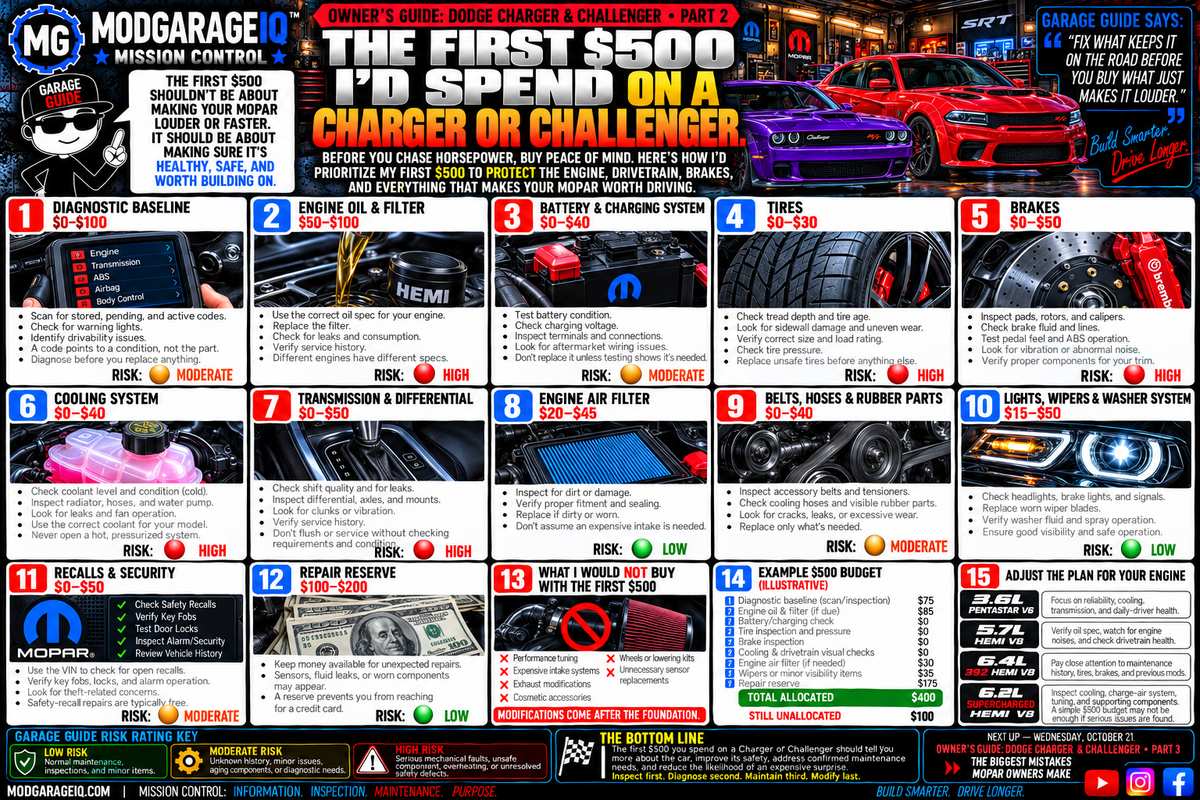
Before You Chase Horsepower, Buy Peace of Mind. Here’s How I’d Prioritize My First $500 to Protect the Engine, Drivetrain, Brakes, and Everything That Makes Your Mopar Worth Driving.
MODGARAGEIQ OWNER’S GUIDE • DODGE CHARGER & CHALLENGER • PART 2 OF 4 • OCTOBER 20, 2026
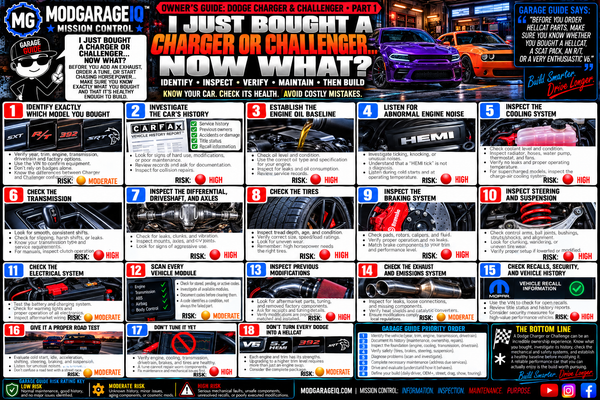
You just bought a Dodge Charger or Challenger.
The keys are in your hand.
The HEMI sounds fantastic—or maybe you’ve got a Pentastar V6 that’s ready to be a dependable daily driver.
Either way, you’ve probably already started shopping.
An exhaust.
A cold-air intake.
A set of wheels.
Maybe a tuner.
Maybe a Hellcat-style hood.
Garage Guide understands. 😂
But here’s the question:
What if your first $500 could prevent your next $2,000 repair?
That’s the mission today.
Not to make your Charger or Challenger faster.
Not to make it louder.
Not to make it look like a higher trim.
We’re going to make it a better-known, safer, healthier vehicle.
And there’s an important catch.
A $500 budget isn’t enough to fix every neglected performance car.
If your Mopar needs tires, brakes, major cooling repairs, or drivetrain work, those problems take priority—even when the repair exceeds today’s budget.
The goal isn’t to spend exactly $500. The goal is to spend intelligently.
Let’s get to work.
1. Start With a Diagnostic Baseline — $0–$100
Before buying replacement parts, find out what the vehicle is trying to tell you.
A basic OBD-II scan can identify many powertrain-related trouble codes, but a more capable scan tool may be needed to inspect transmission, ABS, airbag, and body-control systems.
Check for:
- Active, stored, and pending diagnostic trouble codes.
- Check-engine or other warning lights.
- Abnormal operating temperatures.
- Misfire symptoms.
- Fuel-trim irregularities, where supported.
- Transmission-related faults.
- ABS and stability-control warnings.
- Battery and charging-system concerns.
What I’d spend: $0 if I already own a suitable scanner, or approximately $50–$100 for an initial diagnostic assessment.
Remember, scanning is not the same as diagnosing.
A trouble code points toward a detected condition. It doesn’t automatically identify which part to replace.
If the scan reveals a significant fault, investigate it before continuing down the shopping list.
Garage Guide Risk Rating: 🟡 MODERATE
Garage Guide Says:
“Before you buy a part that promises more horsepower, make sure the car isn’t already asking for help.”
2. Establish the Engine Oil Baseline — $50–$100
A used Charger or Challenger deserves a verified oil-service history.
Especially if the previous owner can’t tell you when the oil was last changed.
Depending on model year, your vehicle might have a:
- 3.6L Pentastar V6.
- 5.7L HEMI V8.
- 6.1L HEMI V8.
- 6.4L / 392 HEMI V8.
- Supercharged 6.2L HEMI V8.
These engines do not all use the same oil specifications.
Use the viscosity, oil specification, capacity, and filter required for your exact engine and model year.
Don’t automatically put one HEMI’s oil in another HEMI.
Don’t assume a thicker oil is better.
And don’t replace oil based solely on mileage if reliable records show that the correct service was recently completed.
Inspect for leaks and unusual consumption, too.
What I’d spend: Approximately $50–$100 for a suitable oil-and-filter service, depending on engine, product requirements, and whether the work is DIY or professionally performed. Some professional services, especially on performance trims, will cost more.
Garage Guide Risk Rating: 🔴 HIGH when oil condition, level, or service history raises a serious concern.
Garage Guide Says:
“An oil change won’t make your HEMI famous on the internet. But it might help keep it running long enough to enjoy the horsepower.” 😂
3. Check the Battery and Charging System — $0–$40
Here’s a great example of why diagnosis comes before replacement.
You don’t need to buy a new battery just because you bought a used car.
You need to find out whether the battery you already have is healthy.
Inspect:
- Battery age, where known.
- Terminal corrosion.
- Loose connections.
- Starting performance.
- Charging voltage and system behavior.
- Battery state of health using an appropriate test.
- Signs of previous electrical modifications.
Some auto-parts retailers offer battery testing at no charge.
A professional battery and charging-system evaluation may cost more.
What I’d spend: $0–$40 for basic testing and minor terminal maintenance, where appropriate.
If the battery fails testing, replacement becomes a priority and may consume a significant portion of the $500 budget.
Don’t buy a battery based on age alone without considering its actual condition.
Garage Guide Risk Rating: 🟡 MODERATE, rising to 🔴 HIGH when unreliable starting could leave you stranded.
Garage Guide Says:
“A fresh exhaust sounds great. A car that actually starts sounds even better.”
4. Inspect the Tires — $0–$30
This might be the most important inspection in the entire article.
Chargers and Challengers can be heavy, powerful vehicles.
Even the lower-output versions need proper tire grip to steer, brake, and maintain control.
Inspect:
- Tread depth.
- Tire age and date codes.
- Sidewall damage.
- Uneven wear.
- Correct size.
- Load and speed ratings.
- Cold inflation pressure.
- Matching tire types and configurations.
- Signs of previous burnouts or hard use.
Don’t assume tires are healthy because they have plenty of tread.
A tire can have substantial tread and still be unsuitable because of age, damage, or inappropriate operating conditions.
And don’t assume a wide tire automatically offers superior traction.
What I’d spend: $0 for a careful visual and pressure inspection, or approximately $10–$30 for a basic inspection or pressure-related service where charged.
Important: If the tires are unsafe, replace them before spending on nonessential upgrades. A proper set may exceed the entire $500 budget.
Garage Guide Risk Rating: 🔴 HIGH
Garage Guide Says:
“You bought the horsepower. Now make sure you’ve got four tires capable of handling the responsibility.”
5. Inspect the Brakes — $0–$50
A Charger or Challenger that accelerates well but stops poorly is not a finished vehicle.
And with some performance trims using substantial braking hardware, brake repairs can become expensive quickly.
Inspect:
- Pad thickness.
- Rotor condition.
- Caliper operation.
- Brake hoses.
- Fluid level and condition.
- Pedal feel.
- Parking-brake operation.
- ABS warning lights.
- Abnormal vibration or noise.
Remember that an R/T, Scat Pack, SRT, and Hellcat may have different braking configurations.
Always verify the actual equipment before ordering parts.
What I’d spend: $0–$50 for an inspection, depending on access, equipment, and whether a shop charges separately.
If the brakes need significant repairs, address those before spending on modifications.
And don’t assume a brake-fluid flush is automatically required just because the car is used. Follow the applicable service schedule and condition assessment.
Garage Guide Risk Rating: 🔴 HIGH
Garage Guide Says:
“The gas pedal makes the smile. The brake pedal makes sure you get to smile again tomorrow.”
6. Inspect the Cooling System — $0–$40
This is another area where a little inspection can prevent a very expensive surprise.
Look at:
- Coolant level when the engine is cold.
- Visible coolant leaks.
- Radiator condition.
- Hoses and connections.
- Cooling-fan operation.
- Water-pump leakage.
- Operating temperatures.
- Reservoir condition.
- Charge-air cooling components on applicable supercharged models.
Use the coolant specification required for your exact model year.
Don’t assume all coolant colors represent interchangeable formulations.
Don’t mix unknown coolant types without verifying compatibility.
And never open a hot, pressurized cooling system.
What I’d spend: $0–$40 for a basic inspection and appropriate testing, if needed.
If overheating, coolant loss, or another serious problem is discovered, stop and diagnose it before proceeding.
Garage Guide Risk Rating: 🔴 HIGH
Garage Guide Says:
“The cheapest cooling-system repair is often the problem you catch before the temperature gauge starts climbing.”
7. Check the Transmission and Differential — $0–$50
Here’s where buying a used performance car gets interesting.
You may have a Charger or Challenger with a different transmission and drivetrain configuration than the next owner.
Depending on model year and trim, these vehicles have used multiple automatic transmissions, and certain Challengers were available with manual transmissions.
Some configurations also use all-wheel drive.
That means service requirements vary.
Inspect:
- Transmission shift quality.
- Fluid leaks.
- Delayed engagement.
- Harsh shifting.
- Clutch behavior on manual models.
- Differential leaks.
- Driveline vibration.
- Axle and CV-joint condition.
- Unusual clunks.
- Service records.
Don’t automatically authorize a transmission flush or differential-fluid replacement without verifying the service requirements and mechanical condition.
A full fluid service may exceed this initial budget.
What I’d spend: $0–$50 for a preliminary inspection, with additional diagnostics or service priced separately if needed.
Garage Guide Risk Rating: 🔴 HIGH when serious drivetrain symptoms are present.
Garage Guide Says:
“The engine can make all the power it wants. The transmission and differential still have to deliver it.”
8. Replace a Dirty Engine Air Filter — $20–$45
Now we’re getting into the smaller, more manageable expenses.
An engine air filter helps protect the engine from incoming contaminants.
Inspect the existing filter.
Look for:
- Heavy dirt accumulation.
- Physical damage.
- Poor sealing.
- Incorrect fitment.
- Debris in the airbox.
- Improper aftermarket intake installation.
If the filter is clean, properly installed, and not due for replacement, leave it alone.
If it’s dirty or damaged, install the correct replacement.
What I’d spend: Approximately $20–$45 for a conventional replacement filter, with some applications costing more.
And no, Garage Guide isn’t recommending a $400 intake system as part of our first maintenance budget. 😂
Garage Guide Risk Rating: 🟢 LOW for routine replacement, provided the filter is correctly fitted.
Garage Guide Says:
“Before buying an expensive intake, make sure the engine can breathe through the filter it already has.”
9. Inspect Belts, Hoses, and Visible Rubber Components — $0–$40
Rubber components age.
Heat, time, contamination, and mechanical wear can take their toll.
Inspect applicable:
- Accessory-drive belts.
- Belt tensioners.
- Cooling hoses.
- Rubber couplings.
- Visible seals.
- Engine mounts.
- Suspension bushings.
On supercharged models, inspect the relevant drive-belt system according to the factory service procedures.
Don’t replace every belt and hose simply because the vehicle is used.
Look for actual damage, symptoms, service requirements, and documented age.
What I’d spend: $0–$40 for basic inspection or minor consumables.
Significant repairs belong in a separate, properly estimated repair plan.
Garage Guide Risk Rating: 🟡 MODERATE
Garage Guide Says:
“A $20 problem is a lot more entertaining than a $700 tow-and-repair adventure.”
10. Check the Lights, Wipers, and Washer System — $15–$50
Not every important improvement is under the hood.
Some of the most useful maintenance dollars improve visibility and safety.
Inspect:
- Headlights.
- Brake lights.
- Turn signals.
- Reverse lights.
- License-plate lights.
- Wiper blades.
- Washer-fluid level.
- Washer-spray operation.
- Windshield condition.
Replace worn wipers or failed bulbs with the correct components.
If your vehicle uses specialized lighting, repair costs may exceed this allowance.
What I’d spend: Approximately $15–$50 for basic consumables, depending on what actually needs replacement.
Garage Guide Risk Rating: 🟢 LOW for routine maintenance, although driving with severely impaired visibility or critical lighting faults is a serious safety concern.
Garage Guide Says:
“You don’t need 500 extra horsepower to appreciate being able to see through the windshield.”
11. Verify Recalls and Basic Security — $0–$50
Before buying cosmetic accessories, check the vehicle’s safety-recall status.
Use the VIN and official manufacturer or government resources.
In the United States, you can start with:
Also verify:
- Key-fob operation.
- Door locks.
- Alarm operation, where equipped.
- Spare-key availability.
- Evidence of previous theft-related damage.
- Aftermarket alarm or immobilizer wiring.
High-performance Charger and Challenger models deserve particular attention to theft prevention.
However, don’t assume an inexpensive accessory is a complete security solution.
And don’t modify safety-critical electronics without understanding the consequences.
What I’d spend: $0 to check recalls and inspect existing systems, with up to $50 reserved for a small, appropriate security-related improvement.
Safety-recall remedies are generally performed without charge under the applicable recall program.
Garage Guide Risk Rating: 🟡 MODERATE, rising to 🔴 HIGH for unresolved safety defects.
Garage Guide Says:
“Protect the car before somebody else decides they want to build it.” 😂
12. Keep a Repair Reserve — $100–$200
This is the step people love to skip.
And it’s one of the smartest things you can do.
You bought a used vehicle.
Even with a good inspection, something unexpected may appear.
Maybe a sensor fails.
Maybe a small coolant leak becomes noticeable.
Maybe a worn suspension component needs attention.
Maybe you discover that a previous owner used the wrong replacement part.
Having money left over means you can respond without immediately reaching for a credit card.
What I’d spend: $0.
That’s the whole point.
I’d try to preserve $100–$200 of the original budget when the vehicle’s condition allows it.
And if the car is already healthy?
I’d happily keep even more.
Garage Guide Risk Rating: 🟢 LOW
Garage Guide Says:
“The best $150 you spend on a used Mopar might be the $150 you don’t spend yet.”
13. What I Would NOT Buy With My First $500
Let’s make this very clear.
Unless the vehicle’s condition and actual needs justify it, these are not my first priorities:
- Performance tuning.
- Supercharger pulley changes.
- Cosmetic engine-bay accessories.
- Decorative badges.
- Expensive aftermarket intakes.
- Exhaust modifications.
- Oversized wheels.
- Unnecessary suspension lowering.
- Random sensor replacements.
- Complete fluid changes without checking the service history.
- Performance parts intended to imitate a higher trim.
That doesn’t mean modifications are bad.
It means modifications come after the baseline.
If the car is healthy, maintained, and safe, start saving for the build you actually want.
Garage Guide Risk Rating: 🟡 MODERATE, potentially 🔴 HIGH for poorly planned performance modifications.
Garage Guide Says:
“You can order the loud exhaust next month. The worn brake pads would prefer you handle them today.”
14. My Actual First $500 Budget
Here’s one example of how I’d allocate the money on a used Charger or Challenger with no known urgent defects.
These are illustrative allowances, not guaranteed service prices. Costs vary by engine, model year, location, and DIY versus professional labor.
A practical starting allocation:
- Diagnostic baseline: $75
- Engine oil and filter, if due or undocumented: $85
- Battery and charging-system check: $0
- Tire inspection and pressure check: $0
- Brake inspection: $0
- Cooling and drivetrain visual checks: $0
- Engine air filter, if needed: $30
- Wiper blades or minor visibility items, if needed: $35
- Repair reserve: $175
Total allocated: $400
Still unallocated: $100
That’s right.
We didn’t even spend the entire budget.
And that is perfectly fine.
The example assumes the owner can safely perform basic inspections or obtain them without separate charges. A comprehensive professional inspection may cost more, and the oil service may also cost more on some trims.
If you don’t have the tools, training, or safe access to inspect the vehicle, use the budget for a qualified technician instead.
If a serious problem is discovered, the allocation changes immediately.
Garage Guide Says:
“A budget is a spending limit, not a challenge to see how fast you can empty your wallet.”
15. How the $500 Plan Changes by Engine
Here’s where we make the guide genuinely useful instead of pretending every Mopar is identical.
3.6L Pentastar V6
Focus on:
- Oil-service history and leaks.
- Cooling-system condition.
- Abnormal engine noises.
- Transmission behavior.
- Tire and brake condition.
- Overall daily-driver reliability.
A healthy V6 doesn’t need unnecessary performance modifications to be a worthwhile ownership experience.
5.7L HEMI V8
Focus on:
- Correct engine-oil specification.
- Oil level and maintenance records.
- Abnormal ticking or exhaust leaks.
- Cooling-system condition.
- Transmission and drivetrain behavior.
- Evidence of previous tuning or aggressive use.
Don’t assume every engine noise is a failed lifter.
Diagnose the source.
6.1L and 6.4L / 392 HEMI V8
Focus on:
- Accurate engine identification and service requirements.
- Engine-oil history.
- Cooling-system performance.
- Tire condition and grip.
- Brake hardware and maintenance.
- Drivetrain wear.
- Previous performance modifications.
These are serious naturally aspirated performance engines. Treat their maintenance requirements accordingly.
Supercharged 6.2L HEMI V8
Focus on:
- Engine and supercharger drive-system condition.
- Cooling and charge-air cooling.
- Previous tuning.
- Pulley or boost-related modifications.
- Fuel-system changes.
- Transmission and drivetrain health.
- Correct high-performance tires.
- Brake condition.
A supercharged performance car with undocumented modifications may require a professional assessment well beyond $500.
Don’t force the budget to fit a problem that deserves a more thorough inspection.
Garage Guide Risk Rating: 🔴 HIGH for ignored engine-specific concerns or questionable high-output modifications.
Garage Guide Says:
“A Pentastar, an R/T, a 392, and a Hellcat don’t need identical shopping lists. They need the right maintenance for the machine.”
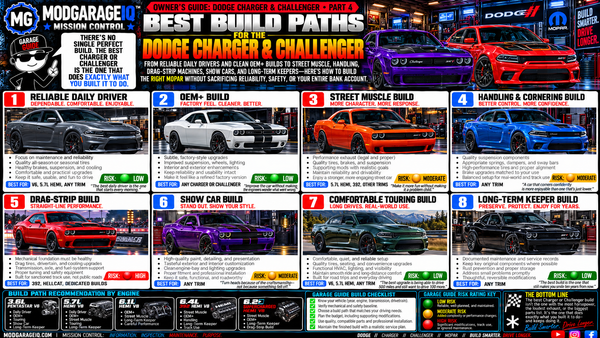
Garage Guide’s First $500 Priority Order
If the money is limited, here’s the order I’d follow.
PRIORITY 1 — SAFETY
Tires, brakes, steering, suspension, and critical safety defects.
PRIORITY 2 — ENGINE PROTECTION
Oil level, correct service requirements, overheating, leaks, and serious mechanical symptoms.
PRIORITY 3 — DIAGNOSTICS
Investigate warning lights, stored faults, abnormal noises, and drivability concerns.
PRIORITY 4 — DRIVETRAIN HEALTH
Transmission, differential, axles, and other load-bearing components.
PRIORITY 5 — RELIABILITY
Battery, charging system, filters, belts, hoses, and visibility items.
PRIORITY 6 — FINANCIAL RESERVE
Keep money available for unexpected repairs.
PRIORITY 7 — MODIFICATIONS
Only after the foundation is healthy.
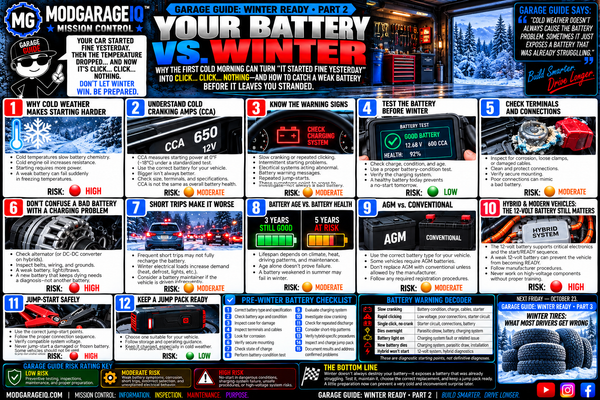
Garage Guide Risk Rating Summary
🟢 LOW RISK
Routine inspections, correct air-filter replacement, minor visibility maintenance, documenting service history, and preserving a repair reserve.
🟡 MODERATE RISK
Unknown service history, aging electrical components, minor fluid leaks, worn rubber components, and undocumented modifications that require investigation.
🔴 HIGH RISK
Unsafe tires or brakes, overheating, serious lubrication concerns, major drivetrain symptoms, unresolved safety defects, and poorly executed performance modifications.
The most important rule: A red-risk problem overrides the planned budget.
The Bottom Line
The first $500 you spend on a Dodge Charger or Challenger should tell you more about the car, improve its safety, address confirmed maintenance needs, and reduce the likelihood of an expensive surprise.
That doesn’t mean every vehicle needs $500 in repairs.
And it doesn’t mean every vehicle can be brought up to standard for $500.
A healthy Charger might need an oil service, a filter, and a careful inspection.
A neglected Challenger might need a set of tires that costs more than the entire budget.
A modified Hellcat might need a professional diagnostic assessment before anyone should consider adding more power.
The smartest owners adapt the budget to the vehicle.
They don’t adapt the vehicle’s needs to a shopping list.
Inspect first. Diagnose second. Maintain third. Modify last.
And if you finish with money left over?
Garage Guide calls that a win.
Garage Guide Says:
“The first $500 shouldn’t be about making your Charger or Challenger louder, faster, or flashier. It should be about making sure the car you bought is healthy enough to enjoy—and worth building on.”
Build Smarter. Drive Longer.
COMING WEDNESDAY, OCTOBER 21
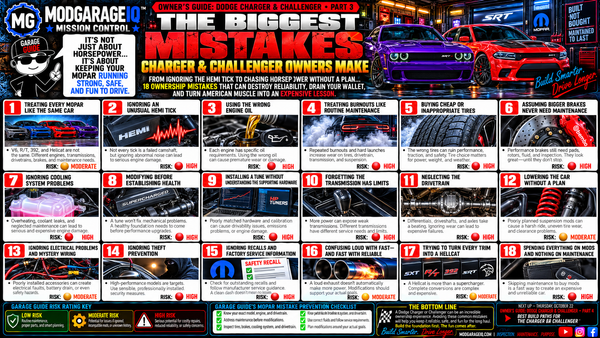
The Biggest Mistakes Dodge Charger & Challenger Owners Make
From ignoring mechanical warning signs to chasing horsepower without a plan, we’re covering the ownership mistakes that can turn American muscle into an expensive driveway ornament. 😂🔧
#ModGarageIQ #GarageGuide #DodgeCharger #DodgeChallenger #Mopar #HEMI #Pentastar #ScatPack #392HEMI #Hellcat #AmericanMuscle #CarMaintenance #UsedCarTips #PerformanceCarMaintenance #OwnersGuide #BuildSmarterDriveLonger