The Biggest Mistakes Dodge Charger & Challenger Owners Make
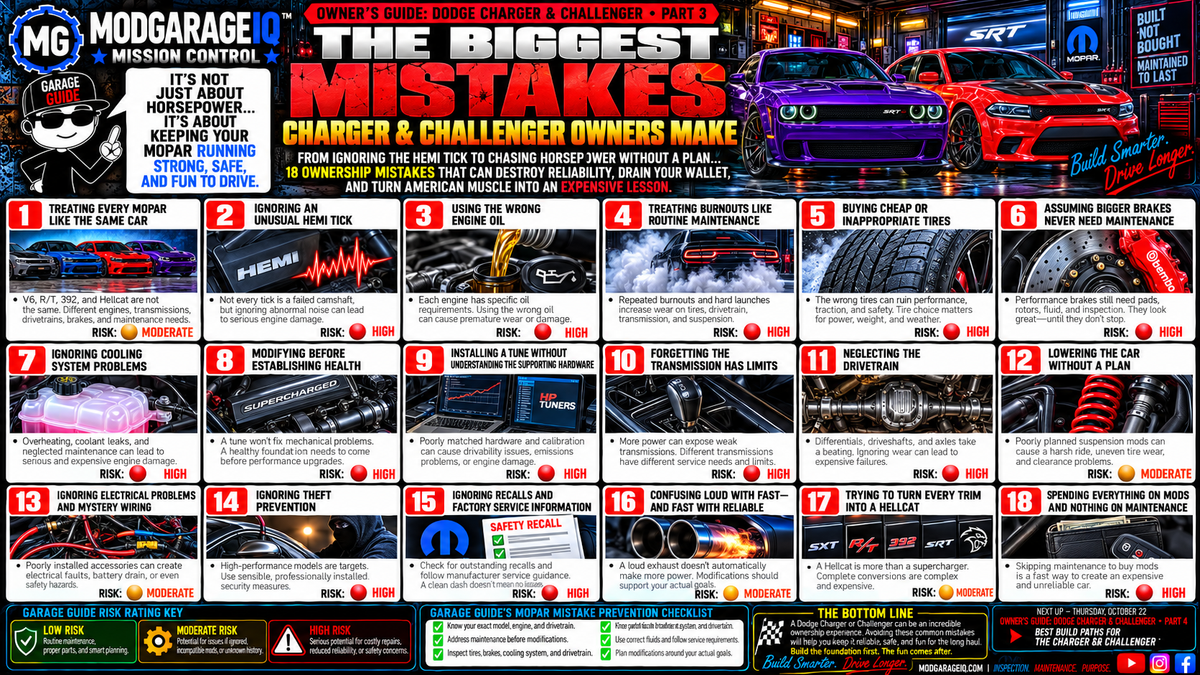
From Ignoring the HEMI Tick to Chasing Horsepower Without a Plan—18 Ownership Mistakes That Can Destroy Reliability, Drain Your Wallet, and Turn American Muscle Into an Expensive Lesson.
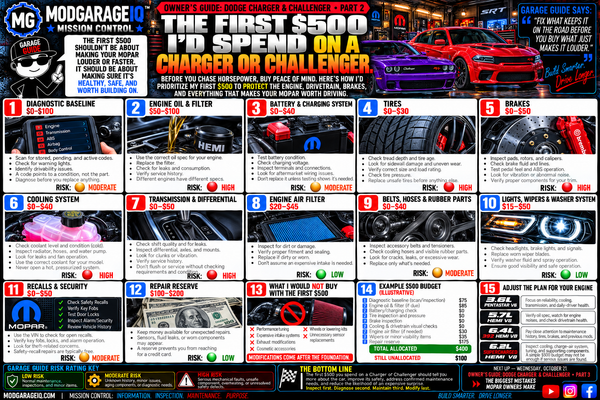
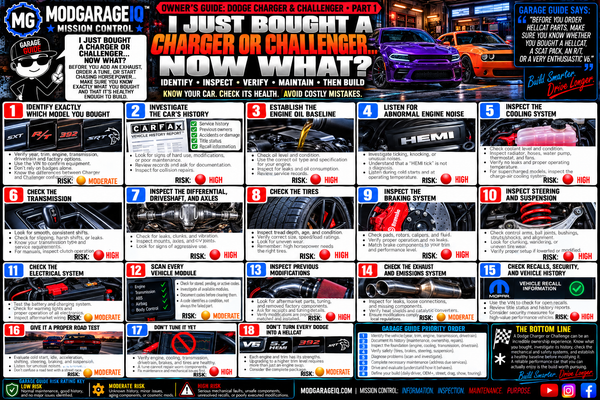
MODGARAGEIQ OWNER’S GUIDE • DODGE CHARGER & CHALLENGER • PART 3 OF 4 • OCTOBER 21, 2026
There’s something special about owning a Dodge Charger or Challenger.
The styling.
The sound.
The torque.
The unmistakable presence of a big American performance car.
And for some owners, the ability to make the rear tires disappear faster than their paycheck. 😂
But here’s something Garage Guide wants every Mopar owner to understand:
These cars aren’t automatically unreliable because they’re powerful. And they aren’t automatically reliable just because the engine has a HEMI badge.
A well-maintained Charger or Challenger can provide years of enjoyment.
A neglected one can become an expensive collection of warning lights, drivetrain noises, and unfinished modifications.
The difference often comes down to the decisions owners make.
Some mistakes happen because people don’t understand their specific engine or transmission.
Others happen because social media makes modifications look easier than they really are.
And some happen because owners confuse a car that still runs with a car that’s actually healthy.
Today, we’re covering 18 mistakes worth avoiding.
Our focus is primarily the modern HEMI-era Charger and Challenger, including the V6 models and their different drivetrains. Equipment and maintenance requirements vary by model year and trim.
Let’s get into it.
1. Treating Every Charger and Challenger Like the Same Car
This is where a lot of ownership mistakes begin.
A V6 Charger, a 5.7L Challenger R/T, a 392 Scat Pack, and a supercharged Hellcat do not have identical mechanical requirements.
Across different model years, you’ll find differences in:
- Engine design and output.
- Oil specifications and capacities.
- Automatic and manual transmissions.
- Rear-wheel-drive and certain all-wheel-drive configurations.
- Brake packages.
- Suspension systems.
- Cooling requirements.
- Tire sizes and ratings.
- Electronic systems.
A modification that works on one model might not fit another.
A maintenance recommendation for one HEMI might be wrong for a different HEMI.
The smarter approach: Verify your VIN, year, engine, transmission, drivetrain, and factory equipment before ordering parts or following maintenance advice.
Garage Guide Risk Rating: 🟡 MODERATE
Garage Guide Says:
“The word Mopar doesn’t mean every part fits every Mopar. Your wallet will appreciate learning that early.”
2. Ignoring an Unusual HEMI Tick
Few phrases make HEMI owners more nervous than HEMI tick.
But here’s the problem.
Owners sometimes treat every ticking sound as proof of catastrophic engine damage.
Others dismiss every ticking sound as completely normal.
Both approaches can be mistakes.
Depending on the engine and circumstances, ticking or tapping may involve:
- Exhaust manifold leaks.
- Fuel injector operation.
- Valvetrain components.
- Lifter or camshaft problems.
- Accessory-drive components.
- Other mechanical issues.
The sound’s location, frequency, temperature dependence, and operating conditions matter.
An exhaust leak near the manifold can sometimes resemble valvetrain noise.
Persistent abnormal valvetrain noise, especially with misfires or other symptoms, deserves prompt investigation.
The smarter approach: Identify the actual source before replacing parts or continuing aggressive driving. If serious internal damage is suspected, avoid operating the engine until it has been assessed.
Garage Guide Risk Rating: 🔴 HIGH
Garage Guide Says:
“Not every tick means your camshaft is dying. But ignoring every tick is a pretty good way to miss something important.”
3. Using the Wrong Engine Oil
This mistake is especially frustrating because it’s avoidable.
Some owners hear that a particular oil works well in one HEMI and assume it belongs in every HEMI.
It doesn’t.
Different engines and model years can require different:
- Oil viscosities.
- Manufacturer specifications.
- Oil capacities.
- Filters.
- Service intervals.
A Pentastar V6 isn’t a 5.7 HEMI.
A 5.7 HEMI isn’t a 392.
And a supercharged 6.2L HEMI has its own requirements.
The smarter approach: Follow the oil specifications for your exact engine and model year, using the applicable owner’s manual and service information.
Also check the oil level regularly and investigate unusual consumption or leaks.
Don’t attempt to fix an unidentified mechanical noise simply by switching to a thicker oil.
Garage Guide Risk Rating: 🔴 HIGH
Garage Guide Says:
“Your engine doesn’t care what oil somebody’s cousin uses in his Hellcat. It cares whether you used the correct oil.”
4. Treating Burnouts Like Routine Maintenance
Garage Guide knows.
It’s a Dodge.
The temptation is practically included in the owner’s manual. 😂
But repeated burnouts and aggressive launches place additional stress on more than the tires.
Depending on the vehicle and circumstances, they can accelerate wear or contribute to damage involving:
- Tires.
- Differential components.
- Axles.
- Driveshaft connections.
- Transmission.
- Clutch on manual models.
- Suspension bushings.
- Other drivetrain components.
High-performance vehicles may have factory features intended for controlled performance use, but that doesn’t eliminate wear or make public-road stunts safe.
The smarter approach: Enjoy the car responsibly, follow manufacturer guidance, and reserve high-performance driving for appropriate controlled environments.
Inspect tires and drivetrain components after demanding use.
Garage Guide Risk Rating: 🔴 HIGH
Garage Guide Says:
“Burnouts are fun until your differential decides it would rather retire early.”
5. Buying Cheap or Inappropriate Tires
This is one of the most serious mistakes on the list.
A Charger or Challenger can have tremendous power.
But even a modest-output model depends on its tires for braking, steering, and stability.
Common tire mistakes include:
- Choosing solely by price.
- Using incorrect load or speed ratings.
- Mixing incompatible tire types.
- Ignoring tire age.
- Driving on damaged sidewalls.
- Using summer performance tires in unsuitable cold conditions.
- Neglecting inflation pressure.
- Assuming a wider tire guarantees better traction.
Tire selection must match the vehicle, climate, intended use, and manufacturer requirements.
The smarter approach: Choose appropriate tires and inspect their condition regularly.
Remember that traction isn’t just about acceleration.
It’s also about your ability to stop and turn.
Garage Guide Risk Rating: 🔴 HIGH
Garage Guide Says:
“The pavement doesn’t care how much horsepower your HEMI makes when your tires can’t hold onto it.”
6. Assuming Bigger Brakes Never Need Maintenance
Some Chargers and Challengers have impressive factory braking systems.
Large rotors.
Multi-piston calipers.
Performance-oriented pads.
But high-performance brake hardware still needs maintenance.
Owners sometimes overlook:
- Pad wear.
- Rotor condition.
- Brake-fluid condition.
- Caliper problems.
- Brake-hose damage.
- Uneven braking.
- Abnormal vibration.
- ABS warning lights.
And performance brake parts can be expensive, especially on certain trims.
The smarter approach: Inspect the braking system regularly and use replacement components appropriate for the vehicle’s actual equipment and intended use.
Never postpone a safety-critical brake repair to afford a performance upgrade.
Garage Guide Risk Rating: 🔴 HIGH
Garage Guide Says:
“Big red calipers look fantastic. They’re considerably less impressive when the pads are worn out.”
7. Ignoring Cooling-System Problems
Heat is a serious consideration in performance-car ownership.
Naturally aspirated HEMI engines generate substantial heat under load.
Supercharged models add charge-air cooling considerations.
Common mistakes include:
- Ignoring coolant loss.
- Driving with repeated overheating.
- Using incompatible coolant.
- Overlooking damaged hoses.
- Ignoring cooling-fan problems.
- Failing to investigate water-pump leaks.
- Modifying engine output without evaluating cooling capacity.
Not every cooling problem requires replacing the radiator.
And not every temperature fluctuation indicates a failed thermostat.
The smarter approach: Diagnose the cause and use the correct coolant specification and service procedures.
Never open a hot, pressurized cooling system.
If the vehicle overheats, stop safely and investigate rather than continuing to drive aggressively.
Garage Guide Risk Rating: 🔴 HIGH
Garage Guide Says:
“Horsepower makes heat. Ignoring that heat can make a very expensive paperweight.”
8. Modifying the Engine Before Establishing Its Health
This is one of Garage Guide’s biggest rules.
Don’t modify an unhealthy engine.
Before considering performance upgrades, investigate:
- Oil consumption.
- Abnormal engine noises.
- Misfires.
- Cooling-system issues.
- Fuel-system faults.
- Transmission symptoms.
- Drivetrain vibration.
- Previous tuning.
- Maintenance history.
Adding performance demand can make an existing weakness more consequential.
A tune isn’t a mechanical repair.
A cold-air intake doesn’t fix low compression.
And a supercharger pulley doesn’t solve a cooling-system problem.
The smarter approach: Establish a documented mechanical baseline before increasing performance.
Garage Guide Risk Rating: 🔴 HIGH
Garage Guide Says:
“If the engine is already asking for help, adding horsepower is not the answer it’s looking for.”
9. Installing a Tune Without Understanding the Supporting Hardware
Modern engine calibrations are complex.
A tune can affect far more than peak horsepower.
Depending on the application, calibration changes may influence:
- Ignition timing.
- Fuel delivery.
- Torque management.
- Throttle response.
- Boost-related controls.
- Transmission behavior.
- Engine protection strategies.
Not every modification requires the same calibration.
And not every aftermarket tune is appropriate for every engine or configuration.
Poorly matched hardware and calibration can cause drivability problems, emissions violations, or mechanical damage.
The smarter approach: Use qualified professionals, appropriate hardware, and legal, application-specific calibrations. Verify the health of the engine and supporting systems first.
Garage Guide Risk Rating: 🔴 HIGH
Garage Guide Says:
“A laptop can change a calibration in minutes. Fixing the consequences of a bad calibration can take months.”
10. Forgetting the Transmission Has Limits
Owners love discussing horsepower.
But the transmission is the component responsible for transferring engine output through the drivetrain.
Modern Chargers and Challengers have used different automatic transmissions, and certain Challengers have manual transmissions.
These systems have different:
- Fluid specifications.
- Maintenance procedures.
- Operating characteristics.
- Hardware limits.
- Cooling requirements.
Common mistakes include ignoring shift abnormalities, using incorrect fluids, and increasing torque without considering the transmission’s condition and capabilities.
Manual-transmission owners also need to consider clutch condition and operation.
The smarter approach: Identify your exact transmission, follow its service requirements, and investigate abnormal behavior before performance modifications.
Garage Guide Risk Rating: 🔴 HIGH
Garage Guide Says:
“Your engine might be ready for more power. Your transmission would appreciate being included in that conversation.”
11. Neglecting the Differential, Driveshaft, and Axles
The drivetrain doesn’t end at the transmission.
Rear-wheel-drive Chargers and Challengers place significant demands on their rear driveline components.
Depending on the configuration, inspect:
- Differential condition.
- Differential mounts.
- Driveshaft connections.
- Axles.
- CV joints.
- Related bushings.
- Fluid leaks.
- Unusual vibration or clunking.
Vehicles with all-wheel drive have additional drivetrain components and service considerations.
Repeated aggressive launches can increase mechanical stress.
The smarter approach: Inspect the drivetrain, investigate abnormal noises, and verify that any modifications are compatible with the vehicle’s actual configuration.
Garage Guide Risk Rating: 🔴 HIGH
Garage Guide Says:
“Horsepower is made at the engine. Expensive noises can happen anywhere between there and the pavement.”
12. Lowering the Car Without Planning the Suspension
A lowered Charger or Challenger can look fantastic.
But appearance isn’t the only consideration.
Poorly planned suspension modifications can create:
- Reduced suspension travel.
- Harsh ride quality.
- Incorrect alignment.
- Excessive tire wear.
- Clearance problems.
- Damaged components.
- Unpredictable handling.
Installing springs without evaluating the condition and compatibility of the dampers and other components may create disappointing results.
The smarter approach: Select a properly engineered suspension package for your model and intended use.
Inspect existing components first and obtain an appropriate alignment after suspension work.
Garage Guide Risk Rating: 🟡 MODERATE, rising to 🔴 HIGH when handling or component safety is compromised.
Garage Guide Says:
“Lowering the car two inches doesn’t help if every pothole feels like the suspension is filing a complaint.”
13. Ignoring Electrical Problems and Mystery Wiring
Modern Chargers and Challengers use extensive electrical and electronic systems.
A poor aftermarket installation can introduce problems that are difficult to diagnose.
Watch for:
- Unprotected wiring.
- Improper splices.
- Incorrect fuse protection.
- Poor grounding.
- Battery drain.
- Unreliable accessories.
- Intermittent warning lights.
- Communication faults.
Aftermarket audio, lighting, security, and performance electronics should be installed properly.
The smarter approach: Inspect questionable wiring, use correct protection and connection methods, and diagnose electrical faults before replacing unrelated components.
Garage Guide Risk Rating: 🟡 MODERATE, potentially 🔴 HIGH for wiring that presents a fire or safety hazard.
Garage Guide Says:
“If the previous owner used electrical tape as an engineering degree, we may have a problem.” 😂
14. Ignoring Theft Prevention
Certain Charger and Challenger performance trims are attractive targets for theft.
And while no security measure can guarantee protection, owners can reduce risk through thoughtful precautions.
Common mistakes include:
- Ignoring manufacturer security updates or applicable service information.
- Leaving keys unsecured.
- Assuming factory security alone is sufficient for every situation.
- Installing questionable aftermarket security equipment.
- Overlooking signs of previous tampering.
The smarter approach: Review available manufacturer-supported security measures, keep software and equipment appropriately maintained, secure keys, and consider professionally installed supplemental protection where warranted.
Avoid modifications that compromise emergency access, safety, or reliable operation.
Garage Guide Risk Rating: 🔴 HIGH where theft exposure or unsafe security modifications create substantial risk.
Garage Guide Says:
“You spent years dreaming about the car. Don’t make it easy for somebody else to drive away with the dream.”
15. Ignoring Recalls and Factory Service Information
A clean dashboard doesn’t guarantee that every safety-related issue has been addressed.
Owners sometimes assume that if a vehicle runs normally, there’s nothing to investigate.
But safety recalls can involve components that show no obvious symptoms beforehand.
The smarter approach:
- Check outstanding recalls using the VIN.
- Review applicable manufacturer service information.
- Verify that previous recall repairs were completed.
- Keep maintenance and repair records.
- Follow appropriate model-year guidance.
For U.S. vehicles, check the official NHTSA recall lookup.
Remember that a technical service bulletin is not automatically a recall or proof that your vehicle has the described defect.
Garage Guide Risk Rating: 🔴 HIGH for unresolved safety recalls.
Garage Guide Says:
“The absence of a warning light doesn’t mean the manufacturer has nothing important to tell you.”
16. Confusing Loud With Fast—and Fast With Reliable
This one might upset the internet. 😂
A loud exhaust doesn’t automatically mean the car makes more power.
A cold-air intake doesn’t automatically create a dramatic performance improvement.
And a high dyno number doesn’t guarantee the vehicle will be reliable.
Owners sometimes spend thousands chasing modifications without defining what they want the vehicle to accomplish.
Ask yourself:
- Is this a daily driver?
- A comfortable highway cruiser?
- A street-oriented performance build?
- A track or drag-strip project?
- A show car?
- A long-term keeper?
Each mission has different priorities.
The smarter approach: Define your intended use and evaluate modifications based on measurable benefits, compatibility, cost, and reliability—not just appearance or sound.
Garage Guide Risk Rating: 🟡 MODERATE
Garage Guide Says:
“Making more noise is easy. Building a balanced performance car takes a little more thought.”
17. Trying to Turn Every Trim Into a Hellcat
There’s nothing wrong with appreciating higher-performance trims.
But attempting to recreate one through scattered modifications can become expensive.
A factory Hellcat is more than a supercharger bolted onto an engine.
Its performance package involves engineering considerations across multiple systems, including:
- Engine hardware.
- Fuel delivery.
- Cooling.
- Calibration.
- Transmission.
- Drivetrain.
- Braking.
- Suspension.
- Electronics.
That doesn’t mean owners can’t build impressive cars from other trims.
It means a complete, properly engineered conversion is more involved than copying a few visible parts.
The smarter approach: Appreciate the strengths of your existing platform and establish realistic performance, reliability, and financial goals.
A well-maintained R/T or Scat Pack can be an excellent build without pretending to be something else.
Garage Guide Risk Rating: 🟡 MODERATE, potentially 🔴 HIGH for poorly engineered mechanical conversions.
Garage Guide Says:
“You don’t need a Hellcat badge to have a great Mopar. You need a build that makes sense for the car you actually own.”
18. Spending Everything on Modifications and Nothing on Maintenance
And here’s the mistake that ties the entire article together.
An owner buys a Charger or Challenger.
Then immediately spends money on:
- Wheels.
- Exhaust.
- Intake.
- Suspension.
- Cosmetic upgrades.
- Performance parts.
Meanwhile, the car still needs tires, brake service, cooling repairs, or drivetrain attention.
The modifications look great.
But the underlying vehicle is getting worse.
The smarter approach: Maintain a realistic repair reserve and prioritize safety, mechanical condition, and required maintenance before optional upgrades.
If the car needs an expensive repair, adjust the build timeline.
There’s no shame in waiting.
Garage Guide Risk Rating: 🔴 HIGH when safety or serious mechanical needs are neglected.
Garage Guide Says:
“If your mod budget is $3,000 and your maintenance budget is zero, Garage Guide has some questions.” 😂
Garage Guide’s Mopar Mistake Prevention Checklist
Before your next modification, ask yourself:
- IDENTITY: Do I know my exact engine, transmission, drivetrain, and factory equipment?
- ENGINE: Is the engine mechanically healthy, properly lubricated, and free of unresolved serious symptoms?
- COOLING: Does the cooling system operate correctly?
- DRIVETRAIN: Are the transmission, differential, and axles in suitable condition?
- TIRES: Are the tires appropriate, undamaged, and properly inflated?
- BRAKES: Can the vehicle stop safely and consistently?
- SUSPENSION: Are steering and suspension components healthy?
- ELECTRICAL: Are wiring and electronic systems functioning correctly?
- HISTORY: Have previous modifications and repairs been investigated?
- SECURITY: Have I evaluated sensible theft-prevention measures?
- RECALLS: Have outstanding safety recalls been checked?
- BUDGET: Can I afford necessary maintenance after buying the modification?
- PURPOSE: Does this upgrade actually support the way I use the car?
If you can’t confidently answer those questions, you may have some groundwork left before moving to performance upgrades.
Garage Guide Risk Rating Summary
🟢 LOW RISK
Correct routine maintenance, documenting service history, choosing compatible replacement parts, inspecting systems, and developing a realistic build plan.
🟡 MODERATE RISK
Unverified aftermarket accessories, poorly planned cosmetic or suspension changes, unknown maintenance history, and modifications that don’t clearly support the vehicle’s intended use.
🔴 HIGH RISK
Ignoring serious engine noises, incorrect lubrication, unsafe tires or brakes, overheating, drivetrain abuse, poor tuning, unresolved safety defects, and postponing critical repairs to afford upgrades.
Remember: The same modification can carry different risks depending on the engine, installation, calibration, and vehicle condition.
The Bottom Line
The biggest mistake a Dodge Charger or Challenger owner can make isn’t buying the wrong exhaust.
It isn’t choosing the wrong wheels.
And it isn’t deciding to keep the car completely stock.
It’s failing to understand and maintain the vehicle before asking more from it.
These cars can be exciting, comfortable, powerful, and genuinely enjoyable to own.
But they deserve realistic maintenance expectations.
Use the correct oil.
Investigate abnormal noises.
Maintain the cooling system.
Respect the transmission and drivetrain.
Choose suitable tires.
Keep the brakes healthy.
Verify modifications.
Protect the vehicle.
And don’t let the pursuit of horsepower distract you from the fundamentals.
A smart Mopar build isn’t necessarily the most powerful one.
It’s the one that performs its intended job safely, reliably, and consistently.
Garage Guide Says:
“The biggest mistake a Charger or Challenger owner can make is treating horsepower like the priority and reliability like an afterthought. Build the foundation first. The fun comes after.”
Build Smarter. Drive Longer.
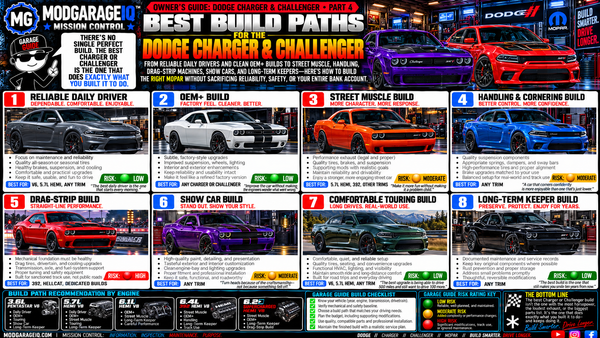
COMING THURSDAY, OCTOBER 22
Best Build Paths for the Dodge Charger & Challenger
Daily Driver, OEM+, Street Muscle, Handling, Drag Strip, Show Car, and Long-Term Keeper—finding the right build for your Mopar without turning it into a money pit.
#ModGarageIQ #GarageGuide #DodgeCharger #DodgeChallenger #Mopar #HEMI #Pentastar #ScatPack #392HEMI #Hellcat #AmericanMuscle #MoparMaintenance #PerformanceCarTips #CarOwnership #AutomotiveEducation #OwnersGuide #BuildSmarterDriveLonger