Winter Tires: What Most Drivers Get Wrong
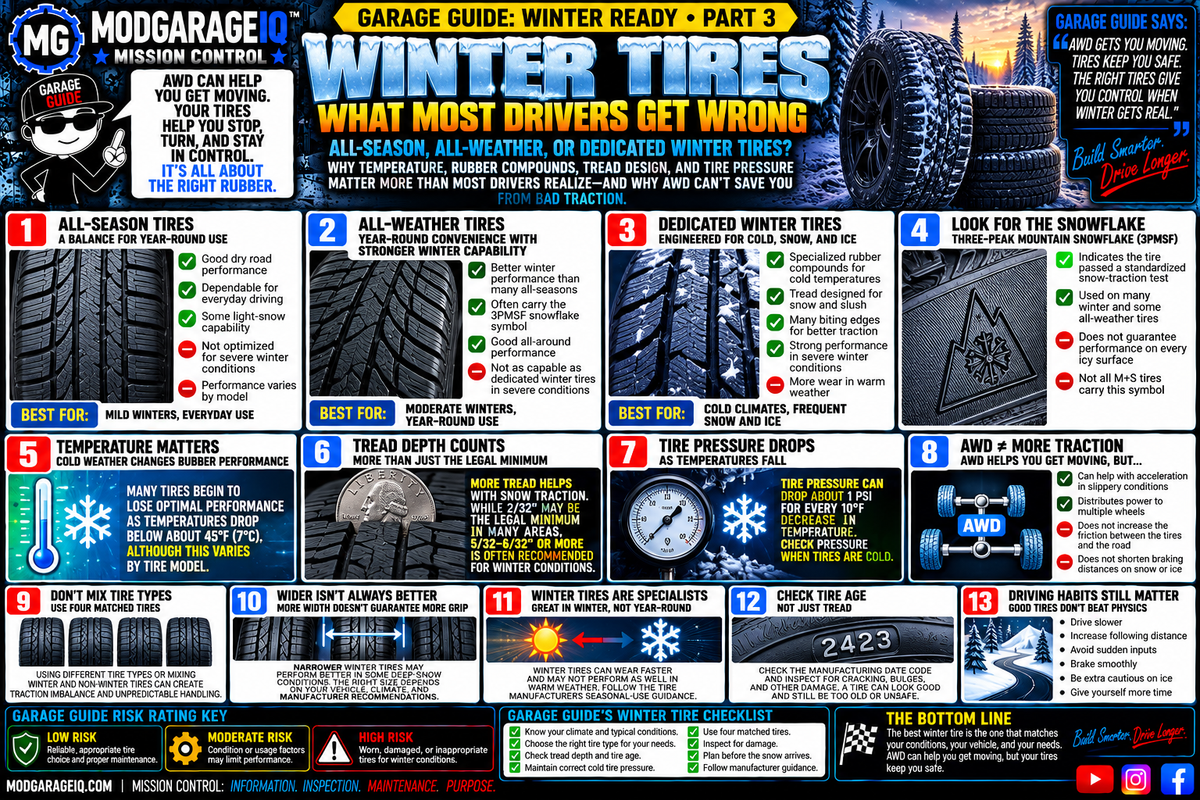
All-Season, All-Weather, or Dedicated Winter Tires? Why Temperature, Rubber Compounds, Tread Design, and Tire Pressure Matter More Than Most Drivers Realize—and Why AWD Can’t Save You From Bad Traction.
MODGARAGEIQ • GARAGE GUIDE: WINTER READY • PART 3 • FRIDAY, OCTOBER 23, 2026
There’s a moment every winter when drivers discover something important about their vehicles.
It usually happens on a cold morning.
Maybe the roads are wet.
Maybe there’s a little snow.
Maybe there’s ice that nobody noticed.
You press the accelerator.
The wheels spin.
You touch the brakes.
The vehicle keeps sliding.
And suddenly, that AWD badge on the back doesn’t feel quite as reassuring.
Here’s the problem.
A lot of drivers misunderstand what actually keeps their vehicles connected to the road.
They assume all-season tires are designed for every possible season.
They assume AWD means winter-ready.
They assume tires with plenty of tread must still be good.
And they assume winter tires are only necessary when the roads are covered in deep snow.
None of those assumptions tells the whole story.
Winter traction is about much more than tread depth.
It’s about rubber compounds, temperatures, road conditions, tire design, and the small contact patches connecting your vehicle to the pavement.
Today, Garage Guide is breaking down 18 things every driver should understand about winter tires.
No specific vehicle. No brand loyalty. Just the science, safety, and practical decisions that matter when winter arrives.
Let’s get into it.
1. Understand the Three Main Tire Categories
Before comparing performance, we need to understand what we’re actually comparing.
Not every tire labeled for year-round driving is designed for the same conditions.
All-Season Tires
These are designed to provide a balance of performance across a range of conditions.
Depending on the tire, they may offer:
- Comfortable everyday driving.
- Good dry-road performance.
- Wet-weather capability.
- Long tread life.
- Some light-snow capability.
But all-season performance varies significantly by model.
Many conventional all-season tires are not optimized for severe winter conditions.
All-Weather Tires
All-weather tires are designed for year-round use with stronger winter capability than many conventional all-season tires.
Many carry the Three-Peak Mountain Snowflake certification.
They can be a practical compromise for drivers who experience moderate winter conditions but prefer not to switch tire sets seasonally.
Dedicated Winter Tires
Winter tires are specifically engineered for cold-weather conditions.
Depending on the tire, they may offer:
- Rubber compounds designed for low temperatures.
- Tread patterns optimized for snow and slush.
- Numerous biting edges.
- Improved snow traction.
- Better performance on certain icy surfaces.
Some winter tires emphasize snow and slush performance, while others are designed primarily for ice and very cold paved roads.
The smarter approach: Choose tires based on actual conditions, not just the category printed on the sidewall.
Garage Guide Risk Rating: 🟡 MODERATE
Garage Guide Says:
“All-season means versatile. It doesn’t mean every all-season tire is equally prepared for a January ice storm.”
2. Cold Weather Changes How Tires Perform
Here’s one of winter’s biggest misconceptions.
You don’t need snow on the road for temperature to matter.
Tire rubber changes its behavior as temperatures change.
Some compounds remain more flexible in cold weather than others.
That flexibility influences how effectively the tire interacts with the road surface.
Many tire manufacturers use approximately 45°F (7°C) as a practical reference point for considering dedicated winter tires.
But that isn’t a universal temperature where every all-season tire suddenly becomes unsafe.
Actual performance depends on:
- Tire compound.
- Tire model.
- Pavement temperature.
- Road moisture.
- Tread condition.
- Driving conditions.
Some summer performance tires have specific minimum operating and storage-temperature restrictions that must be followed.
The smarter approach: Check the tire manufacturer’s guidance and select a tire designed for the temperatures you regularly encounter.
Garage Guide Risk Rating: 🟡 MODERATE
Garage Guide Says:
“Winter doesn’t have to cover the road in snow to change the way your tires behave.”
3. AWD Does Not Replace Winter Tires
This is the big one.
All-wheel drive can help distribute driving torque among multiple wheels.
That may improve acceleration and the ability to get moving in slippery conditions.
But AWD does not magically increase the friction available between the tires and the road.
And it does not eliminate the limitations of braking or cornering on snow and ice.
Your vehicle still relies on its tires to:
- Accelerate.
- Brake.
- Turn.
- Maintain directional control.
A two-wheel-drive vehicle with suitable winter tires may outperform an AWD vehicle with inappropriate tires in some winter braking and cornering situations.
Results depend on the vehicles, tires, surfaces, and test conditions.
The smarter approach: Treat AWD as a drivetrain feature—not a substitute for appropriate tires.
Garage Guide Risk Rating: 🔴 HIGH
Garage Guide Says:
“AWD helps you get moving. It doesn’t give you a free pass when it’s time to stop.” ❄️
4. Understand the Three-Peak Mountain Snowflake Symbol
You’ve probably seen the small mountain symbol with a snowflake inside.
Three-Peak Mountain Snowflake (3PMSF)
This marking indicates that a tire has met a defined snow-traction performance requirement under an applicable test standard.
It’s a useful indicator when shopping for tires with winter capability.
But here’s what it doesn’t mean.
It doesn’t guarantee:
- Excellent braking on every icy surface.
- Equal performance among all certified tires.
- Suitability for every winter condition.
- That the tire is a dedicated winter tire.
Some all-weather tires carry the symbol.
Dedicated winter tires commonly do as well.
The smarter approach: Use the symbol as one piece of evidence, then compare the tire’s intended application and independent performance testing.
Garage Guide Risk Rating: 🟡 MODERATE
Garage Guide Says:
“The snowflake tells you the tire met a snow-traction standard. It doesn’t mean Mother Nature signed a warranty agreement.”
5. Don’t Confuse M+S With Severe-Snow Certification
Some tires have M+S, meaning Mud and Snow, molded into their sidewalls.
But M+S and 3PMSF do not represent the same performance standard.
M+S is generally a tread-design designation.
It does not, by itself, establish that the tire passed the standardized snow-traction performance test associated with the Three-Peak Mountain Snowflake marking.
A tire can carry M+S without carrying 3PMSF.
The smarter approach: Don’t assume an M+S marking means the tire offers the same winter capability as a severe-snow-rated tire.
Garage Guide Risk Rating: 🟡 MODERATE
Garage Guide Says:
“Two letters on a sidewall aren’t a substitute for understanding what the tire was actually designed to do.”
6. Tread Depth Matters More Than You Think
A tire can still have legally permissible tread depth and deliver disappointing snow performance.
Why?
Because winter traction depends partly on the tire’s ability to engage with snow and evacuate slush.
As tread wears down, those capabilities can decline.
In many U.S. jurisdictions, 2/32 inch is a commonly used minimum tread-depth threshold.
But that minimum should not be treated as an ideal winter-performance target.
For snow use, 5/32–6/32 inch or more is a commonly recommended planning range, depending on tire type, conditions, and manufacturer guidance.
Inspect:
- Tread depth across the full width.
- Uneven wear.
- Damaged tread blocks.
- Cracking.
- Embedded objects.
- Tire age and condition.
The smarter approach: Replace tires before they become unsuitable for the winter conditions you expect—not merely when they reach a legal minimum.
Garage Guide Risk Rating: 🔴 HIGH
Garage Guide Says:
“Legal tread depth and good winter traction are not always the same thing.”
7. Tire Pressure Drops as Temperatures Fall
Here’s a winter problem almost every driver encounters.
The temperature drops.
The tire-pressure warning light appears.
And people assume the tire must be leaking.
Sometimes it is.
But sometimes the pressure change is caused by temperature.
A common rule of thumb is that tire pressure changes by roughly 1 PSI for every 10°F change in temperature, although actual changes vary.
That means a significant overnight temperature drop can noticeably affect tire pressure.
Low tire pressure may contribute to:
- Poor handling.
- Uneven wear.
- Increased rolling resistance.
- Heat buildup during driving.
- Reduced tire durability.
The smarter approach:
- Check pressure when tires are cold.
- Use the vehicle manufacturer’s specified cold inflation pressure.
- Inspect all tires, including the spare where applicable.
- Recheck pressure during major temperature changes.
- Investigate pressure that repeatedly drops.
Do not use the maximum pressure printed on the tire sidewall as the vehicle’s routine inflation target.
Garage Guide Risk Rating: 🟡 MODERATE
Garage Guide Says:
“Your tires don’t know it’s winter. They just know the air inside them is behaving differently.”
8. Don’t Install Only Two Winter Tires
This is a mistake that can create unpredictable handling.
Some drivers install winter tires only on the drive wheels.
The thinking is simple.
“If my front wheels drive the vehicle, I only need winter tires in front.”
Or:
“My rear-wheel-drive vehicle only needs winter tires in the back.”
But tire grip affects steering, braking, and vehicle stability—not just acceleration.
Mixing substantially different seasonal tire capabilities between axles can create a traction imbalance.
Depending on the setup, that can increase the risk of oversteer or understeer.
The smarter approach: Use a properly matched set of four winter tires, following vehicle and tire manufacturer guidance.
For AWD vehicles, also follow requirements concerning tire size, rolling circumference, and tread-depth matching.
Garage Guide Risk Rating: 🔴 HIGH
Garage Guide Says:
“Winter tires aren’t a buy-two-get-half-the-traction special. Balance matters.”
9. Wider Tires Aren’t Automatically Better in Snow
In performance driving, wider tires are often associated with increased grip.
But winter conditions complicate the picture.
Snow depth, surface type, tread design, compound, tire loading, and size all affect performance.
A narrower winter tire may offer advantages in some deep-snow or slush conditions.
But narrower isn’t universally better.
And wider isn’t universally worse.
The vehicle must also support the selected wheel and tire dimensions.
The smarter approach: Choose an approved winter tire size with the correct load and speed ratings, wheel fitment, and clearance.
Don’t improvise tire sizes based solely on appearance or general rules of thumb.
Garage Guide Risk Rating: 🟡 MODERATE
Garage Guide Says:
“Winter traction isn’t a contest to see who can fit the widest tire under the fender.”
10. Winter Tires Don’t Make Ice Safe
Dedicated winter tires can provide meaningful advantages in cold conditions.
But ice remains dangerous.
Especially polished ice or surfaces covered by a thin, difficult-to-see frozen layer.
Traction can be extremely limited regardless of tire type.
Some specialized winter tires are designed with particular emphasis on ice performance.
Studded tires may be permitted in certain jurisdictions and restricted in others.
Even specialized equipment cannot eliminate the need for cautious driving.
The smarter approach:
- Reduce speed.
- Increase following distance.
- Avoid sudden inputs.
- Brake smoothly.
- Leave extra room for turns.
- Avoid unnecessary travel during severe icing.
Garage Guide Risk Rating: 🔴 HIGH
Garage Guide Says:
“Winter tires improve your odds. They don’t repeal the laws of physics.”
11. All-Weather Tires Can Be a Smart Compromise
Not every driver needs two complete sets of tires.
For some people, all-weather tires make sense.
They can offer a practical balance between year-round convenience and improved winter capability.
They may be especially attractive when:
- Winters are moderate.
- Snowfall is occasional.
- Roads are frequently cleared.
- Storage space is limited.
- Seasonal tire changes are inconvenient.
However, performance varies considerably among tire models.
And an all-weather tire is not automatically equivalent to a dedicated winter tire in every snow or ice condition.
The smarter approach: Compare independent tests and choose based on your actual winter exposure.
Garage Guide Risk Rating: 🟢 LOW when the tire is appropriate for the vehicle and conditions.
Garage Guide Says:
“The smartest tire isn’t always the most specialized one. It’s the one that fits the conditions you actually drive through.”
12. Dedicated Winter Tires Still Have Trade-Offs
Winter tires aren’t magic.
And they aren’t the perfect tire for every season.
Depending on the tire, using winter tires in warm weather can result in:
- Faster tread wear.
- Less precise warm-weather handling.
- Longer stopping distances on some warm, dry surfaces.
- Reduced performance compared with an appropriate warm-weather tire.
Their compounds and tread designs are optimized for different conditions.
The smarter approach: Follow the tire manufacturer’s seasonal-use guidance and change tires when conditions warrant.
Don’t assume that because winter tires work well in January, they’re automatically the best choice in July.
Garage Guide Risk Rating: 🟡 MODERATE
Garage Guide Says:
“Winter tires are specialists. Don’t make them work the summer shift unless the manufacturer says they’re suited for it.”
13. Check Tire Age, Not Just Tread
A tire can have plenty of tread and still be unsuitable for continued use.
Rubber ages.
Heat, sunlight, storage, use, and environmental exposure influence tire condition.
Inspect for:
- Cracking.
- Bulges.
- Cuts.
- Sidewall damage.
- Unusual deformation.
- Irregular wear.
- Evidence of previous improper repairs.
Check the tire identification date code to determine when it was manufactured.
But don’t treat age alone as a complete condition assessment.
Manufacturers provide different inspection and replacement recommendations.
The smarter approach: Follow the tire and vehicle manufacturers’ age-related guidance, and have questionable tires inspected by a qualified professional.
Garage Guide Risk Rating: 🔴 HIGH for damaged or structurally compromised tires.
Garage Guide Says:
“A tire can look young from the tread and still be old enough to know better.”
14. Store Seasonal Tires Properly
If you use separate winter and warm-weather tire sets, storage matters.
Poor storage can contribute to deterioration or damage.
General best practices include:
- Clean and dry the tires before storage.
- Keep them away from direct sunlight.
- Avoid excessive heat.
- Keep them away from ozone-producing equipment.
- Avoid contact with petroleum products and harmful chemicals.
- Follow manufacturer recommendations for storing mounted and unmounted tires.
- Inspect before reinstalling.
Some performance summer tires have particularly important cold-temperature storage and handling restrictions.
The smarter approach: Follow the exact tire manufacturer’s storage instructions.
Garage Guide Risk Rating: 🟢 LOW
Garage Guide Says:
“Your winter tires shouldn’t spend the summer aging next to a heater and a collection of mystery chemicals.”
15. Don’t Forget Wheel Fitment and TPMS
Switching to a winter wheel-and-tire package can be convenient.
But proper fitment matters.
Verify:
- Wheel diameter and width.
- Bolt pattern.
- Offset.
- Center-bore compatibility.
- Brake-caliper clearance.
- Load capacity.
- Tire size.
- Tire load and speed ratings.
- TPMS compatibility.
- Correct lug hardware and torque specifications.
Some high-performance brake packages require specific wheel clearances.
And some vehicles may require TPMS programming or relearning when switching wheel sets.
The smarter approach: Verify compatibility before purchasing.
Garage Guide Risk Rating: 🟡 MODERATE, potentially 🔴 HIGH for unsafe fitment.
Garage Guide Says:
“A winter wheel package is only a bargain if the wheels actually fit over the brakes.” 😂
16. Understand Why Stopping Distance Changes
Here’s a simple truth.
Your brakes cannot create traction that your tires don’t have.
ABS helps manage wheel lockup during braking.
Stability control can assist with maintaining vehicle control.
But neither system can overcome the available tire-to-road friction.
On snow and ice, stopping distances may increase dramatically compared with dry pavement.
And the exact difference depends on many variables:
- Surface condition.
- Tire type and condition.
- Vehicle speed.
- Vehicle weight and loading.
- Road gradient.
- Temperature.
- Driver inputs.
The smarter approach: Increase following distance substantially, reduce speed, and anticipate stops early.
Never assume AWD, ABS, or stability control guarantees short stopping distances.
Garage Guide Risk Rating: 🔴 HIGH
Garage Guide Says:
“Your brakes can ask the wheels to stop. Your tires still have to negotiate with the road.”
17. Don’t Wait for the First Snowstorm to Buy Tires
This is one of the most avoidable winter mistakes.
Drivers wait until the forecast shows snow.
Then everybody suddenly wants winter tires.
Availability may become limited.
Popular sizes can sell out.
Installation appointments may be harder to schedule.
And drivers may feel pressured into buying whatever is available.
The smarter approach:
- Evaluate tires before winter.
- Research suitable models.
- Check tread and condition.
- Confirm sizing.
- Arrange installation before severe weather.
- Plan for proper storage if using seasonal sets.
Garage Guide Risk Rating: 🟡 MODERATE
Garage Guide Says:
“The best time to shop for winter tires is before everybody in town remembers winter exists.” 😂
18. Remember That Driving Habits Still Matter
You can buy excellent winter tires.
You can have AWD.
You can have ABS, traction control, and electronic stability control.
And you can still lose control if you exceed the available traction.
Winter driving requires smoother, more deliberate inputs.
Focus on:
- Lower speeds.
- Longer following distances.
- Gentle acceleration.
- Smooth steering.
- Progressive braking.
- Avoiding sudden lane changes.
- Watching for shaded and elevated icy surfaces.
- Leaving extra travel time.
- Avoiding travel when conditions are unsafe.
Tires are part of the safety equation.
The driver is another.
Garage Guide Risk Rating: 🔴 HIGH
Garage Guide Says:
“The best winter tire in the world can’t fix a driver who thinks snow is just dry pavement with decorations.”
Garage Guide’s Winter Tire Decision Guide
Not sure which type of tire makes sense?
Start with your real-world conditions.
OPTION A — CONVENTIONAL ALL-SEASON TIRES
Consider when:
- Winters are mild.
- Snow and ice are uncommon.
- Temperatures and conditions remain within the tire’s intended operating range.
- You can avoid driving during severe winter weather.
OPTION B — ALL-WEATHER TIRES
Consider when:
- Winters are moderate.
- You encounter occasional snow.
- You want year-round convenience.
- You prefer a tire with demonstrated severe-snow capability.
- You understand the compromise compared with dedicated winter tires.
OPTION C — DEDICATED WINTER TIRES
Consider when:
- Temperatures are consistently cold.
- Snow or ice is common.
- Winter driving is unavoidable.
- You travel through mountainous or poorly cleared areas.
- Maximum appropriate winter capability is a priority.
Important: These are general selection guidelines, not guarantees of performance. Evaluate individual tire models, vehicle requirements, and local conditions.
Garage Guide’s 10-Minute Winter Tire Inspection
Before the next cold snap:
1. CHECK THE SIDEWALL
Identify the tire model, size, load rating, and relevant winter markings.
2. MEASURE TREAD DEPTH
Check several points across each tire.
3. INSPECT FOR DAMAGE
Look for cracking, cuts, bulges, and irregular wear.
4. CHECK COLD TIRE PRESSURE
Use the vehicle’s specified cold inflation pressure.
5. VERIFY TIRE MATCHING
Check that all four tires are appropriately matched for the vehicle and drivetrain.
6. REVIEW TIRE AGE
Locate the manufacturing date code and compare with manufacturer guidance.
7. EVALUATE YOUR CLIMATE
Decide whether your current tires are appropriate for expected temperatures and road conditions.
8. PLAN BEFORE THE STORM
Arrange replacements or seasonal changes before severe weather arrives.
Garage Guide Risk Rating Summary
🟢 LOW RISK
Choosing suitable tires for your climate, inspecting them regularly, maintaining correct pressure, planning seasonal changes, and storing tires properly.
🟡 MODERATE RISK
Using tires with limited winter capability in marginal conditions, neglecting pressure changes, choosing poorly matched tire sizes, and delaying seasonal preparation.
🔴 HIGH RISK
Driving on damaged or excessively worn tires, mixing incompatible winter tire setups, relying on AWD to overcome poor traction, driving too fast for snow or ice, and assuming electronic safety systems can defeat slippery-road physics.
The Bottom Line
Winter traction begins where the rubber meets the road.
Not at the engine.
Not at the transmission.
Not at the AWD badge.
And not at the traction-control button.
Your tires are the connection between the vehicle and the pavement.
Everything else depends on that connection.
Conventional all-season tires can be appropriate for some climates.
All-weather tires can be an excellent compromise for certain drivers.
Dedicated winter tires can offer meaningful advantages in sustained cold, snow, and ice.
But no tire is perfect for every condition.
And no drivetrain can eliminate the laws of physics.
Choose the right tires. Maintain them properly. Match all four. Respect the weather. Adjust your driving.
Because the most important winter performance upgrade isn’t always more power.
Sometimes it’s simply having the right rubber underneath you.
Garage Guide Says:
“AWD can help you get moving, but it can’t create traction your tires don’t have. When winter shows up, the smartest drivers don’t ask how many wheels are powered—they ask how well all four tires can grip the road.”
Build Smarter. Drive Longer.
❄️ GARAGE GUIDE: WINTER READY — SERIES PROGRESS
Part 1 — Is Your Car Ready for Winter?
Part 2 — Your Battery vs. Winter
Part 3 — Winter Tires: What Most Drivers Get Wrong
Part 4 — Coolant & Freeze Protection • October 30
#ModGarageIQ #GarageGuide #WinterReady #WinterTires #AllWeatherTires #AllSeasonTires #WinterDriving #TireSafety #AWD #TirePressure #SnowTraction #ColdWeatherDriving #CarMaintenance #AutomotiveEducation #WinterCarCare #BuildSmarterDriveLonger