Why Is My Car Losing Coolant?
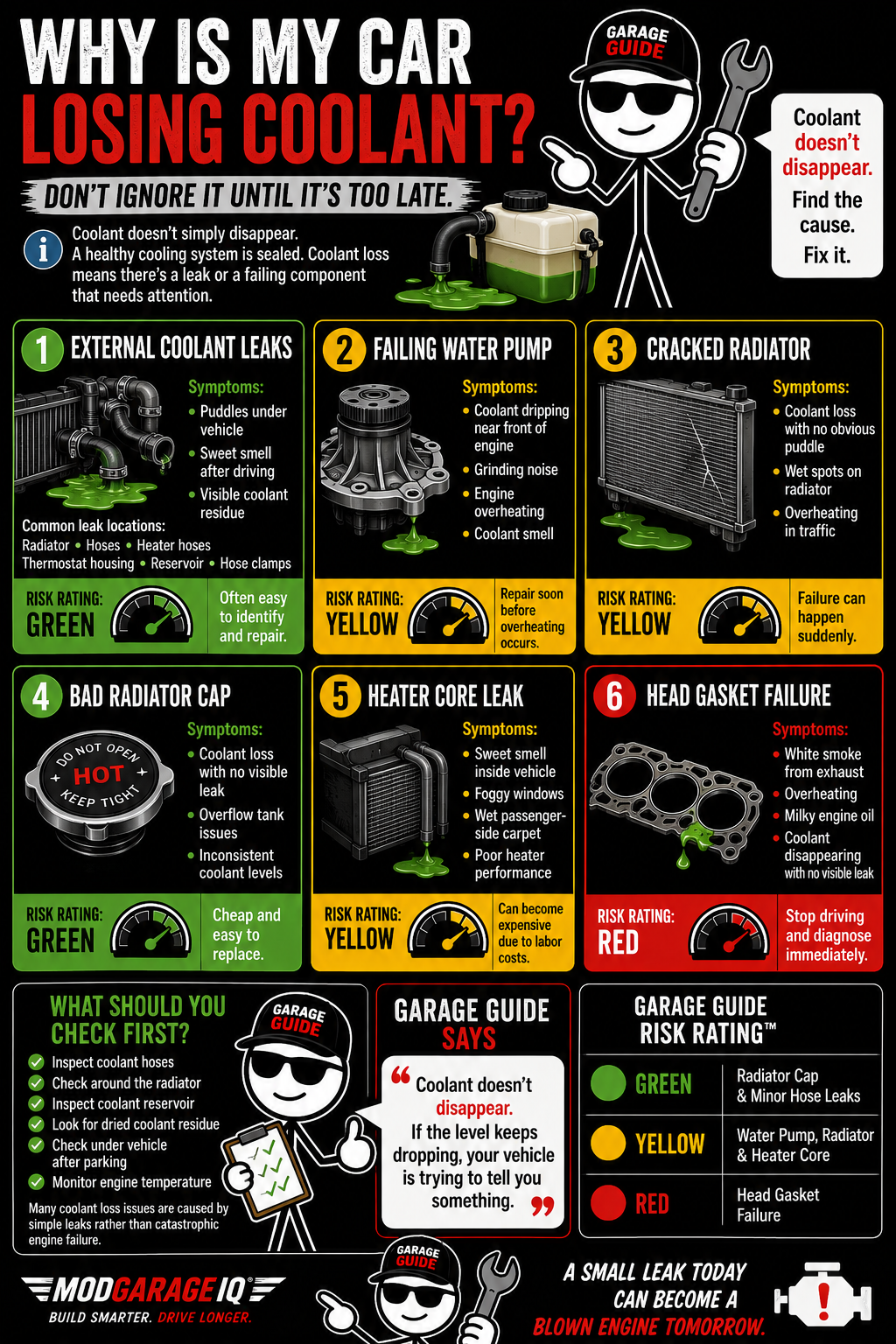
Don’t Ignore It Until It’s Too Late
If you’re adding coolant every few days, something is wrong.
Coolant doesn’t simply disappear.
A healthy cooling system is sealed. If the coolant level keeps dropping, there’s usually a leak, a failing component, or an internal engine problem that needs attention.
Ignoring coolant loss can quickly turn a minor repair into a major engine failure.
Common Causes Of Coolant Loss
1. External Coolant Leaks
The most common cause is a leak somewhere in the cooling system.
Common leak locations include:
• Radiator
• Radiator hoses
• Heater hoses
• Thermostat housing
• Coolant reservoir
• Hose clamps
Symptoms:
• Puddles under vehicle
• Sweet smell after driving
• Visible coolant residue
🟢 Garage Guide Risk Rating: GREEN
Often easy to identify and repair.
2. Failing Water Pump
Water pumps wear out over time.
Many contain a weep hole that begins leaking when internal seals fail.
Symptoms:
• Coolant dripping near front of engine
• Grinding noise
• Engine overheating
• Coolant smell
🟡 Garage Guide Risk Rating: YELLOW
Repair soon before overheating occurs.
3. Cracked Radiator
Plastic radiator tanks become brittle with age and heat cycles.
Small cracks can leak coolant slowly and may only appear when the system is under pressure.
Symptoms:
• Coolant loss with no obvious puddle
• Wet spots on radiator
• Overheating in traffic
🟡 Garage Guide Risk Rating: YELLOW
Failure can happen suddenly.
4. Bad Radiator Cap
The radiator cap controls cooling system pressure.
A weak cap can allow coolant to escape as steam.
Symptoms:
• Coolant loss with no visible leak
• Overflow tank issues
• Inconsistent coolant levels
🟢 Garage Guide Risk Rating: GREEN
Cheap and easy to replace.
5. Heater Core Leak
The heater core is essentially a small radiator inside your dashboard.
When it leaks, coolant can enter the cabin.
Symptoms:
• Sweet smell inside vehicle
• Foggy windows
• Wet passenger-side carpet
• Poor heater performance
🟡 Garage Guide Risk Rating: YELLOW
Can become expensive due to labor costs.
6. Head Gasket Failure
This is the one everyone hopes it isn’t.
A failed head gasket can allow coolant to enter the combustion chamber or engine oil.
Symptoms:
• White smoke from exhaust
• Overheating
• Milky engine oil
• Coolant disappearing with no visible leak
🔴 Garage Guide Risk Rating: RED
Stop driving and diagnose immediately.
What Should You Check First?
Before assuming the worst:
✅ Inspect coolant hoses
✅ Check around the radiator
✅ Inspect coolant reservoir
✅ Look for dried coolant residue
✅ Check under vehicle after parking
✅ Monitor engine temperature
Many coolant loss issues are caused by simple leaks rather than catastrophic engine failure.
Garage Guide Says
“Coolant doesn’t disappear. If the level keeps dropping, your vehicle is trying to tell you something.”
Garage Guide Risk Rating™
🟢 Radiator Cap & Minor Hose Leaks
🟡 Water Pump, Radiator & Heater Core
🔴 Head Gasket Failure
Bottom Line
Losing coolant is never normal.
The sooner you find the cause, the less expensive the repair usually becomes.
A small coolant leak today can become a blown engine tomorrow.
Don’t wait for the temperature gauge to tell you what your coolant reservoir already knows.
🏁 Build Smarter. Drive Longer.
#ModGarageIQ #GarageGuide #CoolantLeak #CarMaintenance #AutomotiveTips #CheckEngineLight #VehicleRepair #CarProblems #BuildSmarterDriveLonger #CarCare