Best Build Paths for the Subaru WRX STI
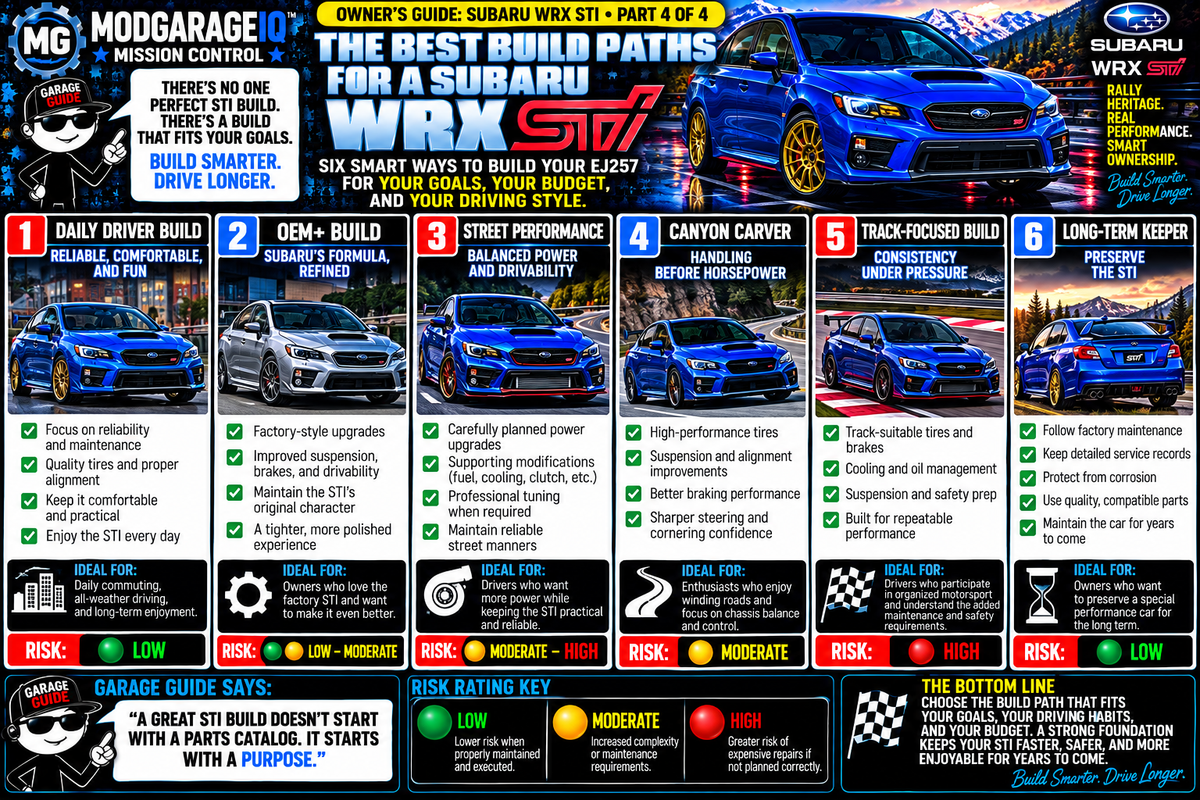
Daily Driver, OEM+, Street Performance, Canyon Carver, Track Build, or Long-Term Keeper? Six Smart Ways to Build Your EJ257-Powered STI Without Sacrificing Reliability, Drivability, or Your Budget.
MODGARAGEIQ OWNER’S GUIDE | SUBARU WRX STI | PART 4 OF 4 | OCTOBER 29, 2026
There’s no shortage of aftermarket parts for the Subaru WRX STI.
Turbochargers. Intercoolers. Exhaust systems. Coilovers. Wheels. Brakes. Engine components.
You could spend thousands of dollars before ever deciding what you actually want the car to do.
And that’s where many builds go wrong.
A great STI build doesn’t start with a parts catalog. It starts with a purpose.
The 2015–2021 U.S.-market WRX STI features a turbocharged 2.5L EJ257 boxer engine, six-speed manual transmission, and sophisticated all-wheel-drive system.
It’s already a capable performance platform.
But the ideal modifications depend on whether you’re commuting, enjoying winding roads, participating in motorsports, or preserving the car for years to come.
Today, Garage Guide is breaking down six build paths and the decisions that make each one work.
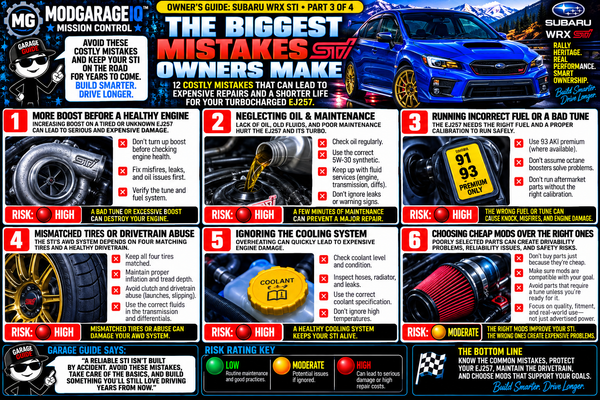
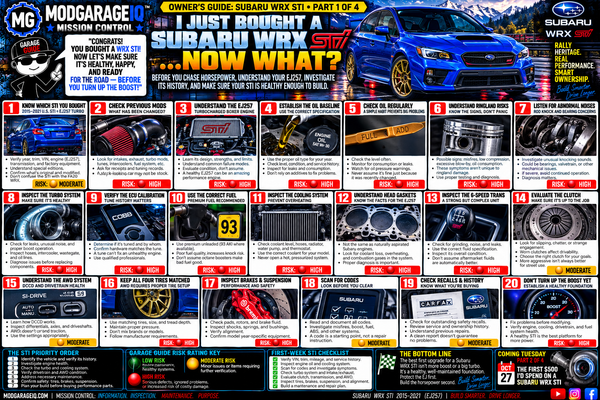
One rule applies to every path: Start with a healthy engine, sound drivetrain, appropriate tires, and functioning brakes.
Let’s build smarter!
1. The Daily Driver Build — Reliable, Comfortable, and Fun
Mission: Enjoy the STI every day without turning routine transportation into a maintenance nightmare.
A daily-driven STI should be dependable, predictable, and comfortable enough for regular use.
You don’t need enormous horsepower to enjoy the EJ257.
Where I’d Focus
- Correct engine oil and documented maintenance.
- Healthy cooling and turbocharger systems.
- Quality tires suited to local weather.
- Proper alignment.
- Good brake pads and fluid.
- Factory-compatible replacement components.
- Preserving ride comfort and reasonable noise levels.
Avoid excessively stiff suspension setups or aggressive clutch combinations unless your actual driving needs justify them.
Best modification philosophy: Improve the ownership experience without creating unnecessary mechanical demands.
Garage Guide Risk Rating: 🟢 LOW, assuming proper maintenance and compatible components.
Garage Guide Says:
“The best daily-driver STI is the one that’s exciting on Saturday and still gets you to work on Monday.”
2. The OEM+ Build — Subaru’s Formula, Refined
Mission: Make the STI feel more polished without losing its factory personality.
OEM+ is about carefully selected improvements that complement the original design.
Think refinement rather than transformation.
Where I’d Focus
- High-quality replacement dampers when needed.
- Manufacturer-compatible suspension components.
- Premium street tires.
- Appropriate brake pads.
- Improved shift feel through compatible components.
- Refreshed bushings where worn.
- Restoring factory performance equipment to proper condition.
The goal isn’t necessarily to make the car louder, lower, or more powerful.
It’s to make the complete vehicle feel tighter and more consistent.
Best modification philosophy: Preserve the STI’s identity while addressing real shortcomings.
Garage Guide Risk Rating: 🟢 LOW to 🟡 MODERATE, depending on the modifications.
Garage Guide Says:
“OEM+ means improving what Subaru built—not replacing every part just because somebody sells a blue version.” 😂
3. The Street Performance Build — Balanced Power
Mission: Improve acceleration and responsiveness while preserving sensible street drivability.
This is where many owners start thinking about power modifications.
But an EJ257 performance build requires planning.
Increasing engine output can affect:
- Combustion pressures.
- Fuel-system demands.
- Intake and exhaust temperatures.
- Cooling requirements.
- Clutch capacity.
- Engine longevity.
Where I’d Focus
- Establishing engine health.
- Reviewing existing modifications.
- Verifying fuel-system condition.
- Selecting compatible hardware.
- Professional calibration when required.
- Monitoring operating conditions.
- Maintaining appropriate tires and brakes.
Avoid selecting modifications solely from advertised horsepower claims.
And don’t assume that a particular horsepower number is universally safe for every EJ257.
Engine condition, calibration, fuel, operating conditions, and mechanical configuration all matter.
Best modification philosophy: Build a complete system rather than chasing isolated horsepower gains.
Garage Guide Risk Rating: 🟡 MODERATE to 🔴 HIGH, depending on the power increase and supporting work.
Garage Guide Says:
“A balanced 350-horsepower build isn’t automatically better than a healthy stock STI. The right amount of power is the amount your complete setup can responsibly support.”
Horsepower figures are illustrative, not guarantees or recommended safe limits.
4. The Canyon Carver — Handling Before Horsepower
Mission: Improve steering response, cornering confidence, and chassis consistency.
For enthusiasts who enjoy winding roads, the STI’s handling characteristics can be more rewarding to refine than its horsepower output.
However, performance driving belongs in appropriate legal and controlled environments.
Where I’d Focus
- High-quality performance tires.
- Proper wheel fitment.
- Suspension-condition assessment.
- Carefully selected dampers and springs.
- Professional alignment.
- Brake-system health.
- Driver education.
Avoid excessively aggressive lowering.
Suspension geometry, available travel, damping, and tire behavior all influence handling.
A lower car isn’t automatically a better-handling car.
And wider tires aren’t automatically better in every situation.
Best modification philosophy: Improve usable grip, control, and predictability.
Garage Guide Risk Rating: 🟡 MODERATE
Garage Guide Says:
“The fastest way through a corner isn’t always more horsepower. Sometimes it’s better tires and an owner who knows how to use them.”
5. The Track-Focused STI — Consistency Under Pressure
Mission: Build for repeated performance in a controlled motorsport environment.
Track driving can expose weaknesses that aren’t obvious during ordinary street use.
Repeated acceleration, braking, and cornering create significant thermal and mechanical demands.
Where I’d Focus
- Mechanical inspection before events.
- Appropriate performance tires.
- Track-suitable brake pads and fluid.
- Cooling-system condition.
- Engine-oil monitoring.
- Suspension and alignment suited to the application.
- Properly secured equipment.
- Safety requirements for the event and sanctioning organization.
Depending on the type and intensity of track use, additional oil-management or cooling considerations may be appropriate.
Those decisions should be made with qualified professionals familiar with the EJ257 and the intended motorsport application.
Important: Track preparation doesn’t automatically make a car safe for competition. Driver protection, technical inspection, and event-specific rules matter.
Best modification philosophy: Prioritize durability, safety, and repeatability over a single impressive lap.
Garage Guide Risk Rating: 🔴 HIGH because sustained motorsport operation increases mechanical and safety demands.
Garage Guide Says:
“A track build isn’t about surviving one fast lap. It’s about performing consistently without ignoring the systems keeping you safe.”
6. The Long-Term Keeper — Preserve the STI
Mission: Keep the STI healthy, enjoyable, and mechanically sound for years.
Not every STI needs to become a high-horsepower project.
Some owners want to preserve a distinctive performance car that is no longer offered new in the same form.
That’s a perfectly legitimate build path.
Where I’d Focus
- Following manufacturer maintenance requirements.
- Maintaining detailed service records.
- Addressing leaks promptly.
- Protecting the underbody from corrosion.
- Preserving original components.
- Avoiding unnecessary irreversible modifications.
- Using correct replacement parts.
- Keeping the engine-management system properly matched to installed hardware.
If you live in an area where roads are treated with salt, corrosion prevention deserves particular attention.
And if you plan to keep the vehicle for many years, preserving documentation can be just as valuable as preserving parts.
Best modification philosophy: Protect the car’s mechanical condition and original character.
Garage Guide Risk Rating: 🟢 LOW
Garage Guide Says:
“Sometimes the smartest build is keeping a great car great.”
7. Understand the EJ257’s Power Limitations
Here’s something every STI owner should understand.
There is no single horsepower number that guarantees EJ257 reliability.
The engine’s ability to tolerate additional power depends on numerous factors:
- Mechanical condition.
- Internal engine components.
- Fuel quality.
- Calibration.
- Turbocharger characteristics.
- Torque delivery.
- Cooling performance.
- Lubrication.
- Operating conditions.
Two vehicles producing similar peak horsepower can experience very different mechanical demands.
For example, the shape of the torque curve matters, not just the highest number on a dyno graph.
Likewise, a professionally assembled engine with upgraded internal components is not automatically immune to poor calibration or inadequate lubrication.
The smarter move: Define a realistic performance target with qualified professionals who understand the entire engine and drivetrain package.
Garage Guide Risk Rating: 🔴 HIGH when power is increased without appropriate engineering and verification.
Garage Guide Says:
“A dyno number tells you what happened during a test. It doesn’t promise how long your engine will survive.”
8. Choose Modifications in the Right Order
The order of modifications matters.
Here’s how I’d approach a new STI project.
FIRST — Mechanical Health
Address engine, turbocharger, cooling, and drivetrain concerns.
SECOND — Maintenance
Complete necessary fluid services and replace worn components.
THIRD — Safety and Traction
Verify tires, brakes, steering, and suspension.
FOURTH — Build Purpose
Choose the driving experience you’re actually trying to create.
FIFTH — Compatible Components
Research fitment, operating requirements, and supporting modifications.
SIXTH — Calibration and Verification
When modifications require ECU calibration, use qualified professionals and verify the resulting operation.
SEVENTH — Reevaluate
Drive the vehicle in appropriate conditions and determine whether additional changes are genuinely necessary.
The goal: Avoid creating problems that later modifications must solve.
Garage Guide Risk Rating: 🟢 LOW for a disciplined, safety-first approach.
Garage Guide Says:
“Build the foundation first. The fun parts work better when everything underneath them is healthy.”
9. Don’t Forget the Real Cost of a Build
The advertised price of a performance part rarely represents the entire project cost.
Additional expenses may include:
- Installation labor.
- Supporting components.
- ECU calibration.
- Alignment.
- Replacement fluids.
- Diagnostic work.
- Maintenance.
- Tires and brakes.
- Repairs.
- Increased operating costs.
A modification can also affect emissions compliance, insurance, warranty coverage where applicable, and vehicle inspection requirements.
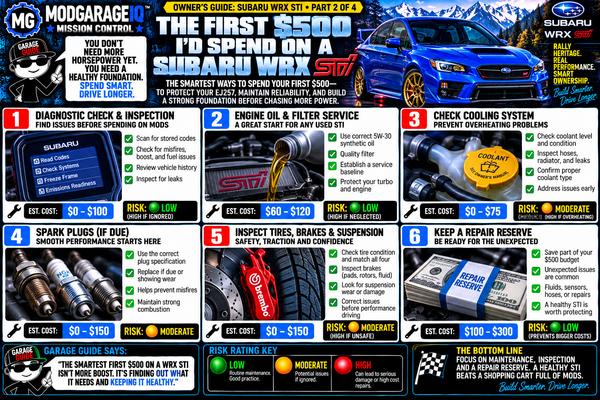
Before buying anything, calculate the complete cost of installing and maintaining it.
The smarter move: Keep a repair reserve and avoid spending the entire budget on parts alone.
Garage Guide Risk Rating: 🟡 MODERATE
Garage Guide Says:
“If the part costs $500 but needs another $1,500 to work correctly, congratulations—you found a $2,000 modification.” 😂
10. Build for Your Driving Habits, Not Someone Else’s
Social media can make every STI build look like a competition.
More boost.
More horsepower.
Louder exhaust.
Lower suspension.
Bigger wheels.
But none of those automatically make a vehicle better for your needs.
Ask yourself:
- Is this my daily driver?
- How often do I drive in bad weather?
- Do I value comfort or maximum performance?
- Will I participate in organized motorsports?
- What’s my maintenance budget?
- How long do I plan to own the car?
Your answers should determine the build.
The smarter move: Choose modifications that improve your actual ownership experience.
Garage Guide Risk Rating: 🟢 LOW when modifications are planned responsibly.
Garage Guide Says:
“The best STI build isn’t the one that gets the most likes. It’s the one that makes you smile every time you drive it.”
Garage Guide’s STI Build Selection Guide
Choose DAILY DRIVER if: Reliability, comfort, and everyday usability are your priorities.
Choose OEM+ if: You love the factory STI but want a more refined driving experience.
Choose STREET PERFORMANCE if: You want carefully planned additional power and accept the added expense and mechanical demands.
Choose CANYON CARVER if: Steering, cornering behavior, and chassis balance interest you more than peak horsepower.
Choose TRACK-FOCUSED if: You’re preparing for organized motorsport and understand the additional maintenance and safety requirements.
Choose LONG-TERM KEEPER if: Preservation, documentation, and dependable ownership matter most.
You can combine compatible elements of multiple paths.
A daily driver can benefit from OEM+ improvements.
A long-term keeper can receive thoughtful maintenance-oriented upgrades.
And a track-focused car still needs a healthy engine and drivetrain.
The important thing is that every modification supports the overall mission.
Garage Guide Risk Rating Summary
🟢 LOW RISK
Routine maintenance, preservation, quality replacement components, and sensible OEM+ improvements.
🟡 MODERATE RISK
Suspension changes, street-performance modifications, and upgrades that introduce additional maintenance or compatibility requirements.
🔴 HIGH RISK
Major power increases, poorly matched calibrations, excessive drivetrain demands, and sustained motorsport use without appropriate preparation.
Risk depends on the vehicle, modification, installation quality, and operating conditions—not simply the name of the build path.
The Bottom Line
The Subaru WRX STI doesn’t have one perfect build.
It has the build that’s right for your goals.
A daily driver should be dependable.
An OEM+ STI should feel refined.
A street-performance build should balance power with supporting systems.
A handling-focused STI should prioritize traction and control.
A track car should emphasize consistency and safety.
And a long-term keeper should protect the mechanical character that makes the STI special.
Whatever path you choose, remember the foundation.
Engine health. Correct maintenance. Compatible modifications. Proper calibration. Healthy drivetrain. Good tires. Reliable brakes.
Because building an STI isn’t about proving how much money you can spend.
It’s about making the car better at what you actually want it to do.
Garage Guide Says:
“The best Subaru WRX STI build isn’t necessarily the fastest, loudest, lowest, or most expensive. It’s the one built around a clear purpose, supported by healthy mechanical systems, and designed to keep delivering the driving experience you love.”
Build Smarter. Drive Longer.
❄️ COMING FRIDAY, OCTOBER 30
GARAGE GUIDE: WINTER READY — PART 4
Coolant & Freeze Protection: What Every Driver Should Know
Why the right coolant chemistry, concentration, and cooling-system condition matter when temperatures drop—and why coolant color alone doesn’t tell the whole story.
#ModGarageIQ #GarageGuide #SubaruWRXSTI #WRXSTI #SubaruSTI #EJ257 #SubaruPerformance #AWD #JDM #Turbocharged #PerformanceBuild #OEMPlus #TrackPreparation #AutomotiveEducation #OwnersGuide #BuildSmarterDriveLonger