The Biggest Mistakes Subaru WRX STI Owners Make
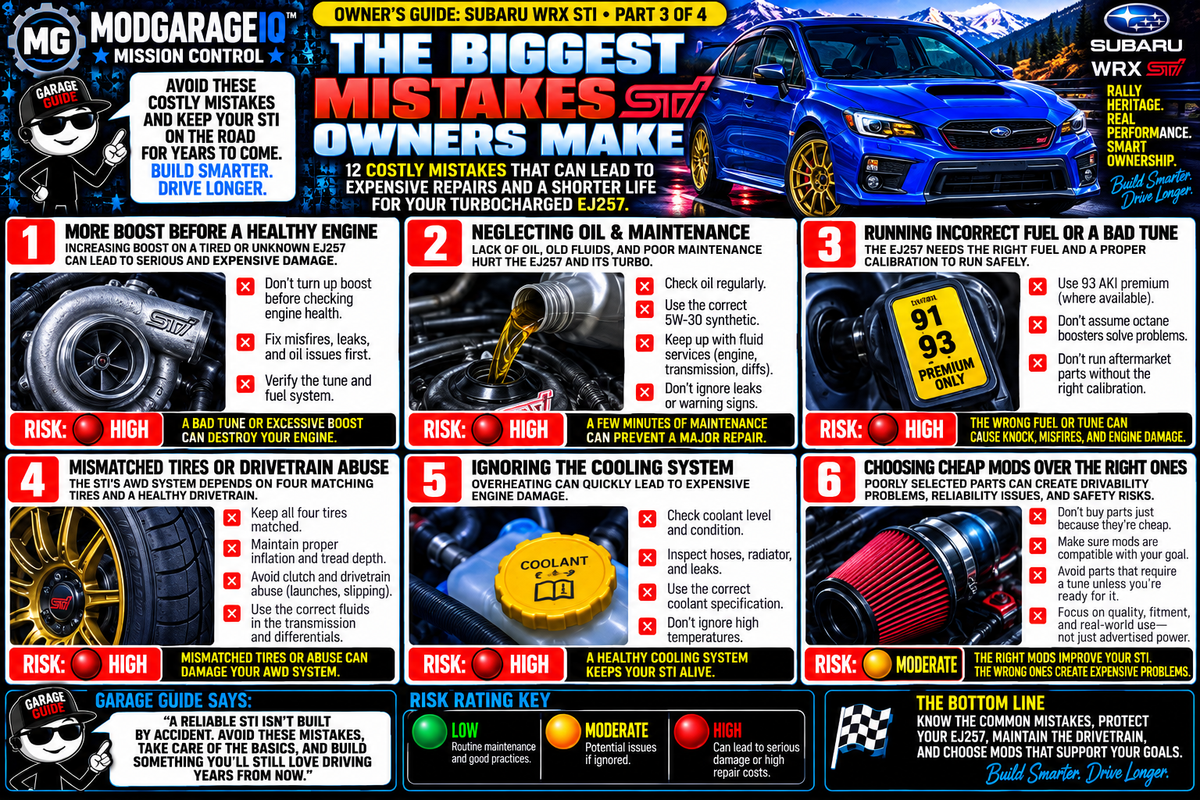
From Bad Tunes and Excessive Boost to Oil Neglect, Mismatched Tires, and Drivetrain Abuse—12 Costly Mistakes That Can Shorten the Life of Your Turbocharged EJ257.
MODGARAGEIQ OWNER’S GUIDE | SUBARU WRX STI | PART 3 OF 4 | OCTOBER 28, 2026
The Subaru WRX STI is a special kind of performance car.
A turbocharged boxer engine. A six-speed manual transmission. Rally-inspired all-wheel drive. And enough personality to make an ordinary grocery run feel like a qualifying lap.
But there’s something every STI owner needs to understand.
Performance doesn’t eliminate mechanical limits.
The EJ257 can deliver an exciting driving experience, but its reliability depends on engine condition, maintenance, calibration, and how the vehicle is operated.
Unfortunately, some owners learn those lessons the expensive way.
Today, Garage Guide is breaking down 12 mistakes STI owners should avoid.
Our primary focus is the 2015–2021 U.S.-market Subaru WRX STI equipped with the 2.5L turbocharged EJ257.
Earlier STI generations share some characteristics, but specifications and equipment vary.
Let’s protect that boxer engine!
1. Increasing Boost Before Checking Engine Health
More boost can increase the amount of air entering the engine, creating the potential for more torque and horsepower.
It can also increase mechanical and thermal demands.
Increasing boost without evaluating engine health, fueling, and calibration can create serious problems.
Before modifying boost-related systems:
- Investigate oil consumption and leaks.
- Address misfires or abnormal noises.
- Verify cooling-system operation.
- Confirm fuel-system condition.
- Evaluate the existing calibration.
- Use a qualified tuner when calibration changes are necessary.
The smarter move: Establish a healthy mechanical baseline before increasing performance.
Garage Guide Risk Rating: 🔴 HIGH
Garage Guide Says:
“More boost doesn’t fix a tired engine. It just asks the tired engine to work harder.”
2. Running an Intake Without the Correct Calibration
Not every aftermarket intake works properly with the factory ECU calibration.
Some intake designs change airflow measurement characteristics, potentially affecting fueling and engine operation.
The problem isn’t simply whether the intake fits.
It’s whether the complete system operates correctly.
Before installing one:
- Check the manufacturer’s calibration requirements.
- Verify compatibility with your STI’s model year.
- Confirm the installed ECU calibration.
- Inspect intake plumbing for leaks.
- Maintain emissions compliance.
The smarter move: Don’t assume a bolt-on part is automatically compatible with the factory tune.
Garage Guide Risk Rating: 🔴 HIGH
Garage Guide Says:
“Just because it bolts on doesn’t mean your ECU knows what to do with it.”
3. Ignoring Engine-Oil Level and Consumption
This is one of the most avoidable ownership mistakes.
The EJ257 relies on proper lubrication to protect internal engine components and support turbocharger operation.
Operating with insufficient oil can cause severe damage.
Make it a habit to:
- Check oil according to Subaru’s procedure.
- Monitor consumption between services.
- Investigate visible leaks.
- Use the correct oil specification.
- Follow the appropriate service interval.
- Respond immediately to oil-pressure warnings.
Don’t assume an oil change guarantees the level will remain correct until the next service.
The smarter move: Make oil checks part of normal STI ownership.
Garage Guide Risk Rating: 🔴 HIGH
Garage Guide Says:
“A dipstick check takes minutes. Replacing an EJ257 takes considerably longer.” 😂
4. Ignoring Knock, Misfires, and Abnormal Engine Noises
A check-engine light isn’t something to dismiss because the vehicle still feels fast.
Likewise, abnormal engine noises deserve investigation.
Potential warning signs include:
- Persistent misfires.
- Unusual knocking sounds.
- Unexpected power loss.
- Excessive oil consumption.
- Abnormal exhaust smoke.
- Significant changes in engine behavior.
These symptoms can have multiple causes.
For example, a misfire doesn’t automatically indicate piston ringland damage.
And a knocking sound doesn’t automatically establish a bearing diagnosis.
The smarter move: Diagnose symptoms properly rather than relying on internet guesses.
If serious internal damage is suspected, avoid continued engine operation.
Garage Guide Risk Rating: 🔴 HIGH
Garage Guide Says:
“Your engine shouldn’t have to file three complaints before you listen to the first one.”
5. Using Inappropriate Fuel
The STI’s turbocharged engine has specific fuel requirements.
For the 2015–2021 U.S.-market STI, Subaru generally recommends 93 AKI premium unleaded gasoline where available, with model-year-specific guidance for acceptable alternatives.
Always follow your owner’s manual and any legitimate calibration requirements.
Using fuel with insufficient knock resistance for the engine’s operating conditions can increase the risk of abnormal combustion.
Especially when the vehicle has been modified.
The smarter move: Use fuel appropriate for the engine and its calibration.
Don’t assume a bottle of octane booster automatically solves a fuel-quality problem.
Garage Guide Risk Rating: 🔴 HIGH
Garage Guide Says:
“Premium fuel costs more. An engine rebuild costs a whole lot more.”
6. Driving Aggressively Before the Engine Is Warm
Starting the engine and immediately demanding maximum performance isn’t a good habit.
After a cold start, the engine and drivetrain need time to reach appropriate operating conditions.
Oil temperature, coolant temperature, and component temperatures don’t necessarily rise at the same rate.
Good habits include:
- Allowing the engine to stabilize after starting.
- Driving gently during warm-up.
- Avoiding high boost and heavy loads while cold.
- Following Subaru’s operating guidance.
- Allowing appropriate cooldown after demanding operation.
Extended stationary idling is not generally necessary simply to warm the vehicle.
The smarter move: Warm the car through gentle operation before asking for serious performance.
Garage Guide Risk Rating: 🟡 MODERATE
Garage Guide Says:
“Your STI isn’t a microwave. You can’t hit START and expect everything to be hot in 30 seconds.” 😂
7. Lugging the Engine in a High Gear
This mistake deserves more attention.
Lugging occurs when an engine is asked to produce substantial torque at an excessively low engine speed.
For example, accelerating heavily in a high gear while the engine is operating well below a suitable RPM range.
On a turbocharged engine, high load at low RPM can create undesirable operating conditions.
The smarter move:
- Downshift when appropriate.
- Avoid heavy throttle at excessively low RPM.
- Use a gear suited to the requested acceleration.
- Follow the manufacturer’s operating guidance.
You don’t need to drive at high RPM constantly.
The goal is to avoid demanding heavy engine load when the engine is poorly positioned to deliver it.
Garage Guide Risk Rating: 🟡 MODERATE, potentially 🔴 HIGH under severe conditions.
Garage Guide Says:
“Your six-speed has six gears for a reason. Don’t make sixth gear do everybody else’s job.”
8. Abusing the Clutch and AWD Drivetrain
The STI’s six-speed manual transmission is a major strength of the platform.
But the clutch, axles, differentials, and other drivetrain components still experience mechanical stress.
Aggressive launches and repeated clutch abuse can accelerate wear or cause damage.
Avoid:
- Excessive clutch slipping.
- Repeated high-load launches.
- Forcing gear changes.
- Ignoring grinding or unusual noises.
- Using inappropriate drivetrain fluids.
- Installing poorly matched clutch components.
The smarter move: Treat the drivetrain as a coordinated mechanical system, not an indestructible launch-control experiment.
Garage Guide Risk Rating: 🔴 HIGH
Garage Guide Says:
“AWD gives you traction. It doesn’t give your clutch diplomatic immunity.” 😂
9. Running Mismatched Tires
The STI’s AWD system makes tire matching especially important.
Significant differences in rolling circumference can create unwanted drivetrain stress.
Tire mismatch can result from:
- Different tire sizes.
- Different models or constructions.
- Significant tread-depth differences.
- Improper inflation.
- Incorrect replacement choices.
Follow Subaru’s requirements for tire matching and allowable differences.
If one tire is damaged, don’t automatically assume replacing only that tire is appropriate.
Have the complete tire set evaluated.
The smarter move: Keep all four tires compatible, properly inflated, and within manufacturer requirements.
Garage Guide Risk Rating: 🔴 HIGH
Garage Guide Says:
“Four driven wheels need four tires that agree on how big a circle is.” 😂
10. Overlooking the Cooling System
Turbocharged performance engines produce significant heat.
Ignoring cooling-system problems can lead to expensive damage.
Warning signs include:
- Unexplained coolant loss.
- Overheating.
- Visible leaks.
- Damaged hoses.
- Abnormal temperature behavior.
- Repeated coolant top-offs.
Use the correct coolant specification.
Never open a hot, pressurized cooling system.
And don’t assume a larger radiator or aftermarket component automatically solves an existing problem.
The smarter move: Diagnose cooling faults before installing performance upgrades.
Garage Guide Risk Rating: 🔴 HIGH
Garage Guide Says:
“A bigger intercooler won’t save an engine that’s already overheating.”
11. Buying Cheap Modifications Instead of Compatible Ones
Not every aftermarket modification improves a vehicle.
Poorly selected parts can create:
- Fitment problems.
- Excessive noise or vibration.
- Reduced drivability.
- Premature component wear.
- Calibration incompatibility.
- Safety concerns.
This applies to intakes, suspension components, engine mounts, clutch systems, and many other modifications.
A quality modification should serve a clear purpose.
The smarter move: Choose parts based on compatibility, engineering, intended use, and installation quality—not just advertised horsepower or low prices.
Garage Guide Risk Rating: 🟡 MODERATE, potentially 🔴 HIGH for safety-critical or engine-management components.
Garage Guide Says:
“A cheap part that creates three expensive problems wasn’t a bargain.”
12. Chasing Horsepower Instead of Building a Balanced STI
This is the mistake that connects everything else.
It’s easy to focus on horsepower numbers.
But a genuinely enjoyable STI depends on more than engine output.
Consider:
- Engine reliability.
- Cooling performance.
- Clutch and transmission condition.
- Tire traction.
- Braking capability.
- Suspension behavior.
- Fuel-system capacity.
- Calibration quality.
- Intended driving conditions.
A daily-driven STI doesn’t need the same setup as a dedicated track car.
And a car built for occasional spirited driving may benefit more from maintenance, tires, and chassis improvements than additional boost.
The smarter move: Define your build’s purpose before buying modifications.
Garage Guide Risk Rating: 🟡 MODERATE, rising to 🔴 HIGH when critical supporting systems are neglected.
Garage Guide Says:
“A balanced STI that works every day beats a dyno queen that spends every weekend on jack stands.”
Garage Guide’s STI Mistake-Prevention Checklist
Before your next modification or spirited drive:
- Check the engine-oil level.
- Investigate warning lights and abnormal noises.
- Verify the fuel matches the calibration requirements.
- Confirm cooling-system health.
- Inspect turbocharger and intake connections.
- Check all four tires for proper matching and condition.
- Evaluate clutch and drivetrain behavior.
- Verify that aftermarket hardware and ECU calibration are compatible.
- Address safety-related maintenance first.
- Make sure each modification supports your actual build goals.
One important reminder: If the STI has a serious mechanical or safety concern, fix it before driving aggressively.
Garage Guide Risk Rating Summary
🟢 LOW RISK
Routine inspections, correct maintenance, compatible modifications, and responsible driving habits.
🟡 MODERATE RISK
Poor warm-up habits, questionable parts selection, overdue maintenance, and unnecessary drivetrain stress.
🔴 HIGH RISK
Inappropriate tuning, excessive boost on an unhealthy engine, oil starvation, serious overheating, unsafe tires, significant drivetrain abuse, and ignoring major mechanical warning signs.
Risk depends on the specific vehicle, operating conditions, and severity of the problem.
The Bottom Line
The Subaru WRX STI is a rewarding performance car.
But the EJ257, turbocharger, transmission, and AWD drivetrain deserve knowledgeable ownership.
Don’t increase boost before evaluating engine health.
Don’t install calibration-sensitive modifications without understanding their requirements.
Don’t ignore oil consumption.
Don’t dismiss misfires or abnormal noises.
Don’t abuse the clutch.
Don’t run mismatched tires.
And don’t sacrifice reliability just to chase a horsepower number.
The smartest STI owners don’t simply ask how much power they can make. They ask how to build a car that can reliably use the power it has.
Garage Guide Says:
“The biggest mistake an STI owner can make is confusing more horsepower with a better car. Protect the EJ257, respect the drivetrain, choose your modifications carefully, and build something you’ll still love driving years from now.”
Build Smarter. Drive Longer.
🏁 COMING THURSDAY, OCTOBER 29
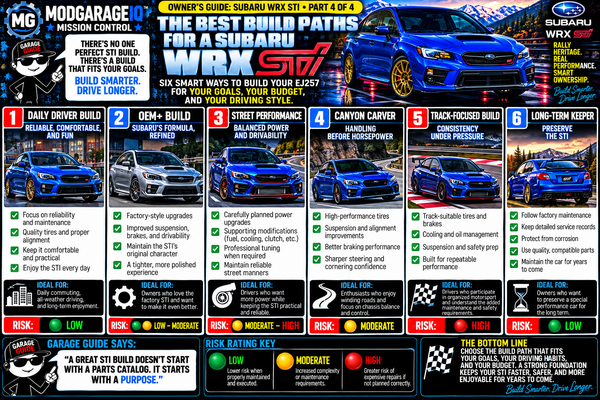
Best Build Paths for the Subaru WRX STI
Daily driver, OEM+, street performance, canyon carver, track-focused build, or long-term keeper—which STI build actually makes sense for your goals?
#ModGarageIQ #GarageGuide #SubaruWRXSTI #WRXSTI #SubaruSTI #EJ257 #Turbocharged #BoxerEngine #SubaruPerformance #AWD #STIMaintenance #JDM #PerformanceCars #AutomotiveEducation #OwnersGuide #BuildSmarterDriveLonger