The First $500 I’d Spend on a Subaru WRX STI
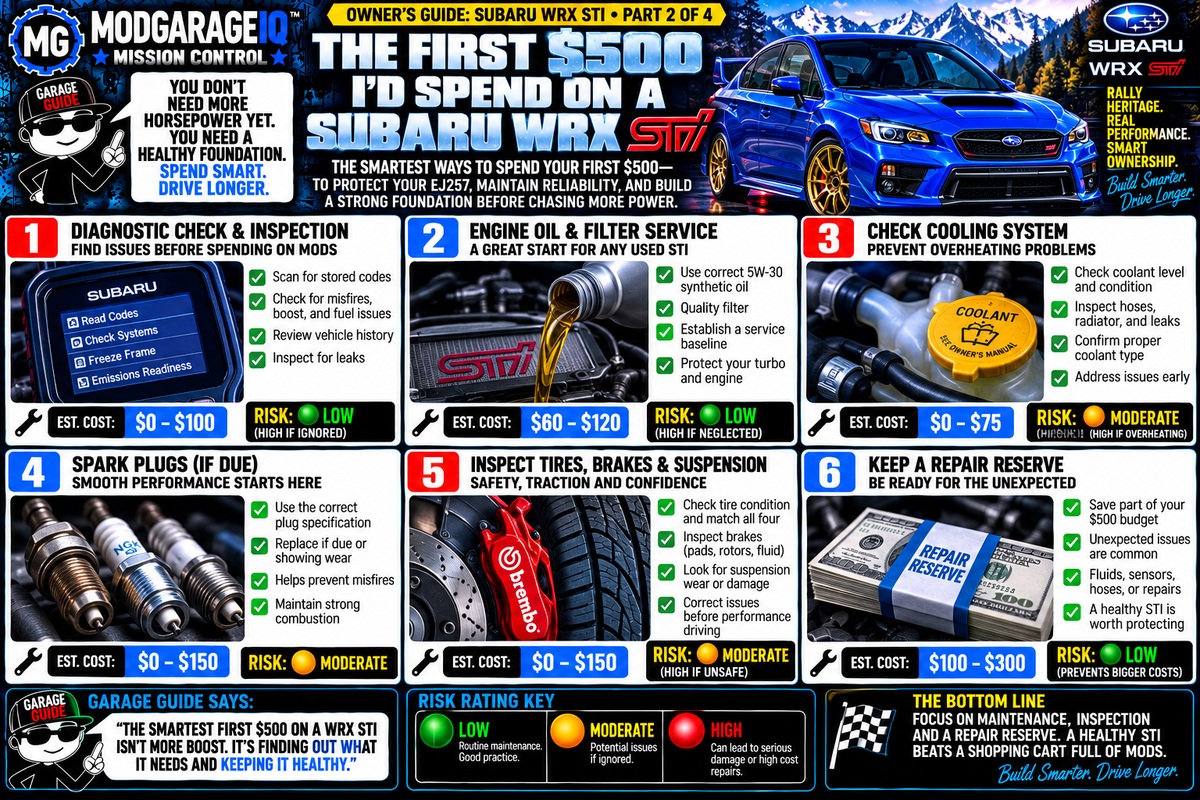
Before You Buy an Intake, Boost Controller, Blow-Off Valve, or Bigger Turbo—Here’s How I’d Prioritize $500 Toward EJ257 Engine Health, Maintenance, Diagnostics, and Long-Term Reliability.
MODGARAGEIQ OWNER’S GUIDE • SUBARU WRX STI • PART 2 OF 4 • OCTOBER 27, 2026
You just bought a Subaru WRX STI.
Congratulations!
You’ve got a turbocharged boxer engine, a six-speed manual transmission, a sophisticated all-wheel-drive system, and one of the most recognizable performance sedans of its generation.
Naturally, you’ve started researching modifications.
Cold-air intakes.
Cat-back exhaust systems.
Intercoolers.
Turbochargers.
Suspension upgrades.
Wheels.
Tuning.
And somewhere, somebody is telling you that your STI needs another 100 horsepower immediately.
Garage Guide has a question.
Does your STI actually need more horsepower right now?
Or does it need an oil change?
Maybe the tires are mismatched.
Maybe the previous owner installed an intake without the appropriate calibration.
Maybe the coolant is overdue for service.
Maybe there’s a small oil leak.
Or maybe the vehicle is already in excellent condition and you don’t need to spend the entire $500.
That’s the point of today’s guide.
We’re not trying to spend $500 just because we have $500. We’re trying to make the smartest decisions possible with a limited budget.
Our primary focus is the 2015–2021 U.S.-market Subaru WRX STI equipped with the turbocharged 2.5L EJ257 engine.
Earlier EJ-powered STI models share some of these concerns, but parts, specifications, and service procedures can differ.
And remember: the standard 2015–2021 WRX uses a different engine.
Don’t blindly apply STI-specific recommendations to a regular WRX.
Let’s get into it.
1. Start With a Diagnostic Baseline — $0–$100
Before buying replacement parts, determine what the vehicle actually needs.
A basic diagnostic scan can identify stored information that deserves investigation.
Depending on the scan tool and vehicle systems, you may be able to review:
- Engine diagnostic trouble codes.
- Pending faults.
- Misfire-related information.
- Fuel-system concerns.
- Boost-control faults.
- Emissions readiness monitors.
- Available freeze-frame data.
- ABS or stability-control faults with compatible equipment.
Some basic code scans are available at no charge through participating parts retailers.
However, those scans generally do not replace comprehensive diagnostics.
A professional inspection or diagnostic session may cost considerably more than $100, depending on location and the work required.
My recommendation:
If the car runs normally and has credible maintenance records, begin with a basic scan and inspection.
If the car has abnormal noises, misfires, warning lights, overheating, or unexplained modifications, prioritize professional diagnosis—even if that consumes most or all of the budget.
Don’t buy performance parts while ignoring possible mechanical faults.
Estimated allocation: $0–$100
Garage Guide Risk Rating: 🟢 LOW for routine baseline checks; 🔴 HIGH if serious symptoms are ignored.
Garage Guide Says:
“A scan tool doesn’t make horsepower, but it might save you from buying horsepower your engine can’t safely handle.”
2. Verify the ECU Calibration — $0–$150+
This is one of the most important STI-specific priorities.
The EJ257 relies on engine management to coordinate fueling, ignition timing, boost-related control, and other operating parameters.
Aftermarket modifications can change the conditions the factory calibration was designed to manage.
Particularly important modifications include:
- Aftermarket intake systems.
- Turbocharger changes.
- Boost-control modifications.
- Fuel-system upgrades.
- Certain exhaust changes.
- Other hardware that alters airflow or engine operating conditions.
A vehicle can appear mechanically stock while still having an altered calibration.
Likewise, a car may have aftermarket hardware installed while running an inappropriate calibration.
Both situations deserve investigation.
If the seller provided tuning documentation, preserve it.
If the vehicle has an aftermarket engine-management device, identify exactly what it is and what calibration is installed.
Do not assume that a handheld device’s presence proves the vehicle has been tuned correctly.
And do not assume that removing a device automatically restores every component to factory configuration.
My recommendation:
Use existing records and an informed inspection first.
If the vehicle’s calibration cannot be verified, a qualified Subaru performance specialist may need to investigate.
Professional calibration work can exceed this entire $500 budget.
Estimated allocation: $0–$150+ for preliminary verification; comprehensive tuning may cost substantially more.
Garage Guide Risk Rating: 🔴 HIGH
Garage Guide Says:
“An intake without the right calibration can become the most expensive ‘cheap upgrade’ you ever buy.”
3. Inspect the Engine Oil Before Spending Anything — $0
Here’s an upgrade that costs absolutely nothing.
Open the hood.
Follow the manufacturer’s oil-checking procedure.
Check the dipstick.
That’s it.
Well, almost.
Pay attention to:
- Oil level.
- Visible contamination.
- Evidence of leakage.
- Maintenance records.
- Unusual oil consumption.
- Abnormal engine noises.
- Oil-pressure warnings.
The EJ257 is a turbocharged performance engine.
Adequate lubrication matters.
An insufficient oil supply can contribute to serious engine and turbocharger damage.
Important: A normal oil level doesn’t prove the engine is mechanically healthy, and oil appearance alone cannot reliably establish oil condition.
But checking the level is still one of the easiest ways to identify a potentially serious problem.
If the engine has an oil-pressure warning, stop safely and follow the owner’s manual rather than continuing to drive.
Estimated allocation: $0
Garage Guide Risk Rating: 🔴 HIGH if lubrication concerns are ignored.
Garage Guide Says:
“The cheapest STI maintenance tool is still the dipstick. Use it before the engine gives you a reason to regret it.” 😂
4. Prioritize an Engine-Oil and Filter Service — $60–$120
If the service history is uncertain, an oil change is one of my first paid maintenance priorities.
For the 2015–2021 U.S.-market STI, Subaru generally specifies SAE 5W-30 synthetic oil meeting the applicable model-year requirements for normal operation.
Always verify the exact specification and service procedure in the owner’s manual.
Use:
- Correct oil viscosity and specification.
- Appropriate oil quantity.
- A compatible, quality oil filter.
- A suitable drain-plug sealing washer where required.
- Correct installation procedures.
Avoid assuming that a thicker oil automatically provides better protection.
Oil selection can depend on manufacturer guidance, operating conditions, and any legitimate engine modifications.
If the engine has been modified internally, its builder may have additional requirements.
My recommendation:
If the oil-change history is documented and the oil isn’t due for replacement, don’t change it unnecessarily just to spend money.
If the history is unknown, prioritize the service.
Estimated allocation: $60–$120
Garage Guide Risk Rating: 🟢 LOW when performed correctly; 🔴 HIGH when oil-related problems are ignored.
Garage Guide Says:
“Before buying an expensive turbo upgrade, make sure the turbo you’ve already got is receiving the lubrication it needs.”
5. Check the Air Filter and Intake System — $0–$50
A dirty or damaged air filter can restrict airflow or allow contamination if the filtration system is compromised.
Inspect:
- Filter condition.
- Airbox sealing.
- Intake clamps.
- Intake plumbing.
- Cracked hoses.
- Loose connections.
- Evidence of aftermarket modifications.
Replace the filter if necessary.
But here’s the STI-specific warning.
Do not assume an aftermarket intake is a harmless bolt-on modification.
Some aftermarket intake systems change airflow measurement characteristics.
Depending on the design and calibration, they can affect fueling and engine operation.
An intake that requires calibration should not be installed without it.
If the vehicle already has an aftermarket intake, identify its manufacturer, configuration, and tuning requirements.
My recommendation:
Keep a healthy factory intake system unless you have a clear reason to change it.
Estimated allocation: $0–$50
Garage Guide Risk Rating: 🟡 MODERATE, rising to 🔴 HIGH for incompatible modifications.
Garage Guide Says:
“A shiny intake pipe isn’t worth much if it makes your ECU misunderstand how much air the engine is breathing.”
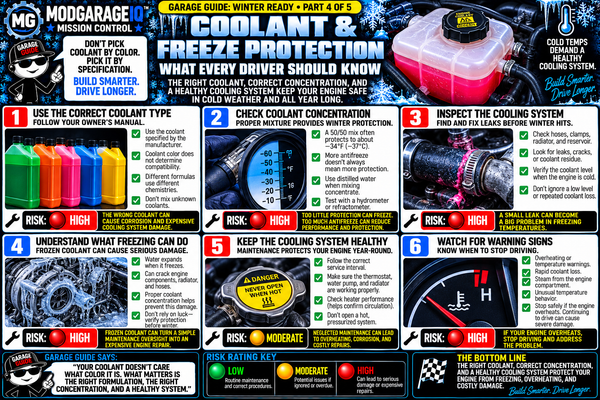
6. Inspect the Cooling System — $0–$75
Cooling-system problems deserve attention before performance upgrades.
Inspect the system when the engine is cold.
Look for:
- Correct coolant level.
- Visible leaks.
- Damaged hoses.
- Radiator deterioration.
- Loose connections.
- Coolant residue.
- Abnormal operating temperatures.
- Evidence of previous overheating.
Use the coolant specified for your model year.
Do not select coolant solely by color.
And never open a hot, pressurized cooling system.
My recommendation:
If the coolant is correct, the level is stable, and the system is functioning properly, leave it alone.
If a leak or overheating concern is present, diagnose it.
A proper repair may exceed the $500 budget, but that doesn’t make it optional.
Estimated allocation: $0–$75 for basic inspection and minor appropriate service.
Garage Guide Risk Rating: 🔴 HIGH when overheating or coolant loss is present.
Garage Guide Says:
“A bigger intercooler won’t fix a cooling system that’s already struggling to keep the engine alive.”
7. Check the Spark-Plug Service History — $0–$150+
Spark plugs play an important role in combustion quality.
On a turbocharged engine, incorrect or worn plugs can contribute to misfires and poor operation.
Review:
- Maintenance records.
- Manufacturer replacement intervals.
- Correct plug specification.
- Previous engine modifications.
- Misfire symptoms.
- Ignition-system condition.
For the 2015–2021 STI, follow the maintenance schedule applicable to the specific model year and operating conditions.
Don’t automatically install a colder spark plug because someone online recommends it.
Modified engines may require different ignition-system considerations, but those decisions should be based on the actual setup and qualified guidance.
My recommendation:
If plugs are due, budget for the correct service.
If they’re not due and the engine operates normally, don’t replace them just to use up your $500.
Labor costs can make professional replacement substantially more expensive than the plugs themselves.
Estimated allocation: $0–$150+
Garage Guide Risk Rating: 🟡 MODERATE
Garage Guide Says:
“The right spark plug for your engine beats the fanciest spark plug in the catalog.”
8. Inspect the Turbocharger Plumbing — $0–$60
Before replacing the turbocharger, inspect the components supporting it.
Check accessible:
- Intake connections.
- Charge-air hoses.
- Intercooler connections.
- Vacuum and pressure lines.
- Hose clamps.
- Oil-line connections.
- Evidence of air leaks.
- Evidence of abnormal oil leakage.
Loose or damaged connections can cause drivability and boost-control problems.
But don’t assume every boost-related symptom is a loose hose.
Turbocharger systems require proper diagnosis.
My recommendation:
Start with a visual inspection.
Replace damaged components when identified.
If the car has unexplained boost behavior, have the system evaluated appropriately rather than increasing boost pressure to compensate.
Estimated allocation: $0–$60 for basic inspection and minor replacement items.
Garage Guide Risk Rating: 🟡 MODERATE, rising to 🔴 HIGH for serious faults.
Garage Guide Says:
“Sometimes the smartest turbo upgrade is tightening the connection that’s supposed to be there.”
9. Inspect the Clutch Before Buying Power Parts — $0–$100+
The STI’s six-speed manual transmission is a major part of the driving experience.
But the clutch deserves attention, especially on a used performance car.
Look for:
- Slipping.
- Chatter.
- Abnormal engagement.
- Hydraulic-system leaks.
- Pedal abnormalities.
- Unusual noises.
- Evidence of previous clutch modifications.
An aggressive aftermarket clutch isn’t necessarily an improvement for a daily-driven STI.
Some performance clutches sacrifice smooth engagement and comfort.
And a worn clutch can become a bigger problem when engine torque increases.
My recommendation:
Inspect before modifying.
If the clutch is healthy, keep it.
If it’s failing, prioritize repair over horsepower.
A clutch replacement will generally cost far more than this article’s $500 budget.
Estimated allocation: $0–$100+ for preliminary inspection.
Garage Guide Risk Rating: 🟡 MODERATE, rising with severity.
Garage Guide Says:
“If the clutch can’t handle the power you’ve already got, more power isn’t the solution.”
10. Verify the Transmission and Differential Service History — $0–$200+
The STI’s drivetrain deserves careful maintenance.
Review service records for:
- Manual transmission lubricant.
- Front differential requirements.
- Rear differential lubricant.
- Fluid leaks.
- Unusual noises.
- Shift quality.
- Previous drivetrain repairs.
Important STI detail: On the VA-generation STI, the manual transmission and front differential share a lubricant supply; they should not be treated as two unrelated fluid reservoirs.
The rear differential has its own service requirements.
Use the correct manufacturer-specified lubricants and procedures.
Avoid selecting fluid based solely on online anecdotes.
My recommendation:
If the service history is unknown and the vehicle is due for service, prioritize the applicable drivetrain fluids.
However, a complete professional drivetrain service may exceed the remaining budget.
Estimated allocation: $0–$200+ depending on the services required.
Garage Guide Risk Rating: 🟡 MODERATE, rising to 🔴 HIGH for significant faults.
Garage Guide Says:
“Your STI has more drivetrain hardware than a typical front-wheel-drive commuter. Maintain it like you understand that.”
11. Inspect All Four Tires — $0
This is one of the most important free checks.
Your STI’s AWD system depends on four tires operating together.
Inspect:
- Tire size.
- Brand and model.
- Tread depth.
- Wear patterns.
- Inflation pressure.
- Sidewall condition.
- Tire age.
- Wheel damage.
Follow Subaru’s requirements for matching tires and acceptable wear differences.
Significant rolling-circumference differences can stress AWD drivetrain components.
And don’t assume AWD compensates for poor tire traction.
My recommendation:
If all four tires are appropriate and healthy, don’t spend anything.
If they’re mismatched, damaged, or unsafe, addressing them becomes a priority—even if replacement exceeds $500.
Estimated allocation: $0 for inspection.
Garage Guide Risk Rating: 🔴 HIGH for unsafe or significantly mismatched tires.
Garage Guide Says:
“AWD doesn’t mean four random tires get to become a team.” 😂
12. Check the Brakes Before Increasing Performance — $0–$100+
The STI has serious performance potential.
That means braking-system condition matters.
Inspect:
- Pad thickness.
- Rotor condition.
- Caliper operation.
- Brake hoses.
- Brake-fluid condition.
- Leaks.
- Abnormal vibration.
- Unusual braking noises.
Different STI model years have different factory brake configurations.
For example, the 2018–2021 VA-generation STI received updated Brembo brake equipment compared with earlier VA models.
Verify the correct components before ordering parts.
My recommendation:
If the brakes are healthy, leave them alone.
If they’re worn or malfunctioning, address the problem before performance driving.
A complete brake repair may exceed the budget.
Estimated allocation: $0–$100+ for inspection and limited service.
Garage Guide Risk Rating: 🔴 HIGH for safety-critical defects.
Garage Guide Says:
“Horsepower is fun. Being able to stop the car afterward is considerably more important.”
13. Inspect the Suspension and Alignment — $0–$150+
Used STIs may have experienced aggressive driving, lowered suspension setups, or aftermarket component installations.
Inspect:
- Control arms.
- Bushings.
- Ball joints.
- Tie rods.
- Dampers.
- Springs.
- Wheel bearings.
- Tire wear.
- Ride height.
- Alignment condition.
If the vehicle pulls, tracks poorly, or wears tires unevenly, investigate the cause.
Don’t pay for an alignment before addressing worn or damaged suspension components.
And don’t assume that lowering the car automatically improves handling.
My recommendation:
Inspect first.
If the suspension is mechanically sound but alignment is incorrect, a proper alignment may be worthwhile.
Estimated allocation: $0–$150+
Garage Guide Risk Rating: 🟡 MODERATE, rising to 🔴 HIGH for unsafe components.
Garage Guide Says:
“A lowered STI that handles worse isn’t a performance build. It’s a geometry lesson.” 😂
14. Check for Outstanding Safety Recalls — $0
This one is easy.
Check the VIN for outstanding safety recalls.
For U.S. vehicles, use the official NHTSA recall lookup.
You can also contact an authorized Subaru dealer.
Safety recall repairs are generally performed without charge under the recall program.
Verify applicability by VIN.
My recommendation:
Do this before spending money on modifications.
A safety recall is not something to postpone because you found a good deal on an exhaust system.
Estimated allocation: $0 for eligible recall repairs.
Garage Guide Risk Rating: 🔴 HIGH for unresolved safety defects.
Garage Guide Says:
“Free safety repairs before expensive performance upgrades. Garage Guide approves this financial strategy.”
15. Save Money for Problems You Haven’t Found Yet — $100–$300+
This might be the most important recommendation in the entire article.
Keep a repair reserve.
You just purchased a used turbocharged performance car.
Even if it looks excellent, you may discover maintenance needs after spending more time with it.
Possible expenses include:
- Fluid services.
- Sensors.
- Hoses.
- Ignition components.
- Cooling-system repairs.
- Tire replacement.
- Brake service.
- Professional diagnostics.
- Previous-modification corrections.
A $500 budget can disappear quickly.
And major engine, clutch, or drivetrain repairs can cost many times that amount.
My recommendation:
Don’t spend money simply because the budget exists.
If the STI checks out, keep the remaining cash.
Estimated allocation: $100–$300+ held in reserve.
Garage Guide Risk Rating: 🟢 LOW
Garage Guide Says:
“The best $200 you spend on your STI might be the $200 you don’t spend today.”
My Actual First $500 STI Budget
Let’s assume the following:
You purchased a 2015–2021 Subaru WRX STI.
The vehicle starts and drives normally.
There are no obvious warning signs requiring immediate major repairs.
The maintenance history is incomplete.
The tires and brakes pass inspection.
And there is no known urgent safety issue.
Under those assumptions, here’s how I’d allocate the first $500.
1. Basic Diagnostic Scan and Initial Inspection — $75
Check available diagnostic information.
Document any stored faults.
Inspect for obvious leaks and abnormal conditions.
Running total: $75
2. Engine Oil and Filter Service — $90
Use the correct oil and filter.
Establish a documented service baseline.
Running total: $165
3. Air Filter, If Needed — $35
Inspect the factory intake system.
Replace the filter only if necessary.
Running total: $200
4. Cooling-System and Turbo-Plumbing Inspection — $50
Inspect accessible hoses, connections, and visible components.
This assumes limited inspection work, not a comprehensive professional diagnosis.
Running total: $250
5. Repair and Maintenance Reserve — $250
Keep the remaining money available.
Use it only when a genuine maintenance or repair need is identified.
Total budget: $500
Immediate planned spending: $250
Money preserved: $250
And if the air filter is already healthy?
Don’t replace it.
If the oil service was recently completed and documented?
Don’t automatically repeat it.
If the STI needs a $500 professional diagnostic session?
That may be the best possible use of the entire budget.
The budget follows the vehicle’s needs—not the other way around.
All prices are illustrative U.S. estimates, not quotes. Actual parts, labor, taxes, and regional costs vary. Multiple inspections may overlap in a real shop visit.
Five Things I Would NOT Buy With My First $500
Let’s talk about the temptation.
1. An Intake That Requires a Tune
An aftermarket intake may look appealing.
But if the system requires a compatible calibration, the true cost isn’t just the intake.
It’s the hardware, calibration, installation, and any necessary supporting work.
Garage Guide Risk Rating: 🔴 HIGH when calibration requirements are ignored.
2. A Manual Boost Controller
Increasing boost without properly accounting for engine management, fuel delivery, and operating limits can introduce serious risks.
Garage Guide Risk Rating: 🔴 HIGH
3. An Atmospheric Blow-Off Valve Just for the Sound
On a mass-airflow-based system, venting air that has already been measured can affect fueling and drivability.
Compatibility and calibration matter.
Garage Guide Risk Rating: 🟡 MODERATE to 🔴 HIGH
4. Cheap Coilovers
Low price doesn’t guarantee appropriate damping, spring rates, durability, or fitment.
Poorly selected suspension components can make the STI less predictable.
Garage Guide Risk Rating: 🟡 MODERATE, potentially 🔴 HIGH if unsafe.
5. A Random Performance Tune
A calibration should be matched to the actual hardware, fuel, engine condition, and intended use.
Downloading an unknown calibration is not a substitute for qualified tuning.
Garage Guide Risk Rating: 🔴 HIGH
What If My STI Already Has Perfect Maintenance Records?
Great!
That’s the best-case scenario.
If the vehicle has:
- Documented recent oil service.
- Correct and healthy fluids.
- Matching tires in good condition.
- Healthy brakes.
- No concerning diagnostic information.
- No unresolved recalls.
- Verified calibration.
- No significant mechanical symptoms.
Then you may not need to spend much at all.
Instead, I’d establish a maintenance schedule, preserve a repair reserve, and begin planning modifications around the vehicle’s actual purpose.
A daily-driven STI and a dedicated track STI have different priorities.
And a well-maintained factory STI is already a capable performance vehicle.
You do not need to modify it immediately to enjoy it.
Garage Guide Risk Rating Summary
🟢 LOW RISK
Checking oil, reviewing service records, performing routine maintenance correctly, checking recalls, documenting the vehicle’s condition, and preserving a repair reserve.
🟡 MODERATE RISK
Unknown maintenance history, overdue noncritical services, minor leaks, worn suspension components, and modifications requiring further verification.
🔴 HIGH RISK
Ignoring oil-pressure warnings, overheating, significant misfires, unsafe brakes or tires, inappropriate ECU calibration, serious drivetrain problems, or increasing boost before confirming engine health.
Remember: The risk rating depends on the condition and circumstances. A diagnostic scan is low risk; ignoring a serious problem revealed by that scan is not.
The Bottom Line
The Subaru WRX STI is a fantastic performance platform.
But the first $500 you spend should be guided by the car’s actual condition.
Not by social media.
Not by a parts catalog.
And definitely not by someone claiming you need a bigger turbo before you’ve checked the oil.
Start with diagnostics.
Verify the calibration.
Establish maintenance history.
Inspect the turbocharger system.
Check the cooling system.
Evaluate the clutch and drivetrain.
Inspect all four tires.
Make sure the brakes are healthy.
And preserve money for repairs you haven’t discovered yet.
Because a healthy STI doesn’t need to prove itself with a shopping cart full of modifications.
It needs an owner who understands what makes it work.
Garage Guide Says:
“If I had $500 and a newly purchased Subaru WRX STI, I wouldn’t start by buying horsepower. I’d start by finding out exactly what kind of STI I bought, making sure the EJ257 is healthy, and keeping enough money in my pocket to handle whatever the previous owner forgot to mention.”
Build Smarter. Drive Longer.
🏁 COMING WEDNESDAY, OCTOBER 28
The Biggest Mistakes Subaru WRX STI Owners Make
From chasing boost on an unknown engine to ignoring oil consumption, mismatched tires, questionable tuning, and drivetrain abuse—we’re breaking down the mistakes that can turn a dream STI into an expensive nightmare.
#ModGarageIQ #GarageGuide #SubaruWRXSTI #WRXSTI #SubaruSTI #EJ257 #Turbocharged #BoxerEngine #SubaruPerformance #AWD #DCCD #STIMaintenance #JDM #PerformanceCars #CarMaintenance #AutomotiveEducation #OwnersGuide #BuildSmarterDriveLonger