I Just Bought a Subaru WRX STI… Now What?
Before You Turn Up the Boost, Install an Intake, Order a Downpipe, or Chase 400 Horsepower—Understand Your EJ257, Investigate Its History, and Make Sure Your STI Is Healthy Enough to Build.
MODGARAGEIQ OWNER’S GUIDE • SUBARU WRX STI • PART 1 OF 4 • OCTOBER 26, 2026
There’s something special about buying a Subaru WRX STI.
Maybe it’s the unmistakable boxer-engine sound.
Maybe it’s the giant rear wing.
Maybe it’s the six-speed manual transmission.
Maybe it’s the rally-inspired all-wheel-drive system.
Or maybe it’s the fact that you’ve wanted one ever since you were a kid watching blue Subarus throw gravel around corners.
Whatever brought you here, congratulations.
You bought one of the most recognizable Japanese performance cars of its era.
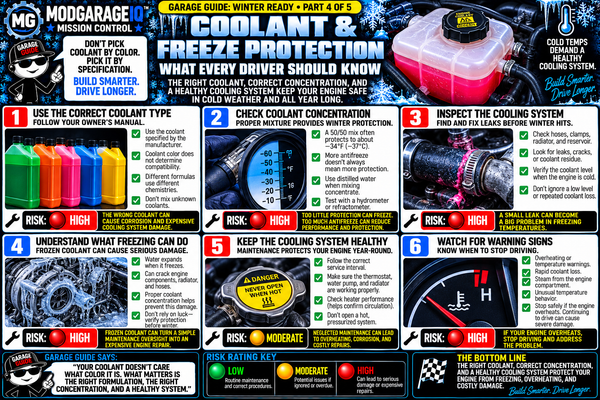
But Garage Guide has something important to tell you.
The Subaru WRX STI rewards knowledgeable ownership—and can punish careless modifications.
The EJ257 is a turbocharged performance engine with specific lubrication, cooling, fueling, and calibration requirements.
The six-speed manual transmission is a serious piece of performance hardware.
The all-wheel-drive system is sophisticated.
And the previous owner?
Well…
Let’s just say Garage Guide would like to know how many times they said, “Watch this!” before launching the car. 😂
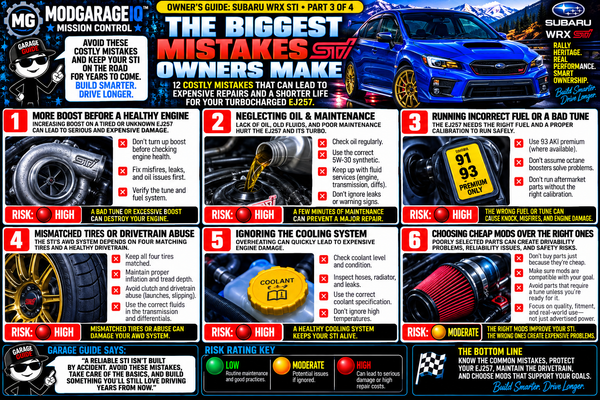
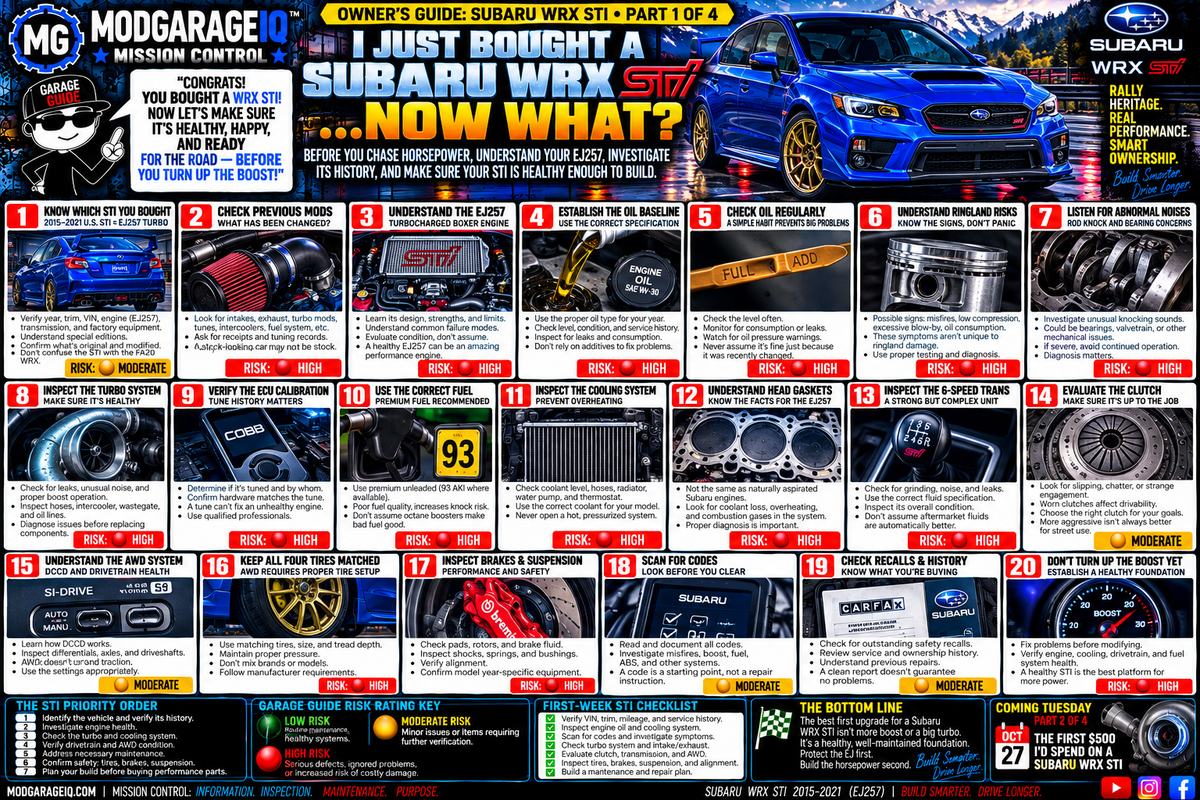
Today, we’re covering 20 things every new WRX STI owner should understand before modifying anything.
Our primary focus is the U.S.-market 2015–2021 WRX STI. Earlier STI generations share important EJ-series characteristics but differ in equipment, calibration, service requirements, and mechanical details.
The mission: Establish a healthy baseline before increasing performance.
1. Identify Exactly Which STI You Bought
Before ordering parts, establish the vehicle’s identity.
The 2015–2021 U.S.-market WRX STI uses the turbocharged 2.5L EJ257 flat-four engine.
That is an important distinction from the standard 2015–2021 WRX, which uses the FA20DIT engine.
Although both vehicles carry WRX branding, their engines and many associated systems differ.
Document:
- Model year and trim.
- VIN.
- Engine configuration.
- Transmission.
- Mileage.
- Factory performance equipment.
- Service history.
- Previous modifications.
- ECU calibration history, where available.
- Wheel and tire specifications.
Certain special editions have unique factory equipment.
Do not assume every STI uses identical suspension, brakes, wheels, or calibration.
Garage Guide Risk Rating: 🟡 MODERATE
Garage Guide Says:
“Before you buy STI parts, make sure you know exactly which STI is sitting in your driveway.”
2. Investigate the Previous Owner’s Modifications
This is one of the most important steps in buying a used STI.
These cars have a large aftermarket.
That’s part of their appeal.
Unfortunately, it also means some vehicles have experienced modifications that were poorly selected, improperly installed, or inadequately calibrated.
Inspect for evidence of:
- Aftermarket intakes.
- Modified exhaust components.
- Turbocharger upgrades.
- Boost-control modifications.
- Intercooler changes.
- Fuel-system modifications.
- Engine-management devices.
- Nonfactory ECU calibrations.
- Altered emissions equipment.
- Aftermarket engine internals.
- Suspension modifications.
- Clutch upgrades.
A car that looks stock isn’t necessarily mechanically stock.
Some owners return vehicles to factory hardware before selling them.
That doesn’t automatically mean something is wrong, but it makes documentation especially valuable.
Ask for receipts, tuning records, and installation information.
Garage Guide Risk Rating: 🔴 HIGH
Garage Guide Says:
“The most dangerous modification might be the one the seller forgot to mention.” 😂
3. Understand the EJ257 Before Increasing Boost
The EJ257 is a turbocharged, horizontally opposed four-cylinder engine.
Its design gives the STI a distinctive character.
But understanding the engine matters more than memorizing horsepower figures.
Important considerations include:
- Engine-oil condition and supply.
- Cooling-system performance.
- Fuel quality.
- Combustion temperatures and knock control.
- Turbocharger operation.
- Calibration accuracy.
- Engine wear.
- Previous operating conditions.
The EJ257 has a reputation for certain failure modes, but not every engine experiences them.
The smarter approach: Evaluate the condition of your specific engine instead of assuming either that it’s fragile or that it’s indestructible.
Garage Guide Risk Rating: 🔴 HIGH
Garage Guide Says:
“The EJ257 isn’t asking you to be afraid of horsepower. It’s asking you to understand what makes horsepower safely.”
4. Establish the Correct Engine-Oil Baseline
Turbocharged engines place significant demands on lubrication.
Engine oil helps protect moving components and supports turbocharger operation.
Before aggressive driving, verify:
- Correct oil level.
- Required viscosity.
- Applicable oil specification.
- Service history.
- Oil-filter condition.
- Evidence of leaks.
- Unusual oil consumption.
- Abnormal oil-pressure behavior.
For the 2015–2021 U.S.-market STI, Subaru generally specifies SAE 5W-30 synthetic engine oil meeting the applicable manual requirements for normal operation.
Always confirm the exact requirements for your model year and operating conditions.
Don’t assume thicker oil automatically solves lubrication problems.
And don’t use oil additives as a substitute for diagnosing mechanical concerns.
Garage Guide Risk Rating: 🔴 HIGH
Garage Guide Says:
“Before asking your turbo to work harder, make sure the engine has the lubrication it needs to survive the conversation.”
5. Check the Oil Regularly
This deserves its own section.
A turbocharged performance engine should not be operated with an insufficient oil supply.
Check the level according to the manufacturer’s procedure.
Pay attention to:
- Oil consumption between services.
- Leaks.
- Changes in engine noise.
- Oil-pressure warnings.
- Oil contamination.
- Unexpected changes in oil level.
Some oil consumption can occur during engine operation, but excessive or changing consumption deserves investigation.
Never assume that because the oil was changed recently, the level must still be correct.
If an oil-pressure warning appears while driving, stop safely and shut down the engine as directed by the owner’s manual.
Continuing to operate an engine with inadequate oil pressure can cause severe damage.
Garage Guide Risk Rating: 🔴 HIGH
Garage Guide Says:
“The dipstick isn’t glamorous. Neither is replacing an engine because nobody checked it.”
6. Understand Ringland Concerns Without Panicking
Let’s address one of the EJ257’s most discussed issues.
Piston ringland damage.
A ringland is part of the piston structure that separates and supports the piston rings.
Damage can affect cylinder sealing and engine performance.
Potential contributing factors can include abnormal combustion, excessive cylinder pressure, unsuitable calibration, and other mechanical or operating conditions.
Possible symptoms include:
- Misfires.
- Excessive crankcase pressure.
- Increased oil consumption.
- Poor compression.
- Abnormal exhaust smoke.
- Reduced engine performance.
However, these symptoms are not unique to ringland damage.
A misfire does not automatically mean a broken piston.
And a healthy-running STI does not automatically need an engine rebuild.
The smarter approach: If symptoms justify it, use appropriate diagnostic testing, potentially including compression and leak-down tests, to investigate cylinder sealing.
Interpret results using proper procedures and supporting evidence.
Garage Guide Risk Rating: 🔴 HIGH
Garage Guide Says:
“Don’t diagnose a broken piston from a forum post. Diagnose the engine that’s actually in front of you.”
7. Listen for Rod-Knock and Bearing-Related Warning Signs
Abnormal internal engine noises deserve serious attention.
A deep knocking sound that changes with engine speed or load can indicate a significant mechanical concern.
But sound alone doesn’t establish a diagnosis.
Possible sources of abnormal engine noise include:
- Internal bearing problems.
- Valvetrain components.
- Exhaust leaks.
- Accessory-drive components.
- Other mechanical faults.
If severe internal damage is suspected, avoid continuing to run the engine.
A qualified technician may need to inspect the lubrication system, evaluate mechanical condition, and perform additional testing.
Garage Guide Risk Rating: 🔴 HIGH
Garage Guide Says:
“If your EJ starts making expensive noises, turning up the stereo is not a repair strategy.” 😂
8. Inspect the Turbocharger System
The turbocharger is a defining feature of the STI.
But boost pressure alone doesn’t tell you whether the system is healthy.
Inspect applicable components:
- Turbocharger oil lines.
- Intake plumbing.
- Intercooler connections.
- Charge-air hoses.
- Wastegate operation.
- Boost-control components.
- Vacuum and pressure lines.
- Exhaust connections.
- Evidence of abnormal oil leakage.
Pay attention to:
- Unexpected power loss.
- Unusual turbocharger noise.
- Smoke.
- Boost-control faults.
- Air leaks.
- Abnormal operating behavior.
Not every whistle means the turbo is failing.
And not every boost problem requires a new turbocharger.
The smarter approach: Diagnose the system before replacing components.
Garage Guide Risk Rating: 🔴 HIGH
Garage Guide Says:
“A turbo should make boost—not turn your engine bay into a guessing game.”
9. Verify the ECU Calibration
This is absolutely critical on a modified STI.
The engine-management system controls numerous operating parameters, including fueling, ignition timing, and boost-related behavior.
Changing airflow or boost-related hardware can alter the operating conditions the factory calibration was designed to manage.
Depending on the modification, proper calibration may be necessary.
But remember:
A tune cannot repair an unhealthy engine.
And a poorly developed calibration can introduce serious reliability problems.
Before considering performance tuning:
- Verify engine health.
- Identify installed hardware.
- Investigate previous calibration changes.
- Confirm fuel-system condition.
- Understand the vehicle’s operating requirements.
- Use qualified professionals.
- Maintain emissions and legal compliance.
Garage Guide Risk Rating: 🔴 HIGH
Garage Guide Says:
“The wrong tune can turn an exciting turbocharged engine into a very expensive collection of metal parts.”
10. Use the Correct Fuel
The EJ257 is designed for premium-fuel operation.
For the U.S.-market 2015–2021 WRX STI, premium unleaded gasoline with an octane rating of 93 AKI is recommended where available, with the owner’s manual describing applicable alternatives and precautions.
Verify your exact model-year guidance.
Fuel quality matters because the engine operates under substantial combustion pressures.
Using inappropriate fuel can increase the risk of knock-related problems, particularly under demanding conditions.
Also investigate:
- Poor-quality fuel.
- Contamination.
- Fuel-delivery faults.
- Unexpected knock-related behavior.
- Modifications requiring different fuel-system capabilities.
Do not assume adding an octane booster automatically makes an unsuitable fuel appropriate.
Garage Guide Risk Rating: 🔴 HIGH
Garage Guide Says:
“Premium fuel isn’t where you want to start negotiating with a turbocharged performance engine.”
11. Inspect the Cooling System
The EJ257 produces substantial heat under demanding operation.
A healthy cooling system is essential.
Inspect:
- Radiator condition.
- Coolant level.
- Coolant specification.
- Hoses.
- Water pump.
- Thermostat operation.
- Cooling fans.
- Visible leaks.
- Operating temperatures.
Use coolant compatible with the vehicle’s manufacturer requirements.
Do not assume coolant color alone identifies the correct formulation.
Never open a hot, pressurized cooling system.
And if the engine has a history of overheating, investigate it before modifying or driving aggressively.
Garage Guide Risk Rating: 🔴 HIGH
Garage Guide Says:
“Before chasing cooler intake temperatures, make sure the engine itself isn’t overheating.”
12. Understand Head-Gasket Concerns Correctly
Subaru engines are often associated with head-gasket discussions.
But it’s important not to lump every Subaru engine together.
The turbocharged EJ257 is not mechanically identical to the naturally aspirated Subaru engines commonly associated with certain historical head-gasket problems.
That doesn’t mean an EJ257 cannot experience head-gasket failure.
It means engine-specific diagnosis matters.
Potential warning signs include:
- Unexplained coolant loss.
- Repeated overheating.
- Abnormal cooling-system pressure.
- Combustion gases entering the cooling system.
- Persistent white exhaust vapor after warm-up under relevant conditions.
These symptoms can have multiple causes.
Proper diagnosis may involve cooling-system pressure testing and other appropriate procedures.
Garage Guide Risk Rating: 🔴 HIGH
Garage Guide Says:
“Not every Subaru has the same head-gasket story. Know your engine before believing the internet.”
13. Inspect the Six-Speed Manual Transmission
The STI’s six-speed manual transmission is one of its defining mechanical features.
But a strong transmission still requires appropriate care.
Check for:
- Difficulty selecting gears.
- Grinding.
- Unusual noises.
- Fluid leaks.
- Abnormal vibration.
- Shifter problems.
- Signs of previous drivetrain abuse.
Verify the correct transmission-fluid specification and service requirements for your model year.
Don’t assume every aftermarket fluid is appropriate simply because another owner recommends it.
Garage Guide Risk Rating: 🔴 HIGH for significant transmission faults.
Garage Guide Says:
“The STI six-speed is a serious piece of hardware. That doesn’t mean it enjoys being treated like a rental go-kart.”
14. Evaluate the Clutch Before Modifying the Engine
The clutch is responsible for transferring engine torque through the manual drivetrain.
A worn or poorly matched clutch can affect:
- Engagement.
- Drivability.
- Power delivery.
- Heat management.
- Transmission behavior.
Look for:
- Slipping under load.
- Chatter.
- Abnormal engagement.
- Unusual noises.
- Hydraulic-system problems.
- Evidence of improper installation.
An aggressive aftermarket clutch isn’t automatically better for street use.
Some performance clutches introduce additional noise, vibration, or harshness.
The smarter approach: Choose a clutch suited to the vehicle’s actual torque requirements and intended use.
Garage Guide Risk Rating: 🟡 MODERATE, rising to 🔴 HIGH when serious defects are ignored.
Garage Guide Says:
“A clutch that feels like an industrial light switch isn’t automatically a performance upgrade.” 😂
15. Understand the STI’s AWD System
Here’s where the STI becomes especially interesting.
Its all-wheel-drive system includes mechanical and electronic components that work together to distribute torque and manage traction.
The 2015–2021 STI features a driver-controlled center differential system, commonly known as DCCD.
Depending on model year, the system provides automatic and driver-selectable operating modes.
But here’s what owners need to understand.
DCCD is not a magic traction button.
It doesn’t create tire grip.
It doesn’t eliminate drivetrain limitations.
And it doesn’t mean every setting is appropriate for every surface.
Use the operating guidance for your specific model year.
Also inspect:
- Differential condition.
- Fluid service history.
- Axles.
- CV joints.
- Driveshaft components.
- Abnormal drivetrain noises.
Garage Guide Risk Rating: 🟡 MODERATE
Garage Guide Says:
“AWD helps manage available traction. It doesn’t manufacture traction out of thin air.”
16. Keep All Four Tires Properly Matched
This is especially important on an AWD vehicle.
Significant differences in tire rolling circumference can create unwanted drivetrain stress.
Follow Subaru’s requirements for:
- Tire size.
- Tire construction.
- Tire type.
- Tread wear.
- Inflation pressure.
- Wheel fitment.
Avoid casually mixing tire brands, models, sizes, or significantly different tread depths.
If one tire is damaged, determine the appropriate replacement strategy using the manufacturer’s specifications and a qualified tire professional.
Garage Guide Risk Rating: 🔴 HIGH
Garage Guide Says:
“Four matching tires aren’t just about appearance. Your AWD system has a mechanical interest in that decision.”
17. Inspect the Brakes and Suspension
The STI is designed around more than straight-line acceleration.
Its braking, steering, and suspension systems are important parts of the driving experience.
Inspect:
- Brake pads.
- Rotors.
- Calipers.
- Brake fluid.
- Control arms.
- Bushings.
- Ball joints.
- Tie rods.
- Dampers.
- Wheel bearings.
- Alignment.
Some STI model years have different factory brake configurations.
For example, the 2018–2021 U.S.-market STI received updated Brembo brake hardware compared with the preceding VA-model years.
Verify the actual equipment before ordering replacement parts.
If the car has been lowered, inspect the quality and compatibility of the suspension modifications.
Garage Guide Risk Rating: 🔴 HIGH for safety-critical defects.
Garage Guide Says:
“Rally heritage doesn’t excuse worn brakes and questionable suspension parts.”
18. Scan the Vehicle Before Clearing Codes
A diagnostic scan is one of the smartest early ownership steps.
Depending on the equipment, investigate:
- Engine faults.
- Misfire-related codes.
- Fuel-system concerns.
- Boost-control faults.
- Transmission-related information.
- ABS and stability-control faults.
- Body and electrical systems.
Document diagnostic trouble codes before clearing them.
A code is a starting point for investigation, not an automatic instruction to replace a component.
And a vehicle with no active check-engine light can still have stored information worth reviewing.
Garage Guide Risk Rating: 🟡 MODERATE
Garage Guide Says:
“The scan tool tells you where to start looking. It doesn’t replace knowing what you’re looking at.”
19. Check Recalls, Service History, and Previous Repairs
Before spending money on modifications, investigate the vehicle’s documented history.
Review:
- Safety recalls.
- Maintenance records.
- Collision history.
- Previous engine repairs.
- Transmission and clutch work.
- Turbocharger replacements.
- ECU modifications.
- Previous ownership.
- Title status.
For U.S. vehicles, use the VIN to check outstanding safety recalls through the official NHTSA recall lookup.
Remember that a clean vehicle-history report doesn’t guarantee the car has never been damaged.
And a rebuilt engine isn’t automatically a problem—but you should understand what was replaced, why the work was performed, and who completed it.
Garage Guide Risk Rating: 🟡 MODERATE, rising to 🔴 HIGH for unresolved safety defects.
Garage Guide Says:
“A folder full of good maintenance records is worth more than a trunk full of mystery performance parts.”
20. Don’t Turn Up the Boost Yet
Garage Guide knows what you’re thinking.
You bought an STI.
You want to hear the turbo.
You want more power.
You want to know what the EJ257 can do.
And somewhere on the internet, somebody is explaining how their friend makes enormous horsepower on a supposedly stock engine.
😂
But here’s the truth.
Your first job is not to find the engine’s horsepower limit.
Your first job is to establish its health.
Before increasing performance, verify:
- Engine compression and sealing, if testing is indicated.
- Oil condition and consumption.
- Cooling-system health.
- Turbocharger condition.
- Fuel-system operation.
- Calibration history.
- Transmission and clutch health.
- AWD drivetrain condition.
- Tire and brake suitability.
- Supporting hardware.
A healthy STI can be an outstanding performance platform.
An unhealthy STI with more boost is simply an unhealthy STI operating under greater demands.
Garage Guide Risk Rating: 🔴 HIGH
Garage Guide Says:
“Before asking your STI for another 100 horsepower, make sure it’s happy delivering the horsepower Subaru already gave it.”
Garage Guide’s STI Priority Order
Before buying your first performance modification, follow this sequence.
PRIORITY 1 — IDENTIFY THE VEHICLE
Verify the year, engine, transmission, equipment, and modification history.
PRIORITY 2 — INVESTIGATE THE ENGINE
Check oil, abnormal noises, consumption, leaks, and other signs of mechanical problems.
PRIORITY 3 — VERIFY THE CALIBRATION
Determine whether the ECU and installed hardware are appropriately matched.
PRIORITY 4 — INSPECT THE TURBO AND COOLING SYSTEM
Evaluate boost-related components and cooling-system operation.
PRIORITY 5 — CHECK THE DRIVETRAIN
Inspect the clutch, transmission, differentials, axles, and AWD-related components.
PRIORITY 6 — VERIFY SAFETY
Inspect tires, brakes, steering, and suspension.
PRIORITY 7 — COMPLETE NECESSARY MAINTENANCE
Address overdue services and confirmed faults.
PRIORITY 8 — DEFINE YOUR BUILD
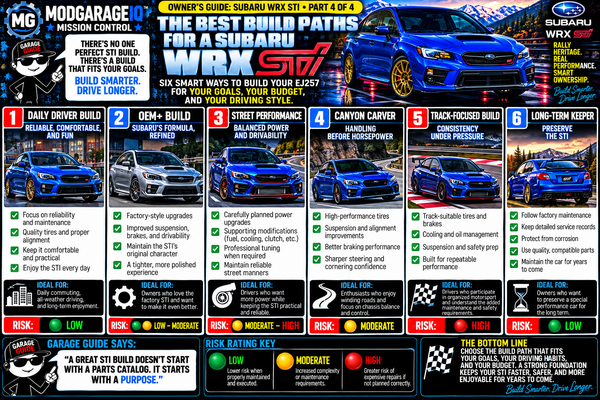
Daily driver? OEM+? Street performance? Handling? Track use? Long-term keeper?
Choose the mission before choosing the modifications.
Garage Guide’s First-Week STI Checklist
Here’s what I’d want every new owner to accomplish.
- DAY 1: Verify the VIN, trim, mileage, and maintenance history.
- DAY 2: Inspect engine oil, visible leaks, and cooling-system condition.
- DAY 3: Perform an appropriate diagnostic scan and investigate any abnormal symptoms.
- DAY 4: Inspect turbocharger plumbing and identify aftermarket modifications.
- DAY 5: Evaluate the clutch, transmission, differentials, and drivetrain.
- DAY 6: Inspect tires, brakes, suspension, and alignment condition.
- DAY 7: Build a maintenance and repair plan before purchasing performance upgrades.
This is a planning checklist, not a requirement to drive a potentially unsafe vehicle for seven days. Serious concerns should be addressed immediately.
Garage Guide Risk Rating Summary
🟢 LOW RISK
Documenting maintenance, inspecting the vehicle, using correct fluids, preserving factory systems, and planning compatible modifications.
🟡 MODERATE RISK
Unknown service history, minor leaks, worn clutch components, undocumented accessories, and modifications that require additional verification.
🔴 HIGH RISK
Serious lubrication problems, suspected internal engine damage, overheating, unsafe tires or brakes, inappropriate ECU calibration, significant drivetrain faults, and increasing boost before establishing engine health.
Important: Risk depends on the actual vehicle condition. A routine maintenance issue can become high risk when ignored, and a modified vehicle is not automatically unsafe simply because it has aftermarket components.
The Bottom Line
Buying a Subaru WRX STI should be exciting.
And it absolutely can be.
The EJ257 has a distinctive character.
The six-speed manual transmission makes the driving experience engaging.
The all-wheel-drive system is a defining part of the platform.
And the STI’s motorsport-inspired identity has made it a favorite among performance enthusiasts.
But smart ownership requires understanding the mechanical systems beneath the badge.
Know the engine.
Check the oil.
Investigate previous tuning.
Inspect the turbocharger.
Maintain the cooling system.
Understand the clutch and transmission.
Respect the AWD drivetrain.
Keep all four tires properly matched.
And don’t chase horsepower before establishing a healthy foundation.
Because the goal isn’t simply to own a fast STI.
It’s to own an STI you can confidently enjoy, maintain, and improve for years to come.
Garage Guide Says:
“The smartest first upgrade for a Subaru WRX STI isn’t more boost, a bigger turbo, or an aggressive tune. It’s turning an unknown performance car into a known, healthy foundation. Protect the EJ first. Build the horsepower second.”
Build Smarter. Drive Longer.
🏁 COMING TUESDAY, OCTOBER 27
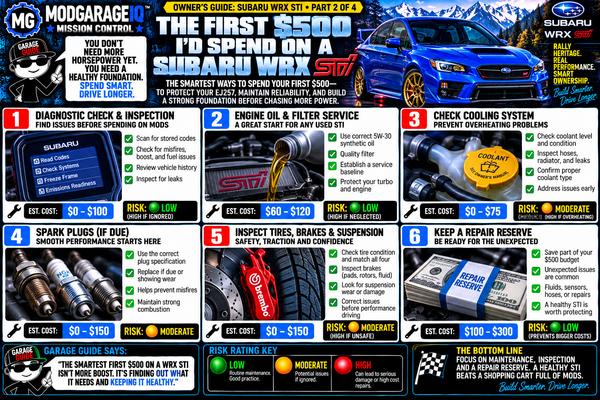
The First $500 I’d Spend on a Subaru WRX STI
Where I’d prioritize the first maintenance dollars on an EJ257-powered STI—and why I’d rather keep money in reserve than waste it on unnecessary modifications.
#ModGarageIQ #GarageGuide #SubaruWRXSTI #WRXSTI #SubaruSTI #EJ257 #Turbocharged #BoxerEngine #SubaruPerformance #AWD #DCCD #STIMaintenance #JDM #PerformanceCars #CarMaintenance #AutomotiveEducation #OwnersGuide #BuildSmarterDriveLonger