Coolant & Freeze Protection: What Every Driver Should Know
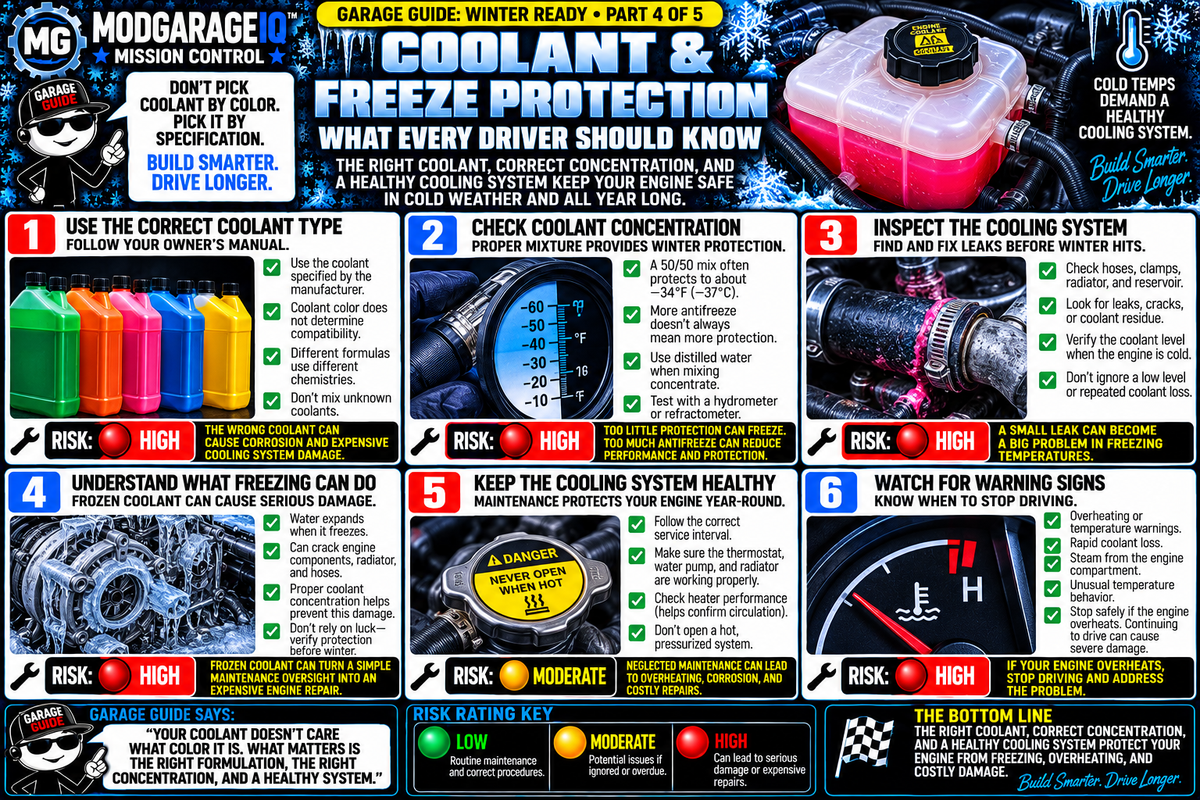
Antifreeze Isn’t Just About Freezing Temperatures—Learn How Coolant Chemistry, Proper Concentration, Corrosion Protection, and Cooling-System Maintenance Keep Your Engine Safe All Winter.
MODGARAGEIQ | GARAGE GUIDE: WINTER READY | PART 4 | OCTOBER 30, 2026
Winter is coming.
Temperatures are dropping.
And somewhere, somebody is looking at their coolant reservoir and thinking:
“It’s green. Looks good to me!”
Garage Guide would like a word. 😂
Your vehicle’s cooling system does much more than prevent overheating.
It also helps protect the engine against freezing, corrosion, and damage caused by extreme temperatures.
But here’s what many drivers misunderstand:
Having coolant in the reservoir doesn’t automatically mean your engine is protected.
The coolant could be the wrong formulation.
It could be improperly diluted.
It could be contaminated.
Or the cooling system could have a leak that becomes a serious problem when temperatures drop.
Today, we’re breaking down 10 things every driver should understand about coolant and winter protection.
No unnecessary technical jargon.
No guessing based on color.
Just practical information that can help protect your engine.
Let’s get into it!
1. Understand What Engine Coolant Actually Does
Engine coolant is designed to transfer heat while providing protection against freezing, boiling, and corrosion.
Most conventional automotive liquid-cooling systems use a mixture of water and antifreeze concentrate, or a manufacturer-approved premixed coolant.
The antifreeze component commonly contains ethylene glycol, although other formulations exist.
Proper coolant also contains additives designed to protect cooling-system materials.
These can include:
- Aluminum engine components.
- Radiators.
- Water pumps.
- Heater cores.
- Metal passages.
- Compatible seals and hoses.
Important: Antifreeze concentrate alone is not necessarily better than a properly diluted mixture.
Water contributes significantly to heat transfer, while the antifreeze and additive package provide additional protection.
Always follow the vehicle manufacturer’s coolant requirements.
Garage Guide Risk Rating: 🟢 LOW when the correct coolant is maintained.
Garage Guide Says:
“Coolant isn’t just colorful water. It’s part of your engine’s protection system.”
2. Don’t Choose Coolant Based on Color
This is one of the biggest coolant mistakes.
Drivers often associate certain colors with specific coolant technologies.
Green.
Orange.
Pink.
Blue.
Yellow.
But here’s the problem.
Coolant color is not a reliable universal identification system.
Different manufacturers may use similar colors for chemically different formulations.
And compatible coolants may appear in different colors.
Modern coolant technologies include various inorganic, organic, and hybrid corrosion-inhibitor formulations.
Their suitability depends on the vehicle’s specifications—not simply their appearance.
The smarter approach:
- Check the owner’s manual.
- Verify the manufacturer’s required coolant specification.
- Read the product’s actual compatibility information.
- Avoid mixing unknown coolant formulations.
- Consult a qualified professional when the existing coolant cannot be identified.
Mixing incompatible formulations may compromise corrosion protection or create other cooling-system problems.
Garage Guide Risk Rating: 🔴 HIGH when incompatible coolant is used.
Garage Guide Says:
“Choosing coolant by color is like choosing engine oil because the bottle matches your paint.” 😂
3. Understand the Importance of Coolant Concentration
Coolant concentration affects freeze protection.
For many vehicles using conventional ethylene-glycol coolant, a mixture containing approximately 50% antifreeze concentrate and 50% water provides freeze protection near −34°F (−37°C).
However, actual protection depends on the coolant formulation and concentration.
A 50/50 mixture is common—not a universal requirement.
Some vehicles use manufacturer-specific premixed coolant.
Others have different concentration requirements.
And certain applications may require specialized fluids.
Adding more antifreeze does not continuously improve protection.
Excessively high concentrations can reduce heat-transfer performance and may provide less freeze protection than an appropriate mixture.
The smarter approach:
Use the concentration specified by the vehicle manufacturer.
If purchasing premixed coolant, don’t dilute it unless the manufacturer explicitly instructs you to.
Garage Guide Risk Rating: 🔴 HIGH when concentration is substantially incorrect.
Garage Guide Says:
“More antifreeze doesn’t always mean more protection. Chemistry doesn’t care about your confidence.”
4. Test Freeze Protection Before Winter
You cannot reliably determine freeze protection by looking at the coolant.
A reservoir can appear full while containing an improperly diluted mixture.
Testing helps identify whether the coolant concentration is appropriate.
Common testing equipment includes:
- Coolant hydrometers.
- Coolant refractometers.
- Manufacturer-approved testing equipment.
A refractometer can estimate glycol concentration or freeze protection when it is properly calibrated and used with the correct coolant scale.
Different coolant formulations may require different measurement procedures.
Important: A freeze-point test does not prove that the coolant’s corrosion inhibitors are still effective.
It also doesn’t confirm that the coolant is chemically compatible with the engine.
The smarter approach:
Test concentration when the coolant history is uncertain, and evaluate service history and condition separately.
Garage Guide Risk Rating: 🟡 MODERATE
Garage Guide Says:
“A coolant reservoir can look ready for winter and still fail the chemistry test.”
5. Inspect the Cooling System for Leaks
Even properly formulated coolant cannot protect an engine if the system loses too much fluid.
Before winter, inspect the cooling system when the engine is cold.
Look for:
- Low coolant level.
- Wet hose connections.
- Coolant residue.
- Damaged hoses.
- Radiator leaks.
- Reservoir damage.
- Water-pump leakage.
- Repeated coolant loss.
A small leak during mild weather can become a serious inconvenience during freezing temperatures.
Low coolant can also affect heater performance and engine-temperature control.
Never remove a radiator or pressurized coolant cap while the system is hot.
Hot coolant and steam can cause severe burns.
The smarter approach:
If coolant keeps disappearing, find the cause.
Repeatedly topping off the reservoir isn’t a permanent repair.
Garage Guide Risk Rating: 🔴 HIGH
Garage Guide Says:
“If your coolant keeps disappearing, your engine isn’t thirsty. Something needs attention.” 😂
6. Understand What Happens When Coolant Freezes
Water expands as it freezes.
In an engine cooling system, freezing can create damaging pressure within confined passages and components.
Potential damage includes:
- Cracked engine components.
- Damaged radiators.
- Split hoses.
- Damaged cooling-system fittings.
- Other expensive mechanical failures.
The severity depends on the amount of freezing, system design, and operating conditions.
Proper coolant concentration lowers the freezing point and helps protect against this damage.
However, coolant protection isn’t an excuse to ignore leaks or system defects.
The smarter approach:
Verify coolant type, concentration, and system condition before sustained freezing temperatures arrive.
Garage Guide Risk Rating: 🔴 HIGH
Garage Guide Says:
“Frozen coolant can turn a simple maintenance oversight into a very expensive engine problem.”
7. Use the Correct Water When Mixing Concentrate
If your vehicle requires coolant concentrate to be mixed with water, water quality matters.
Minerals and contaminants in water can contribute to deposits and cooling-system problems.
Many manufacturers and coolant suppliers recommend distilled or deionized water for mixing.
Follow the specific instructions for the coolant and vehicle.
Important distinction:
Concentrate requires the correct dilution. Premixed coolant is already diluted.
Adding water to a premixed product can reduce freeze protection below the intended level.
And pouring straight concentrate into a system without calculating the final mixture may create an incorrect concentration.
The smarter approach:
Determine the required coolant quantity and concentration before filling.
Use the correct mixing water and follow the manufacturer’s filling procedure.
Garage Guide Risk Rating: 🟡 MODERATE
Garage Guide Says:
“If the bottle says premixed, Garage Guide would prefer you didn’t invent a new recipe.” 😂
8. Don’t Ignore the Thermostat, Water Pump, and Heater
Your cooling system includes several components that influence winter operation.
Thermostat
Regulates coolant flow according to engine temperature.
A malfunctioning thermostat can contribute to overheating or an engine that takes too long to reach normal operating temperature.
Water Pump
Circulates coolant through the system.
Pump problems can cause poor circulation, leakage, or overheating.
Heater Core
Transfers heat from engine coolant to the cabin heating system.
Low coolant, trapped air, restricted flow, or other faults can affect heater performance.
But remember:
A heater that blows cold air does not automatically mean the heater core has failed.
The problem could involve coolant level, thermostat operation, HVAC controls, or another component.
The smarter approach:
Diagnose the cause before replacing parts.
Garage Guide Risk Rating: 🟡 MODERATE, rising to 🔴 HIGH when overheating is involved.
Garage Guide Says:
“Your heater is part of the cooling-system story. Don’t blame the heater core before checking the rest of the plot.”
9. Follow the Correct Coolant Service Interval
Coolant doesn’t necessarily last forever.
Over time, its corrosion-inhibitor performance may decline.
Contamination or system problems can also shorten its useful life.
However, coolant service intervals vary considerably.
Some vehicles require relatively frequent replacement.
Others use long-life coolant with extended manufacturer-specified intervals.
The smarter approach:
- Follow your vehicle’s maintenance schedule.
- Verify the required coolant specification.
- Investigate contamination.
- Avoid unnecessary chemical flushing.
- Use the correct draining and filling procedure.
- Remove trapped air according to the service instructions.
Improper filling can leave air pockets that interfere with coolant circulation and temperature control.
Don’t assume every cooling system needs a chemical flush.
Sometimes a properly performed drain-and-fill is the appropriate service.
Other situations require additional diagnostic or cleaning procedures.
Garage Guide Risk Rating: 🟡 MODERATE
Garage Guide Says:
“Coolant maintenance isn’t about flushing everything in sight. It’s about using the right fluid at the right interval.”
10. Know When to Stop Driving
Some cooling-system symptoms require immediate attention.
Watch for:
- Engine overheating.
- Rapid coolant loss.
- Steam from the engine compartment.
- Temperature warnings.
- Significant coolant leaks.
- Sudden abnormal temperature behavior.
If the engine begins overheating, safely stop and follow the manufacturer’s instructions.
Continuing to drive an overheating engine can cause severe damage.
Do not open a hot, pressurized cooling system.
If coolant is leaking onto the ground, keep children and animals away.
Many automotive coolants are toxic if swallowed, particularly those containing ethylene glycol.
Collect and dispose of used coolant according to local regulations.
The smarter approach:
Treat overheating and significant coolant loss as problems to resolve before continuing normal operation.
Garage Guide Risk Rating: 🔴 HIGH
Garage Guide Says:
“When your temperature gauge starts announcing an emergency, that’s not the time to see if you can make it another 20 miles.”
Garage Guide’s 10-Minute Winter Coolant Check
Before freezing weather arrives:
1. CHECK THE LEVEL
With the engine cold, verify coolant level according to the owner’s manual.
2. LOOK FOR LEAKS
Inspect accessible hoses, connections, and the reservoir.
3. VERIFY THE COOLANT TYPE
Check maintenance records and manufacturer specifications.
4. CONFIRM FREEZE PROTECTION
Test concentration when appropriate, especially if the mixture is unknown.
5. REVIEW SERVICE HISTORY
Determine whether coolant replacement is due.
6. CHECK HEATER OPERATION
Make sure cabin heating and windshield defrosting function properly.
7. WATCH ENGINE TEMPERATURE
Investigate unusual temperature behavior.
8. ADDRESS PROBLEMS EARLY
Don’t wait until the first major freeze.
This is a basic owner inspection, not a substitute for professional cooling-system diagnosis.
Garage Guide Risk Rating Summary
🟢 LOW RISK
Using manufacturer-approved coolant, maintaining the correct concentration, checking fluid levels, and following scheduled maintenance.
🟡 MODERATE RISK
Unknown coolant history, overdue service, questionable concentration, or minor cooling-system concerns that require investigation.
🔴 HIGH RISK
Incorrect coolant chemistry, substantial dilution errors, freezing conditions with inadequate protection, major leaks, overheating, and continued operation with serious cooling-system faults.
Remember: The actual risk depends on the vehicle, environmental conditions, and severity of the problem.
The Bottom Line
Winter coolant protection is about much more than preventing a frozen radiator.
It’s about maintaining the entire cooling system.
The right coolant chemistry protects compatible engine materials.
The correct concentration helps prevent freezing.
Proper maintenance supports corrosion protection.
Healthy hoses, pumps, and thermostats keep coolant circulating.
And early leak detection can prevent expensive problems.
Don’t choose coolant by color.
Don’t assume more antifreeze is always better.
Don’t ignore unexplained coolant loss.
And never assume that a full reservoir guarantees proper freeze protection.
Because the smartest winter preparation happens before the temperature drops below freezing.
Garage Guide Says:
“Your coolant doesn’t care what color it is, how expensive the bottle looks, or what your neighbor uses. What matters is the right chemistry, the right concentration, and a healthy cooling system. Get those right before winter—and give your engine the protection it deserves.”
Build Smarter. Drive Longer.
❄️ COMING FRIDAY, NOVEMBER 6
GARAGE GUIDE: WINTER READY — PART 5
Visibility Is a Safety System
Wipers, windshield washer fluid, defrosters, headlights, and winter visibility—because seeing the road clearly is just as important as having traction.
#ModGarageIQ #GarageGuide #WinterReady #WinterCarCare #EngineCoolant #Antifreeze #FreezeProtection #CoolingSystem #WinterMaintenance #CarMaintenance #AutomotiveEducation #PreventiveMaintenance #GarageGuideWinterReady #BuildSmarterDriveLonger