When Should You Upgrade Your Clutch?
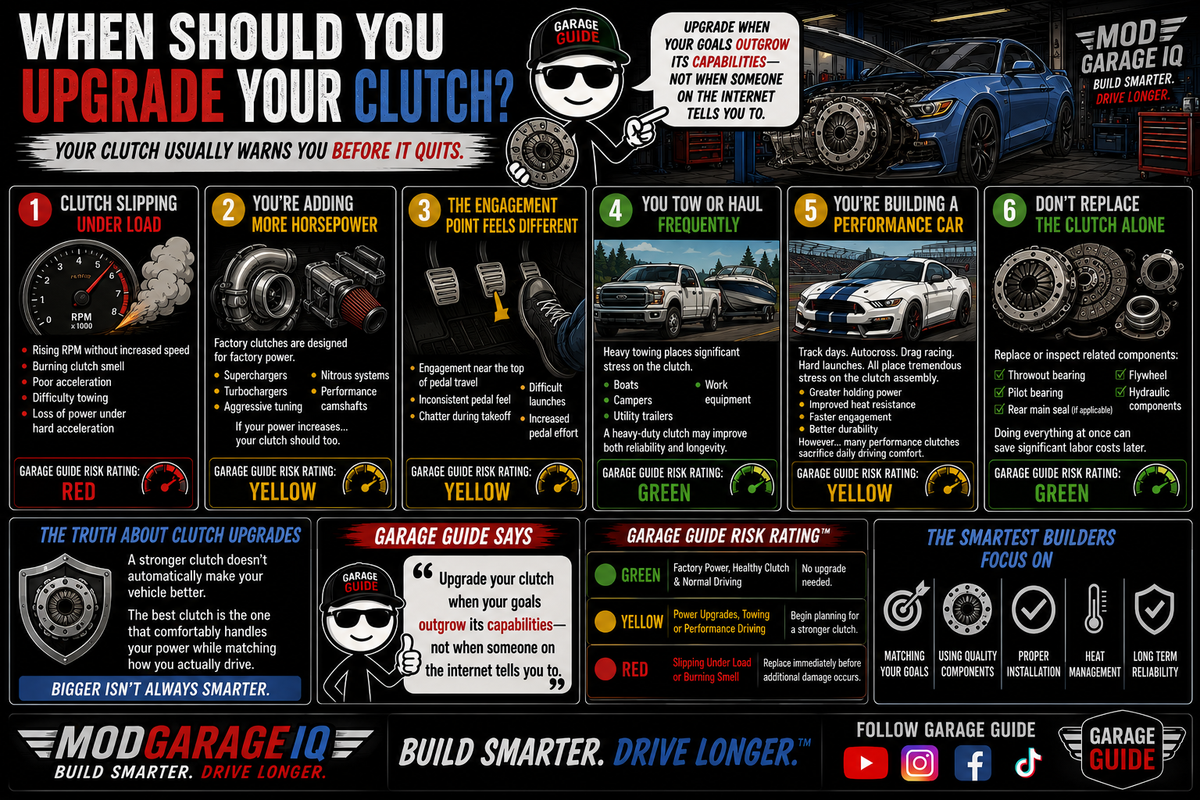
Your Clutch Usually Warns You Before It Quits.
A clutch isn’t a maintenance item that should be replaced simply because of mileage.
Some factory clutches last over 150,000 miles.
Others struggle after a few spirited weekends.
The real question isn’t how old your clutch is.
It’s whether your current clutch still matches your driving style and performance goals.
Clutch Slipping Under Load
One of the first signs of a worn clutch is slipping.
The engine RPM increases…
But the vehicle doesn’t accelerate at the same rate.
Common symptoms include:
• Rising RPM without increased speed
• Burning clutch smell
• Poor acceleration
• Difficulty towing
• Loss of power under hard acceleration
🔴 Garage Guide Risk Rating: RED
A slipping clutch only gets worse with time.
You’re Adding More Horsepower
Factory clutches are designed for factory power.
Once horsepower and torque increase significantly, the stock clutch may no longer have enough holding capacity.
Common upgrades that may require a stronger clutch include:
• Superchargers
• Turbochargers
• Aggressive tuning
• Nitrous systems
• Performance camshafts
If your power increases…
Your clutch should too.
🟡 Garage Guide Risk Rating: YELLOW
Support your power with the right drivetrain components.
The Engagement Point Feels Different
A healthy clutch has a predictable engagement point.
As the clutch wears, you may notice:
• Engagement near the top of pedal travel
• Inconsistent pedal feel
• Chatter during takeoff
• Difficult launches
• Increased pedal effort
These are early warning signs that shouldn’t be ignored.
🟡 Garage Guide Risk Rating: YELLOW
Pay attention before complete failure occurs.
You Tow Or Haul Frequently
Heavy towing places significant stress on the clutch.
Repeated launches under load accelerate wear.
If you regularly tow:
• Boats
• Campers
• Utility trailers
• Work equipment
A heavy-duty clutch may improve both reliability and longevity.
🟢 Garage Guide Risk Rating: GREEN
Upgrade for your workload—not just your horsepower.
You’re Building A Performance Car
Track days.
Autocross.
Drag racing.
Hard launches.
All place tremendous stress on the clutch assembly.
Performance clutches offer:
• Greater holding power
• Improved heat resistance
• Faster engagement
• Better durability
However…
Many performance clutches sacrifice daily driving comfort.
Choose the clutch that matches your intended use.
🟡 Garage Guide Risk Rating: YELLOW
Don’t overbuild a daily driver.
Don’t Replace The Clutch Alone
Replacing the clutch is the perfect opportunity to inspect related components.
Consider replacing:
• Throwout bearing
• Pilot bearing
• Rear main seal (if applicable)
• Flywheel
• Hydraulic components
Doing everything at once can save significant labor costs later.
🟢 Garage Guide Risk Rating: GREEN
Preventive maintenance pays for itself.
The Truth About Clutch Upgrades
A stronger clutch doesn’t automatically make your vehicle better.
The best clutch is the one that comfortably handles your power while matching how you actually drive.
Bigger isn’t always smarter.
Garage Guide Says
“Upgrade your clutch when your goals outgrow its capabilities—not when someone on the internet tells you to.”
Garage Guide Risk Rating™
🟢 Factory Power, Healthy Clutch & Normal Driving
No upgrade needed.
🟡 Power Upgrades, Towing or Performance Driving
Begin planning for a stronger clutch.
🔴 Slipping Under Load or Burning Smell
Replace immediately before additional damage occurs.
Bottom Line
Your clutch is the connection between your engine and the road.
When it begins slipping—or your horsepower exceeds its design limits—it’s time to think about an upgrade.
Choose a clutch that matches your build, your budget, and your driving style.
Because the right clutch doesn’t just transfer power…
It transfers confidence.
🏁 Build Smarter. Drive Longer.
#ModGarageIQ #GarageGuide #ClutchUpgrade #ManualTransmission #PerformanceMods #CarMaintenance #BuildSmarterDriveLonger #CarEnthusiast