What Your Exhaust Smoke Is Really Trying To Tell You
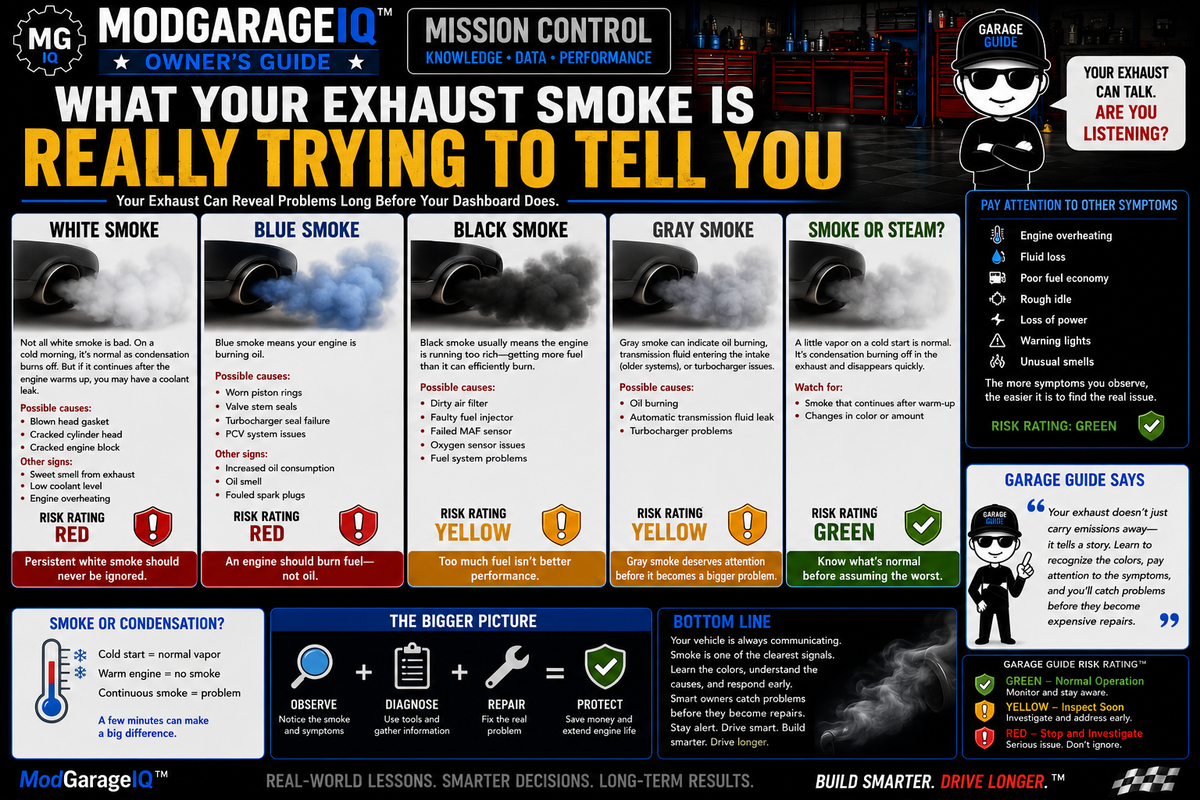
Your Exhaust Can Reveal Problems Long Before Your Dashboard Does.
Most drivers don’t pay much attention to their exhaust…
Until they notice something unusual in the rearview mirror.
A puff of blue smoke.
A cloud of white smoke.
Thick black smoke during acceleration.
These aren’t just colors.
They’re clues.
Your exhaust can provide valuable insight into what’s happening inside your engine, often warning you about problems before they become major repairs.
Learning what each color means can help you make smarter decisions—and potentially save thousands of dollars.
White Smoke
Not all white smoke is bad.
On a cold morning, it’s completely normal to see a light white vapor as condensation burns off inside the exhaust system.
But if thick white smoke continues after the engine reaches operating temperature…
You could have a coolant leak.
Possible causes include:
- Blown head gasket
- Cracked cylinder head
- Cracked engine block
Other warning signs include:
- Sweet smell from the exhaust
- Low coolant level
- Engine overheating
🔴 Garage Guide Risk Rating: RED
Persistent white smoke should never be ignored.
Blue Smoke
Blue smoke almost always means one thing…
Your engine is burning oil.
Common causes include:
- Worn piston rings
- Valve stem seals
- Turbocharger seal failure (where equipped)
- PCV system issues
You may also notice:
- Increased oil consumption
- Oil smell
- Fouled spark plugs
The longer oil burning continues, the greater the potential for engine damage.
🔴 Garage Guide Risk Rating: RED
An engine should burn fuel—not oil.
Black Smoke
Black smoke usually indicates the engine is running too rich.
In other words…
It’s receiving more fuel than it can efficiently burn.
Possible causes include:
- Dirty air filter
- Faulty fuel injector
- Failed MAF sensor
- Oxygen sensor issues
- Fuel system problems
Besides wasting fuel, a rich condition can damage the catalytic converter over time.
🟡 Garage Guide Risk Rating: YELLOW
Too much fuel isn’t better performance.
Gray Smoke
Gray smoke can be more difficult to diagnose.
Depending on the vehicle, it may indicate:
- Oil burning
- Automatic transmission fluid entering the intake (older vacuum-modulated systems)
- Turbocharger problems
If gray smoke appears suddenly, monitor the vehicle closely and have it inspected.
🟡 Garage Guide Risk Rating: YELLOW
Gray smoke deserves attention before it becomes a larger problem.
Smoke Or Steam?
Many owners mistake normal condensation for engine trouble.
A little vapor during cold starts that disappears after a few minutes is usually normal.
Continuous smoke after the engine warms up…
Is not.
Understanding the difference can prevent unnecessary worry—or prevent ignoring a serious problem.
🟢 Garage Guide Risk Rating: GREEN
Know what’s normal before assuming the worst.
Pay Attention To Other Symptoms
Smoke is only one piece of the puzzle.
Also watch for:
- Engine overheating
- Fluid loss
- Poor fuel economy
- Rough idle
- Loss of power
- Warning lights
- Unusual smells
The more symptoms you observe, the easier it becomes to diagnose the problem correctly.
🟢 Garage Guide Risk Rating: GREEN
The best diagnosis comes from seeing the whole picture.
Garage Guide Says
“Your exhaust doesn’t just carry emissions away—it tells a story. Learn to recognize the colors, pay attention to the symptoms, and you’ll catch problems before they become expensive repairs.”
Garage Guide Risk Rating™
🟢 GREEN — Normal Operation
A small amount of water vapor during a cold start is usually normal. Keep an eye on changes, but don’t confuse condensation with a mechanical problem.
🟡 YELLOW — Schedule An Inspection
Black or gray smoke often points to fuel or oil-related issues that should be diagnosed before they worsen.
🔴 RED — Stop And Investigate
Persistent white smoke or blue smoke can indicate serious engine problems that require immediate attention to prevent further damage.
Bottom Line
Your vehicle is constantly communicating with you.
Sometimes it’s through warning lights.
Sometimes it’s through unusual sounds.
And sometimes…
It’s through the color of the smoke coming out of the tailpipe.
Learning to recognize those warning signs helps you respond early, protect your investment, and avoid costly repairs.
Because the smartest drivers don’t just watch the road ahead…
They also pay attention to what’s happening behind them.
🏁 Build Smarter. Drive Longer.