What Your Car’s Vibrations Are Trying to Tell You
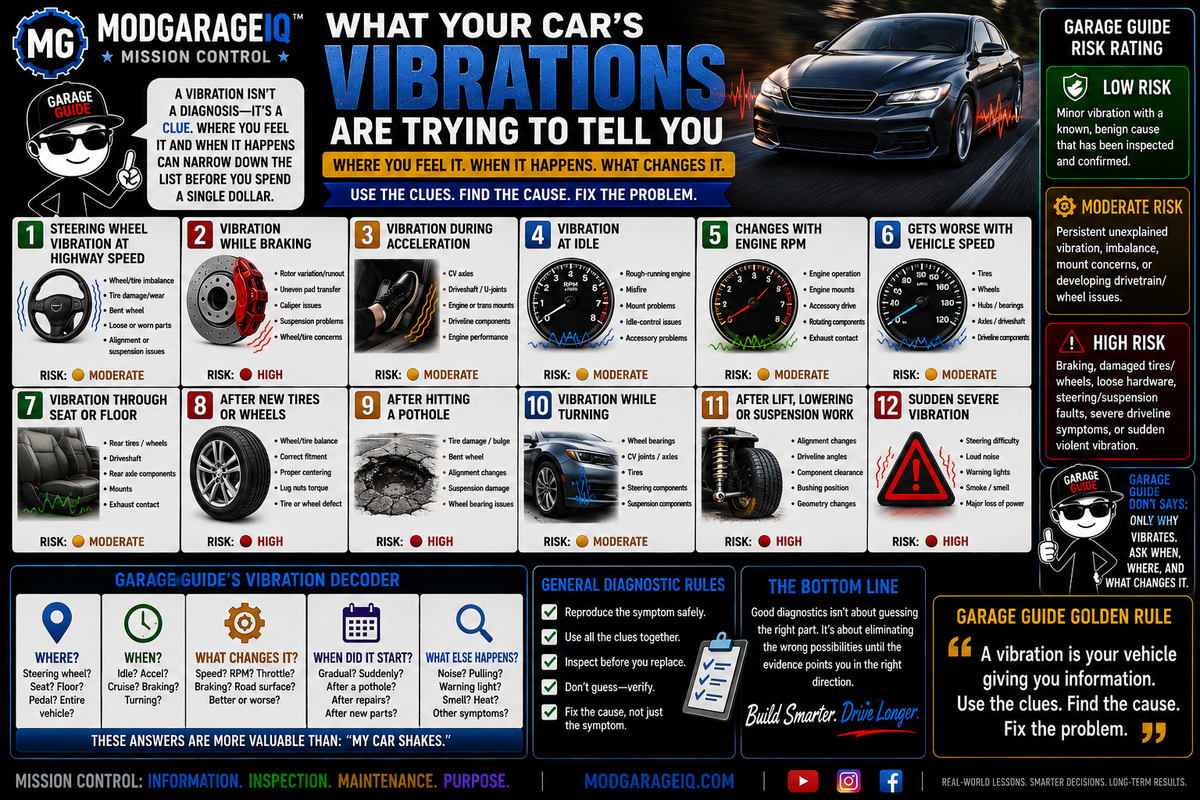
Where You Feel a Vibration—and When It Happens—Can Help Narrow Down Which Part of the Vehicle Needs Your Attention.
Your car is vibrating.
So what’s wrong?
Well…
Where do you feel it?
The steering wheel?
The seat?
The brake pedal?
The entire vehicle?
And when does it happen?
At highway speed?
While braking?
During acceleration?
At idle?
Those details matter.
A vibration isn’t a diagnosis.
It’s a clue.
And one of the best things you can do before replacing a single part is learn exactly when, where, and how the vibration occurs.
Let’s decode what your vehicle may be trying to tell you.
1. Steering Wheel Vibration at Highway Speed
You get up to highway speed and suddenly the steering wheel starts shaking.
One common place to begin investigating is the wheel and tire assembly.
Possible causes can include:
- Wheel/tire imbalance
- Tire damage
- Irregular tire wear
- Bent wheel
- Improper wheel installation
- Loose or damaged components
- Steering or suspension problems
Pay attention to whether the vibration appears within a particular speed range.
If it becomes noticeable around certain speeds and changes as speed changes, that’s useful diagnostic information.
Don’t automatically assume:
“It just needs balancing.”
Inspect the tire and wheel first.
🟡 Garage Guide Risk Rating: MODERATE
Some causes are relatively simple. Others can involve components critical to vehicle control.
Garage Guide Says:
“Don’t balance a damaged tire and call the problem solved.”
2. Vibration While Braking
You’re driving smoothly.
You press the brake pedal…
Shake.
Now we’ve learned something important.
If the vibration occurs primarily during braking, the brake system becomes one of the first places to investigate.
Possible causes can include:
- Brake rotor variation or runout
- Uneven friction material transfer
- Brake component problems
- Sticking or improperly operating caliper
- Loose or worn suspension components
- Wheel/tire issues that become more noticeable during braking
You may feel the vibration through:
The pedal.
The steering wheel.
Or sometimes the vehicle itself.
Don’t simply replace rotors every time a vehicle shakes under braking.
Find the cause.
🔴 Garage Guide Risk Rating: HIGH
Any symptom that may involve braking deserves prompt inspection.
Garage Guide Says:
“If the vibration shows up when you’re trying to stop, move brakes toward the top of the inspection list.”
3. Vibration During Acceleration
Smooth while cruising…
But when you press the accelerator?
Vibration.
Now the load on the drivetrain has changed.
Possible areas to investigate can include, depending on vehicle design:
- CV axles
- Driveshaft
- U-joints
- Engine mounts
- Transmission mounts
- Driveline components
- Wheel/tire issues
- Engine performance problems
The key diagnostic clue is:
It changes with load.
Ask yourself:
Does it happen during light acceleration?
Heavy acceleration?
Only from a stop?
At a certain road speed?
Does it disappear when you lift off the throttle?
Those details can dramatically narrow the search.
🟡 Garage Guide Risk Rating: MODERATE
Some drivetrain problems can become serious if ignored.
Garage Guide Says:
“If the vibration changes when the throttle changes, write that clue down.”
4. Vibration at Idle
You’re stopped at a traffic light.
The vehicle isn’t moving.
But you can feel a vibration through the seat, steering wheel, or cabin.
That tells us something immediately:
The tires aren’t rolling.
The wheels aren’t spinning.
Road speed isn’t involved.
So now we look elsewhere.
Possible causes can include:
- Rough-running engine
- Misfire
- Engine or transmission mount problems
- Idle-control related issues depending on vehicle
- Accessory or rotating-component problems
- Normal engine characteristics that have changed
Pay attention to whether the vibration changes when:
- The engine warms up
- The A/C turns on
- The transmission is placed in gear
- Engine RPM changes
- Electrical or accessory loads change
🟡 Garage Guide Risk Rating: MODERATE
Garage Guide Says:
“If the car shakes while sitting still, stop blaming the tires.”
5. Vibration That Changes With Engine RPM
Here’s an important distinction.
Does the vibration follow:
Vehicle speed?
Or…
Engine speed?
They’re not the same thing.
If the vehicle is stationary and the vibration changes as engine RPM changes, you’ve learned that road speed isn’t required to reproduce the symptom.
Potential areas to investigate may include:
- Engine operation
- Engine mounts
- Accessory drive
- Rotating engine-driven components
- Exhaust contact
- Other components influenced by engine movement
This is why reproducing the symptom safely is so valuable.
🟡 Garage Guide Risk Rating: MODERATE
Garage Guide Says:
“RPM-related and road-speed-related vibrations are two different conversations.”
6. Vibration That Gets Worse With Vehicle Speed
Maybe you barely notice it at 30 mph.
At 50 mph, it’s obvious.
At highway speed, it’s unbearable.
A vibration strongly related to road speed can move your investigation toward rotating components whose speed changes with the vehicle.
Depending on the vehicle, possibilities can include:
- Tires
- Wheels
- Wheel hubs/bearings
- Axles
- Driveshaft components
- Other driveline components
But don’t diagnose solely from speed.
Also ask:
Where do I feel it?
Does throttle position change it?
Does turning change it?
Does braking change it?
That’s how a vague symptom becomes useful information.
🟡 Garage Guide Risk Rating: MODERATE
Garage Guide Says:
“Speed tells you when. Location helps tell you where to look.”
7. Vibration Through the Seat or Floor
Sometimes the steering wheel feels relatively calm…
But your seat feels like it’s receiving a text message. 😂
A vibration felt primarily through the seat or floor can point your investigation toward different areas than a steering-wheel-only vibration.
Depending on vehicle layout, inspect possibilities such as:
- Rear wheel/tire assemblies
- Driveline components
- Driveshaft
- Rear axle-related components
- Mounts
- Exhaust contact
- Other rotating components
Again:
Location is a clue—not proof.
Don’t replace rear tires simply because the vibration is felt in the seat.
Inspect.
Test.
Confirm.
🟡 Garage Guide Risk Rating: MODERATE
Garage Guide Says:
“Where you feel the vibration is evidence. It isn’t a verdict.”
8. Vibration After New Tires or Wheels
This one deserves immediate attention because something changed.
If the vehicle drove smoothly before new wheels or tires and vibrates afterward, start with the work that was just performed.
Check for issues such as:
- Wheel/tire balance
- Correct wheel fitment
- Proper centering
- Correct lug hardware
- Proper lug-nut torque
- Tire defects
- Bent or damaged wheel
- Improper installation
Don’t assume:
“New means good.”
New components can still be defective, incorrectly installed, or incompatible.
🔴 Garage Guide Risk Rating: HIGH
If wheel attachment or fitment is questionable, have it inspected promptly.
Garage Guide Says:
“When a symptom starts immediately after a repair or modification, inspect what changed first.”
9. Vibration After Hitting a Pothole
BANG.
You apologize to the car.
Then everything seems fine…
Until the steering wheel starts vibrating.
After a significant impact, inspect for:
- Tire damage
- Sidewall bulges
- Bent wheel
- Alignment changes
- Suspension damage
- Steering damage
- Wheel-bearing concerns
Some damage isn’t immediately obvious from the driver’s seat.
Inspect the tire carefully.
A damaged tire is not something to gamble with.
🔴 Garage Guide Risk Rating: HIGH
Garage Guide Says:
“The pothole happened in one second. The damage doesn’t have to disappear that quickly.”
10. Vibration While Turning
If the symptom changes during turns, that’s another useful clue.
Pay attention to:
- Which direction you’re turning
- Vehicle speed
- Whether you’re accelerating
- Whether you hear clicking, humming, grinding, or clunking
- Whether the steering feels different
Depending on vehicle design and the accompanying symptoms, inspection may include:
- Wheel bearings
- CV joints/axles
- Tires
- Steering components
- Suspension components
Don’t diagnose based on the turn alone.
Use all the clues together.
🟡 Garage Guide Risk Rating: MODERATE
Garage Guide Says:
“A symptom that changes during a turn just gave you another piece of the puzzle.”
11. Vibration After a Lift, Lowering Kit, or Suspension Work
Modified the suspension…
And now the vehicle vibrates?
Don’t normalize it.
Inspect the modification.
Changes in ride height or suspension geometry can affect:
- Alignment
- Axle angles
- Driveshaft angles
- Component clearance
- Bushing position
- Steering geometry
- Tire wear
- Driveline behavior
The exact effects depend heavily on vehicle design and the modification.
🔴 Garage Guide Risk Rating: HIGH
Suspension modifications can affect vehicle handling and driveline geometry when improperly selected or installed.
Garage Guide Says:
“If the modification created the symptom, the symptom is part of the modification.”
12. Sudden Severe Vibration
This is different.
If a vehicle suddenly develops a violent or severe vibration, especially accompanied by:
- Steering difficulty
- Loud banging
- Grinding
- Tire-pressure warning
- Vehicle pulling
- Smoke
- Burning smell
- Warning lights
- Major loss of power
- Abnormal braking behavior
Don’t keep driving just to see whether it goes away.
Safely reduce speed and stop somewhere appropriate as conditions permit.
Inspect the situation or arrange professional assistance.
🔴 Garage Guide Risk Rating: HIGH
Garage Guide Says:
“A violent new vibration isn’t your car asking for another ten miles.”
Garage Guide’s Vibration Decoder
Before diagnosing anything, answer these questions:
WHERE do you feel it?Steering wheel? Seat? Floor? Pedal? Entire vehicle?
WHEN does it happen?Idle? Acceleration? Cruise? Braking? Turning?
WHAT changes it?Speed? RPM? Throttle? Braking? Road surface?
WHEN did it begin?Gradually? Suddenly? After a pothole? After repairs? After new wheels?
WHAT else happens with it?Noise? Pulling? Warning light? Smell? Heat?
Those answers can be more useful than saying:
“My car shakes.”
Garage Guide Risk Rating
🟢 LOW RISKVery minor vibration with a known benign cause that has been properly inspected and confirmed.
🟡 MODERATE RISKPersistent unexplained vibration, imbalance, mount concerns, or developing drivetrain/wheel issues requiring diagnosis.
🔴 HIGH RISKVibration involving braking, damaged tires/wheels, loose wheel hardware, steering or suspension faults, severe driveline symptoms, or sudden violent shaking.
The Bottom Line
A vibration is your vehicle giving you information.
Don’t immediately throw parts at it.
Instead, figure out:
Where you feel it.
When it happens.
What makes it better or worse.
Whether it follows engine RPM or vehicle speed.
What changed before it started.
Then inspect the systems that match those clues.
Because good diagnostics isn’t about guessing the right part.
It’s about eliminating the wrong possibilities until the evidence points you in the right direction.
Garage Guide Says:
“Don’t ask only why the car vibrates. Ask when, where, and what changes it.”
Build Smarter. Drive Longer.
#ModGarageIQ #GarageGuide #MissionControl #CarVibration #CarShaking #WheelVibration #BrakeVibration #CarDiagnostics #AutomotiveEducation #CarMaintenance #DIYAuto #BuildSmarterDriveLonger