What Different Fluid Leaks Under Your Car Are Trying to Tell You
The Color, Location, Texture, and Smell of a Leak Can Help Point You Toward the System That Needs Attention—but the Puddle Alone Is Never the Diagnosis.
You walk out to your car.
Look down.
And there it is.
A puddle.
Fantastic. 😂
Now comes the inevitable question:
“What is leaking?”
The temptation is to diagnose it by color.
Green?
Coolant.
Red?
Transmission fluid.
Brown?
Oil.
Except automotive fluids aren’t always that cooperative.
Fluid color can change with:
- Age
- Contamination
- Heat
- Maintenance history
- Fluid specification
- What it collected on its way to the ground
And where the puddle lands isn’t necessarily where the leak started.
Airflow and vehicle movement can carry fluid backward.
Covers and splash shields can redirect it.
Gravity can make a leak travel along components before finally dripping.
So Garage Guide isn’t going to teach you:
Color = failed part.
We’re going to learn how to use the puddle as a clue.
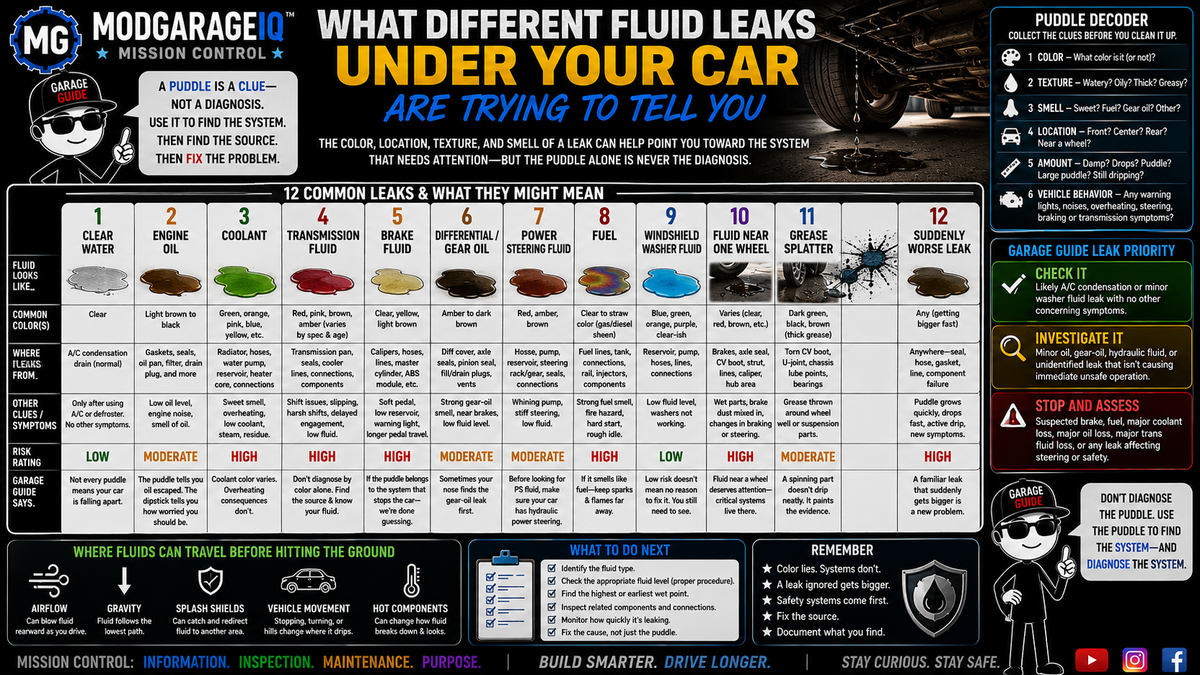
1. Clear Water
Let’s begin with the leak that may not actually be a problem.
You park after running the air conditioning and notice clear water underneath the vehicle.
That can simply be condensation draining from the HVAC system.
Ask:
- Is it clear?
- Does it feel like water?
- Is there no oily residue?
- Did you recently use the A/C or defroster?
- Is the vehicle otherwise behaving normally?
If so, you may be looking at normal condensation.
But don’t automatically assume every clear puddle is harmless.
Inspect before dismissing it.
🟢 Garage Guide Risk Rating: LOW
Garage Guide Says:
“Not every puddle means your car is falling apart. Sometimes your A/C is just doing its job.”
2. Engine Oil
Engine oil leaks can vary dramatically in appearance.
Fresh oil may appear relatively light.
Used oil can become:
Brown.
Dark brown.
Nearly black.
Possible leak areas vary by engine but can include:
- Gaskets
- Seals
- Oil filter area
- Drain plug
- Oil pan
- Other lubricated engine components
If you discover oil underneath the vehicle, check the engine-oil level using the correct procedure.
Then determine:
How quickly is it leaking?
A damp surface and a rapidly growing puddle are two very different situations.
🟡 Garage Guide Risk Rating: MODERATE
Significant oil loss can quickly become high risk.
Garage Guide Says:
“The puddle tells you oil escaped. The dipstick helps tell you how worried you should be right now.”
3. Coolant
Coolant is often recognizable because it may have a distinctive color and sweet odor.
But here’s the important part:
Coolant isn’t always green.
Depending on vehicle and specification, coolant can appear in several different colors.
Possible cooling-system leak areas can include:
- Radiator
- Hoses
- Connections
- Reservoir
- Water pump
- Heater-related components
- Other cooling-system seals or components
You may also notice:
- Dried residue
- Coolant smell
- Rising engine temperature
- Low coolant level
- Steam
Never open a hot pressurized cooling system.
🔴 Garage Guide Risk Rating: HIGH
Loss of coolant can lead to overheating and severe engine damage.
Garage Guide Says:
“Coolant color varies. Overheating consequences don’t.”
4. Transmission Fluid
This one is commonly oversimplified.
People are taught:
Red puddle = transmission fluid.
Sometimes.
But transmission fluids vary by specification, age, and condition.
Depending on the vehicle, possible leak areas may include:
- Transmission pan
- Seals
- Cooler lines
- Connections
- Other transmission components
If you suspect transmission-fluid loss, pay attention to:
- Leak severity
- Shift behavior
- Engagement
- Unusual noises
- Warning messages
And verify the correct inspection procedure for your vehicle.
Some transmissions don’t use a traditional dipstick.
🔴 Garage Guide Risk Rating: HIGH
Significant fluid loss can cause transmission damage or unsafe vehicle operation.
Garage Guide Says:
“Don’t diagnose transmission fluid by color alone. Identify the fluid and find the source.”
5. Brake Fluid
This one moves up the priority list immediately.
Brake fluid may appear relatively clear, yellowish, or darker depending on age and condition.
Possible clues include wetness near:
- Brake calipers
- Wheel cylinders where applicable
- Brake hoses
- Brake lines
- Master-cylinder area
- Other hydraulic brake components
You might also notice:
- Changing pedal feel
- Increased pedal travel
- Warning lights
- Reduced braking performance
- Dropping reservoir level
If you suspect an active brake-fluid leak, don’t treat it like an ordinary driveway stain.
🔴 Garage Guide Risk Rating: HIGH
A hydraulic brake leak can compromise braking ability.
Garage Guide Says:
“If the puddle belongs to the system responsible for stopping the car, we’re done guessing.”
6. Differential / Gear Oil
This one can announce itself before you even see it.
The smell. 😂
Gear lubricants can have a strong, distinctive odor.
Depending on vehicle configuration, leakage may appear around:
- Differential cover
- Drain/fill plugs
- Axle seals
- Pinion seal
- Other differential components
You may notice fluid around the differential housing or farther away if airflow has carried it.
If an axle seal leaks near a braking component, contamination may create additional concerns.
🟡 Garage Guide Risk Rating: MODERATE
Significant loss or contamination of braking components can raise the risk.
Garage Guide Says:
“Sometimes your nose finds the gear-oil leak before your eyes do.”
7. Power-Steering Fluid
Not every vehicle uses hydraulic power steering.
Many modern vehicles use electric systems.
But on vehicles equipped with hydraulic power steering, leakage can occur from areas such as:
- Hoses
- Connections
- Pump
- Reservoir
- Steering rack/gear
- Seals
Possible symptoms may include:
- Low fluid
- Increased steering effort
- Pump noise
- Fluid underneath the vehicle
The exact fluid specification varies by vehicle.
Don’t assume all power-steering systems use the same fluid.
🟡 Garage Guide Risk Rating: MODERATE
Steering-related problems can become high risk depending on severity.
Garage Guide Says:
“Before looking for power-steering fluid, make sure your car actually has hydraulic power steering.”
8. Fuel
If you smell raw gasoline or diesel and suspect a fuel leak:
Take it seriously.
Possible leakage could involve components within the vehicle’s fuel-delivery or storage system.
Don’t crawl underneath with a lighter to improve visibility.
Garage Guide cannot believe he has to say that. 😂
Avoid ignition sources and have the problem appropriately inspected.
🔴 Garage Guide Risk Rating: HIGH
Fuel leaks can create a significant fire hazard.
Garage Guide Says:
“If the puddle smells like fuel, diagnosis starts with keeping sparks and flames away from it.”
9. Windshield-Washer Fluid
Here’s another leak that may look dramatic but usually isn’t catastrophic.
Depending on the product used, washer fluid may appear:
- Blue
- Green
- Orange
- Purple
- Clear-ish
Possible leak areas include:
- Reservoir
- Pump
- Hoses
- Connections
One clue?
Your windshield washers stop working properly while the reservoir mysteriously empties.
🟢 Garage Guide Risk Rating: LOW
Visibility still matters, so repair the system—especially before poor weather.
Garage Guide Says:
“Low mechanical risk doesn’t mean zero reason to fix it. You still need to see where you’re going.”
10. Fluid Near One Wheel
This deserves special attention.
If you notice oily or wet material around one wheel, don’t immediately assume it’s road grime.
Possible sources vary by vehicle and location but can include:
- Brake fluid
- Axle/differential lubricant
- Grease from a damaged CV boot
- Shock/strut fluid
- Other nearby components
Inspect carefully.
If braking or steering components may be involved, treat the situation accordingly.
🔴 Garage Guide Risk Rating: HIGH
Garage Guide Says:
“Fluid near a wheel deserves attention because some very important systems live there.”
11. Grease Splattered Around the Wheel Well
This may not create a puddle at all.
Instead, you notice thick grease thrown around:
- Inside the wheel
- Suspension
- Wheel well
- Nearby components
On vehicles equipped with CV axles, one possible cause is a damaged CV boot allowing grease to escape as the axle rotates.
The splatter pattern itself becomes a clue.
🟡 Garage Guide Risk Rating: MODERATE
Garage Guide Says:
“A spinning part doesn’t drip neatly. Sometimes it paints the evidence everywhere.”
12. A Leak That Suddenly Gets Much Worse
Yesterday:
Two drops.
Today:
A puddle.
That’s information.
Leaks can change.
A seal can deteriorate.
A hose can fail.
A connection can loosen.
A component can crack.
If fluid loss suddenly increases, don’t rely on the fact that:
“It’s been leaking for months.”
The condition has changed.
So should your response.
🔴 Garage Guide Risk Rating: HIGH
Garage Guide Says:
“A familiar leak that suddenly gets bigger is a new problem.”
Garage Guide’s Puddle Decoder
Before wiping the driveway clean, collect some clues.
1 — COLOR
Clear?
Brown?
Red?
Green?
Orange?
Blue?
Something else?
Useful clue.
Not a diagnosis.
2 — TEXTURE
Watery?
Oily?
Thick?
Greasy?
Again:
A clue.
3 — SMELL
Sweet?
Petroleum-like?
Strong gear-oil odor?
Raw fuel?
Don’t deliberately inhale automotive fluids.
Simply note obvious odors safely.
4 — LOCATION
Front?
Center?
Rear?
Driver side?
Passenger side?
Near a wheel?
Remember that fluid can travel before reaching the ground.
5 — AMOUNT
Damp?
A few drops?
Small puddle?
Large puddle?
Still actively dripping?
Severity matters.
6 — VEHICLE BEHAVIOR
Any:
- Warning lights?
- Overheating?
- Steering changes?
- Brake changes?
- Transmission symptoms?
- Unusual noises?
Now the puddle has context.
Garage Guide Leak Priority
🟢 CHECK IT
Likely HVAC condensation or minor washer-fluid leakage with no other concerning symptoms.
🟡 INVESTIGATE IT
Minor oil, gear-oil, hydraulic-fluid, or unidentified leakage that isn’t causing immediate unsafe operation.
🔴 STOP AND ASSESS
Suspected:
- Brake-fluid leak
- Fuel leak
- Significant coolant loss/overheating
- Major engine-oil loss
- Major transmission-fluid loss
- Fluid loss affecting steering
- Any leak accompanied by unsafe vehicle behavior
The Bottom Line
A puddle doesn’t tell you which part to replace.
It tells you:
Start looking.
Identify the fluid.
Check the appropriate fluid level safely.
Look for the highest or earliest visible wet point.
Consider where the vehicle was parked.
Consider airflow.
Consider splash shields.
Consider what symptoms accompany the leak.
And most importantly:
Pay attention to how quickly fluid is being lost.
Because the difference between a harmless puddle of A/C condensation and a serious hydraulic leak isn’t something you want to determine by guessing at the color.
Garage Guide Says:
“Don’t diagnose the puddle. Use the puddle to find the system—and diagnose the system.”
Build Smarter. Drive Longer.
#ModGarageIQ #GarageGuide #MissionControl #FluidLeaks #CarLeaks #OilLeak #CoolantLeak #BrakeFluid #TransmissionFluid #CarDiagnostics #CarMaintenance #AutomotiveEducation #BuildSmarterDriveLonger