What Different Automotive Smells Are Trying to Tell You
Your Car Can Warn You About a Problem Before You See It—Sometimes You’ll Smell It First.
Drivers are taught to watch warning lights.
Listen for strange noises.
Pay attention to vibrations.
But there’s another diagnostic clue that often gets ignored:
Smell.
A new odor coming from your vehicle can provide an early clue that something has changed.
Burning oil smells different from coolant.
Electrical problems can smell different from overheated brakes.
Fuel has its own unmistakable odor.
And sometimes the strange smell inside your car isn’t mechanical at all.
A smell alone usually can’t diagnose the failed component—but it can tell you where to start looking and how urgently you should react.
Here are some of the most common automotive smells and what they may be trying to tell you.
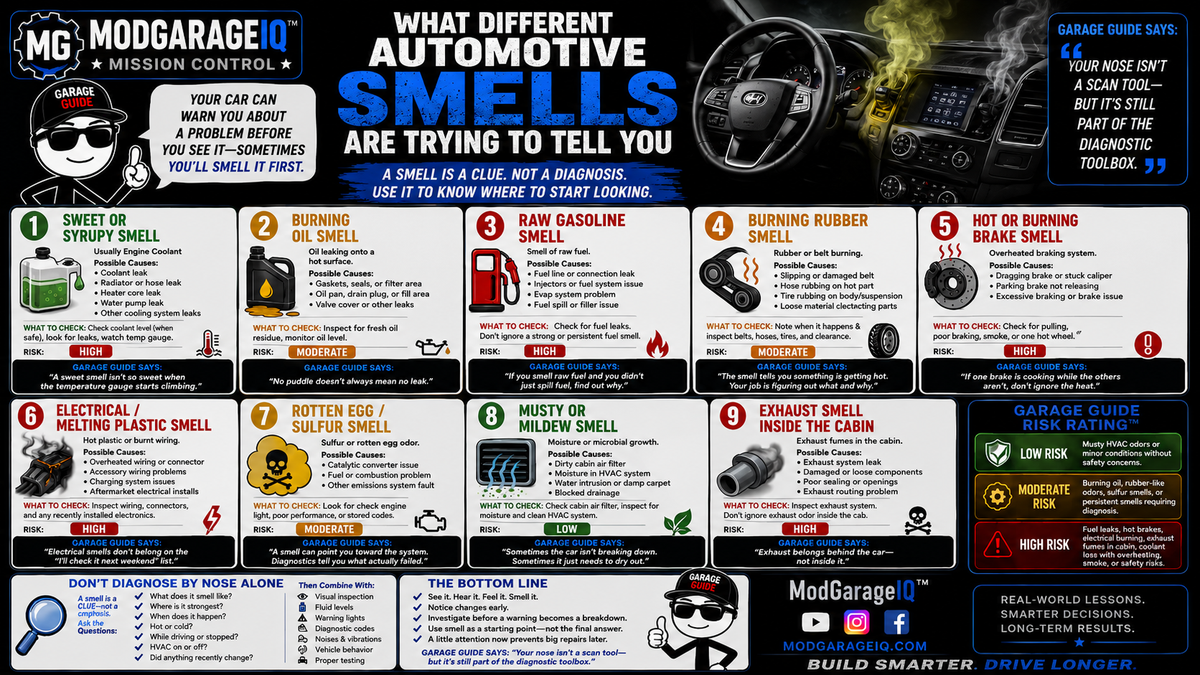
1. Sweet or Syrupy Smell
A noticeably sweet smell can be associated with engine coolant.
Possible causes include:
- Coolant leak
- Radiator leak
- Hose or connection leak
- Reservoir problem
- Water-pump-area leak
- Heater-core leak
- Other cooling-system leakage
If you smell it inside the cabin, particularly with unusual windshield fogging or dampness, the heater system deserves inspection.
Don’t rely on smell alone.
Check the coolant level only when it’s safe to do so, look for visible leakage, and watch the temperature gauge.
🔴 Garage Guide Risk Rating: HIGH
A small coolant leak can eventually become a large one, and operating an overheating engine can cause severe damage.
Garage Guide Says:
“A sweet smell isn’t so sweet when the temperature gauge starts climbing.”
2. Burning Oil Smell
Oil belongs inside the engine and its lubrication system.
When it leaks onto a hot surface, you may smell it before you ever notice a puddle underneath the vehicle.
Possible sources can include leakage around:
- Gaskets
- Seals
- Oil filter area
- Drain plug
- Oil fill area
- Other lubrication-system components
Look for fresh oil residue and monitor the oil level.
Don’t assume that because the driveway is clean, the engine isn’t leaking.
Some leaks burn off before enough fluid reaches the ground.
🟡 Garage Guide Risk Rating: MODERATE
The urgency depends on the source and severity, but low oil level or oil contacting very hot components can become much more serious.
Garage Guide Says:
“No puddle doesn’t always mean no leak.”
3. Raw Gasoline Smell
You should recognize this one quickly.
A persistent raw-fuel smell deserves attention.
Potential causes can involve:
- Fuel lines
- Fuel connections
- Injectors
- Fuel tank or filler system
- Evaporative-emissions components
- Fuel spilled during refueling
- Other fuel-system faults
A brief odor at a gas station is one thing.
A strong or persistent fuel smell around your vehicle is another.
🔴 Garage Guide Risk Rating: HIGH
Fuel is flammable.
If you suspect an active fuel leak, treat it as a safety issue rather than something to monitor casually.
Garage Guide Says:
“If you smell raw fuel and you didn’t just spill fuel, find out why.”
4. Burning Rubber Smell
Burning rubber doesn’t necessarily mean your tires are spinning.
Possible sources include:
- Slipping or damaged belt
- Hose contacting a hot component
- Tire rubbing against body or suspension
- Loose material contacting moving components
- Other heat or friction-related problems
If the vehicle has recently been modified with different wheels, tires, suspension, or ride height, inspect for rubbing.
Pay attention to when the smell occurs.
During turns?
Hard acceleration?
After highway driving?
With the A/C operating?
Those details can help narrow the search.
🟡 Garage Guide Risk Rating: MODERATE
Garage Guide Says:
“The smell tells you something is getting hot. Your job is figuring out what and why.”
5. Hot or Burning Brake Smell
After heavy braking, brakes can become extremely hot.
But a strong burning smell during ordinary driving can indicate something isn’t behaving normally.
Possible causes include:
- Dragging brake
- Sticking caliper
- Parking brake not fully releasing
- Excessive braking
- Brake-system problem creating abnormal heat
Other clues may include:
- Vehicle pulling
- Reduced performance
- Unusual brake feel
- Smoke near a wheel
- One wheel noticeably hotter than the others
- Abnormal brake wear
Don’t touch a potentially overheated brake assembly to check its temperature.
🔴 Garage Guide Risk Rating: HIGH
Braking problems directly affect vehicle safety.
Garage Guide Says:
“If one brake is cooking while the others aren’t, don’t ignore the heat.”
6. Electrical / Melting Plastic Smell
This is one of those odors that should get your attention quickly.
An electrical problem may produce a smell resembling:
- Hot plastic
- Melting insulation
- Burnt electronics
Possible sources include:
- Overheated wiring
- Electrical connector problems
- Accessory wiring
- Charging-system issues
- Electrical components
- Aftermarket installations
Pay particular attention if the smell appears after using a specific accessory or electrical system.
Recently installed:
Lights?
Stereo?
Charger?
Trailer wiring?
Other aftermarket electronics?
Start there.
🔴 Garage Guide Risk Rating: HIGH
Overheated electrical components can present a fire risk.
Garage Guide Says:
“Electrical smells don’t belong on the ‘I’ll check it next weekend’ list.”
7. Rotten Egg / Sulfur Smell
A sulfur-like or rotten-egg odor can sometimes be associated with issues involving the vehicle’s emissions or fuel/combustion systems, including the catalytic converter.
But smell alone isn’t enough to condemn an expensive component.
Look for additional clues such as:
- Check-engine light
- Poor performance
- Abnormal fuel consumption
- Stored diagnostic codes
- Other drivability symptoms
Diagnose the underlying problem before replacing parts.
🟡 Garage Guide Risk Rating: MODERATE
Depending on the cause, continued operation could contribute to additional damage.
Garage Guide Says:
“A smell can point you toward the system. Diagnostics tell you what actually failed.”
8. Musty or Mildew Smell
Not every automotive smell means the engine is in trouble.
A musty odor from the vents can be related to moisture and microbial growth within portions of the HVAC system.
Other possibilities include:
- Dirty cabin air filter
- Moisture accumulation
- Water intrusion
- Damp carpeting
- Blocked drainage
- HVAC-system contamination
If the odor becomes strongest when the fan or air conditioning turns on, the HVAC system is an obvious place to investigate.
Also inspect the interior for moisture.
🟢 Garage Guide Risk Rating: LOW
Usually more unpleasant than mechanically dangerous, although persistent water intrusion can create additional problems.
Garage Guide Says:
“Sometimes the car isn’t breaking down. Sometimes it just needs to dry out.”
9. Exhaust Smell Inside the Cabin
This one deserves special attention.
You shouldn’t routinely smell strong exhaust fumes inside the passenger compartment.
Possible causes can include:
- Exhaust-system leaks
- Damaged components
- Poor sealing
- Openings allowing fumes into the cabin
- Other exhaust-routing problems
If exhaust odor is entering the cabin, investigate it promptly.
🔴 Garage Guide Risk Rating: HIGH
Vehicle exhaust can contain carbon monoxide, which is colorless and odorless itself and can be dangerous.
Garage Guide Says:
“Exhaust belongs behind the car—not inside it.”
Don’t Diagnose by Nose Alone
Smell is a clue.
Not a complete diagnosis.
When you notice something unusual, ask:
What does it smell like?
Where is it strongest?
When does it happen?
Does it happen hot or cold?
Only while driving?
Only after stopping?
Only when the HVAC is running?
Did anything recently change?
Then combine that information with:
- Visual inspection
- Fluid levels
- Warning lights
- Diagnostic codes
- Noises
- Vehicle behavior
- Proper testing
That’s how a vague symptom becomes useful diagnostic information.
Garage Guide Risk Rating
🟢 LOWMusty HVAC odors or minor conditions without accompanying safety or mechanical symptoms.
🟡 MODERATEBurning oil, rubber-like odors, sulfur smells, or other persistent smells requiring diagnosis.
🔴 HIGHRaw fuel, overheated brakes, electrical burning, exhaust entering the cabin, coolant loss accompanied by overheating, smoke, or other immediate safety concerns.
The Bottom Line
Your vehicle communicates in more ways than one.
Sometimes you see the problem.
Sometimes you hear it.
Sometimes you feel it.
And sometimes…
you smell it.
The important part isn’t becoming an expert who can diagnose every failure from one sniff.
It’s recognizing when something has changed and investigating before a warning becomes a breakdown.
Garage Guide Says:
“Your nose isn’t a scan tool—but it’s still part of the diagnostic toolbox.”
Build Smarter. Drive Longer.
#ModGarageIQ #GarageGuide #MissionControl #CarSmells #CarMaintenance #AutomotiveDiagnostics #CarProblems #DIYAuto #AutomotiveEducation #BuildSmarterDriveLonger