What Causes Engine Misfires?
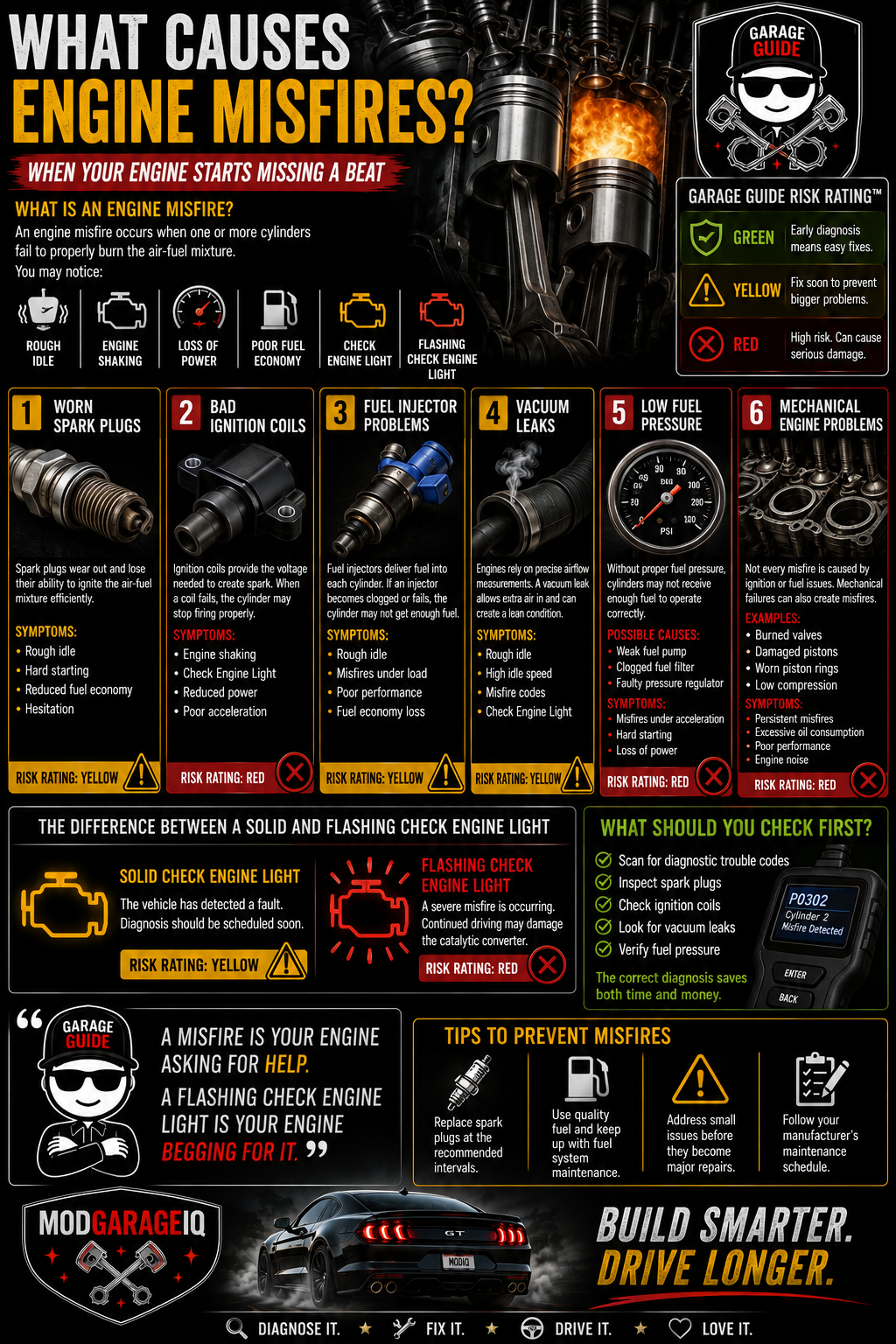
When Your Engine Starts Missing A Beat
Your engine is designed to run like a well-coordinated team.
Every cylinder fires at exactly the right time to produce smooth power.
When one cylinder doesn’t do its job, that’s called a misfire.
Sometimes it’s a minor repair.
Sometimes it’s the first warning sign of a bigger problem.
Either way, it’s something you shouldn’t ignore.
What Is An Engine Misfire?
An engine misfire occurs when one or more cylinders fail to properly burn the air-fuel mixture.
When this happens, you may notice:
• Rough idle
• Engine shaking
• Loss of power
• Poor fuel economy
• Check Engine Light
• Flashing Check Engine Light
The severity depends on what’s causing it.
Worn Spark Plugs
Spark plugs are one of the most common causes of misfires.
Over time they wear out and lose their ability to ignite the air-fuel mixture efficiently.
Symptoms:
• Rough idle
• Hard starting
• Reduced fuel economy
• Hesitation
🟡 Garage Guide Risk Rating: YELLOW
Often one of the easiest fixes.
Bad Ignition Coils
Ignition coils provide the voltage needed to create spark.
When a coil fails, the affected cylinder may stop firing properly.
Symptoms:
• Engine shaking
• Check Engine Light
• Reduced power
• Poor acceleration
🔴 Garage Guide Risk Rating: RED
A failed coil can quickly damage other components if ignored.
Fuel Injector Problems
Fuel injectors deliver fuel into each cylinder.
If an injector becomes clogged or fails, the cylinder may not receive enough fuel.
Symptoms:
• Rough idle
• Misfires under load
• Poor performance
• Fuel economy loss
🟡 Garage Guide Risk Rating: YELLOW
Proper diagnosis is important.
Vacuum Leaks
Engines rely on precise airflow measurements.
A vacuum leak allows extra air into the system and can create a lean condition.
Symptoms:
• Rough idle
• High idle speed
• Misfire codes
• Check Engine Light
🟡 Garage Guide Risk Rating: YELLOW
Small leaks can create big headaches.
Low Fuel Pressure
Without proper fuel pressure, cylinders may not receive enough fuel to operate correctly.
Possible causes:
• Weak fuel pump
• Clogged fuel filter
• Faulty pressure regulator
Symptoms:
• Misfires under acceleration
• Hard starting
• Loss of power
🔴 Garage Guide Risk Rating: RED
Fuel delivery problems should be addressed quickly.
Mechanical Engine Problems
Not every misfire is caused by ignition or fuel issues.
Mechanical failures can also create misfires.
Examples include:
• Burned valves
• Damaged pistons
• Worn piston rings
• Low compression
Symptoms:
• Persistent misfires
• Excessive oil consumption
• Poor performance
• Engine noise
🔴 Garage Guide Risk Rating: RED
These are often the most expensive repairs.
The Difference Between A Solid And Flashing Check Engine Light
Solid Check Engine Light
The vehicle has detected a fault.
Diagnosis should be scheduled soon.
🟡 Garage Guide Risk Rating: YELLOW
Flashing Check Engine Light
A severe misfire is occurring.
Continued driving may damage the catalytic converter.
🔴 Garage Guide Risk Rating: RED
Stop driving as soon as it’s safe.
What Should You Check First?
Start with the basics:
✅ Scan for diagnostic trouble codes
✅ Inspect spark plugs
✅ Check ignition coils
✅ Look for vacuum leaks
✅ Verify fuel pressure
The correct diagnosis saves both time and money.
Garage Guide Says
“A misfire is your engine asking for help. A flashing Check Engine Light is your engine begging for it.”
Garage Guide Risk Rating™
🟢 Early Diagnosis
🟡 Spark Plugs, Injectors & Vacuum Leaks
🔴 Ignition Coils, Fuel Pressure & Mechanical Damage
Bottom Line
Engine misfires rarely fix themselves.
The longer they’re ignored, the greater the chance of damaging expensive components.
If your vehicle starts shaking, stumbling, or flashing warning lights, don’t wait.
A small repair today is usually cheaper than a major repair tomorrow.
🏁 Build Smarter. Drive Longer.
#ModGarageIQ #GarageGuide #EngineMisfire #CheckEngineLight #CarRepair #AutomotiveTips #VehicleMaintenance #DIYMechanic #BuildSmarterDriveLonger #CarProblems