What Breaks First After Adding Power?
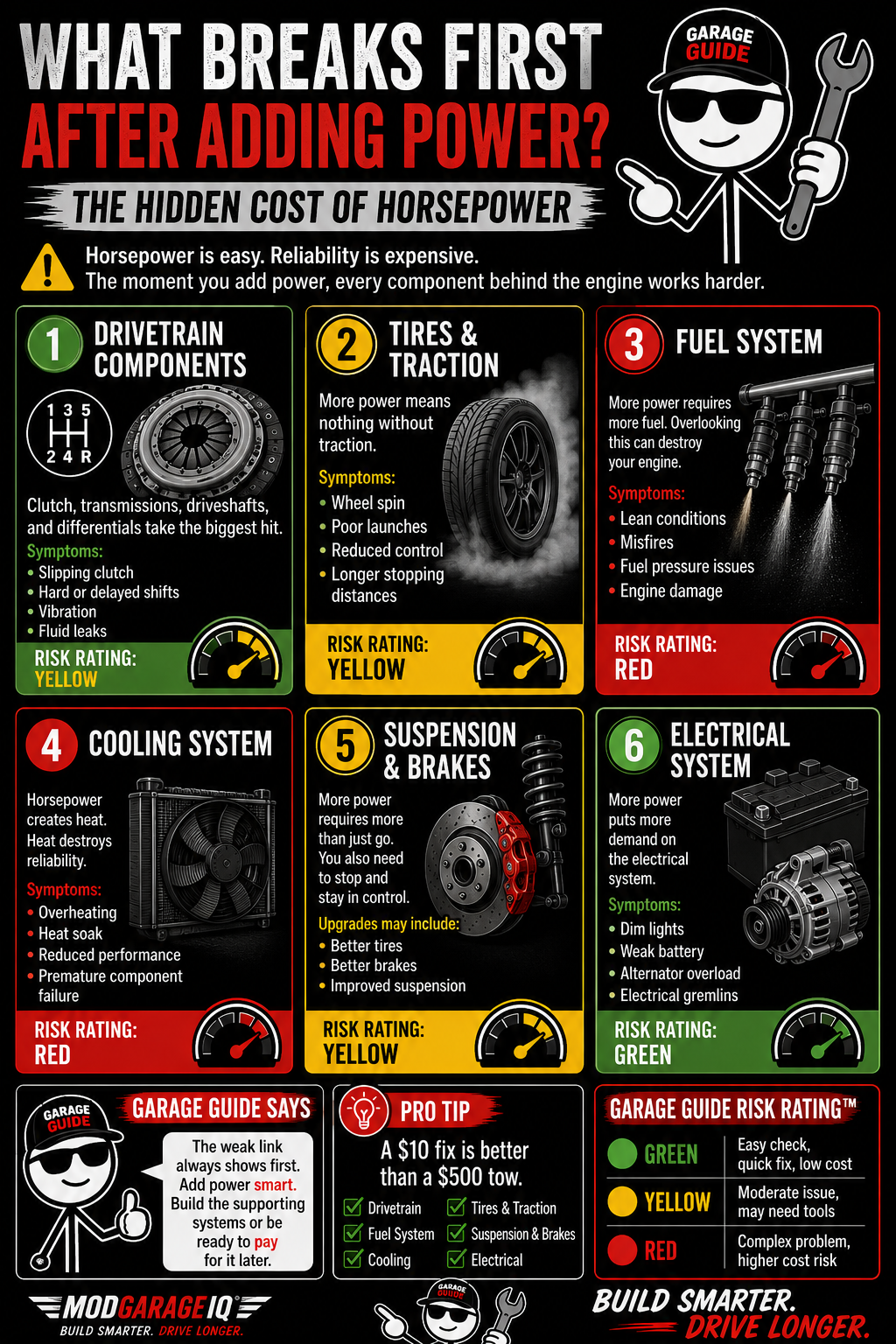
The Hidden Cost Of Horsepower
Adding horsepower is exciting.
Everyone loves bigger dyno numbers, faster acceleration, and more performance.
What most enthusiasts don’t think about is what happens after the power increase.
Horsepower doesn’t just stress the engine.
It stresses the entire vehicle.
The moment you add power, every component behind the engine begins working harder.
The question isn’t if something will experience more stress.
The question is what reaches its limit first.
Drivetrain Components
One of the first areas affected by additional horsepower is the drivetrain.
Manual Transmission Vehicles
Common weak points include:
• Clutch
• Input shaft
• Transmission gears
• Driveshaft
Symptoms may include:
• Clutch slip
• Burning smell
• Difficulty shifting
• High RPM with little acceleration
🟡 Garage Guide Risk Rating: YELLOW
Automatic Transmission Vehicles
Many modern automatics are surprisingly strong, but additional power creates additional heat and stress.
Common weak points include:
• Torque converter
• Internal clutch packs
• Transmission cooling
• Driveshaft
Symptoms may include:
• Delayed shifts
• Transmission slip
• Harsh shifting
• Overheating
🟡 Garage Guide Risk Rating: YELLOW
Tires
More power means nothing without traction.
Adding horsepower without improving tires often results in:
• Wheel spin
• Poor launches
• Reduced control
• Longer stopping distances
🟢 Garage Guide Risk Rating: GREEN
One of the smartest upgrades you can make.
Fuel System
This is one of the most commonly overlooked areas.
More power requires more fuel.
Without adequate fuel delivery, engines can run lean and suffer catastrophic damage.
Symptoms include:
• Lean conditions
• Misfires
• Fuel pressure issues
• Engine damage
🔴 Garage Guide Risk Rating: RED
Never ignore fueling requirements.
Cooling System
Horsepower creates heat.
Heat destroys reliability.
As power levels increase, cooling becomes increasingly important.
Potential problems include:
• Overheating
• Heat soak
• Reduced performance
• Premature component failure
🔴 Garage Guide Risk Rating: RED
Suspension And Brakes
Many enthusiasts focus on acceleration and forget about stopping and handling.
More power often requires:
• Better tires
• Better brakes
• Improved suspension
Without these upgrades, performance gains can become safety concerns.
🟡 Garage Guide Risk Rating: YELLOW
The Real Problem
Most parts don’t fail because they are weak.
They fail because they are being asked to do more than they were designed to do.
The larger the power increase, the more important supporting modifications become.
Garage Guide Says
“The fastest way to break a vehicle is adding power without supporting it.”
Garage Guide Risk Rating™
🟢 Tires & Traction Upgrades
🟡 Drivetrain, Suspension & Brakes
🔴 Fuel System & Cooling Neglect
Bottom Line
Adding horsepower isn’t just about making more power.
It’s about making sure every supporting system can handle it.
The smartest builds focus on the entire vehicle, not just the dyno sheet.
Because the goal isn’t simply to make power.
The goal is to keep it.
🏁 Build Smarter. Drive Longer.
#ModGarageIQ #GarageGuide #Horsepower #PerformanceMods #MustangLife #CarMods #BuildSmarterDriveLonger #AutomotiveTips #PerformanceCars