The Truth About Catch Cans
They’re Not Magic. But They Can Be Smart Insurance.
Few performance modifications spark more debate than the oil catch can.
Some enthusiasts swear by them.
Others say they’re a complete waste of money.
The truth?
A catch can isn’t designed to make horsepower.
It’s designed to help keep your engine cleaner over time.
Whether you need one depends on your engine, your driving habits, and your long-term goals.
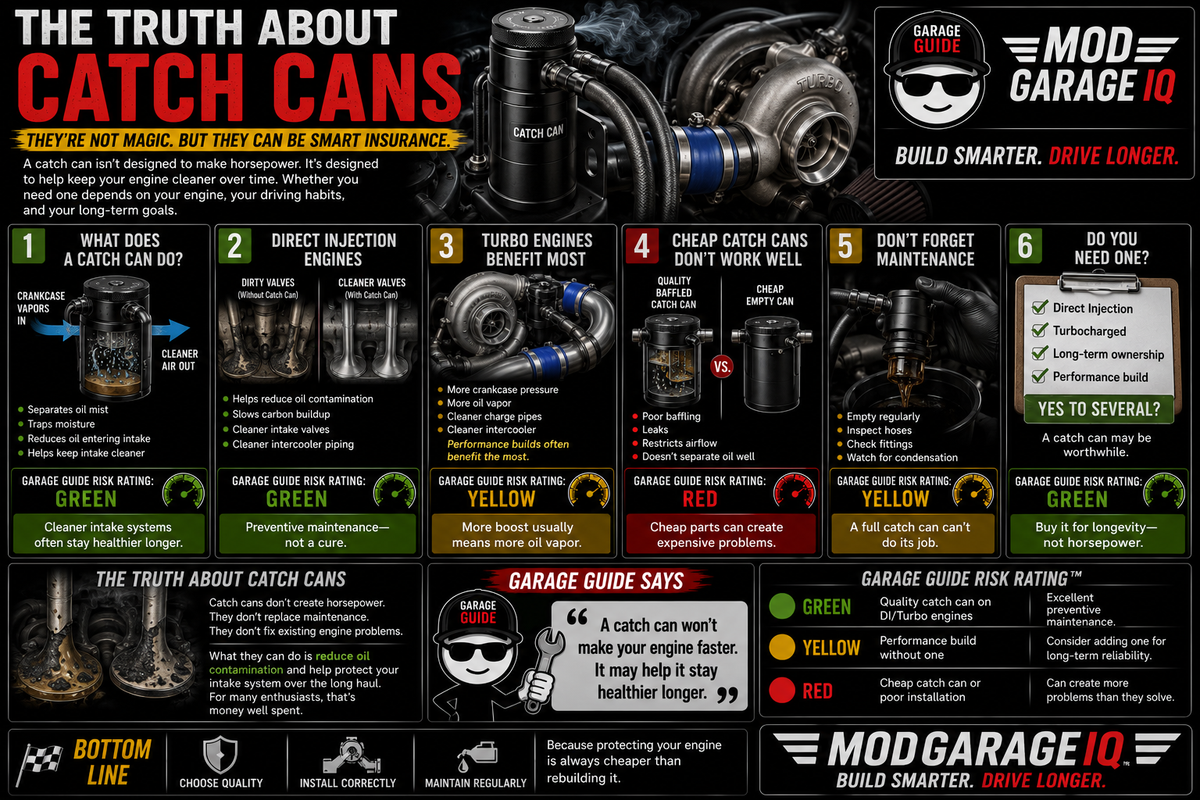
What Does A Catch Can Do?
Modern engines produce crankcase vapors containing:
• Oil mist
• Moisture
• Fuel vapors
• Carbon particles
These vapors are routed back into the intake through the PCV (Positive Crankcase Ventilation) system.
A catch can helps separate much of that oil before it reaches the intake.
🟢 Garage Guide Risk Rating: GREEN
Cleaner intake systems often stay healthier longer.
Direct Injection Engines Benefit The Most
Many modern direct-injection engines don’t spray fuel over the intake valves.
Without fuel constantly washing the valves clean, carbon deposits can build up over time.
A quality catch can may help reduce:
• Oil contamination
• Intake deposits
• Carbon buildup
• Dirty intercoolers (turbo engines)
While it won’t eliminate carbon completely, it can slow the process.
🟢 Garage Guide Risk Rating: GREEN
It’s preventive maintenance—not a cure.
Turbocharged Engines
Turbo engines typically create more crankcase pressure and oil vapor than naturally aspirated engines.
That makes them ideal candidates for a quality catch can.
Benefits may include:
• Cleaner charge pipes
• Cleaner intercoolers
• Reduced oil entering the intake
• More consistent engine performance
Performance builds often benefit the most.
🟡 Garage Guide Risk Rating: YELLOW
More boost usually means more oil vapor.
Cheap Catch Cans Don’t Work Well
Not every catch can is worth buying.
Low-quality units often:
• Have poor internal baffling
• Separate very little oil
• Leak
• Restrict airflow
• Require frequent maintenance
Choose a quality system designed specifically for your engine.
🔴 Garage Guide Risk Rating: RED
A poorly designed catch can may do more harm than good.
They Require Maintenance
Many owners install a catch can…
Then forget it exists.
Catch cans should be inspected and emptied regularly.
Depending on climate and driving conditions, they may collect:
• Oil
• Water
• Fuel vapors
• Condensation
A full catch can can’t do its job.
🟡 Garage Guide Risk Rating: YELLOW
Maintenance doesn’t stop after installation.
Do You Actually Need One?
Not every vehicle requires a catch can.
Ask yourself:
• Is my engine direct injected?
• Is it turbocharged?
• Do I plan to keep this vehicle long-term?
• Have I increased boost or horsepower?
If the answer is yes to several of these…
A catch can may be worthwhile.
🟢 Garage Guide Risk Rating: GREEN
Buy it for longevity—not horsepower.
The Truth About Catch Cans
Catch cans don’t create horsepower.
They don’t replace maintenance.
They don’t fix existing engine problems.
What they can do is reduce oil contamination and help protect your intake system over the long haul.
For many enthusiasts, that’s money well spent.
Garage Guide Says
“A catch can won’t make your engine faster. It may help it stay healthier longer.”
Garage Guide Risk Rating™
🟢 Quality Catch Can On Turbo Or Direct Injection Engines
Excellent preventive maintenance.
🟡 Performance Builds Without One
Consider adding one for long-term reliability.
🔴 Cheap Universal Catch Cans Or Poor Installation
Can create more problems than they solve.
Bottom Line
A catch can isn’t a must-have for every vehicle.
But for many modern direct-injection and turbocharged engines, it can be a valuable investment in long-term reliability.
Choose a quality system.
Install it correctly.
Maintain it regularly.
Because protecting your engine is always cheaper than rebuilding it.
🏁 Build Smarter. Drive Longer.
#ModGarageIQ #GarageGuide #CatchCan #DirectInjection #TurboCars #CarMaintenance #PerformanceMods #BuildSmarterDriveLonger #EngineProtection