The First $500 I’d Spend on a Toyota Camry
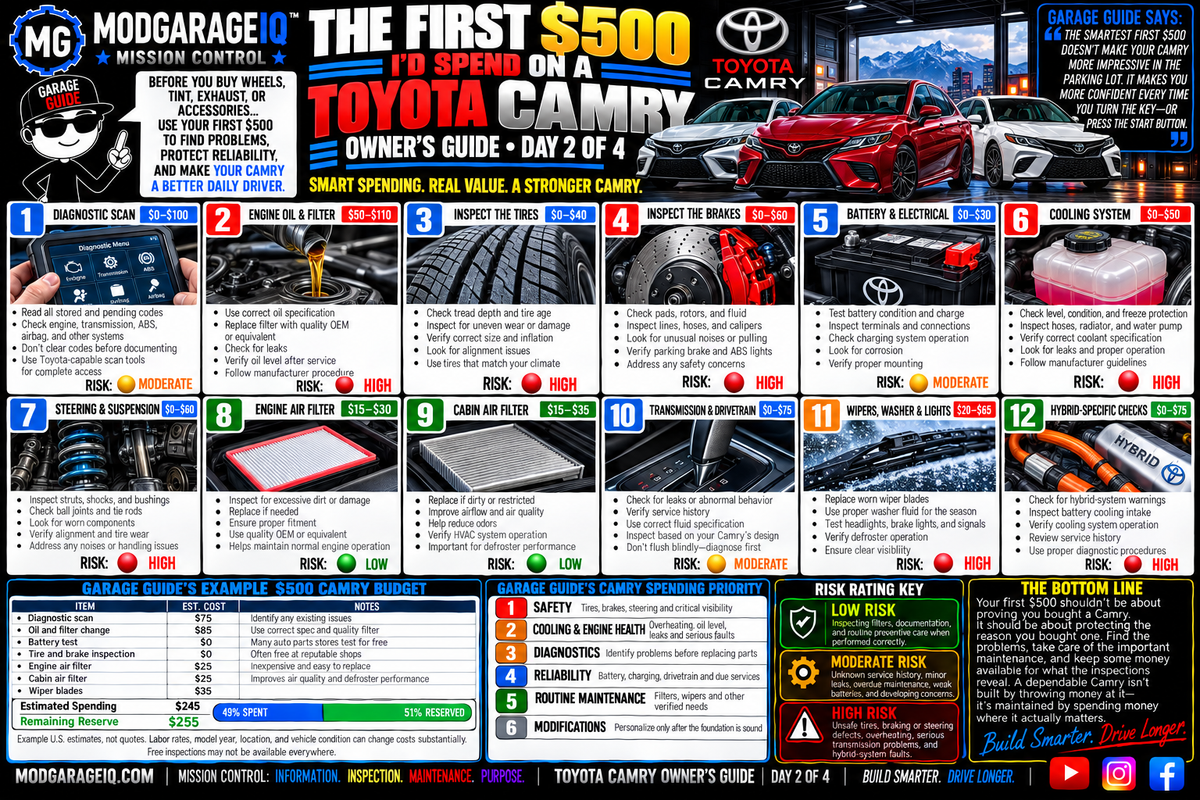
Before You Buy Wheels, Tint, Exhaust, or Accessories—Use Your First $500 to Find Problems, Protect Reliability, and Make Your Camry a Better Daily Driver.
MODGARAGEIQ OWNER’S GUIDE • TOYOTA CAMRY • DAY 2 OF 4
You just bought a Toyota Camry.
Congratulations.
You’ve got a vehicle with a reputation for practicality, comfort, efficiency, and long-term dependability.
And now you’ve got $500 to spend on it.
The internet immediately suggests:
- Window tint
- New wheels
- LED upgrades
- Exhaust tips
- Interior accessories
- Lowering springs
- A questionable performance chip that promises 40 horsepower for $39.99 😂
Garage Guide has a different idea.
What if your first $500 made your Camry more dependable instead of just making it look different?
Because whether you bought an older four-cylinder, a V6, or a newer hybrid, the smartest first investment is understanding what the vehicle needs.
Let’s spend that money intentionally.
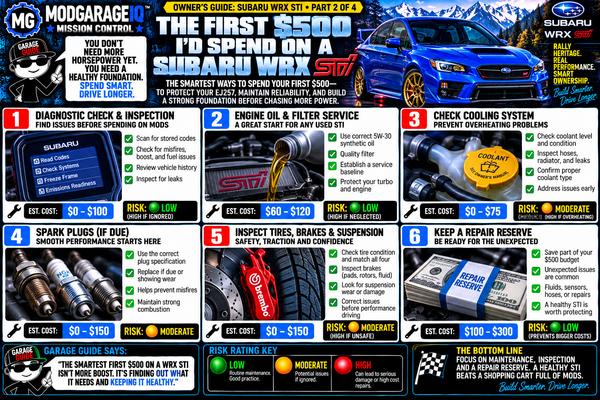
1. Start With a Proper Diagnostic Scan
Estimated budget: $0–$100
Before replacing parts, find out what the vehicle’s electronic systems are reporting.
A capable scan tool may reveal:
- Stored trouble codes
- Pending codes
- Engine-management concerns
- Transmission-related faults
- ABS and stability-control issues
- Hybrid-system faults, if equipped
- Other module warnings
A basic parts-store scan may be free, but it might not access every vehicle system.
For deeper diagnostics, Toyota-capable equipment may be necessary.
Don’t clear codes before documenting them.
And remember that a trouble code isn’t automatically a diagnosis.
Garage Guide Risk Rating: 🟡 MODERATE
Garage Guide Says:
“Before you spend money fixing something, spend a little time figuring out what’s actually wrong.”
2. Change the Engine Oil and Filter—If Due
Estimated budget: $50–$110
This is one of the most valuable routine maintenance services you can perform.
But we’re not changing oil blindly.
First, check the maintenance records.
If the oil was recently changed using the correct specification and there’s reliable documentation, you may not need another oil change yet.
If the history is unknown or service is due, prioritize it.
Use:
- Manufacturer-specified oil viscosity and approval
- Quality oil
- Correct filter
- Proper oil quantity
- Correct service procedure
Inspect for leaks and verify the oil level afterward.
Garage Guide Risk Rating: 🔴 HIGH if oil level or lubrication is seriously compromised.
Garage Guide Says:
“Fresh wheels won’t save an engine that’s running out of oil.”
3. Inspect the Tires Before Buying Anything Else
Estimated inspection budget: $0–$40
The Camry is a daily driver.
That means its tires affect nearly everything you experience behind the wheel.
Inspect:
- Tread depth
- Tire age
- Sidewall condition
- Uneven wear
- Correct sizing
- Inflation pressure
- Matching tire specifications
- Signs of alignment problems
If the tires are unsafe, they jump to the top of the budget.
A full set of quality tires may exceed $500.
That’s okay.
The goal isn’t to complete the shopping list. The goal is to fix the most important problem.
And remember, AWD doesn’t eliminate the need for appropriate tires.
Garage Guide Risk Rating: 🔴 HIGH
Garage Guide Says:
“A $500 tire problem doesn’t become a $40 accessory opportunity just because accessories are more fun.”
4. Inspect the Brakes
Estimated inspection budget: $0–$60
Before spending money on appearance, verify the braking system is healthy.
Inspect:
- Pads
- Rotors
- Calipers
- Brake lines
- Brake hoses
- Brake-fluid condition
- Parking brake
- ABS warning lights
- Pedal feel
For hybrid Camrys, regenerative braking can reduce some friction-brake wear, but it doesn’t eliminate the need for inspection.
If the brakes require repairs, the repair takes priority over cosmetic upgrades.
Don’t assume all four corners need replacement without inspection.
Garage Guide Risk Rating: 🔴 HIGH
Garage Guide Says:
“A Camry that stops properly is worth more than a Camry with shiny wheels and questionable brakes.”
5. Test the Battery and Electrical System
Estimated testing budget: $0–$30
A weak 12-volt battery can cause starting problems and electrical issues.
Check:
- Battery condition
- State of charge
- Terminals
- Cable connections
- Corrosion
- Battery mounting
- Relevant charging-system operation
For hybrids, the 12-volt electrical system has a different role than it does in a conventional gasoline vehicle, so use the appropriate testing procedure.
Don’t automatically replace a battery because it’s a certain age.
Test it.
Then decide.
Garage Guide Risk Rating: 🟡 MODERATE
Garage Guide Says:
“The battery doesn’t care that you just spent $200 making the interior look better.” 😂
6. Inspect the Cooling System
Estimated inspection budget: $0–$50
A Camry with cooling-system problems can become an expensive Camry quickly.
Check applicable:
- Coolant level
- Coolant condition
- Freeze protection
- Hoses
- Radiator
- Water pump
- Reservoir
- Leaks
- Operating temperature
On hybrid models, pay attention to the appropriate cooling circuits.
Don’t mix coolant types simply because the colors look similar.
And don’t open a hot, pressurized cooling system.
If there’s an active coolant leak or overheating problem, it takes priority over routine upgrades.
Garage Guide Risk Rating: 🔴 HIGH
Garage Guide Says:
“The best $500 investment might be preventing a $3,000 problem.”
7. Inspect the Steering and Suspension
Estimated inspection budget: $0–$60
A Camry should feel stable and predictable.
Look for:
- Worn struts or shocks
- Damaged bushings
- Ball-joint play
- Tie-rod wear
- Sway-bar link problems
- Wheel-bearing noise
- Alignment issues
- Uneven tire wear
Don’t pay for an alignment before correcting worn or damaged suspension components.
And don’t assume every noise means you need an entirely new suspension.
Diagnose first.
Garage Guide Risk Rating: 🔴 HIGH for defects that compromise control.
Garage Guide Says:
“A good alignment can’t fix a suspension component that’s already worn out.”
8. Check the Air Filter
Estimated replacement budget: $15–$30
The engine air filter is a relatively inexpensive maintenance item.
Inspect it for:
- Excessive dirt
- Damage
- Improper installation
- Debris
- Incorrect fitment
Replace it if its condition or maintenance schedule calls for replacement.
A clean, properly fitted filter supports normal engine operation.
But don’t expect a dramatic horsepower increase from replacing an ordinary dirty filter.
Garage Guide Risk Rating: 🟢 LOW
Garage Guide Says:
“Not every maintenance item adds horsepower. Some just help the car keep doing its job.”
9. Check the Cabin Air Filter
Estimated replacement budget: $15–$35
This is one of those small maintenance items that can improve the ownership experience.
Inspect the cabin filter if equipped.
Look for:
- Excessive dirt
- Leaves
- Debris
- Restricted airflow
- Unpleasant odors
Replace it when necessary.
Also verify the HVAC system and defroster operate correctly.
A new cabin filter won’t repair a malfunctioning blower motor or HVAC system, but it can address a neglected filter.
Garage Guide Risk Rating: 🟢 LOW
Garage Guide Says:
“Sometimes the best upgrade is making the car smell less like the previous owner’s gym bag.” 😂
10. Inspect the Transmission and Drivetrain
Estimated initial inspection budget: $0–$75
Depending on your Camry’s year and configuration, it may have a conventional automatic transmission or a hybrid transaxle.
AWD models also have additional drivetrain components.
Check applicable:
- Fluid leaks
- Abnormal noises
- Shifting concerns
- Vibration
- Service history
- Correct fluid specification
- Manufacturer maintenance requirements
Don’t automatically authorize a transmission flush because the vehicle has high mileage.
And don’t assume that all Toyota transmissions have identical service procedures.
If service is due, plan it using the correct manufacturer guidance.
Garage Guide Risk Rating: 🟡 MODERATE, potentially 🔴 HIGH for serious faults.
Garage Guide Says:
“Transmission maintenance should be based on the transmission you actually own—not a universal internet rule.”
11. Check the Wipers, Washer System, and Lights
Estimated replacement budget: $20–$65
We’re heading toward winter.
That makes visibility especially important.
Check:
- Wiper blades
- Washer-fluid level
- Appropriate washer-fluid freeze protection
- Washer nozzles
- Headlights
- Brake lights
- Turn signals
- Tail lights
- Reverse lights
- Front and rear defrost
If the wipers streak or chatter, replace them.
If a critical light isn’t functioning, repair it.
If the defroster doesn’t work, investigate.
Garage Guide Risk Rating: 🔴 HIGH when visibility or critical lighting is compromised.
Garage Guide Says:
“You don’t need expensive headlights. You need headlights that work and a windshield you can see through.”
12. Don’t Forget the Hybrid-Specific Checks
Estimated initial inspection budget: $0–$75
If you bought a Camry Hybrid, some additional considerations apply.
Inspect or evaluate:
- Hybrid-system warnings
- Battery cooling-air intake condition
- Cooling-system operation
- Hybrid-related diagnostic codes
- Service records
- Unusual operating behavior
A blocked battery cooling intake can interfere with proper thermal management.
But don’t attempt high-voltage battery repairs without appropriate training and equipment.
And don’t replace expensive hybrid components based on mileage alone.
Garage Guide Risk Rating: 🔴 HIGH for serious system faults or unsafe high-voltage work.
Garage Guide Says:
“Hybrid maintenance is about understanding the system—not being afraid of it.”
13. Fix the Weakest Link and Keep a Reserve
Here’s the most important part of this entire article.
After the inspections, you may discover:
- The tires are unsafe.
- The battery is weak.
- The brakes need attention.
- There’s a coolant leak.
- The suspension has a worn component.
- Everything is actually in pretty good shape.
Those outcomes should lead to different spending decisions.
Don’t spend money on filters, accessories, or optional services while a serious safety issue remains unresolved.
And if the car is healthy?
Keep the remaining money.
That’s not failing to use the budget.
That’s using the budget intelligently.
Garage Guide Risk Rating: 🟢 LOW for holding funds in reserve.
Garage Guide Says:
“Sometimes the smartest thing you can buy for your car is nothing—until you know what it needs.”
Garage Guide’s Example $500 Camry Budget
Here’s one possible allocation for a Camry with no immediate safety defects, due for an oil change, and needing a couple of minor maintenance items.
Sample maintenance budget
Illustrative
Diagnostic scan
$75
Oil and filter service
$85
Battery test
$0
Tire and brake inspection
$0
Engine air filter
$25
Cabin air filter
$25
Wiper blades
$35
Estimated spending $245
Remaining reserve
$255
Spent: 49%Reserved: 51%
Example U.S. estimates, not quotes. Labor rates, model year, location, and vehicle condition can change costs substantially. Free inspections may not be available everywhere.
In this example, we spend $245 and preserve $255 for unexpected needs.
But if the Camry needs $500 worth of tires or critical brake repairs, the budget changes immediately.
Safety comes first.
Garage Guide’s Camry Spending Priority
1
SAFETY
Tires, brakes, steering and critical visibility
2
COOLING & ENGINE HEALTH
Overheating, oil level, leaks and serious faults
3
DIAGNOSTICS
Identify problems before replacing parts
4
RELIABILITY
Battery, charging, drivetrain and due services
5
ROUTINE MAINTENANCE
Filters, wipers and other verified needs
6
MODIFICATIONS
Personalize only after the foundation is sound
Garage Guide Risk Rating
🟢 LOW RISK: Inspecting filters, replacing due routine maintenance items, documenting service, and keeping an emergency reserve.
🟡 MODERATE RISK: Unknown maintenance history, weak batteries, overdue services, minor leaks, and developing drivetrain concerns.
🔴 HIGH RISK: Unsafe tires, faulty brakes, compromised steering, overheating, critically low oil, severe transmission problems, and serious hybrid-system faults.
The Bottom Line
Your first $500 shouldn’t be about proving you bought a Camry.
It should be about protecting the reason you bought one.
Get the vehicle scanned.
Verify the oil service.
Inspect the tires.
Check the brakes.
Test the battery.
Evaluate the cooling system.
Look for steering and suspension problems.
Replace genuinely neglected maintenance items.
And keep some money available for whatever the inspections reveal.
Because a dependable Camry isn’t built by throwing money at it.
It’s maintained by spending money where it actually matters.
Garage Guide Says:
“The smartest first $500 doesn’t make your Camry more impressive in the parking lot. It makes you more confident every time you turn the key—or press the Start button.”
Build Smarter. Drive Longer.
COMING TOMORROW — OCTOBER 14
The Biggest Mistakes Toyota Camry Owners Make
From neglected maintenance and ignored warning signs to poorly planned modifications—how good cars become expensive problems.
#ModGarageIQ #GarageGuide #ToyotaCamry #CamryOwners #ToyotaMaintenance #First500Dollars #CarMaintenance #DailyDriver #UsedCarTips #VehicleReliability #OwnersGuide #AutomotiveEducation #MissionControl #BuildSmarterDriveLonger