The First $500 I’d Spend on a Ram 1500
Your First $500 Shouldn’t Make Your Ram Look Tougher—It Should Make the Truck Safer, Healthier, and More Dependable.
You just bought a Ram 1500.
And if we’re being realistic, you’ve probably already started looking at:
Wheels.
Tires.
Leveling kits.
Exhaust.
Lighting.
Maybe a cold-air intake.
And somewhere in another browser tab is something you absolutely do not need yet. 😂
Close the tab.
Because before we spend money making the truck different, we’re going to spend money learning whether the truck underneath us is healthy.
If Garage Guide handed me a newly purchased used Ram 1500 and said:
“You’ve got $500. Spend it wisely.”
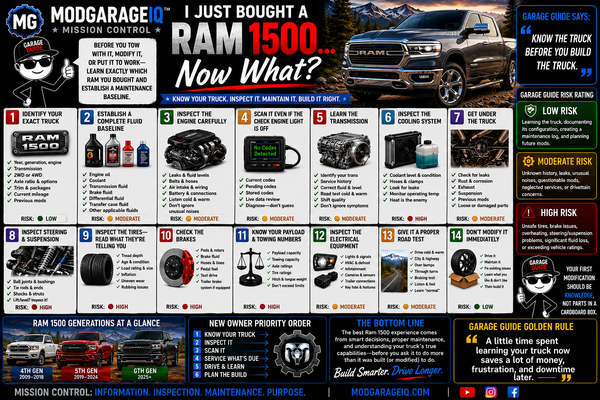
Here’s where I’d start.
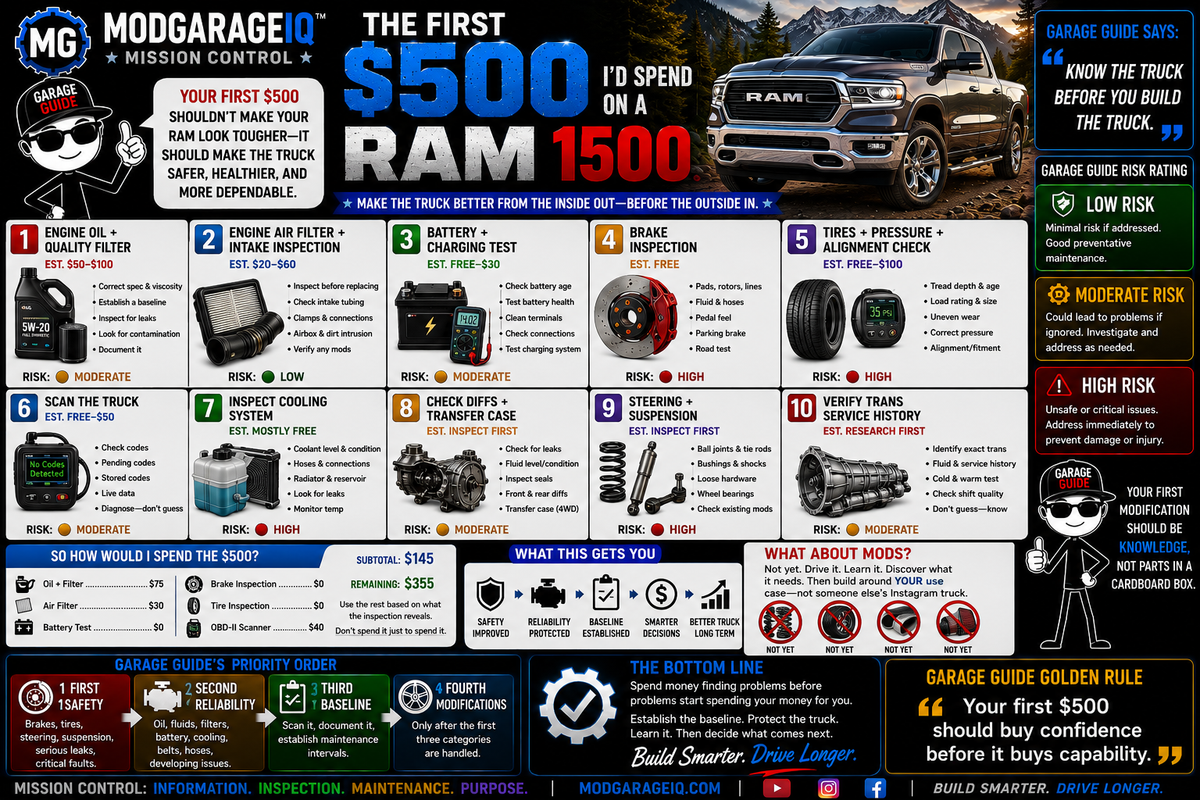
1. Engine Oil + Quality Filter
Estimated budget: $50–$100
Unless you have trustworthy documentation showing exactly when the oil was changed, establish your own baseline.
Use the correct oil specification and viscosity for your specific engine and model year.
While servicing it, inspect for:
- Low oil level
- Oil leakage
- Filter-area leakage
- Drain-plug damage
- Unusual contamination
- Signs of poor previous service
Then document:
Date.
Mileage.
Oil used.
Filter used.
Now the maintenance history belongs to you.
🟡 Garage Guide Risk Rating: MODERATE
Oil maintenance isn’t exciting, but neither is paying for engine repairs caused by neglect.
Garage Guide Says:
“Before you add horsepower, protect the horsepower you already paid for.”
2. Engine Air Filter + Intake Inspection
Estimated budget: $20–$60
Don’t automatically replace the filter.
Inspect it first.
If it’s clean and serviceable, keep your money.
If it’s dirty or damaged, replace it with an appropriate quality filter.
While you’re there, inspect:
- Intake tubing
- Clamps
- Connections
- Airbox
- Evidence of dirt intrusion
- Previous aftermarket modifications
If the truck already has an aftermarket intake, identify what it is and make sure it’s installed properly.
An aftermarket part isn’t automatically an upgrade simply because the previous owner paid for it.
🟢 Garage Guide Risk Rating: LOW
Garage Guide Says:
“Inspect first. Replace what needs replacing—not what the internet tells you to buy.”
3. Battery + Charging-System Test
Estimated budget: FREE–$30 for testing/basic service
Trucks tend to accumulate electrical demands.
Lighting.
Accessories.
Trailer equipment.
Phone chargers.
Aftermarket electronics.
And sometimes wiring from previous owners that looks like it was installed during a power outage. 😂
Start with the foundation.
Check:
- Battery age
- Battery condition
- Terminal corrosion
- Cable connections
- Battery hold-down
- Charging-system performance
Don’t automatically spend $200 on a battery because it’s a few years old.
Test it.
If it’s healthy, move on.
If it’s weak, replacement may become one of the smartest uses of your remaining budget.
🟡 Garage Guide Risk Rating: MODERATE
Garage Guide Says:
“Test first. Replace second. Guess never.”
4. Brake Inspection
Estimated budget: FREE if inspected yourself
This gets priority because your Ram may eventually:
Tow.
Haul.
Carry passengers.
Carry cargo.
Or simply weigh considerably more than the little commuter car sitting beside it.
Inspect:
- Pad thickness
- Rotor condition
- Brake fluid
- Hoses
- Lines
- Parking brake
- Pedal feel
Then road-test the truck.
Watch for:
- Pulling
- Pulsation
- Grinding
- Squealing
- Vibration
- Excessive pedal travel
If the brakes need significant work, forget the rest of this hypothetical $500 plan.
The budget just became a brake budget.
🔴 Garage Guide Risk Rating: HIGH
Garage Guide Says:
“A truck capable of pulling weight needs to be capable of controlling it.”
5. Tires + Pressure + Alignment Inspection
Estimated budget: FREE–$100 for inspection/alignment depending on what is needed
This is especially important with used trucks because modifications can complicate the picture.
Inspect:
- Tread depth
- Tire age
- Sidewall condition
- Correct size
- Load rating
- Inflation
- Uneven wear
- Matching tires
- Evidence of rubbing
If the truck has oversized tires, aftermarket wheels, a leveling kit, or a lift, pay even closer attention.
Uneven wear may point toward:
- Alignment
- Worn steering components
- Worn suspension components
- Incorrect inflation
- Poor fitment
- Modification-related geometry changes
Don’t simply replace worn tires without asking why they wore that way.
🔴 Garage Guide Risk Rating: HIGH
If you discover unsafe tires, the $500 budget changes immediately.
Garage Guide Says:
“The truck can have 400 horsepower. The road still only sees the tires.”
6. Scan the Truck
Estimated budget: FREE–$50
A basic OBD-II scanner is one of my favorite first purchases for someone who plans to become more involved with their own vehicle.
Depending on the truck and scanner, look for:
- Current codes
- Pending codes
- Stored codes
- Available live data
No check-engine light?
Scan it anyway.
And if you find a code:
Don’t immediately order a part.
A trouble code identifies a condition the vehicle detected.
It doesn’t automatically identify the failed component.
🟡 Garage Guide Risk Rating: MODERATE
Garage Guide Says:
“A scanner buys information. Information keeps you from buying unnecessary parts.”
7. Inspect the Cooling System
Estimated budget: Mostly FREE unless maintenance or repair is needed
This is another area where inspection comes before spending.
With the engine cold and following appropriate safety precautions, inspect:
- Coolant level
- Coolant condition
- Reservoir
- Hoses
- Connections
- Radiator area
- Evidence of leakage
- Dried coolant residue
Then monitor operating temperature during your road test.
If you’re planning to tow eventually, cooling-system health becomes even more important.
🔴 Garage Guide Risk Rating: HIGH
An active cooling problem can consume your entire maintenance budget—and that’s okay.
Preventing overheating matters more than buying seven different maintenance items just so we can complete a list.
Garage Guide Says:
“Heat doesn’t care what you planned to spend the money on.”
8. Check the Differential and Transfer Case
Estimated budget: Inspection first; service cost varies
This is where truck ownership starts separating itself from basic commuter-car ownership.
Depending on your Ram’s configuration, inspect and verify the maintenance history of applicable drivetrain components such as:
- Front differential
- Rear differential
- Transfer case
- Related seals
- Related fluid levels/condition where appropriate
Don’t guess at fluid specifications or service requirements.
Identify your exact truck and follow the correct maintenance information.
If you find leakage or discover that applicable service is overdue, move that higher on the priority list.
🟡 Garage Guide Risk Rating: MODERATE
Garage Guide Says:
“If it helps put power to the ground, it belongs on the maintenance list.”
9. Inspect the Steering + Suspension
Estimated budget: Inspection first
Before buying a leveling kit…
Make sure you aren’t about to level a truck with worn suspension components underneath it.
Inspect applicable components for:
- Ball-joint wear
- Tie-rod/end play
- Bushings
- Shocks
- Springs
- Loose hardware
- Wheel-bearing concerns
- Abnormal movement
- Existing lift/level components
If the truck has already been modified, identify exactly what’s installed.
Then determine whether the modification was performed correctly.
🔴 Garage Guide Risk Rating: HIGH
Significant steering and suspension problems outrank cosmetic upgrades every time.
Garage Guide Says:
“Don’t bolt new parts on top of old problems.”
10. Verify Transmission Service History
Estimated budget: Research/inspection first; service varies
Your transmission could consume most or all of the remaining $500 depending on what your specific truck needs.
That’s why we don’t blindly spend.
First identify:
- Exact transmission
- Applicable fluid
- Service requirements
- Previous maintenance
- Current behavior
Then road-test it cold and warm.
Pay attention to:
- Engagement
- Shift quality
- Hesitation
- Shudder
- Unusual RPM behavior
- Abnormal noises
If appropriate maintenance is due, budget for it.
If the transmission has symptoms, diagnose them.
Don’t assume fluid is a magical repair.
🟡 Garage Guide Risk Rating: MODERATE
Garage Guide Says:
“Maintenance can protect a healthy transmission. It can’t promise to repair a damaged one.”
So How Would I Actually Spend the $500?
Here’s the important part.
I wouldn’t necessarily spend all $500.
An example baseline might look something like:
Oil + filter: $75Air filter: $30Battery test: $0Brake inspection: $0Tire inspection: $0OBD-II scanner: $40
Subtotal: approximately $145
That leaves:
$355
And now we stop.
We don’t ask:
“What else can I buy?”
We ask:
“What did the inspection tell me?”
Maybe the remaining money goes toward:
- Alignment
- Battery
- Fluid service
- Differential maintenance
- Transfer-case maintenance
- Cooling-system repair
- Brake service
- Steering repair
- Suspension repair
- A leaking seal
Or maybe the truck checks out beautifully.
Then congratulations.
Keep the $355.
🟢 Garage Guide Risk Rating: SMART MONEY
Garage Guide Says:
“You don’t get bonus points for spending the entire budget.”
What About Mods?
Here we go. 😂
Leveling kit?
Not yet.
Wheels?
Not yet.
Bigger tires?
Not yet.
Exhaust?
Not yet.
Intake?
Still no.
Drive the truck first.
Learn:
- How you use it
- How it rides
- Whether you tow
- Whether you haul
- What terrain you drive
- What actually bothers you
- What already works perfectly
Then modifications can solve real needs instead of creating imaginary ones.
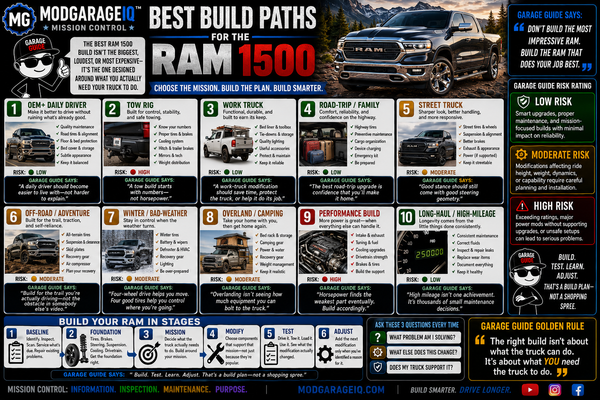
Garage Guide’s First $500 Priority Order
🔴 FIRST — SAFETY
Brakes.
Tires.
Steering.
Suspension.
Serious leaks.
Critical faults.
🟡 SECOND — RELIABILITY
Oil.
Fluids.
Filters.
Battery.
Cooling.
Belts and hoses.
Developing mechanical problems.
🟢 THIRD — BASELINE
Scan it.
Document it.
Establish known maintenance intervals.
🔵 FOURTH — MODIFICATIONS
Only after the first three categories are handled.
The Bottom Line
Your first $500 doesn’t need to transform your Ram 1500.
It needs to transform how much you know about it.
Spend money discovering problems before those problems start spending your money for you.
Establish the baseline.
Protect the engine.
Inspect the brakes.
Read the tires.
Check the drivetrain.
Scan the electronics.
Learn the truck.
And if you finish all of that with $300 still sitting in your pocket?
That’s a win.
There will be plenty of time for modifications later.
Garage Guide Says:
“Your first $500 should buy confidence before it buys capability.”
Build Smarter. Drive Longer.
#ModGarageIQ #GarageGuide #Ram1500 #RamTrucks #RamOwners #First500 #TruckMaintenance #TruckMods #OwnersGuide #MissionControl #AutomotiveEducation #BuildSmarterDriveLonger