The First $500 I’d Spend on a Honda CR-V
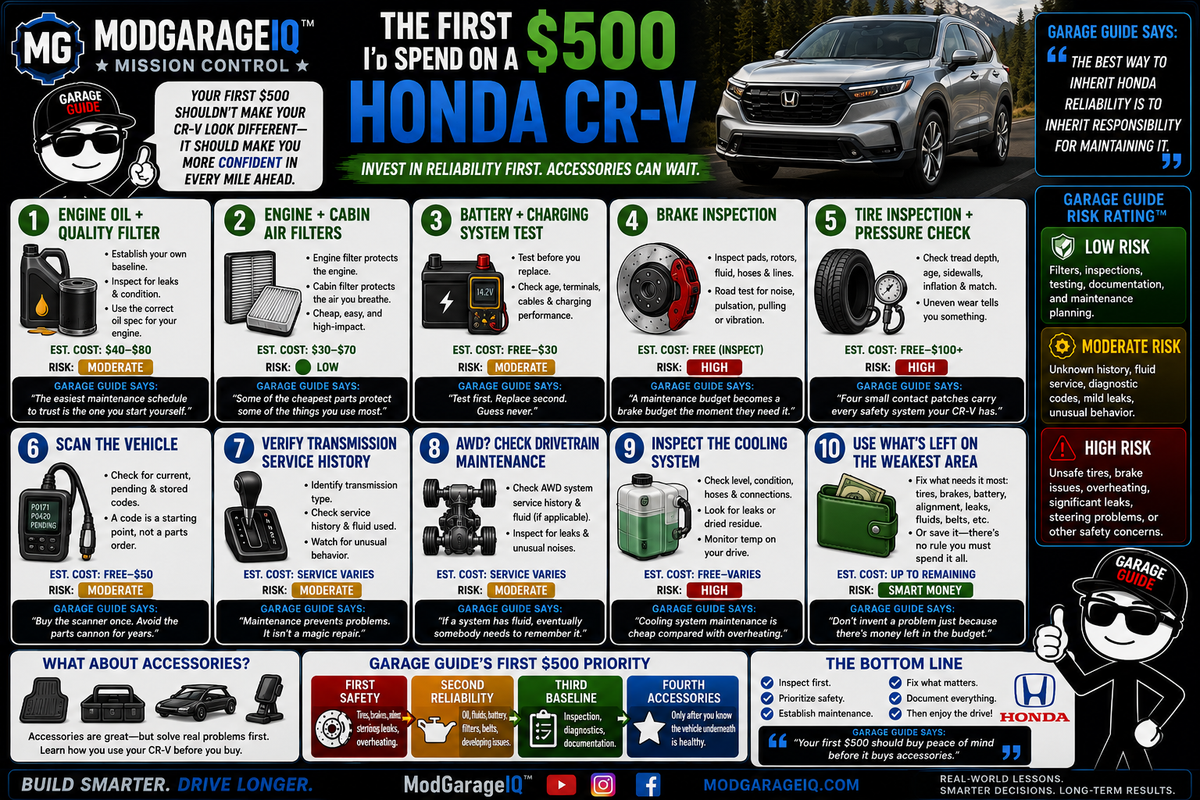
Your First $500 Shouldn’t Make Your CR-V Look Different—It Should Make You More Confident in Every Mile Ahead.
You just bought a Honda CR-V.
And unlike buying a performance car or truck, your first instinct probably isn’t:
“How much horsepower can I add?”
That’s actually an advantage.
Because the CR-V’s greatest strengths are usually the exact things we want to protect:
Reliability.
Efficiency.
Practicality.
Comfort.
Low operating costs.
So if Garage Guide handed me the keys to a newly purchased used CR-V and gave me a $500 budget, I wouldn’t go looking for accessories.
I’d use that money to establish a maintenance baseline and uncover problems before they become expensive ones.
Here’s where I’d start.
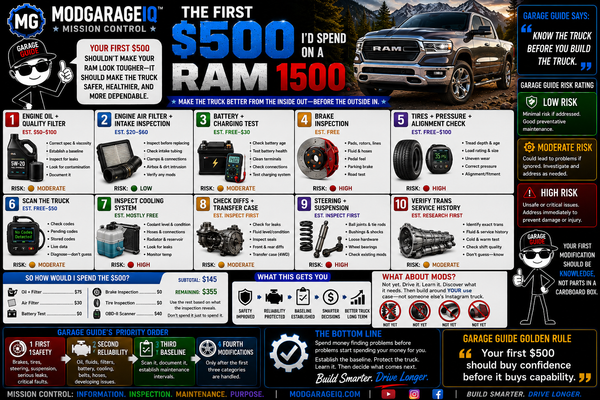
1. Engine Oil + Quality Filter
Estimated budget: $40–$80
Unless you have documentation showing when the oil was changed and what was used, this is an easy place to establish your own starting point.
Use the oil specification and viscosity appropriate for your specific model year and engine.
While you’re there, inspect for:
- Low oil level
- Oil leaks
- Damaged drain plug
- Filter-area leakage
- Signs of poor previous service
- Unusual contamination
Then record the mileage.
Now there’s no guessing when the next service comes around.
🟡 Garage Guide Risk Rating: MODERATE
Oil is inexpensive.
Engines aren’t.
Garage Guide Says:
“The easiest maintenance schedule to trust is the one you start yourself.”
2. Engine Air Filter + Cabin Air Filter
Estimated budget: $30–$70
Two filters.
Two completely different jobs.
The engine air filter protects the engine from dirt and debris entering through the intake.
The cabin air filter helps filter the air moving through the HVAC system.
Inspect both.
A dirty cabin filter may contribute to:
- Reduced HVAC airflow
- Dust
- Odors
A neglected engine filter can restrict airflow when sufficiently contaminated.
Neither is glamorous.
Both are inexpensive.
That’s exactly why they’re perfect first-$500 maintenance.
🟢 Garage Guide Risk Rating: LOW
Garage Guide Says:
“Some of the cheapest parts on the vehicle protect some of the things you use most.”
3. Battery + Charging-System Test
Estimated budget: FREE–$30 for testing and basic service
Don’t automatically buy a battery.
Test the one you have.
Check:
- Battery age
- Terminal condition
- Corrosion
- Cable connections
- Battery hold-down
- Charging performance
If it tests healthy?
Excellent.
You just spent almost nothing and learned something useful.
If testing reveals a weak battery, then replacing it may become one of the smartest uses of the remaining budget.
🟡 Garage Guide Risk Rating: MODERATE
A weak battery has a habit of waiting until the least convenient moment to announce itself.
Garage Guide Says:
“Test first. Replace second. Guess never.”
4. Brake Inspection
Estimated budget: FREE if inspected yourself
Again, we’re not automatically replacing parts.
We’re buying information before buying components.
Inspect:
- Brake pads
- Rotors
- Brake-fluid condition
- Hoses
- Lines
- Parking brake where applicable
- Pedal feel
During your road test, look for:
- Pulsation
- Grinding
- Squealing
- Pulling
- Vibration
- Abnormal pedal travel
If everything checks out, move on.
If it doesn’t?
The brakes immediately move ahead of accessories.
🔴 Garage Guide Risk Rating: HIGH
Garage Guide Says:
“A maintenance budget becomes a brake budget the moment the brakes need it.”
5. Tire Inspection + Pressure Check
Estimated budget: FREE–$100 depending on what you discover
Your tires affect:
- Braking
- Handling
- Wet-weather grip
- Ride quality
- Road noise
- Fuel economy
- Overall safety
Inspect:
- Tread depth
- Tire age
- Sidewalls
- Inflation
- Correct size
- Matching tires
- Uneven wear
- Damage
If the CR-V is AWD, pay particular attention to tire matching and wear and follow the applicable requirements for your specific vehicle.
And don’t just look at worn tires.
Look at how they’re worn.
The pattern may point toward inflation, alignment, suspension, or other issues that need investigation.
🔴 Garage Guide Risk Rating: HIGH
Unsafe tires don’t wait for the rest of your maintenance budget.
Garage Guide Says:
“Four small contact patches carry every safety system your CR-V has.”
6. Scan the Vehicle
Estimated budget: FREE–$50
If you already own an appropriate scan tool, this costs nothing.
If you don’t, a basic OBD-II scanner can be a useful addition to your garage.
Depending on the vehicle and scanner, check for:
- Current trouble codes
- Pending codes
- Stored information
- Relevant available data
But remember our rule:
A code isn’t a parts order.
If you find something, diagnose it.
Don’t replace a component simply because its name appears somewhere in a code description.
🟡 Garage Guide Risk Rating: MODERATE
Garage Guide Says:
“Buy the scanner once. Avoid the parts cannon for years.”
7. Verify Transmission Service History
Estimated budget: Inspection/research first; service cost varies
This is where I wouldn’t blindly spend money.
First determine:
- Which transmission your CR-V has
- What service applies to it
- When it was last serviced
- What fluid is specified
- Whether the vehicle currently has any symptoms
If service is due based on the appropriate maintenance guidance, this may deserve a significant portion of the $500 budget.
Use the correct fluid and service procedure for the specific vehicle.
And if the transmission is behaving abnormally?
Diagnose the problem rather than assuming fresh fluid will magically repair it.
🟡 Garage Guide Risk Rating: MODERATE
Garage Guide Says:
“Maintenance prevents problems. It isn’t a magic repair for mechanical damage.”
8. AWD? Check the Drivetrain Maintenance
Estimated budget: Depends on service required
If your CR-V is front-wheel drive, this section may not apply.
If it’s AWD, identify the additional drivetrain service requirements for your specific model.
Verify:
- Service history
- Correct fluid
- Applicable maintenance interval
- Evidence of leaks
- Unusual drivetrain noises or behavior
This is exactly the kind of maintenance item that can disappear from an owner’s radar because it isn’t sitting under the hood.
🟡 Garage Guide Risk Rating: MODERATE
Garage Guide Says:
“If a system has fluid, eventually somebody needs to remember that fluid exists.”
9. Inspect the Cooling System
Estimated budget: Mostly FREE unless service or repair is needed
With the vehicle cold and following appropriate safety procedures, inspect:
- Coolant level
- Coolant condition
- Hoses
- Reservoir
- Visible connections
- Evidence of leakage or dried residue
Also pay attention to the temperature indication during normal driving.
If maintenance is due, budget accordingly.
If you find an active leak, that takes priority.
🔴 Garage Guide Risk Rating: HIGH
A healthy engine can become an unhealthy engine very quickly when overheating enters the equation.
Garage Guide Says:
“Cooling-system maintenance is cheap compared with overheating.”
10. Spend What’s Left on the CR-V’s Weakest Area
Here’s where this strategy becomes different from a traditional:
“Top 10 things to buy for your new car” list.
Suppose you’ve spent:
Oil + filter: $60Filters: $45Battery test: $0Brake inspection: $0Tire inspection: $0Scanner: $40
That’s only about $145.
You still have roughly $355 available.
Now use what you learned during the inspection.
Maybe your CR-V needs:
- A battery
- Brake service
- Alignment
- Transmission service
- AWD drivetrain service
- Cooling-system maintenance
- Wipers
- A belt
- Minor leak repair
- A worn suspension component addressed
Or maybe…
it doesn’t need anything.
Then keep the money.
Your first $500 is a budget, not an obligation.
🟢 Garage Guide Risk Rating: SMART MONEY
Garage Guide Says:
“Don’t invent a problem just because there’s money left in the budget.”
What About Accessories?
Floor mats.
Cargo organizers.
Roof accessories.
Phone mounts.
Lighting.
Wheels.
Audio upgrades.
Nothing wrong with enjoying your CR-V.
But first make sure you’re improving a vehicle that’s already mechanically sound.
Give yourself a few weeks to learn:
- How you use the cargo area
- What storage you actually need
- Whether road noise bothers you
- Whether the lighting meets your needs
- Whether you really need roof storage
- What annoys you during everyday driving
Then buy accessories that solve real problems.
Not imagined ones.
Garage Guide’s First $500 Priority
🔴 FIRST — SAFETY
Tires. Brakes. Steering. Serious leaks. Overheating.
🟡 SECOND — RELIABILITY
Oil. Fluids. Battery. Filters. Belts. Developing mechanical issues.
🟢 THIRD — BASELINE
Inspection. Diagnostics. Documentation.
🔵 FOURTH — ACCESSORIES
Only after you know the vehicle underneath them is healthy.
The Bottom Line
The smartest first $500 doesn’t necessarily leave behind $500 worth of new parts.
Sometimes it buys:
Fresh maintenance.
Sometimes it buys:
A repair.
Sometimes it buys:
A diagnostic tool.
And sometimes…
It barely gets spent at all.
That’s okay.
The goal isn’t to empty your wallet.
The goal is to turn an unfamiliar used CR-V into a vehicle whose condition you understand.
Inspect first.
Prioritize safety.
Establish maintenance.
Fix what matters.
Then enjoy the vehicle.
Garage Guide Says:
“Your first $500 should buy peace of mind before it buys accessories.”
Build Smarter. Drive Longer.
#ModGarageIQ #GarageGuide #HondaCRV #CRV #HondaOwners #First500 #CarMaintenance #SUVMaintenance #OwnersGuide #AutomotiveEducation #BuildSmarterDriveLonger