The First $500 I’d Spend on a Ford F-150
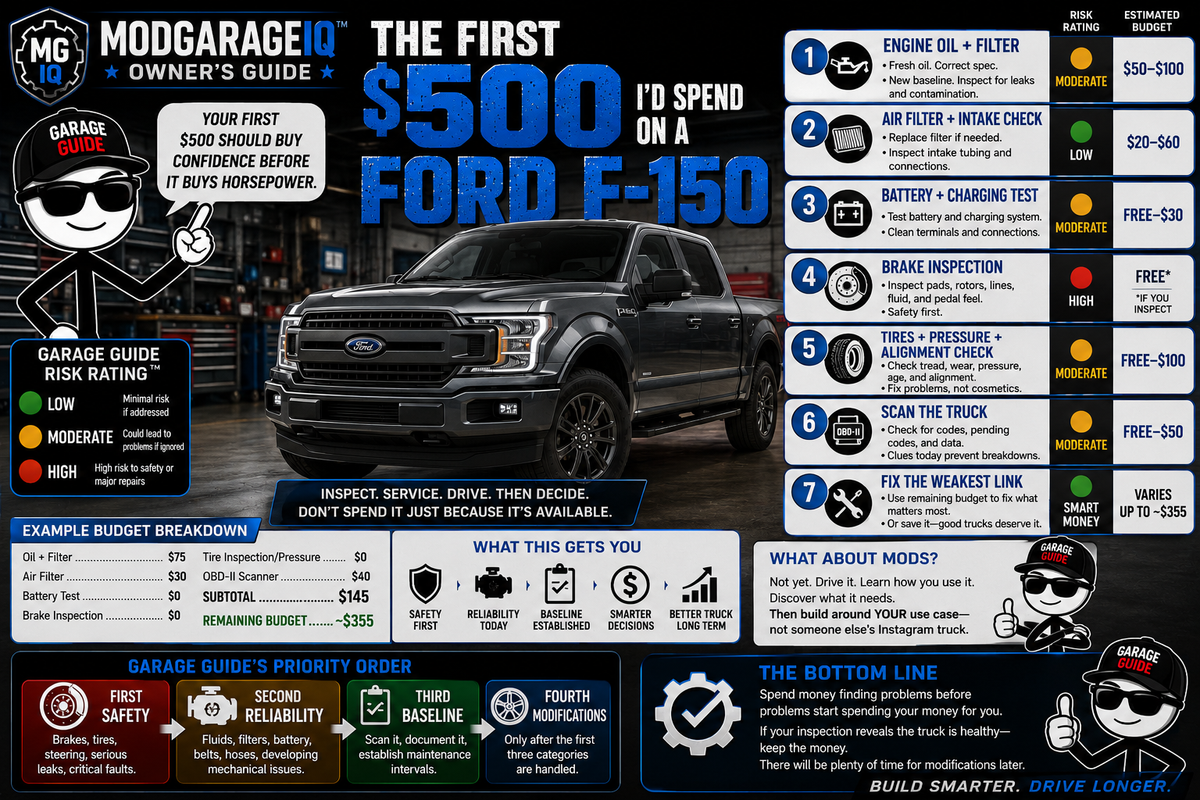
Your First $500 Should Buy Confidence Before It Buys Horsepower.
There are probably already a dozen things you want to change.
Leveling kit. Wheels. Tires. Exhaust. Intake. Lights. Maybe a tune.
But if you handed Garage Guide $500 and the keys to a newly purchased used F-150, the first shopping trip probably wouldn’t be very exciting.
It would be about making sure the truck is healthy.
Because before we spend money making an F-150 look better, sound better, tow more confidently, or make more power, we need to know whether the truck underneath all of that is ready for it.
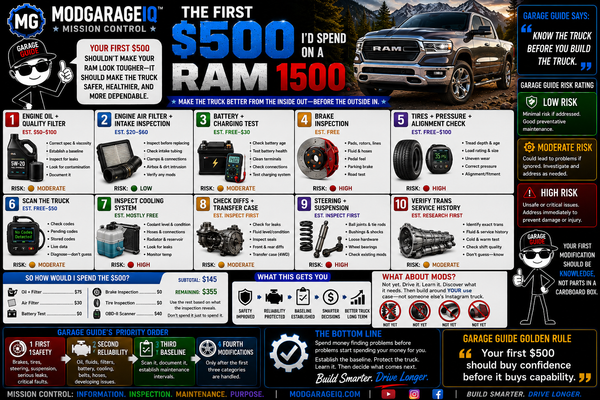
Here’s where I’d spend the first $500.
1. Engine Oil + Quality Filter
Estimated budget: $50–$100
Even if the previous owner says:
“Oil was just changed.”
Unless there’s documentation you trust, verify it yourself.
Fresh oil gives you a known starting point and provides an opportunity to inspect for:
- Abnormally low oil level
- Leaks
- Unusual contamination
- Incorrect filter
- Damaged drain plug
- Evidence of neglected maintenance
Use the correct oil specification and viscosity for your particular engine and model year rather than assuming every F-150 takes the same thing.
Once finished, record the mileage.
Congratulations—you now know exactly when the oil was serviced.
🟡 Garage Guide Risk Rating: MODERATE
Running an engine with low, incorrect, or severely degraded oil can turn a simple maintenance item into an expensive repair.
Garage Guide Says:
“Don’t inherit someone else’s oil-change schedule. Start your own.”
2. Air Filter + Intake Inspection
Estimated budget: $20–$60
This is inexpensive, easy to overlook, and gives you a reason to inspect the entire intake tract.
Check the filter for:
- Dirt
- Leaves and debris
- Oil contamination
- Damage
- Poor fitment
Then inspect the intake tubing and connections.
If the truck already has an aftermarket intake, figure out exactly what was installed and inspect its condition.
Don’t automatically replace a perfectly good factory intake because an aftermarket one looks more exciting.
We’re spending our first $500 on needs before wants.
🟢 Garage Guide Risk Rating: LOW
Garage Guide Says:
“A shiny part isn’t automatically an upgrade.”
3. Battery + Charging-System Test
Estimated budget: FREE–$30 for testing/cleaning
Before replacing the battery, test it.
Check:
- Battery age
- Terminal condition
- Corrosion
- Cable connections
- Hold-down
- Resting voltage
- Charging performance
A battery that seems fine during warm weather can reveal its weakness the first cold morning you actually need the truck.
If testing shows the battery is healthy, great.
Keep the money.
If it isn’t, we’ve identified something worth addressing before buying modifications.
🟡 Garage Guide Risk Rating: MODERATE
Garage Guide Says:
“The best time to discover a weak battery is in your driveway—not a parking lot.”
4. Brake Inspection
Estimated budget: FREE if inspected yourself
Notice I said inspection, not automatically replacing everything.
We’re trying to spend intelligently.
Inspect:
- Front pads
- Rear pads
- Rotors
- Brake hoses
- Brake lines
- Fluid condition
- Parking brake
- Pedal feel
Then pay attention during the road test.
Does the truck:
- Pull while braking?
- Vibrate through the steering wheel?
- Pulsate through the pedal?
- Squeal?
- Grind?
- Require excessive pedal travel?
If the brakes are healthy, the budget stays intact.
If they’re not, they immediately move ahead of modifications.
🔴 Garage Guide Risk Rating: HIGH
Garage Guide Says:
“Never spend money making a vehicle faster before you’re confident it can stop.”
5. Tires + Pressure + Alignment Check
Estimated budget: FREE–$100 depending on inspection/alignment needs
Don’t buy new tires just because we’re spending $500.
Inspect the tires you already own.
Check:
- Tread depth
- Tire pressure
- Sidewall condition
- Tire age
- Uneven wear
- Matching sizes
- Load rating
- Signs of rubbing
Then look at the wear pattern.
Inside-edge wear, outside-edge wear, cupping, or irregular tread wear may be telling you something about alignment, suspension, inflation, or worn components.
If everything looks good, spend nothing.
If alignment is clearly questionable, that’s a far better use of the budget than a cosmetic accessory.
🟡 Garage Guide Risk Rating: MODERATE
Garage Guide Says:
“Your tires are constantly giving you an inspection report. Learn how to read it.”
6. Scan the Truck
Estimated budget: FREE–$50
If you don’t already own a basic OBD-II scanner, this is one tool I’d seriously consider adding to the garage.
Scan for:
- Current codes
- Pending codes
- Stored codes
- Relevant available data
A dashboard without a warning light does not automatically mean there’s nothing worth investigating.
And if you discover a problem?
Don’t immediately fire the parts cannon.
Diagnose first.
🟡 Garage Guide Risk Rating: MODERATE
Garage Guide Says:
“Codes are clues—not shopping lists.”
7. Put the Remaining Money Toward the Truck’s Weakest Area
Here’s where the plan changes depending on what you discovered.
Suppose we’ve spent roughly:
Oil + filter: $75Air filter: $30Battery test: $0Brake inspection: $0Tire inspection: $0Scanner: $40
We’re only around $145 into our $500 budget.
That leaves roughly $355.
Don’t spend it just because it’s available.
Use the inspection from Day One to decide what deserves it.
Maybe that means:
- Replacing worn brake components
- Correcting an alignment problem
- Servicing another fluid
- Replacing worn belts or hoses
- Addressing a leak
- Repairing a suspension component
- Replacing a weak battery
- Fixing questionable previous-owner modifications
Or maybe the truck checks out beautifully.
In that case?
Keep the money.
You don’t receive a trophy for spending the entire $500.
🟢 Garage Guide Risk Rating: SMART MONEY
Garage Guide Says:
“A budget is a limit—not a spending requirement.”
What About Mods?
This is where people usually expect me to say:
Cold-air intake. Exhaust. Tune. Leveling kit.
Not yet.
Those things aren’t necessarily bad.
But we’re only on Day Two of ownership.
Drive the truck first.
Learn:
- How you actually use it
- What bothers you
- What it genuinely needs
- Whether you tow
- Whether you haul
- Whether you go off-road
- Whether fuel economy matters
- Whether ride quality matters
- Whether performance matters
Then build around your use case instead of somebody else’s Instagram truck.
Garage Guide’s First $500 Priority
🔴 FIRST — Safety
Brakes, tires, steering, serious leaks, critical faults.
🟡 SECOND — Reliability
Fluids, filters, battery, belts, hoses, developing mechanical issues.
🟢 THIRD — Baseline
Scan it, document it, establish maintenance intervals.
🔵 FOURTH — Modifications
Only after the first three categories are handled.
That order matters.
The Bottom Line
The first $500 you spend on a newly purchased F-150 shouldn’t automatically make the truck:
Taller.
Louder.
Faster.
Brighter.
It should make the truck better understood and better prepared.
Spend money finding problems before problems start spending your money for you.
And if your inspection reveals that the truck is already healthy?
Excellent.
Put the remaining money back in your pocket.
There will be plenty of time for modifications later.
Garage Guide Says:
“Your first $500 should buy confidence before it buys horsepower.”
Build Smarter. Drive Longer.
#ModGarageIQ #GarageGuide #F150 #FordF150 #F150Owners #TruckMaintenance #TruckOwnership #First500 #OwnerGuide #AutomotiveEducation #BuildSmarterDriveLonger