The Biggest Mistakes Toyota Camry Owners Make
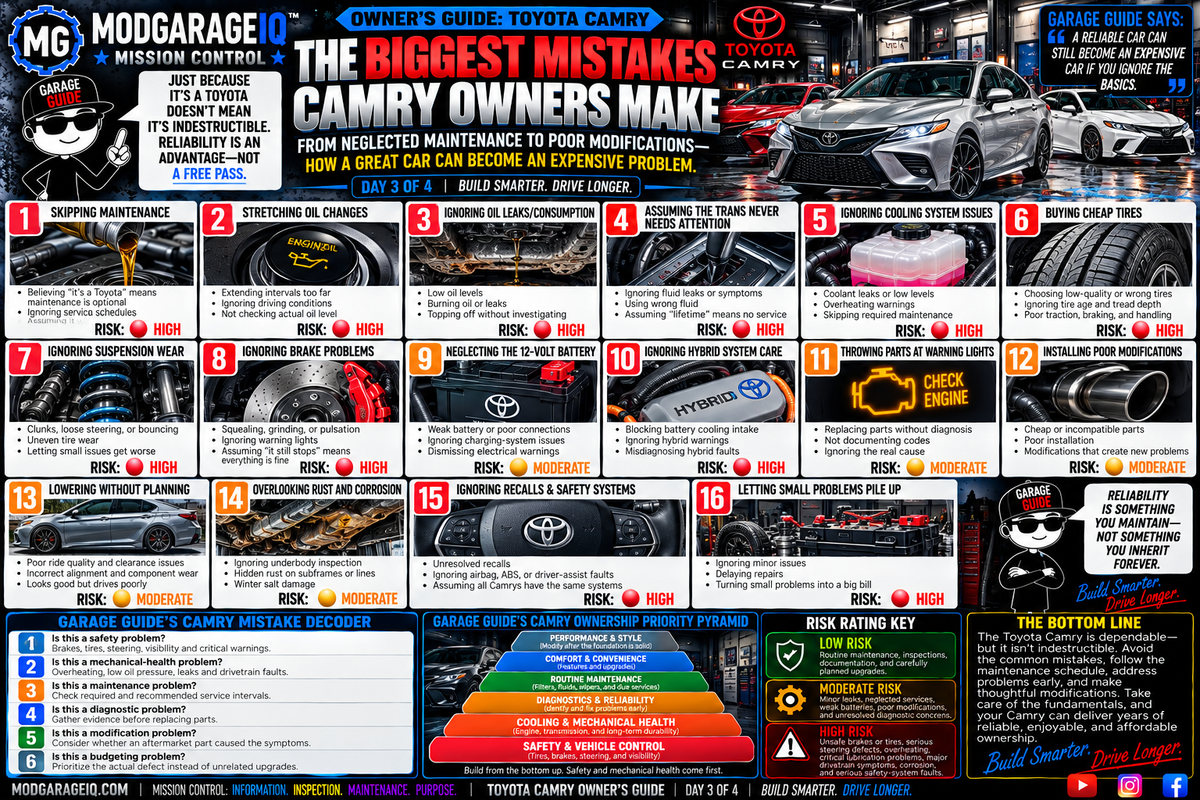
The Camry Has Earned Its Reputation for Reliability—But Neglected Maintenance, Ignored Warning Signs, and Poorly Planned Modifications Can Still Turn a Great Car Into an Expensive Problem.
MODGARAGEIQ OWNER’S GUIDE • TOYOTA CAMRY • DAY 3 OF 4
The Toyota Camry has spent decades earning a reputation for dependability.
Comfortable.
Practical.
Efficient.
Easy to live with.
And when properly maintained, capable of providing years of dependable transportation.
But there’s a problem with owning a vehicle known for reliability.
Sometimes owners start believing that reputation means they don’t have to take care of it.
Oil changes get delayed.
Warning lights get ignored.
Strange noises become background music.
Transmission concerns get dismissed.
And before long, the Camry that was supposed to save money starts demanding it.
The Camry’s greatest strength is reliability. Its greatest ownership mistake is taking that reliability for granted.
Let’s break down the mistakes Garage Guide wants every Camry owner to avoid.
1. Believing “It’s a Toyota” Means Maintenance Is Optional
This is the big one.
Toyota’s reputation was built on engineering, manufacturing, and durability.
Not magic.
Every Camry still depends on:
- Proper lubrication
- Cooling-system health
- Transmission maintenance
- Good tires
- Functional brakes
- Healthy electrical systems
- Timely inspections
Skipping maintenance because the vehicle has a reputation for lasting a long time defeats the entire advantage of owning one.
Garage Guide Risk Rating: 🔴 HIGH
Garage Guide Says:
“Toyota built the reputation. Your maintenance habits determine whether your Camry lives up to it.”
2. Stretching Oil Changes Without Considering Driving Conditions
Some owners treat the longest published oil-change interval as a universal recommendation.
But service requirements can vary with:
- Model year
- Engine
- Oil specification
- Driving conditions
- Short-trip operation
- Towing or heavy use where applicable
- Manufacturer-defined severe-service conditions
And an oil-life reminder or maintenance indicator isn’t a substitute for checking the actual oil level.
Follow the correct maintenance schedule for your vehicle and driving conditions.
Don’t assume every Camry uses the same interval.
Garage Guide Risk Rating: 🔴 HIGH
Garage Guide Says:
“The cheapest engine repair is usually the oil change you didn’t skip.”
3. Ignoring Oil Consumption or Leaks
A Camry shouldn’t get a free pass simply because it’s a Camry.
Some older Toyota engine families have documented oil-consumption concerns.
But not every Camry engine shares those problems.
Pay attention to:
- Falling oil levels
- Oil spots
- Burning-oil odors
- Smoke
- Leaks around engine seals
- Changes in consumption
If the oil level keeps dropping, investigate.
Don’t just keep topping it off indefinitely without understanding why.
And never continue driving with critically low oil pressure.
Garage Guide Risk Rating: 🔴 HIGH
Garage Guide Says:
“A reliable engine can still fail if it runs out of the one thing keeping its moving parts alive.”
4. Assuming the Transmission Never Needs Attention
This mistake can get expensive.
Different Camry generations use different transmission designs.
Some have conventional automatics.
Hybrid Camrys use an electronically controlled hybrid transaxle.
Maintenance requirements and procedures aren’t interchangeable.
Common mistakes include:
- Ignoring fluid leaks
- Dismissing harsh shifting
- Overlooking unusual vibrations
- Using incorrect fluid
- Assuming every transmission is maintenance-free
- Performing inappropriate flush procedures
- Ignoring manufacturer service guidance
The right approach?
Identify the exact transmission.
Review its maintenance requirements.
Diagnose symptoms before authorizing repairs.
Garage Guide Risk Rating: 🔴 HIGH
Garage Guide Says:
“A transmission doesn’t become maintenance-free just because somebody called the fluid lifetime.”
5. Ignoring Cooling-System Problems
A cooling-system problem doesn’t become harmless because the vehicle has a Toyota badge.
Watch for:
- Coolant leaks
- Overheating
- Low coolant
- Unusual temperature behavior
- Water-pump problems
- Deteriorated hoses
- Cooling-fan concerns
And remember that hybrids may have additional cooling circuits requiring their own procedures.
If the engine is overheating, safely stop and investigate rather than trying to finish the trip.
Garage Guide Risk Rating: 🔴 HIGH
Garage Guide Says:
“The temperature gauge doesn’t care how many miles your neighbor’s Camry made it.”
6. Buying Cheap Tires Because “It’s Just a Camry”
This one drives Garage Guide crazy. 😂
A Camry is often used for:
- Commuting
- Highway driving
- Family transportation
- Rainy-weather travel
- Winter driving
- Long road trips
Those are exactly the situations where good tires matter.
Cheap or inappropriate tires can compromise:
- Wet traction
- Braking
- Steering response
- Ride quality
- Noise
- Winter performance
And don’t forget tire age, tread depth, proper inflation, and alignment.
Garage Guide Risk Rating: 🔴 HIGH
Garage Guide Says:
“The road doesn’t give your tires an easier job because the car is a daily driver.”
7. Ignoring Suspension Wear Until the Car Feels Terrible
Suspension components wear gradually.
That’s what makes this mistake easy to overlook.
Over time, owners get used to:
- Clunks
- Loose steering
- Excessive bouncing
- Wandering
- Uneven tire wear
- Vibration
- Reduced ride quality
Inspect applicable struts, shocks, bushings, ball joints, tie rods, wheel bearings, and other components.
Don’t assume a Camry should feel sloppy simply because it has high mileage.
Garage Guide Risk Rating: 🔴 HIGH when steering or vehicle control is compromised.
Garage Guide Says:
“A comfortable car shouldn’t become a floating couch with license plates.”
8. Ignoring Brake Problems Because the Car Still Stops
A brake system can develop problems long before it completely fails.
Warning signs include:
- Grinding
- Squealing
- Pulsation
- Pulling
- Unusual pedal feel
- Brake warning lights
- Uneven pad wear
On hybrids, regenerative braking doesn’t eliminate conventional brake maintenance.
In some operating conditions, reduced friction-brake use can also make corrosion or sticking components worth monitoring.
Inspect the system instead of assuming everything is fine.
Garage Guide Risk Rating: 🔴 HIGH
Garage Guide Says:
“Still stopping isn’t the same thing as stopping properly.”
9. Ignoring the 12-Volt Battery
A weak battery can create all kinds of headaches.
Depending on the Camry’s powertrain, the 12-volt system plays different roles.
But it’s still important.
Owners sometimes ignore:
- Slow cranking on gasoline models
- Corroded terminals
- Weak battery test results
- Electrical warning messages
- Charging problems
- Poor connections
For hybrid Camrys, don’t confuse the 12-volt auxiliary battery with the high-voltage traction battery.
Diagnose the correct system.
Garage Guide Risk Rating: 🟡 MODERATE
Garage Guide Says:
“A dead battery can make a perfectly healthy Camry look like it suddenly forgot how to be a car.” 😂
10. Neglecting Hybrid Battery Cooling and System Maintenance
Hybrid Camry owners have a few additional responsibilities.
Depending on model year and design, hybrid battery cooling relies on airflow through designated intake passages.
Obstructions can interfere with proper thermal management.
Common mistakes include:
- Blocking cooling-air intakes
- Ignoring hybrid warnings
- Neglecting applicable cooling-system maintenance
- Assuming all hybrid faults mean the traction battery has failed
- Attempting unsafe high-voltage repairs
Follow the specific inspection and maintenance guidance for your model.
High-voltage components require proper training and procedures.
Garage Guide Risk Rating: 🔴 HIGH
Garage Guide Says:
“Hybrid systems aren’t something to fear. They’re something to understand.”
11. Throwing Parts at Warning Lights
The check-engine light comes on.
Someone scans the car.
A code appears.
And suddenly an expensive component gets ordered.
Problem solved?
Not necessarily.
Diagnostic codes identify detected conditions.
They don’t always identify the failed component.
Proper diagnosis may involve:
- Code documentation
- Freeze-frame data
- Live data
- Wiring checks
- Sensor testing
- Mechanical inspection
- Manufacturer diagnostic procedures
Don’t turn a diagnostic clue into a blind shopping spree.
Garage Guide Risk Rating: 🟡 MODERATE
Garage Guide Says:
“The scan tool tells you where to start looking. It doesn’t always tell you what to buy.”
12. Installing Cheap or Poorly Designed Modifications
There’s nothing wrong with personalizing a Camry.
But some upgrades can create more problems than they solve.
Be careful with:
- Questionable lowering springs
- Poor-quality wheels
- Incorrect wheel offsets
- Cheap lighting conversions
- Improper wiring
- Universal exhaust components
- Unsupported engine modifications
- Low-quality suspension parts
An upgrade should improve the vehicle for its intended purpose.
Not introduce new problems.
And modifications should comply with applicable safety and emissions requirements.
Garage Guide Risk Rating: 🟡 MODERATE
Garage Guide Says:
“Making a Camry different is easy. Making it better takes planning.”
13. Lowering the Car Without Considering Alignment and Geometry
A lower ride height can look good.
But suspension changes affect more than appearance.
Depending on the modification, you may alter:
- Alignment
- Suspension travel
- Ground clearance
- Ride quality
- Tire clearance
- Component wear
- Handling balance
A poorly planned lowering setup can make a comfortable Camry unpleasant to drive.
Use compatible components, verify clearance, and perform the appropriate alignment afterward.
Garage Guide Risk Rating: 🟡 MODERATE
Garage Guide Says:
“If your Camry looks great parked but hates every pothole, the build needs another meeting.”
14. Overlooking Rust and Underbody Damage
This is especially important for Camrys that spend winters on salted roads.
Inspect:
- Subframes
- Suspension mounting points
- Brake lines
- Fuel lines
- Exhaust components
- Body seams
- Wheel wells
- Underbody panels
Rust isn’t automatically catastrophic.
But structural corrosion and severely deteriorated brake lines can become serious safety issues.
Don’t wait until something breaks to inspect underneath the vehicle.
Garage Guide Risk Rating: 🟡 MODERATE, escalating to 🔴 HIGH for critical corrosion.
Garage Guide Says:
“The shiny paint on top doesn’t tell you what’s happening underneath.”
15. Ignoring Recalls and Safety-System Warnings
A dependable engine doesn’t make an unresolved safety issue acceptable.
Verify recalls using the vehicle’s VIN.
And investigate warnings involving:
- Airbags
- ABS
- Stability control
- Braking systems
- Steering
- Driver-assistance features
- Hybrid systems
Safety equipment and Toyota Safety Sense features vary by year and trim.
Never assume every Camry has the same systems.
Garage Guide Risk Rating: 🔴 HIGH
Garage Guide Says:
“Reliability gets you down the road. Safety systems help protect you while you’re there.”
16. Letting Small Problems Stack Into One Big Repair Bill
This is how many dependable vehicles become expensive.
It starts with one little issue.
Then another.
Then another.
A minor leak goes unaddressed.
Tires wear unevenly.
The suspension starts clunking.
The battery gets weak.
The brakes begin making noise.
And suddenly the owner says:
“This Camry is costing me a fortune!”
But the real problem may not be the Camry.
It may be months—or years—of deferred maintenance arriving at the same time.
Garage Guide Risk Rating: 🔴 HIGH
Garage Guide Says:
“The expensive repair bill often starts with several inexpensive problems nobody wanted to deal with.”
Garage Guide’s Camry Mistake Decoder
When something starts going wrong, ask yourself:
1
Is this a safety problem?
Brakes, tires, steering, visibility, structural damage and critical warnings come first.
2
Is this a mechanical-health problem?
Overheating, low oil pressure, serious leaks and drivetrain faults need prompt attention.
3
Is this a maintenance problem?
Check whether a required or recommended service has been neglected.
4
Is this a diagnostic problem?
Gather evidence before replacing components.
5
Is this a modification problem?
Consider whether an aftermarket part or installation caused the symptoms.
6
Is this a budgeting problem?
Prioritize the actual defect rather than purchasing unrelated upgrades.
Garage Guide’s Camry Ownership Priority Pyramid
PERFORMANCE & STYLE
COMFORT & CONVENIENCE
ROUTINE MAINTENANCE
DIAGNOSTICS & RELIABILITY
COOLING & MECHANICAL HEALTH
SAFETY & VEHICLE CONTROL
Build from the bottom up. Safety and mechanical health form the foundation.
Garage Guide Risk Rating
🟢 LOW RISK
Routine inspections, documented maintenance, and carefully planned cosmetic upgrades.
🟡 MODERATE RISK
Minor leaks, neglected filters, weak batteries, poor modification choices, and unresolved diagnostic concerns.
🔴 HIGH RISK
Unsafe brakes or tires, serious steering defects, overheating, critical lubrication problems, major drivetrain symptoms, structural corrosion, and serious safety-system faults.
The Bottom Line
The Toyota Camry doesn’t need to be treated like a fragile performance car.
But it shouldn’t be treated like an indestructible appliance either.
Respect the maintenance schedule.
Monitor the oil.
Protect the cooling system.
Pay attention to the transmission.
Buy good tires.
Maintain the brakes.
Inspect the suspension.
Understand the hybrid system if equipped.
Diagnose warning lights.
Avoid questionable modifications.
And never let small problems quietly pile up.
Because the best thing about owning a Camry isn’t that it never needs attention.
It’s that taking care of the fundamentals can reward you with years of dependable ownership.
Garage Guide Says:
“The biggest Camry mistake isn’t buying the wrong modification. It’s forgetting that reliability is something you maintain—not something you inherit forever.”
Build Smarter. Drive Longer.
COMING TOMORROW — OCTOBER 15
Best Build Paths for the Toyota Camry
Daily driver, OEM+, comfort cruiser, sport-inspired street build, efficiency-focused commuter, and long-term keeper—which Camry build actually makes sense for you?
#ModGarageIQ #GarageGuide #ToyotaCamry #Toyota #CamryOwners #CamryNation #ToyotaMaintenance #CarMaintenance #CommonCarMistakes #UsedCarTips #DailyDriver #VehicleReliability #OwnersGuide #AutomotiveEducation #MissionControl #BuildSmarterDriveLonger