The Biggest Mistakes Ram 1500 Owners Make
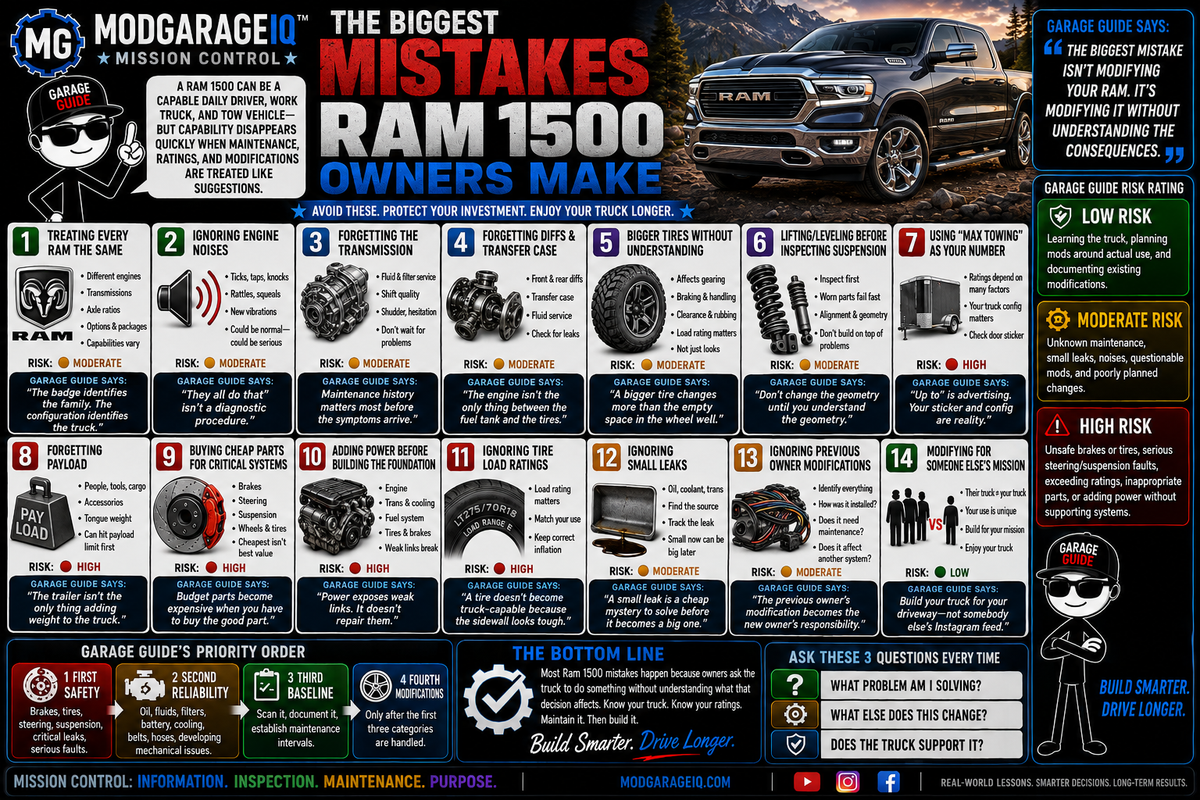
A Ram 1500 Can Be a Capable Daily Driver, Work Truck, and Tow Vehicle—but Capability Disappears Quickly When Maintenance, Ratings, and Modifications Are Treated Like Suggestions.
The Ram 1500 is an easy truck to personalize.
That’s part of the appeal.
Wheels.
Tires.
Leveling kits.
Suspension.
Exhaust.
Lighting.
Towing equipment.
Performance upgrades.
You can take a stock Ram and start changing it almost immediately.
But there’s a problem:
Every modification still depends on the health of the truck underneath it.
And modifications aren’t the only place owners get into trouble.
Some of the most expensive Ram mistakes start with ordinary things:
Ignoring maintenance.
Guessing at towing capacity.
Running worn tires.
Overlooking noises.
Buying parts before diagnosing problems.
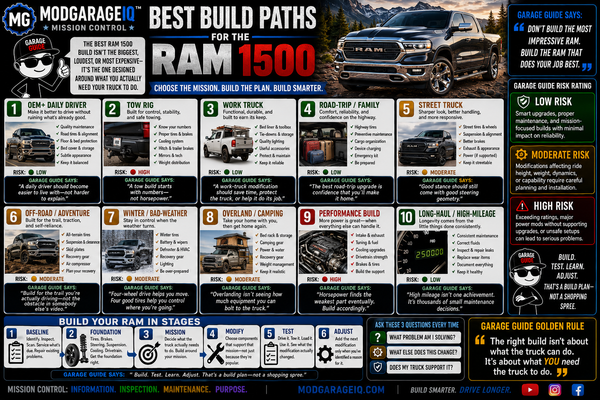
So before we start building our Ram, here are the mistakes Garage Guide wants us to avoid.
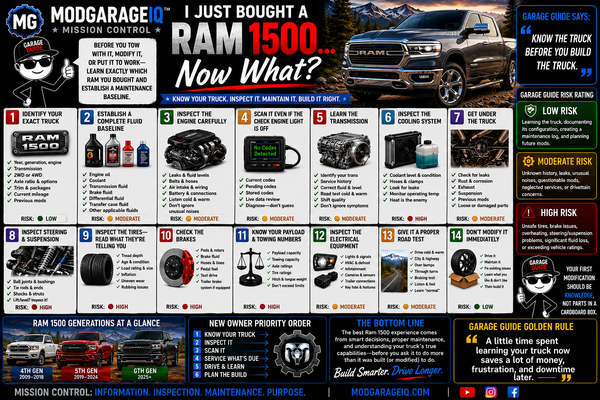
1. Treating Every Ram 1500 Like It’s the Same Truck
A badge on the tailgate doesn’t tell you everything you need to know.
Ram 1500s vary by:
- Model year
- Generation
- Engine
- Transmission
- 2WD or 4WD
- Axle ratio
- Suspension
- Trim
- Payload configuration
- Towing equipment
- Factory options
Those differences can affect maintenance, parts, fluids, capability, and modification choices.
So don’t ask:
“What does a Ram 1500 need?”
Ask:
“What does MY Ram 1500 need?”
🟡 Garage Guide Risk Rating: MODERATE
Garage Guide Says:
“The badge identifies the family. The configuration identifies the truck.”
2. Ignoring Engine Noises Because “They All Do That”
This is a dangerous phrase in automotive ownership:
“They all do that.”
Some noises may be characteristic of a particular engine or operating condition.
Others may indicate a developing problem.
The important part is determining which one you’re hearing.
If you notice a:
- Tick
- Tap
- Knock
- Rattle
- Squeal
- Grinding sound
- New vibration
Pay attention to when it occurs.
Cold start?
Warm idle?
Acceleration?
Deceleration?
Under load?
Don’t diagnose the truck from sound alone—but don’t turn the radio up either.
🟡 Garage Guide Risk Rating: MODERATE
Some abnormal noises can indicate higher-risk problems depending on their cause.
Garage Guide Says:
“‘They all do that’ isn’t a diagnostic procedure.”
3. Forgetting About the Transmission Until It Acts Up
Your transmission is doing a lot of work.
Especially if the truck:
- Tows
- Hauls
- Sees stop-and-go traffic
- Runs larger tires
- Has power modifications
- Works in demanding conditions
Know which transmission you have.
Understand its maintenance requirements.
Pay attention to:
- Shift quality
- Engagement
- Shudder
- Hesitation
- Unusual noises
- Abnormal RPM behavior
- Changes between cold and warm operation
Don’t wait until the truck drives differently to become interested in its service history.
🟡 Garage Guide Risk Rating: MODERATE
Garage Guide Says:
“Maintenance history matters most before the symptoms arrive.”
4. Forgetting the Differentials and Transfer Case Exist
Engine oil gets all the attention.
Meanwhile, the rest of the drivetrain quietly goes to work.
Depending on your truck’s configuration, additional components may require inspection or maintenance, including:
- Front differential
- Rear differential
- Transfer case
- Associated seals and components
Verify what applies to your exact truck and what service has actually been performed.
Look underneath for leakage.
And if you tow or work the truck hard, understand how your use may affect maintenance requirements.
🟡 Garage Guide Risk Rating: MODERATE
Garage Guide Says:
“The engine isn’t the only thing between the fuel tank and the tires doing work.”
5. Installing Bigger Tires Without Understanding What Changes
Bigger tires can look great on a Ram.
But they’re not just cosmetic.
Changing tire size can affect things such as:
- Effective gearing
- Acceleration
- Braking feel
- Steering response
- Unsprung/rotating mass
- Clearance
- Fuel economy
- Speedometer accuracy depending on configuration/calibration
- Suspension and steering loads
Then there’s fitment.
Will they rub?
Do they require additional changes?
Are the wheels properly specified?
Does the tire have an appropriate load rating?
A good truck build considers the system, not just the tire.
🟡 Garage Guide Risk Rating: MODERATE
Poor fitment or inappropriate components can create higher-risk conditions.
Garage Guide Says:
“A bigger tire changes more than the empty space inside the wheel well.”
6. Leveling or Lifting the Truck Before Inspecting the Suspension
The box arrives.
The weekend is free.
Time to level the truck.
Except…
When was the last time anyone inspected the suspension underneath it?
Before changing ride height, inspect applicable components such as:
- Ball joints
- Tie rods
- Bushings
- Shocks
- Wheel bearings
- Control arms
- Existing suspension hardware
Then understand how the modification affects alignment and geometry.
Don’t install shiny new parts around worn-out old ones.
🟡 Garage Guide Risk Rating: MODERATE
Improperly installed or poorly selected suspension modifications can create serious handling and component-wear problems.
Garage Guide Says:
“Don’t change the geometry until you understand the geometry.”
7. Assuming the Internet’s Maximum Towing Number Is Your Towing Number
This one matters.
You see an advertisement:
“Tows up to…”
And suddenly that number becomes your truck’s number.
Not necessarily.
Actual capability depends on the specific truck and configuration.
Relevant considerations can include:
- Engine
- Transmission
- Axle ratio
- Drivetrain
- Equipment
- Payload
- Hitch system
- Tire ratings
- Trailer configuration
Then remember that trailer tongue weight, occupants, tools, cargo, and accessories can affect how much capacity remains.
Use the ratings and documentation applicable to your specific truck.
🔴 Garage Guide Risk Rating: HIGH
Exceeding vehicle, tire, axle, hitch, or trailer ratings can create a serious safety problem.
Garage Guide Says:
“‘Up to’ is advertising. Your door sticker and configuration are reality.”
8. Forgetting About Payload
Towing gets the big number.
Payload gets ignored.
But everything carried by the truck matters.
Depending on the situation, that can include:
- Driver
- Passengers
- Cargo
- Tools
- Bed equipment
- Accessories
- Hitch equipment
- Trailer tongue weight
A truck can encounter a payload limitation before reaching the impressive towing number somebody saw online.
Know the ratings applicable to your vehicle.
🔴 Garage Guide Risk Rating: HIGH
Garage Guide Says:
“The trailer isn’t the only thing adding weight to the truck.”
9. Buying Cheap Suspension, Steering, or Brake Parts
There are places where saving money makes sense.
Components directly affecting vehicle control deserve more thought.
When replacing or modifying:
Brakes.Steering.
Suspension.
Wheels.
Tires.
Quality, suitability, installation, and correct specifications matter.
The cheapest listing isn’t automatically the best value.
Especially on a truck that may eventually carry or tow substantial weight.
🔴 Garage Guide Risk Rating: HIGH
Garage Guide Says:
“Budget parts become expensive when you have to buy the good part afterward.”
10. Adding Power Before Building the Foundation
More power is fun.
But power doesn’t exist in isolation.
Before meaningful performance modifications, evaluate the condition and capability of supporting systems such as:
- Engine
- Transmission
- Cooling
- Fuel system
- Drivetrain
- Tires
- Brakes
Also consider:
- Calibration requirements
- Fuel requirements
- Heat
- Reliability goals
- Intended use
- Applicable emissions/legal requirements
If the truck already has mechanical problems, horsepower isn’t the repair.
🔴 Garage Guide Risk Rating: HIGH
Garage Guide Says:
“Power exposes weak links. It doesn’t repair them.”
11. Ignoring Tire Load Ratings
Truck tires aren’t chosen by appearance alone.
If your Ram tows, hauls, works, or carries substantial loads, tire capability matters.
Make sure your tires are appropriate for:
- Vehicle requirements
- Wheel size
- Intended use
- Expected loads
Also maintain proper inflation based on appropriate vehicle/tire guidance.
A giant aggressive-looking tire isn’t automatically the right tire.
🔴 Garage Guide Risk Rating: HIGH
Garage Guide Says:
“A tire doesn’t become truck-capable because the sidewall looks tough.”
12. Ignoring Small Leaks
A few drops on the driveway.
A damp differential.
Oil residue.
Coolant staining.
Transmission-area moisture.
Easy to dismiss.
Instead, identify:
What fluid is it?
Where is it coming from?
How quickly is it leaking?
Is the fluid level changing?
Some leaks remain minor.
Others become expensive quickly.
The earlier you understand one, the better your options usually are.
🟡 Garage Guide Risk Rating: MODERATE
Significant fluid loss can become high risk.
Garage Guide Says:
“A small leak is a cheap mystery to solve before it becomes a big one.”
13. Ignoring Previous Owner Modifications
Buying a modified truck doesn’t automatically mean buying a bad truck.
But every modification becomes something you now need to understand.
Identify:
- Suspension changes
- Wheel/tire changes
- Exhaust work
- Intake modifications
- Tuning
- Electrical accessories
- Towing equipment
- Lighting
- Aftermarket wiring
Ask:
What is it?
Who installed it?
How was it installed?
Does it require maintenance?
Does it affect another system?
Never assume the previous owner built the truck correctly.
🟡 Garage Guide Risk Rating: MODERATE
Garage Guide Says:
“The previous owner’s modification becomes the new owner’s responsibility.”
14. Modifying the Truck for Somebody Else’s Mission
This is the mistake that wastes the most money.
You see a truck online.
It looks incredible.
So you copy:
The wheels.
The tires.
The suspension.
The lights.
The accessories.
But that owner may use their truck completely differently.
Maybe you commute 70 miles every day.
Maybe you tow.
Maybe you never tow.
Maybe you need bed capacity.
Maybe you drive in snow.
Maybe comfort matters more than off-road clearance.
Build around your mission.
🟢 Garage Guide Risk Rating: LOW
The mechanical risk may be low, but the financial risk of building something you don’t enjoy can be substantial.
Garage Guide Says:
“Build your truck for your driveway—not somebody else’s Instagram feed.”
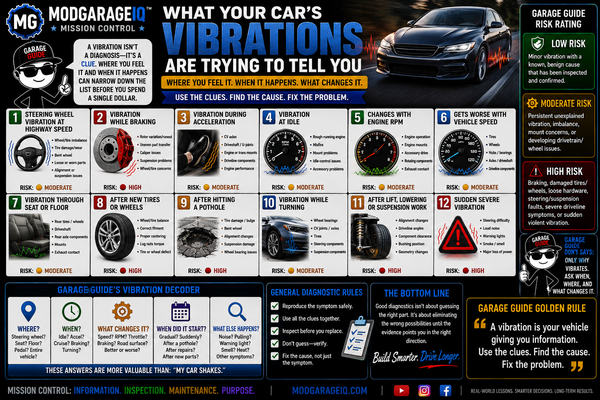
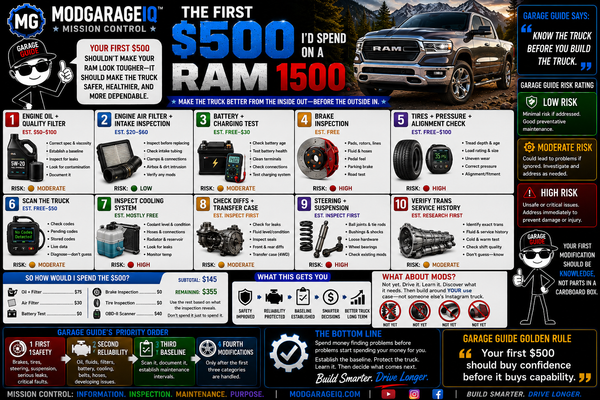
Garage Guide Risk Rating
🟢 LOW RISKLearning the truck, planning modifications around actual use, and documenting existing modifications.
🟡 MODERATE RISKUnknown drivetrain maintenance, small leaks, unexplained noises, questionable previous modifications, and poorly planned wheel/tire or suspension changes.
🔴 HIGH RISKUnsafe brakes or tires, serious steering/suspension faults, exceeding towing or payload ratings, inappropriate load-rated components, or adding significant power without supporting systems.
The Bottom Line
Most Ram 1500 mistakes aren’t caused by owners wanting too much from their trucks.
They’re caused by asking the truck to do something without understanding what that decision affects.
Bigger tires affect more than appearance.
Suspension changes affect more than ride height.
Towing involves more than horsepower.
Payload matters.
Maintenance matters.
Supporting systems matter.
And the truck’s exact configuration matters.
So before every repair, modification, or capability upgrade, ask:
What problem am I solving?
What else does this change?
Does the truck underneath it support the decision?
If you can answer those three questions, you’re already building smarter.
Garage Guide Says:
“The biggest mistake isn’t modifying your Ram. It’s modifying it without understanding the consequences.”
Build Smarter. Drive Longer.
#ModGarageIQ #GarageGuide #Ram1500 #RamTrucks #RamOwners #TruckMistakes #TruckMaintenance #TruckMods #Towing #OwnersGuide #MissionControl #AutomotiveEducation #BuildSmarterDriveLonger