The Biggest Mistakes Honda CR-V Owners Make
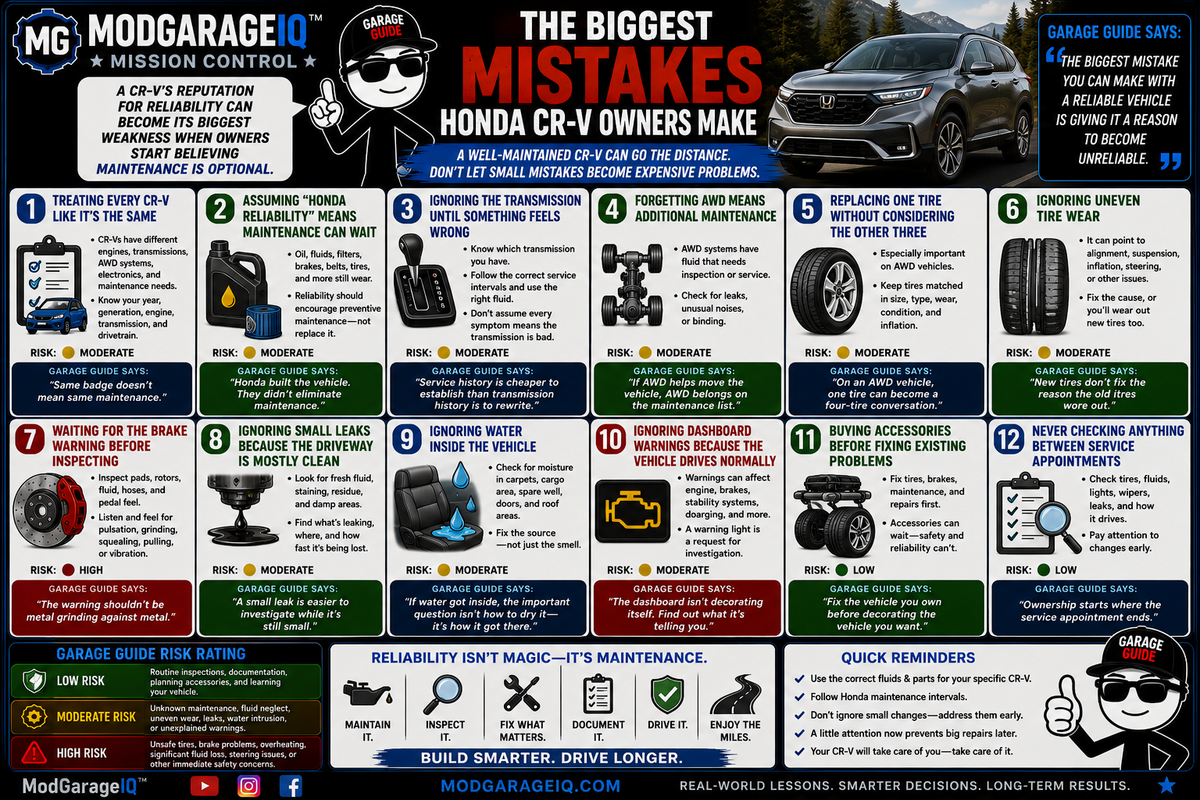
A CR-V’s Reputation for Reliability Can Become Its Biggest Weakness When Owners Start Believing Maintenance Is Optional.
The Honda CR-V has earned a reputation for being practical, efficient, and dependable.
And that’s exactly where some owners get into trouble.
When a vehicle has a reputation for reliability, it’s easy to assume:
“It’s a Honda. It’ll be fine.”
Oil changes get stretched.
Fluid services get forgotten.
Small noises become background noise.
Warning signs get ignored because the vehicle still starts every morning.
But reliability isn’t immunity from wear.
A well-maintained CR-V can be an excellent long-term vehicle. A neglected one can become expensive just like anything else.
Here are some of the biggest mistakes CR-V owners should avoid.
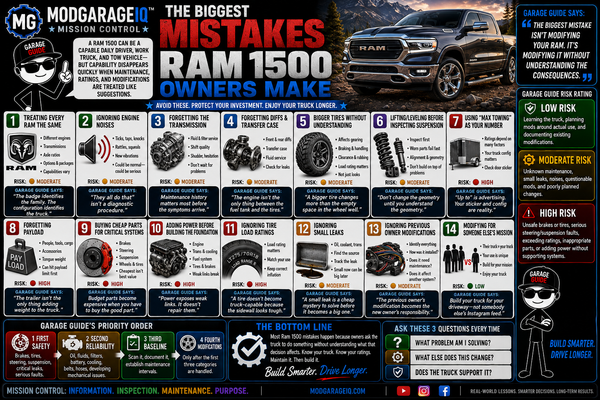
1. Treating Every CR-V Like It’s the Same Vehicle
The CR-V name has been around for decades.
During that time, Honda has used different:
- Engines
- Transmissions
- AWD systems
- Electronics
- Safety systems
- Maintenance requirements
Advice that applies perfectly to one generation may not apply to another.
Before ordering a part, choosing a fluid, following a service procedure, or diagnosing a problem, identify your:
Year.
Generation.
Engine.
Transmission.
Drivetrain.
🟡 Garage Guide Risk Rating: MODERATE
Using incorrect parts, fluids, or procedures can create problems that didn’t exist before the maintenance began.
Garage Guide Says:
“Same badge doesn’t mean same maintenance.”
2. Assuming “Honda Reliability” Means Maintenance Can Wait
This is probably the biggest mistake on the list.
A reliable vehicle still needs:
- Engine oil
- Filters
- Coolant
- Transmission maintenance
- Brake maintenance
- Spark plugs when applicable
- Belts
- Tires
- Battery
- AWD drivetrain maintenance where applicable
Components still wear.
Fluids still age.
Rubber still deteriorates.
And mileage still accumulates.
Reliability should encourage preventive maintenance—not replace it.
🟡 Garage Guide Risk Rating: MODERATE
Garage Guide Says:
“Honda built the vehicle. They didn’t eliminate maintenance.”
3. Ignoring the Transmission Until Something Feels Wrong
Transmission maintenance isn’t something to discover after the vehicle develops symptoms.
First, know which transmission your CR-V actually has.
Then follow the appropriate maintenance information for that vehicle and use the correct fluid and procedure.
Pay attention to changes such as:
- Hesitation
- Shudder
- Delayed engagement
- Unusual noises
- Abnormal RPM behavior
- Changes in driving feel
And don’t assume that every transmission complaint means the transmission itself has failed.
Diagnose before replacing parts.
🟡 Garage Guide Risk Rating: MODERATE
Garage Guide Says:
“Service history is cheaper to establish than transmission history is to rewrite.”
4. Forgetting AWD Means Additional Maintenance
AWD can disappear into the background during normal ownership.
Turn the key.
Drive.
Nothing reminds you that additional drivetrain components are underneath the vehicle.
Until they need attention.
If your CR-V is equipped with AWD, determine what additional fluid inspection or service applies to your specific model.
Also investigate:
- Leaks
- Unusual noises
- Binding or abnormal behavior
- Previous service history
🟡 Garage Guide Risk Rating: MODERATE
Garage Guide Says:
“If AWD helps move the vehicle, AWD belongs on the maintenance list.”
5. Replacing One Tire Without Considering the Other Three
This becomes especially important on AWD vehicles.
Imagine one tire is damaged.
The other three have substantial wear.
Installing one brand-new tire may create a meaningful difference in circumference compared with the worn tires.
Whether that difference is acceptable depends on the vehicle and tire situation, so follow the appropriate guidance for your CR-V.
More broadly, try to keep tires appropriately matched in:
- Size
- Type
- Wear
- Condition
- Inflation
🟡 Garage Guide Risk Rating: MODERATE
Garage Guide Says:
“On an AWD vehicle, one tire can become a four-tire conversation.”
6. Ignoring Uneven Tire Wear
Replacing worn tires is only half the job.
Ask:
Why did they wear that way?
Uneven wear may point toward:
- Incorrect inflation
- Alignment
- Suspension wear
- Steering issues
- Tire imbalance
- Driving conditions
If you install new tires without correcting the underlying cause, you may simply begin wearing out another set.
🟡 Garage Guide Risk Rating: MODERATE
Garage Guide Says:
“New tires don’t fix the reason the old tires wore out.”
7. Waiting for the Brake Warning Before Inspecting the Brakes
Your brake system shouldn’t only get attention when something starts grinding.
Regularly inspect:
- Pad thickness
- Rotor condition
- Brake-fluid condition
- Hoses and lines
- Pedal feel
And pay attention while driving.
Watch for:
- Pulsation
- Pulling
- Squealing
- Grinding
- Vibration
- Changes in pedal feel
A daily driver spends its life in traffic, intersections, parking lots, and stop-and-go driving.
Brakes are working constantly.
🔴 Garage Guide Risk Rating: HIGH
Garage Guide Says:
“The warning shouldn’t be metal grinding against metal.”
8. Ignoring Small Leaks Because the Driveway Is Mostly Clean
A leak doesn’t have to create a giant puddle to deserve attention.
Look for:
- Fresh fluid
- Damp areas
- Staining
- Dried residue
- Fluid collecting on splash shields
- Unexplained changes in fluid level
Some leaks remain small for a long time.
Others don’t.
Identify what is leaking, where it’s coming from, and how quickly fluid is being lost.
Then decide the appropriate response.
🟡 Garage Guide Risk Rating: MODERATE
Garage Guide Says:
“A small leak is easier to investigate while it’s still small.”
9. Ignoring Water Inside the Vehicle
This one doesn’t sound mechanical.
But water intrusion can create a surprisingly large headache.
Check for moisture around:
- Carpeting
- Cargo area
- Spare-tire well where applicable
- Door seals
- Roof or sunroof areas where equipped
- Headliner
- HVAC drainage areas
Persistent moisture can contribute to:
- Odors
- Mold or mildew
- Interior deterioration
- Corrosion
- Electrical problems depending on where water travels
If the interior smells damp after rain, don’t simply cover the smell with an air freshener.
Find the water.
🟡 Garage Guide Risk Rating: MODERATE
Garage Guide Says:
“If water got inside, the important question isn’t how to dry it—it’s how it got there.”
10. Ignoring Dashboard Warnings Because the Vehicle Drives Normally
Modern vehicles monitor a lot more than whether the engine starts.
If a warning appears, determine what it means.
Don’t automatically assume:
“It still drives fine, so it must not be serious.”
Some faults affect:
- Engine operation
- Emissions
- Braking systems
- Stability systems
- Driver-assistance systems
- Charging
- Tire pressure
- Other vehicle functions
A warning light isn’t a diagnosis.
It’s a request for investigation.
🟡 Garage Guide Risk Rating: MODERATE
Some warnings can indicate higher-risk conditions, so always identify the specific warning and respond accordingly.
Garage Guide Says:
“The dashboard isn’t decorating itself. Find out what it’s telling you.”
11. Buying Accessories Before Fixing Existing Problems
The CR-V aftermarket offers plenty of ways to personalize the vehicle.
Roof accessories.
Lighting.
Wheels.
Audio.
Cargo equipment.
Appearance upgrades.
But if your CR-V currently needs:
Tires, brakes, maintenance, alignment, or repairs…
That’s where the money goes first.
The accessory will still be available next month.
🟢 Garage Guide Risk Rating: LOW
Garage Guide Says:
“Fix the vehicle you own before decorating the vehicle you want.”
12. Never Checking Anything Between Service Appointments
This is one of the easiest habits to correct.
You don’t need to become a mechanic.
Periodically look at your vehicle.
Check:
- Tire pressure
- Tire condition
- Fluid levels where owner-checkable
- Exterior lights
- Wipers
- Evidence of leaks
- Unusual noises
- Warning messages
Pay attention to how it:
Starts.
Drives.
Steers.
Stops.
Sounds.
A service appointment shouldn’t be the only time anyone looks closely at your CR-V.
🟢 Garage Guide Risk Rating: LOW
Garage Guide Says:
“Ownership starts where the service appointment ends.”
Garage Guide Risk Rating
🟢 LOW RISKRoutine inspections, documentation, planning accessories, and learning your vehicle.
🟡 MODERATE RISKUnknown maintenance, transmission or AWD neglect, uneven tire wear, small leaks, water intrusion, or unexplained warning lights.
🔴 HIGH RISKUnsafe tires, brake problems, overheating, significant fluid loss, serious steering problems, or other immediate safety concerns.
The Bottom Line
The Honda CR-V’s reputation for reliability is deserved because millions of owners have experienced exactly what makes these vehicles appealing:
Practical transportation that can keep doing its job for a long time.
But reliability isn’t something you purchase once at the dealership.
It’s something you help preserve.
Don’t ignore maintenance because it’s a Honda.
Don’t ignore a noise because it still drives.
Don’t ignore a warning because the light eventually disappeared.
Don’t replace parts without diagnosing the problem.
And don’t wait for your next service appointment to start paying attention.
Garage Guide Says:
“The biggest mistake you can make with a reliable vehicle is giving it a reason to become unreliable.”
Build Smarter. Drive Longer.
#ModGarageIQ #GarageGuide #HondaCRV #CRV #HondaOwners #CRVMaintenance #CarMaintenance #SUVProblems #OwnersGuide #MissionControl #AutomotiveEducation #BuildSmarterDriveLonger