The Biggest Mistakes Honda Civic Owners Make
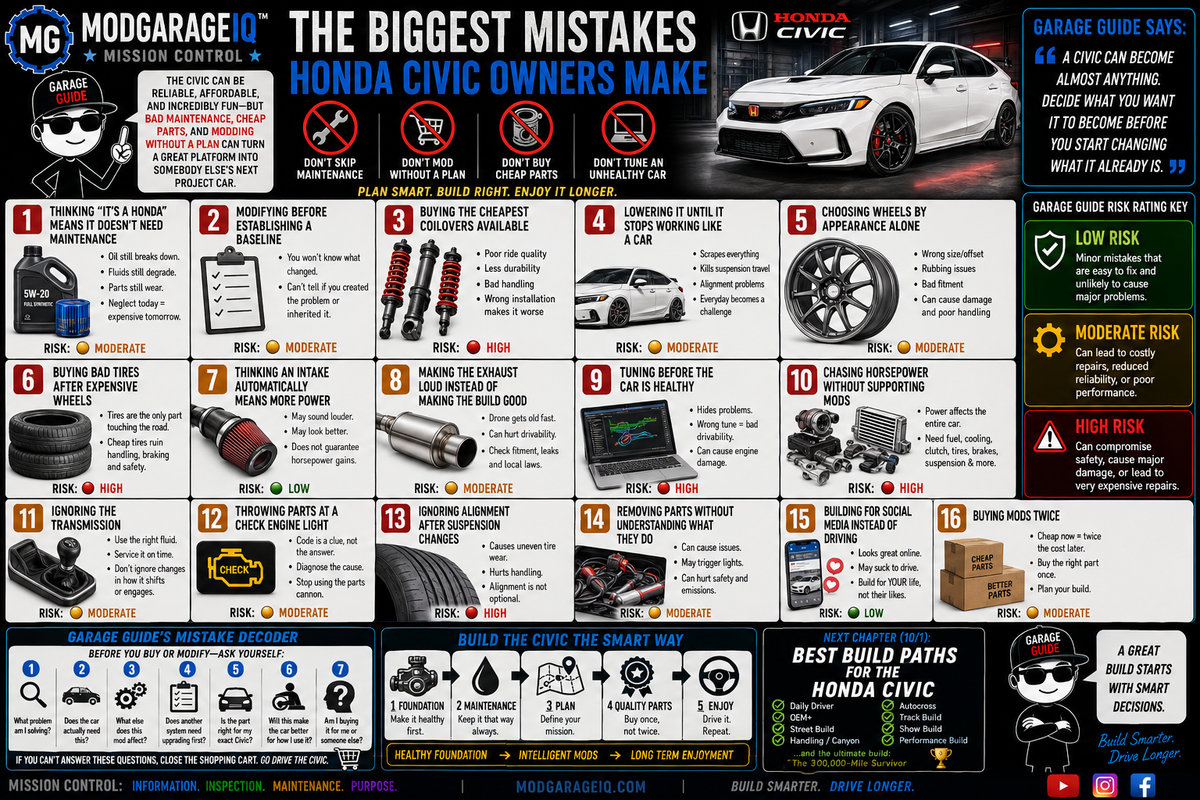
The Civic Can Be Reliable, Affordable, and Incredibly Fun—but Bad Maintenance, Cheap Parts, and Modifying Without a Plan Can Turn a Great Platform Into Somebody Else’s Next Project Car.
The Honda Civic has one of the largest enthusiast communities in the automotive world.
That’s awesome.
It also means there is an absolutely enormous supply of:
Parts.
Advice.
Videos.
Builds.
Tunes.
Suspension setups.
Wheel combinations.
And some truly questionable Facebook Marketplace decisions. 😂
The Civic’s reputation for durability can make owners believe almost anything can be done to one without consequences.
But reliability isn’t invincibility.
And aftermarket support doesn’t mean every aftermarket part is a good idea.
So before Garage Guide lets us build the Civic tomorrow, we’re covering the mistakes that can make ownership unnecessarily expensive.
1. Assuming “It’s a Honda” Means It Doesn’t Need Maintenance
This may be the biggest Civic mistake of all.
Honda built a reputation for dependable vehicles.
That reputation was never:
“Ignore the car indefinitely.”
Engine oil still ages.
Fluids still require attention.
Filters still become dirty.
Spark plugs still wear.
Suspension components still wear.
Rubber components still age.
Maintenance still matters.
🟡 Garage Guide Risk Rating: MODERATE
Neglect can eventually turn into expensive mechanical problems.
Garage Guide Says:
“Reliable doesn’t mean maintenance-free. Reliable means it’s worth maintaining.”
2. Modifying Before Establishing a Baseline
You bought the Civic Saturday.
Sunday:
Wheels ordered.
Monday:
Coilovers.
Tuesday:
Intake.
Wednesday:
Exhaust.
Thursday:
Laptop appears.
Garage Guide:
“BRO.”
😂
Before modifying anything, know the condition of the:
- Engine
- Transmission
- Cooling system
- Brakes
- Tires
- Steering
- Suspension
- Electrical system
Otherwise, when something changes afterward, you won’t know whether you:
Created the problem…
or
Inherited it.
🟡 Garage Guide Risk Rating: MODERATE
Garage Guide Says:
“You need a baseline before you can tell whether a modification made something better—or worse.”
3. Buying the Cheapest Coilovers Available
The Civic aftermarket makes lowering incredibly accessible.
That doesn’t mean every suspension kit deserves to be underneath your car.
Extremely cheap components can compromise:
- Ride quality
- Damping control
- Suspension travel
- Durability
- Adjustment quality
- Handling
- Tire wear
And installation matters too.
After changing ride height, inspect the entire setup and address alignment appropriately.
🔴 Garage Guide Risk Rating: HIGH
Poor suspension components or installation can affect vehicle control and tire contact.
Garage Guide Says:
“Your suspension is holding the car off the pavement. Maybe don’t sort by price: lowest first.” 😂
4. Lowering the Car Until It Stops Working Like a Car
There’s lowered.
Then there’s:
“I have to approach the gas station diagonally at 0.7 mph.” 😂
Ride height changes can affect:
- Ground clearance
- Suspension travel
- Alignment
- Tire clearance
- Steering geometry
- Underbody clearance
- Everyday usability
A street car still needs to survive:
Potholes.
Driveways.
Speed bumps.
Passengers.
Cargo.
Real roads.
🟡 Garage Guide Risk Rating: MODERATE
Extreme or poorly executed setups can become high risk.
Garage Guide Says:
“If your suspension modification removes the suspension’s ability to suspend, we need to talk.”
5. Choosing Wheels by Appearance Alone
You found the wheels.
They’re perfect.
Except nobody checked:
- Diameter
- Width
- Offset
- Tire size
- Load requirements
- Brake clearance
- Suspension clearance
- Fender clearance
Wheel fitment is a system.
Changing one measurement can affect another.
And remember:
The tire matters at least as much as the wheel.
🟡 Garage Guide Risk Rating: MODERATE
Poor fitment can create rubbing, tire damage, handling problems, or component interference.
Garage Guide Says:
“A wheel fitting onto the hub doesn’t mean the wheel fits the car.”
6. Buying Bad Tires After Buying Expensive Wheels
This one hurts Garage Guide personally. 😂
Beautiful wheels.
Suspension.
Exhaust.
Cosmetics.
Then:
The cheapest tires available.
Your tires influence:
- Braking
- Acceleration
- Wet-weather traction
- Cornering
- Steering feel
- Ride
- Noise
They are the connection between everything you’ve built and the pavement.
🔴 Garage Guide Risk Rating: HIGH
Garage Guide Says:
“Don’t spend $2,000 improving the car and then save $200 on the part touching the road.”
7. Assuming an Intake Automatically Means More Power
An intake can:
Look good.
Sound good.
Change induction noise.
And on some applications, support a properly planned performance setup.
But:
“Aftermarket intake installed”
does not automatically equal:
“Huge horsepower gained.”
Performance changes depend on the specific engine, hardware, calibration, and overall combination.
Buy modifications because they support your goal.
Not because the box says:
PERFORMANCE.
🟢 Garage Guide Risk Rating: LOW
Risk can increase if modifications create poor filtration, installation issues, calibration problems, or other faults.
Garage Guide Says:
“Louder air isn’t automatically faster air.” 😂
8. Making the Exhaust Loud Instead of Making the Build Good
Exhaust is subjective.
Some owners want quiet.
Some want aggressive.
Some want performance.
That’s fine.
But consider:
- Drone
- Daily drivability
- Fitment
- Ground clearance
- Exhaust leaks
- Local regulations
- Emissions requirements
- Overall system design
A car that sounds incredible for thirty seconds outside a meet might become exhausting during a three-hour highway trip.
🟡 Garage Guide Risk Rating: MODERATE
Garage Guide Says:
“Build an exhaust for the 99% of the time you’re inside the car too.”
9. Tuning Before the Car Is Healthy
This is where mistakes can become expensive.
Before changing engine calibration, establish mechanical health.
Depending on the Civic and modification level, that means understanding the condition of applicable:
- Engine
- Fuel system
- Ignition system
- Cooling system
- Intake system
- Exhaust system
- Transmission/clutch
- Supporting components
And use appropriate calibration for the actual combination.
Don’t treat tuning like installing a phone app.
🔴 Garage Guide Risk Rating: HIGH
Improper calibration can contribute to poor drivability, excessive mechanical stress, emissions issues, or engine damage.
Garage Guide Says:
“A tune should optimize a healthy combination—not hide a sick one.”
10. Chasing Horsepower Without Supporting Mods
Eventually the question becomes:
“How much power can it make?”
Garage Guide has another question:
“How much power can the entire car handle well?”
Power affects more than the engine.
Depending on the build, consider:
- Cooling
- Fuel delivery
- Clutch/transmission
- Axles
- Tires
- Brakes
- Suspension
- Engine condition
- Calibration
A dyno graph doesn’t show whether the car is enjoyable to drive every morning.
🔴 Garage Guide Risk Rating: HIGH
Garage Guide Says:
“Don’t build the horsepower number faster than you build the car supporting it.”
11. Ignoring the Transmission
The engine gets all the attention.
The transmission gets remembered when something feels wrong.
Whether your Civic uses a:
Manual.
Automatic.
or
CVT.
Know what it requires.
Use the correct fluid.
Understand appropriate service requirements.
And pay attention to changes in operation.
For manual cars, don’t ignore:
- Clutch slipping
- Grinding
- Difficult engagement
- Abnormal noises
For automatic/CVT-equipped cars, don’t ignore:
- Shudder
- Hesitation
- Engagement changes
- Abnormal RPM behavior
- Unusual noises
🟡 Garage Guide Risk Rating: MODERATE
Garage Guide Says:
“Everybody wants to modify the engine. Somebody still has to deliver that power to the wheels.”
12. Throwing Parts at a Check Engine Light
Civic throws a code.
Internet search.
Part ordered.
Part installed.
Light returns.
Another part ordered.
Welcome to:
THE PARTS CANNON.
😂
Instead:
Scan.
Understand the code.
Inspect.
Test.
Diagnose.
A trouble code describes something the vehicle detected.
It does not necessarily name the failed component.
🟡 Garage Guide Risk Rating: MODERATE
Garage Guide Says:
“The code is evidence. Treat it like evidence.”
13. Ignoring Alignment After Suspension Changes
New coilovers installed.
Car looks fantastic.
Three months later:
Inside edges of the tires look like racing slicks.
Whoops.
Any significant suspension or ride-height change deserves proper inspection and alignment consideration.
Then continue monitoring tire wear.
Because alignment isn’t just about:
“Does the steering wheel look straight?”
It affects how the tires interact with the road.
🔴 Garage Guide Risk Rating: HIGH
Garage Guide Says:
“If you changed where the suspension sits, check where the tires point.”
14. Removing Parts Without Understanding What They Do
This applies especially to heavily modified builds.
Before removing or altering a factory component, understand:
- Its purpose
- What systems interact with it
- Whether removal affects drivability
- Whether warning lights may result
- Whether calibration is involved
- Whether safety is affected
- Whether emissions compliance is affected
“Everybody deletes it” isn’t technical documentation.
🟡 Garage Guide Risk Rating: MODERATE
Potential risk depends heavily on the system being altered.
Garage Guide Says:
“Know why Honda installed it before deciding Honda didn’t need it.”
15. Building for Social Media Instead of Driving
This might be the easiest mistake to make.
You see a Civic online.
Perfect wheels.
Perfect stance.
Aggressive aero.
Beautiful engine bay.
And suddenly your perfectly enjoyable daily driver feels unfinished.
But you don’t know:
How it rides.
How often it scrapes.
Whether it overheats.
Whether it rubs.
Whether it spends every weekend being repaired.
Whether the owner even likes driving it.
Build inspiration is great.
But your Civic has to work for your life.
🟢 Garage Guide Risk Rating: LOW
Financial risk?
Garage Guide would like a separate rating category. 😂
Garage Guide Says:
“Don’t ruin a car you enjoy driving to build a car you enjoy photographing.”
16. Buying Mods Twice
This is the hidden budget killer.
Cheap suspension now.
Better suspension later.
Wrong wheels now.
Correct wheels later.
Random exhaust now.
Quality exhaust later.
Generic tune now.
Proper calibration later.
Suddenly the “cheap build” cost more than doing it correctly once.
Before purchasing anything, determine the eventual mission.
Then choose components that can remain part of that build.
🟡 Garage Guide Risk Rating: MODERATE
Garage Guide Says:
“Buying the right part once is usually cheaper than buying your way toward it three times.”
Garage Guide’s Civic Mistake Decoder
Before purchasing a modification, ask:
1. What problem am I solving?
2. Does the car actually need this?
3. What else does this modification affect?
4. Does another system need upgrading first?
5. Is the part appropriate for my exact Civic?
6. Will this make the car better for how I actually use it?
7. Am I buying this because I want it—or because somebody else’s build convinced me I need it?
If you can’t answer those questions…
Close the shopping cart.
Go drive the Civic.
😂🫡
Garage Guide Risk Rating
🟢 LOW RISKPlanning the build, researching parts, sensible appearance changes, and modifications that preserve vehicle function.
🟡 MODERATE RISKPoorly planned exhaust/intake changes, unknown maintenance, questionable previous modifications, bad fitment, or modifying without understanding system interactions.
🔴 HIGH RISKUnsafe tires, poorly executed suspension changes, tuning unhealthy vehicles, major power increases without supporting systems, brake deficiencies, or modifications that compromise vehicle control.
The Bottom Line
The Honda Civic doesn’t need protection from modifications.
It needs protection from modifications without a plan.
The platform can handle everything from a nearly stock commuter to a serious enthusiast build.
But the best examples have something in common:
Healthy foundation.
Quality components.
Correct installation.
Proper maintenance.
A defined mission.
And patience.
Don’t build the car five times because you couldn’t wait to build it correctly once.
Tomorrow, Garage Guide finally opens the catalog.
Because 10/1 closes our Civic series with:
Best Build Paths for the Honda Civic
Daily driver.
OEM+.
Street.
Handling.
Autocross.
Track.
Show.
Performance.
And maybe even the ultimate Civic build:
The 300,000-mile survivor. 😎
Garage Guide Says:
“A Civic can become almost anything. Decide what you want it to become before you start changing what it already is.”
Build Smarter. Drive Longer.
#ModGarageIQ #GarageGuide #HondaCivic #Civic #Honda #CivicMistakes #CivicBuild #HondaOwners #CarMods #ModifiedHonda #TunerCars #CarMaintenance #MissionControl #OwnersGuide #AutomotiveEducation #BuildSmarterDriveLonger