The Biggest Mistakes Ford F-150 Owners Make
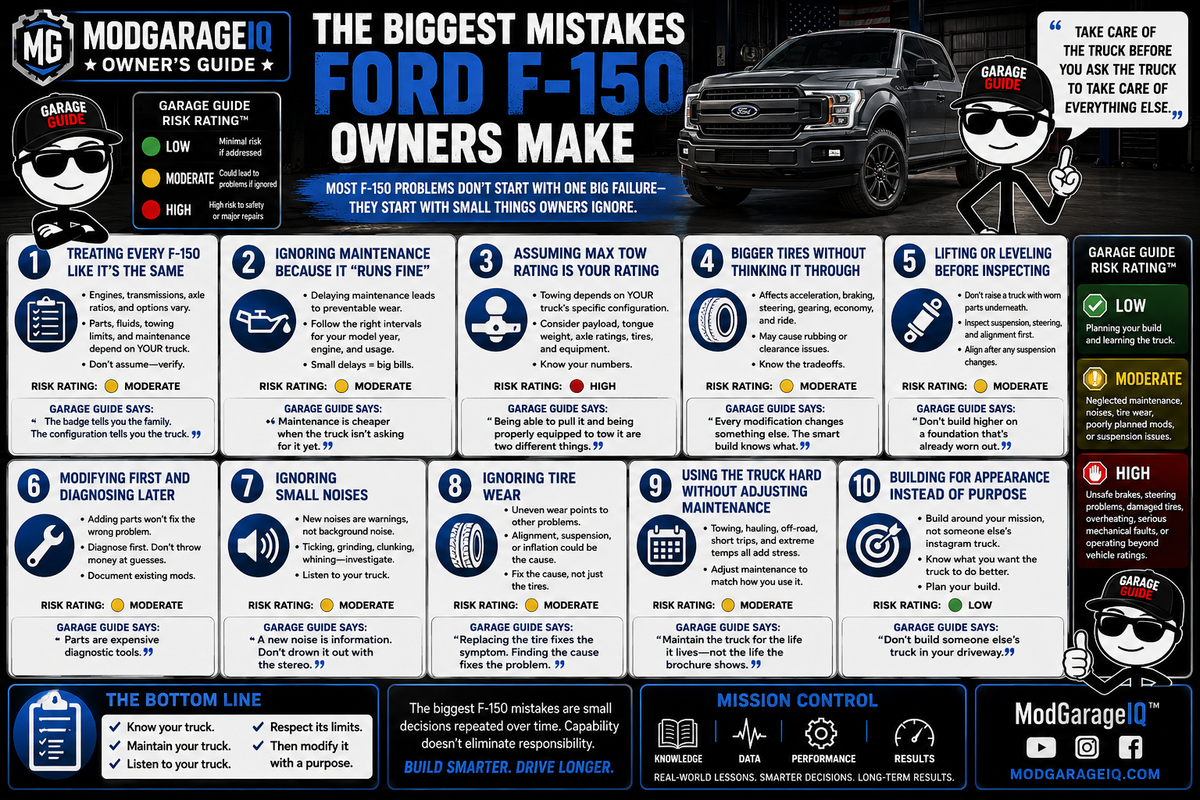
Most F-150 Problems Don’t Start With One Big Failure—They Start With Small Things Owners Ignore.
The Ford F-150 is built to do a little bit of everything.
Commute.
Tow.
Haul.
Work.
Travel.
Modify.
And sometimes spend its entire life doing little more than carrying groceries.
That versatility is one of the reasons the F-150 has become such a popular truck—but it can also create a dangerous assumption:
“It’s a truck. It can handle it.”
Usually, it can.
But even a capable truck can become an expensive one when maintenance gets ignored, modifications aren’t thought through, or its limits are misunderstood.
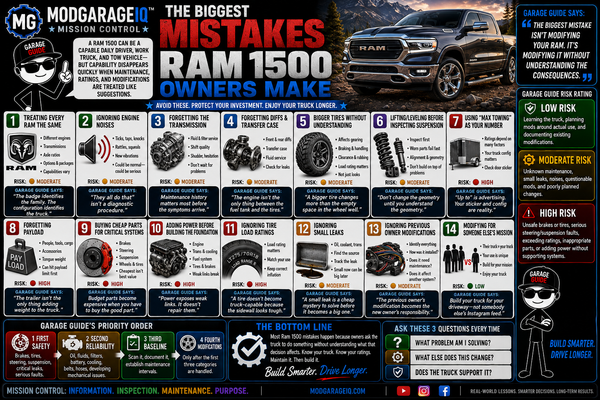
Here are some of the biggest mistakes F-150 owners make.
1. Treating Every F-150 Like It’s the Same Truck
An F-150 badge doesn’t tell you everything you need to know.
Depending on the year and configuration, trucks can differ in:
- Engine
- Transmission
- Axle ratio
- Drivetrain
- Suspension
- Payload capacity
- Towing capability
- Cooling equipment
- Factory packages
That’s why maintenance, parts, fluids, towing recommendations, and modification decisions should be based on your specific truck.
Don’t order parts because someone online said:
“It fits an F-150.”
Verify first.
🟡 Garage Guide Risk Rating: MODERATE
Incorrect parts, fluids, or assumptions about capability can create problems that were completely avoidable.
Garage Guide Says:
“The badge tells you the family. The configuration tells you the truck.”
2. Ignoring Maintenance Because the Truck “Runs Fine”
This is probably one of the easiest habits to fall into.
The truck starts.
No warning lights.
Transmission shifts.
Temperature gauge looks normal.
So maintenance gets pushed another month.
Then another.
But maintenance isn’t supposed to begin when something fails.
Stay on top of the items applicable to your truck, including:
- Engine oil
- Coolant
- Transmission service
- Differential fluid
- Transfer-case fluid on applicable 4WD trucks
- Brake fluid
- Filters
- Spark plugs
- Belts and hoses
- Battery
- Brakes
- Tires
Follow the appropriate service information for your model year, engine, transmission, and usage.
🟡 Garage Guide Risk Rating: MODERATE
Neglected maintenance often doesn’t announce itself immediately.
That’s exactly why it’s easy to neglect.
Garage Guide Says:
“Maintenance is cheaper when the truck isn’t asking for it yet.”
3. Assuming Maximum Tow Rating Means
Your
Truck Can Tow That Much
This deserves its own section because truck marketing can make towing numbers look deceptively simple.
They’re not.
Your truck’s actual capability depends on its specific configuration and ratings.
And towing isn’t only about whether the engine can pull the trailer.
You need to consider things such as:
- Payload
- Occupants
- Cargo
- Tongue weight
- Trailer weight
- Axle ratings
- Tire ratings
- Hitch equipment
- Truck configuration
That giant advertised maximum towing number isn’t automatically your number.
Check the information applicable to your specific vehicle and load.
🔴 Garage Guide Risk Rating: HIGH
Exceeding ratings can affect braking, handling, stability, component life, and safety.
Garage Guide Says:
“Being able to pull it and being properly equipped to tow it are two different things.”
4. Installing Bigger Tires Without Thinking About Everything They Affect
Bigger tires look fantastic on an F-150.
But they’re not just a cosmetic change.
Increasing tire size and weight can influence:
- Acceleration
- Braking
- Steering feel
- Fuel economy
- Effective gearing
- Suspension load
- Clearance
- Ride quality
- Speedometer accuracy, depending on the change
And aggressive wheel offsets can introduce their own fitment and geometry considerations.
None of this means:
Don’t install bigger tires.
It means understand the tradeoffs before you do.
🟡 Garage Guide Risk Rating: MODERATE
Garage Guide Says:
“Every modification changes something else. The smart build knows what.”
5. Leveling or Lifting the Truck Without Inspecting the Suspension First
A leveling kit is one of the most common F-150 modifications.
But modifying ride height doesn’t make worn suspension or steering components healthy.
Before changing suspension geometry, inspect what’s already underneath the truck.
Look for:
- Worn joints
- Damaged bushings
- Leaking shocks
- Steering looseness
- Alignment problems
- Uneven tire wear
- Existing aftermarket components
After suspension-related changes, proper alignment and a thorough inspection become especially important.
🟡 Garage Guide Risk Rating: MODERATE
Garage Guide Says:
“Don’t build higher on a foundation that’s already worn out.”
6. Modifying First and Diagnosing Later
This is where ownership can get expensive quickly.
Truck develops an issue.
Owner installs another part.
Problem remains.
Another part gets installed.
Still there.
Eventually nobody remembers what the truck felt like when it was stock.
If your F-150 develops:
- Misfires
- Hesitation
- Strange shifting
- Overheating
- Vibration
- Steering problems
- Warning lights
- Unusual noises
Diagnose the problem before adding more modifications.
And if the truck has already been modified, document exactly what’s installed.
🟡 Garage Guide Risk Rating: MODERATE
Garage Guide Says:
“Parts are expensive diagnostic tools.”
7. Ignoring Small Noises
Trucks make noises.
That doesn’t mean every noise is normal.
Pay attention when something changes.
Especially:
- New ticking
- Grinding
- Clunking
- Humming
- Squealing
- Whining
- Rattling
- Clicking
A noise doesn’t automatically tell you which component failed.
But it tells you something deserves investigation.
Turn the radio down occasionally and listen to your truck.
🟡 Garage Guide Risk Rating: MODERATE
Garage Guide Says:
“A new noise is information. Don’t drown it out with the stereo.”
8. Ignoring Tire Wear
Your tires can tell you a surprising amount about what’s happening underneath the truck.
Watch for:
- Inner-edge wear
- Outer-edge wear
- Cupping
- Feathering
- Uneven wear across an axle
- Abnormally rapid wear
Possible contributors include:
- Incorrect inflation
- Alignment
- Worn suspension components
- Steering issues
- Tire imbalance
- Driving conditions
Don’t just replace worn tires and assume the problem is solved.
Ask why they wore that way.
🟡 Garage Guide Risk Rating: MODERATE
Garage Guide Says:
“Replacing the tire fixes the symptom. Finding the cause fixes the problem.”
9. Using the Truck Hard Without Adjusting Maintenance
Not every F-150 lives the same life.
One might commute unloaded every day.
Another might regularly:
- Tow
- Haul
- Idle for long periods
- Operate on dusty roads
- Visit job sites
- Travel off-road
- Experience frequent short trips
- Work in extreme temperatures
Usage matters.
A truck subjected to harder operating conditions may need closer inspection and different maintenance attention than one living an easier life.
Your maintenance strategy should reflect how your truck actually works.
🟡 Garage Guide Risk Rating: MODERATE
Garage Guide Says:
“Maintain the truck for the life it lives—not the life the brochure shows.”
10. Building for Appearance Instead of Purpose
This may be the biggest enthusiast mistake of all.
It’s easy to build the truck you saw online.
Huge tires.
Lift.
Exhaust.
Lighting.
Performance modifications.
But before buying anything, ask:
What do I actually want this F-150 to do better?
Maybe you want:
- Better towing confidence
- Better off-road capability
- Better highway comfort
- Better handling
- Better performance
- Better utility
- Better appearance
All are legitimate goals.
But the best builds start with a mission.
🟢 Garage Guide Risk Rating: LOW
The financial risk of random modifications can still be substantial, but the bigger lesson is planning.
Garage Guide Says:
“Don’t build someone else’s truck in your driveway.”
Garage Guide Risk Rating
🟢 LOWPlanning your build and learning the truck.
🟡 MODERATENeglected maintenance, unexplained noises, abnormal tire wear, poorly planned modifications, or suspension issues.
🔴 HIGHUnsafe brakes, steering problems, damaged tires, overheating, serious mechanical faults, or operating beyond vehicle ratings.
The Bottom Line
The biggest F-150 ownership mistakes usually aren’t dramatic.
They’re small decisions repeated over time.
Ignoring maintenance.
Ignoring noises.
Ignoring tire wear.
Guessing at towing capacity.
Adding modifications without understanding their consequences.
The solution isn’t complicated:
Know your truck.
Maintain your truck.
Listen to your truck.
Respect its limits.
Then modify it with a purpose.
An F-150 can be an incredibly versatile platform.
But capability doesn’t eliminate responsibility.
Garage Guide Says:
“Take care of the truck before you ask the truck to take care of everything else.”
Build Smarter. Drive Longer.
#ModGarageIQ #GarageGuide #FordF150 #F150 #F150Owners #TruckMaintenance #TruckProblems #TruckMods #OwnersGuide #AutomotiveEducation #BuildSmarterDriveLonger