The Biggest Mistakes Chevrolet Silverado 1500 Owners Make
Most Expensive Silverado Mistakes Don’t Start With a Catastrophic Failure—They Start With a Small Problem, Bad Assumption, or Modification That Should’ve Been Handled Differently.
The Silverado 1500 is one of those trucks that can become almost anything.
Daily driver.
Work truck.
Tow rig.
Street truck.
Off-road build.
Weekend toy.
And because the aftermarket is enormous, you can start changing one almost immediately.
But before we talk about the best Silverado build paths tomorrow, Garage Guide wants to deal with the mistakes that can make those builds go sideways.
Because there’s a big difference between:
Owning a capable truck.
And…
Maintaining that capability.
Here are the mistakes I’d avoid.
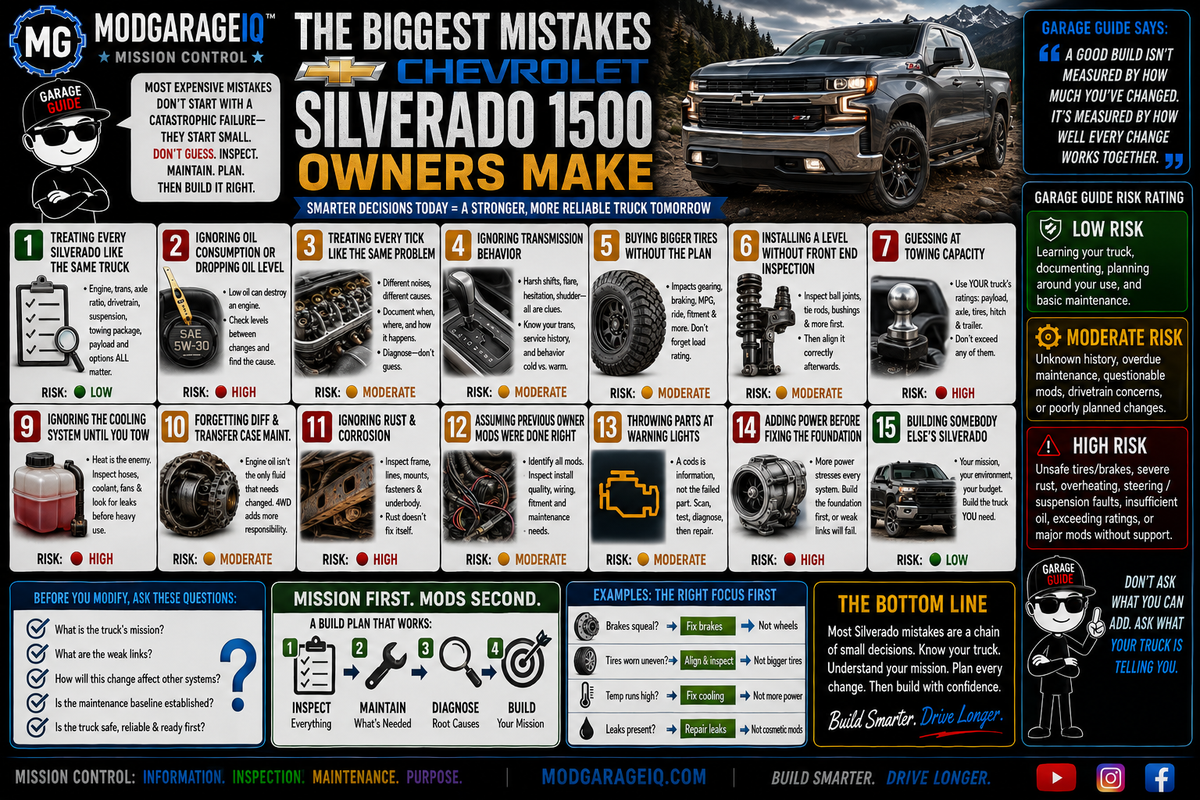
1. Treating Every Silverado 1500 Like the Same Truck
“Silverado 1500” doesn’t tell us enough.
Depending on year and configuration, trucks can differ in:
- Engine
- Transmission
- Drivetrain
- Axle ratio
- Suspension
- Towing equipment
- Payload
- Wheels and tires
- Factory options
That matters when buying parts.
It matters when servicing fluids.
And it absolutely matters when determining capability.
Know your exact truck before making decisions for it.
🟢 Garage Guide Risk Rating: LOW
Garage Guide Says:
“The badge tells me what family it belongs to. The configuration tells me what I’m working on.”
2. Ignoring Oil Consumption or a Dropping Oil Level
An oil change isn’t the only time you should know how much oil is in the engine.
Check the level periodically using the proper procedure for your truck.
If it begins dropping between services, determine why.
Possible explanations can include:
- External leakage
- Oil consumption
- Maintenance-related issues
- Other engine concerns requiring diagnosis
Don’t simply keep adding oil indefinitely without investigating an unexplained change.
🔴 Garage Guide Risk Rating: HIGH
Operating an engine with insufficient oil can result in serious damage.
Garage Guide Says:
“The oil-pressure warning isn’t your reminder to finally check the dipstick.”
3. Treating Every Tick Like the Same Problem
You hear ticking.
Then you search:
“Silverado tick.”
Five minutes later the internet has convinced you the engine needs to come out. 😂
Slow down.
Different noises can have different causes.
Document:
- Cold or warm
- Idle or under load
- Engine RPM
- Frequency
- Location
- Whether it changes after warm-up
- Whether other symptoms are present
Then diagnose the actual noise.
🟡 Garage Guide Risk Rating: MODERATE
Some causes may be minor; others can indicate developing mechanical problems.
Garage Guide Says:
“A nickname for a noise isn’t a diagnosis.”
4. Ignoring Transmission Behavior
A strange shift shouldn’t automatically create panic.
But it shouldn’t automatically be dismissed either.
Pay attention to:
- Harsh engagement
- Hesitation
- Shudder
- Flare
- Unusual RPM changes
- Shift-quality changes
- Cold-versus-warm behavior
Identify the exact transmission in your truck and investigate service history and applicable maintenance requirements.
If behavior changes, diagnose it.
🟡 Garage Guide Risk Rating: MODERATE
Garage Guide Says:
“Learn how it shifts when it’s healthy so you’ll recognize when something changes.”
5. Buying Bigger Tires Before Thinking About the Entire Truck
Bigger tires look good.
We both know why they’re in the shopping cart. 😂
But tire size can affect more than appearance.
Depending on the change, consider:
- Clearance
- Wheel fitment
- Effective gearing
- Acceleration
- Braking feel
- Steering response
- Rotating mass
- Fuel economy
- Speedometer/calibration considerations
- Suspension loads
And don’t forget tire load rating.
A truck tire still needs to be appropriate for the job you’re asking it to do.
🟡 Garage Guide Risk Rating: MODERATE
Poor fitment or unsuitable components can increase the risk considerably.
Garage Guide Says:
“The tire got bigger. The laws of physics didn’t.”
6. Installing a Leveling Kit Without Inspecting the Front End
This might be one of the most common first modifications.
But before changing suspension geometry, inspect what is already there.
Depending on configuration, inspect applicable:
- Ball joints
- Tie rods
- Bushings
- Shocks/struts
- Control arms
- Wheel bearings
- Existing aftermarket components
Then understand what the proposed modification changes.
And get the alignment addressed appropriately afterward.
🟡 Garage Guide Risk Rating: MODERATE
Improper component selection or installation can create higher-risk steering, suspension, or tire issues.
Garage Guide Says:
“Don’t level a worn-out front end and call the suspension upgraded.”
7. Guessing at Towing Capacity
Your friend’s Silverado tows a certain trailer.
That does not automatically mean yours should.
Capability can vary based on the truck’s actual configuration.
Use the ratings and documentation applicable to your vehicle and equipment.
Consider factors such as:
- Payload
- Vehicle ratings
- Axle ratings
- Tire ratings
- Hitch equipment
- Trailer ratings
- Tongue weight
- Cargo
- Passengers
Don’t build your towing plan around the largest Silverado number you found online.
🔴 Garage Guide Risk Rating: HIGH
Garage Guide Says:
“Tow with your truck’s numbers—not somebody else’s screenshot.”
8. Forgetting Payload While Obsessing Over Towing
This mistake deserves its own section.
The trailer isn’t the only thing adding weight.
Depending on the setup, payload considerations can include:
- Driver
- Passengers
- Tools
- Cargo
- Bed accessories
- Aftermarket equipment
- Hitch equipment
- Trailer tongue weight
That giant advertised towing number isn’t the only rating that matters.
🔴 Garage Guide Risk Rating: HIGH
Garage Guide Says:
“Before asking what the truck can pull, know what the truck is already carrying.”
9. Ignoring the Cooling System Until You’re Towing
Everything seems fine commuting to work.
Then you connect a trailer, climb a grade, and substantially increase the demand on the truck.
That’s a bad time to discover a marginal cooling-system problem.
Before demanding use, inspect applicable:
- Coolant condition and level
- Hoses
- Connections
- Reservoir
- Radiator area
- Cooling fans
- Evidence of leakage
And pay attention to operating temperature.
🔴 Garage Guide Risk Rating: HIGH
Garage Guide Says:
“Heavy work doesn’t create every weakness. Sometimes it just exposes the one that was already there.”
10. Forgetting Differential and Transfer-Case Maintenance
Engine oil gets remembered.
Everything underneath the truck gets forgotten.
Depending on configuration and use, your Silverado may have service requirements involving:
- Front differential
- Rear differential
- Transfer case
- Associated driveline components
Determine what applies to your exact truck.
Then document the service.
Especially if the truck:
- Tows
- Hauls
- Operates off-road
- Works hard
- Has unknown history
🟡 Garage Guide Risk Rating: MODERATE
Garage Guide Says:
“Four-wheel drive isn’t maintenance-free drive.”
11. Ignoring Rust and Corrosion
This one depends heavily on where the truck has lived.
A beautiful body doesn’t guarantee a beautiful underside.
Inspect areas such as:
- Frame
- Brake/fuel line areas
- Suspension mounting points
- Body mounts
- Fasteners
- Hitch
- Other exposed underbody components
Surface corrosion and severe structural deterioration aren’t the same thing.
The important part is identifying what you’re looking at and addressing problems appropriately.
🔴 Garage Guide Risk Rating: HIGH
Serious corrosion affecting structural, braking, steering, suspension, or mounting components can become a safety concern.
Garage Guide Says:
“Inspect underneath before the shiny paint convinces you you’ve seen the whole truck.”
12. Assuming Previous Owner Modifications Were Done Correctly
Used trucks attract modifications.
That means your Silverado may have inherited:
- Leveling/lift components
- Wheels and tires
- Exhaust modifications
- Lighting
- Audio equipment
- Trailer wiring
- Engine modifications
- Calibration changes
- Aftermarket electrical accessories
Identify everything that isn’t factory.
Then inspect:
What was installed?
How was it installed?
Does it affect another system?
Does it require maintenance?
Is it appropriate for the truck?
🟡 Garage Guide Risk Rating: MODERATE
Garage Guide Says:
“You didn’t install the previous owner’s modifications—but you own the consequences now.”
13. Throwing Parts at Warning Lights
Check engine light?
Order an oxygen sensor.
ABS light?
Order a wheel-speed sensor.
Battery light?
Order a battery.
No. 😂
Scan the appropriate systems.
Understand the fault information.
Inspect.
Test.
Diagnose.
A fault code identifies information the vehicle detected.
It does not automatically identify the failed part.
🟡 Garage Guide Risk Rating: MODERATE
Garage Guide Says:
“The parts cannon is one of the most expensive diagnostic tools ever invented.”
14. Adding Power Before Fixing the Foundation
Eventually somebody asks:
“How do I make my Silverado faster?”
Fine.
But first:
Is the engine healthy?
Transmission?
Cooling system?
Fuel system?
Drivetrain?
Brakes?
Tires?
Because additional power can increase demands elsewhere.
A performance build should be treated like a system, not a collection of horsepower-producing parts.
🔴 Garage Guide Risk Rating: HIGH
Garage Guide Says:
“Horsepower doesn’t fix weak links. It schedules appointments with them.”
15. Building Somebody Else’s Silverado
Here’s the mistake that doesn’t necessarily break the truck.
It breaks the budget.
You see somebody else’s build online.
Perfect stance.
Perfect wheels.
Perfect tires.
Perfect everything.
So you copy it.
Except…
They don’t tow.
You do.
They drive 3,000 miles a year.
You commute every day.
They live somewhere warm.
You drive through snow.
They built a show truck.
You need a work truck.
Their mission isn’t yours.
🟢 Garage Guide Risk Rating: LOW
Mechanically low risk when properly executed—but potentially expensive if you build a truck you don’t actually enjoy using.
Garage Guide Says:
“Inspiration is free. Copying somebody else’s mission can get expensive.”
Garage Guide Risk Rating
🟢 LOW RISKLearning your exact configuration, planning around your actual use, and documenting the truck.
🟡 MODERATE RISKUnknown maintenance, unexplained noises, questionable modifications, drivetrain concerns, and poorly planned wheel/tire or suspension changes.
🔴 HIGH RISKUnsafe tires or brakes, severe corrosion, overheating, steering/suspension faults, insufficient oil, exceeding vehicle ratings, or major modifications without supporting systems.
The Bottom Line
Most Silverado mistakes aren’t one giant bad decision.
They’re a chain of little ones.
Ignoring the noise.
Ignoring the leak.
Guessing at the rating.
Buying the tire without considering fitment.
Installing the level without inspecting the suspension.
Adding power before establishing reliability.
Assuming the previous owner knew what they were doing.
That’s why the smartest Silverado build begins long before the first modification.
Know the truck.
Know the mission.
Understand what each change affects.
Then tomorrow…
Garage Guide finally stops guarding the aftermarket catalog. 😂
Because we’re closing the Silverado series with:
The Best Build Paths for the Chevrolet Silverado 1500
Garage Guide Says:
“A good build isn’t measured by how much you’ve changed. It’s measured by how well every change works together.”
Build Smarter. Drive Longer.
#ModGarageIQ #GarageGuide #ChevroletSilverado #Silverado1500 #ChevyTrucks #SilveradoOwners #TruckMistakes #TruckMaintenance #TruckMods #Towing #OwnersGuide #MissionControl #AutomotiveEducation #BuildSmarterDriveLonger