The Biggest Mistakes BMW 3 Series Owners Make
A Used BMW Usually Doesn’t Become Expensive Because of One Big Decision—It Becomes Expensive When Small Problems, Cheap Parts, and Poorly Planned Modifications Start Stacking Up.
We’ve identified the BMW.
We’ve established the baseline.
We’ve figured out where the first $500 belongs.
Now comes the dangerous part.
You start getting comfortable. 😂
The car looks good in the driveway.
You’ve joined three BMW groups.
Your algorithm is now 90% exhaust clips, wheel fitment, and tuned 335is.
And suddenly…
Maintenance feels boring.
That’s exactly when Garage Guide walks back into the garage.
Because the BMW 3 Series can be an incredible platform.
But there’s a huge difference between:
Owning a BMW…
and
Maintaining a BMW while modifying it intelligently.
Here are the mistakes that can separate the two.
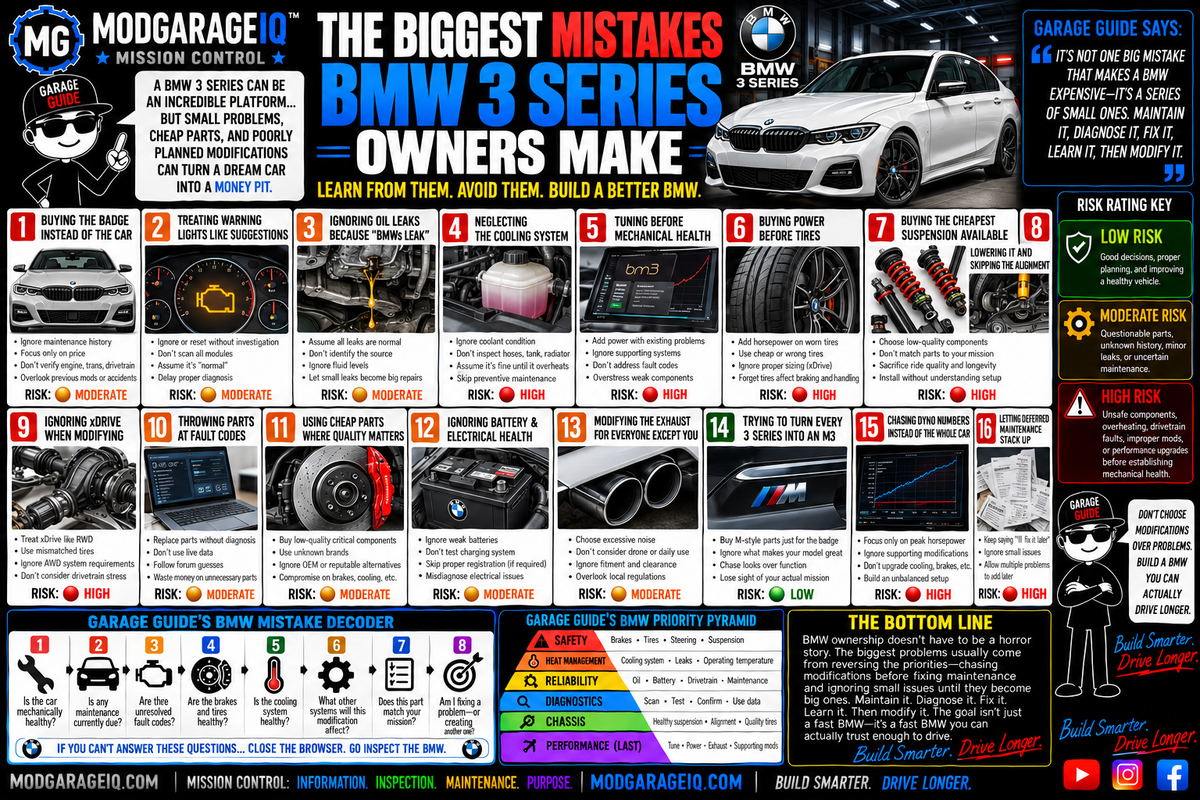
1. Buying the Badge Instead of the Car
A cheap BMW can be extremely tempting.
Especially when the purchase price puts a luxury/performance car within reach.
But purchase price isn’t the same thing as ownership cost.
Before buying—or immediately after buying—understand:
- Maintenance history
- Mileage
- Engine
- Transmission
- Drivetrain
- Existing faults
- Previous modifications
- Accident/repair history
- Overall mechanical condition
A neglected BMW doesn’t become inexpensive because somebody lowered the asking price.
🟡 Garage Guide Risk Rating: MODERATE
Garage Guide Says:
“A cheap BMW and an affordable BMW are not necessarily the same car.”
2. Treating Warning Lights Like Suggestions
BMW dashboard lights have inspired generations of owners to develop an advanced diagnostic technique called:
“I’ll deal with it later.”
😂
Don’t.
A warning doesn’t automatically mean catastrophe.
But it does mean:
Investigate.
Scan the appropriate systems.
Record the faults.
Look at relevant data.
Determine what actually caused the warning.
Then repair the problem based on diagnosis.
🟡 Garage Guide Risk Rating: MODERATE
Some warnings indicate conditions that can become high risk.
Garage Guide Says:
“The warning light isn’t trying to ruin your weekend. It’s trying to get your attention before something else does.”
3. Ignoring Oil Leaks Because “BMWs Leak”
Ah yes.
The unofficial BMW owner’s proverb. 😂
A little residue isn’t necessarily an emergency.
But active leakage should be understood.
Determine:
- What fluid is leaking
- Where it’s coming from
- How quickly it’s leaking
- Whether the level is dropping
- Whether fluid is reaching other components
- How urgently repair is needed
Don’t diagnose by stereotype.
And don’t normalize a developing problem just because other owners have experienced something similar.
🟡 Garage Guide Risk Rating: MODERATE
Significant fluid loss can become high risk.
Garage Guide Says:
“Common problem doesn’t mean optional repair.”
4. Neglecting the Cooling System
This one gets the red box.
The car runs fine.
Temperature seems fine.
No obvious puddle.
So the cooling system disappears from the owner’s mind.
Until it doesn’t.
Inspect the system appropriate to your exact engine and chassis, including applicable:
- Coolant
- Expansion tank
- Hoses
- Connections
- Radiator
- Water-pump-related components
- Thermostat-related components
- Evidence of leakage
- Temperature behavior
Preventive attention here can be dramatically cheaper than overheating.
🔴 Garage Guide Risk Rating: HIGH
Garage Guide Says:
“The temperature gauge isn’t where you want to discover your maintenance strategy failed.”
5. Tuning Before Establishing Mechanical Health
Garage Guide knew we’d get here. 😂
Especially on turbocharged 3 Series models, software can make performance gains extremely tempting.
But before asking the engine for more, evaluate the systems supporting it.
Depending on the platform, consider applicable:
- Ignition
- Fuel delivery
- Cooling
- Intake/charge system
- Turbocharger system
- Existing faults
- Engine condition
- Transmission
- Drivetrain
- Maintenance history
A tune doesn’t erase maintenance debt.
It may simply ask the indebted components to work harder.
🔴 Garage Guide Risk Rating: HIGH
Garage Guide Says:
“Adding boost to deferred maintenance is just making the problem arrive faster.”
6. Buying Power Before Buying Tires
Tune installed.
More torque.
More horsepower.
And the BMW is sitting on:
Old mystery-brand tires.
Bro. 😂
Tires affect:
- Acceleration
- Braking
- Steering
- Cornering
- Wet traction
- Stability
- Ride quality
If the car can’t effectively use the performance it already has, adding more performance isn’t the first priority.
And xDrive owners should pay particular attention to appropriate tire sizing and compatibility for their specific vehicle.
🔴 Garage Guide Risk Rating: HIGH
Garage Guide Says:
“Horsepower doesn’t touch the road. Tires do.”
7. Buying the Cheapest Suspension Available
The 3 Series became famous partly because of how well the chassis works.
Then somebody buys the cheapest coilovers on the internet and wonders why the car rides like a shopping cart. 😂
Suspension changes can affect:
- Ride quality
- Tire contact
- Alignment
- Suspension travel
- Handling
- Ground clearance
- Tire wear
- Component longevity
Buy suspension based on the mission.
Daily driving?
Street performance?
Autocross?
Track?
Show?
Those are different jobs.
🔴 Garage Guide Risk Rating: HIGH
Garage Guide Says:
“Don’t spend money destroying the thing BMW spent money engineering.”
8. Lowering It and Skipping the Alignment
BMW lowered.
Fitment achieved.
Pictures taken.
Three months later:
The inside edges of the tires have left the chat. 😂
After meaningful suspension or ride-height changes, inspect:
- Alignment
- Tire clearance
- Suspension clearance
- Steering behavior
- Tire wear
And make sure worn components aren’t preventing the alignment from being maintained properly.
🔴 Garage Guide Risk Rating: HIGH
Garage Guide Says:
“If you changed where the suspension sits, verify where the tires point.”
9. Ignoring xDrive When Modifying
An xDrive BMW isn’t simply a rear-wheel-drive BMW with extra traction.
The AWD system adds components and considerations.
Before changing wheels, tires, ride height, drivetrain components, or power output, understand how those changes affect your exact vehicle.
Pay particular attention to:
- Correct tire sizing
- Tire wear
- Wheel fitment
- Front/rear compatibility
- Transfer-case health
- Differential health
- Axles
- Suspension geometry
🔴 Garage Guide Risk Rating: HIGH
Garage Guide Says:
“If four wheels are mechanically working together, modify them like they’re working together.”
10. Throwing Parts at Fault Codes
Scanner says something.
Internet says sensor.
Owner orders sensor.
Problem remains.
Owner orders second sensor.
Problem remains.
Congratulations.
The German Parts Cannon is operational.
😂💸
Instead:
Read the fault.
Understand the system.
Inspect.
Test.
Use live data where appropriate.
Confirm the failure.
Then buy the part.
BMW parts can be expensive enough without purchasing practice parts.
🟡 Garage Guide Risk Rating: MODERATE
Garage Guide Says:
“Diagnostic equipment saves money only when diagnosis happens after you plug it in.”
11. Using Cheap Parts Where Quality Matters
Budget building is smart.
Cheap building can become expensive.
Not every replacement component needs to carry the most expensive logo available.
But quality matters greatly for critical systems.
Especially:
- Brakes
- Steering
- Suspension
- Cooling
- Tires
- Engine-management components
- Drivetrain components
Research reputable manufacturers and correct specifications for your exact application.
🟡 Garage Guide Risk Rating: MODERATE
Safety-critical components can move this into high risk.
Garage Guide Says:
“The cheapest part is only cheap until you buy its replacement.”
12. Ignoring Battery and Electrical Health
BMW throws multiple strange warnings.
Owner immediately assumes:
Three computers died simultaneously.
Maybe.
But before writing the car’s obituary, check basic electrical health.
Evaluate:
- Battery
- Charging system
- Connections
- Grounds where applicable
- Corrosion
- Relevant fault information
And remember that some BMWs require specific procedures when replacing the battery.
Electrical diagnosis starts with a healthy electrical supply.
🟡 Garage Guide Risk Rating: MODERATE
Garage Guide Says:
“Never underestimate how dramatic a modern car can become when its voltage isn’t happy.” 😂
13. Modifying the Exhaust for Everyone Except the Driver
Cold start:
🔥🔥🔥
Tunnel:
🔥🔥🔥
Instagram reel:
🔥🔥🔥
Two-hour interstate drive:
AAAAAAAAAAAAAAAA.
😂
Consider:
- Drone
- Cabin noise
- Daily usability
- Fitment
- Ground clearance
- Exhaust leaks
- Applicable emissions requirements
- Local regulations
The best exhaust isn’t necessarily the loudest.
It’s the one that fits the mission.
🟡 Garage Guide Risk Rating: MODERATE
Garage Guide Says:
“Build the exhaust for the person sitting inside the BMW too.”
14. Trying to Turn Every 3 Series Into an M3
Garage Guide is approaching the badge drawer again. 😂
M-style appearance parts?
Fine.
M-inspired wheels?
Cool.
Sportier suspension?
Absolutely, if properly selected.
But your 328i, 330i, 335i, or 340i doesn’t need an identity crisis to be enjoyable.
Build the car you actually own.
Make it:
Healthier.
Sharper.
Better looking.
More capable.
More enjoyable.
🟢 Garage Guide Risk Rating: LOW
Garage Guide Says:
“Build an excellent 3 Series before building an imitation M3.”
15. Chasing Dyno Numbers Instead of Building the Whole Car
Eventually someone asks:
“How much power does it make?”
Garage Guide asks:
“How well does the whole car work?”
More power may require consideration of:
- Cooling
- Fuel system
- Ignition
- Transmission
- Clutch where applicable
- Drivetrain
- Tires
- Brakes
- Suspension
- Calibration
A dyno number is one measurement.
It isn’t the entire build.
🔴 Garage Guide Risk Rating: HIGH
Garage Guide Says:
“Don’t build 500 horsepower with 300 horsepower worth of supporting systems.”
16. Letting Deferred Maintenance Stack Up
This is the big one.
Oil leak.
Later.
Suspension clunk.
Later.
Old coolant.
Later.
Weak battery.
Later.
Brake warning.
Later.
Tires wearing unevenly.
Later.
Eventually, later arrives all at once.
And suddenly the owner says:
“BMWs are ridiculously expensive to maintain.”
Sometimes they are expensive.
But sometimes you’re paying six months of ignored maintenance in one weekend.
🔴 Garage Guide Risk Rating: HIGH
Garage Guide Says:
“Small problems become expensive when you give them enough time to start working together.”
Garage Guide’s BMW Mistake Decoder
Before buying the next modification, ask:
1 — Is the car mechanically healthy?
2 — Is any maintenance currently due?
3 — Are there unresolved fault codes?
4 — Are the brakes and tires healthy?
5 — Is the cooling system healthy?
6 — What other systems will this modification affect?
7 — Does this part match the actual mission?
8 — Am I fixing a problem—or creating another one?
If you can’t answer those questions…
Close the browser.
Go inspect the BMW.
😂🫡
Garage Guide’s BMW Priority Pyramid
🔴
SAFETY
Brakes.
Tires.
Steering.
Suspension.
🟠
HEAT MANAGEMENT
Cooling system.
Leaks.
Operating temperature.
🟡
RELIABILITY
Oil.
Battery.
Drivetrain.
Maintenance.
🔵
DIAGNOSTICS
Scan.
Test.
Confirm.
🟢
CHASSIS
Healthy suspension.
Alignment.
Quality tires.
🟣
PERFORMANCE
Tune.
Power.
Exhaust.
Supporting modifications.
Notice where horsepower landed?
LAST.
😂
Garage Guide Risk Rating
🟢 LOW RISKThoughtful cosmetic changes, documentation, planning, and improving a healthy vehicle.
🟡 MODERATE RISKMinor leaks, questionable parts, unknown service history, poor exhaust decisions, electrical concerns, or replacing parts without proper diagnosis.
🔴 HIGH RISKOverheating, unsafe tires or brakes, neglected steering/suspension, improper AWD setups, tuning unhealthy cars, poorly executed suspension modifications, or substantial power without supporting systems.
The Bottom Line
BMW ownership doesn’t have to be a horror story.
And modifying one doesn’t automatically make it unreliable.
The trouble usually begins when priorities get reversed.
Performance before maintenance.
Appearance before tires.
Lowering before suspension health.
Parts before diagnosis.
More power before cooling.
Build it the other way around.
Maintain it.
Diagnose it.
Fix it.
Learn it.
Then modify it.
Because the goal isn’t simply owning a fast BMW.
It’s owning a fast BMW you can actually trust enough to drive.
Tomorrow, 10/8, Garage Guide finally stops guarding the modification catalog. 😂🔥
We’re closing the BMW series with:
Best Build Paths for the BMW 3 Series
Daily Driver.
OEM+.
Sport Sedan.
Handling/Canyon.
Autocross.
Track.
Touring.
Show.
Big Power.
And the build path that might secretly be the smartest one of all:
The Long-Term Keeper. 😎
Garage Guide Says:
“The expensive BMW isn’t always the one with expensive parts. It’s the one whose owner kept choosing modifications over problems.”
Build Smarter. Drive Longer.
#ModGarageIQ #GarageGuide #BMW #BMW3Series #BMWOwners #E46 #E90 #F30 #G20 #BMWMaintenance #BMWProblems #BMWBuild #ModifiedBMW #GermanCars #MissionControl #OwnersGuide #AutomotiveEducation #BuildSmarterDriveLonger