Supporting Mods Explained
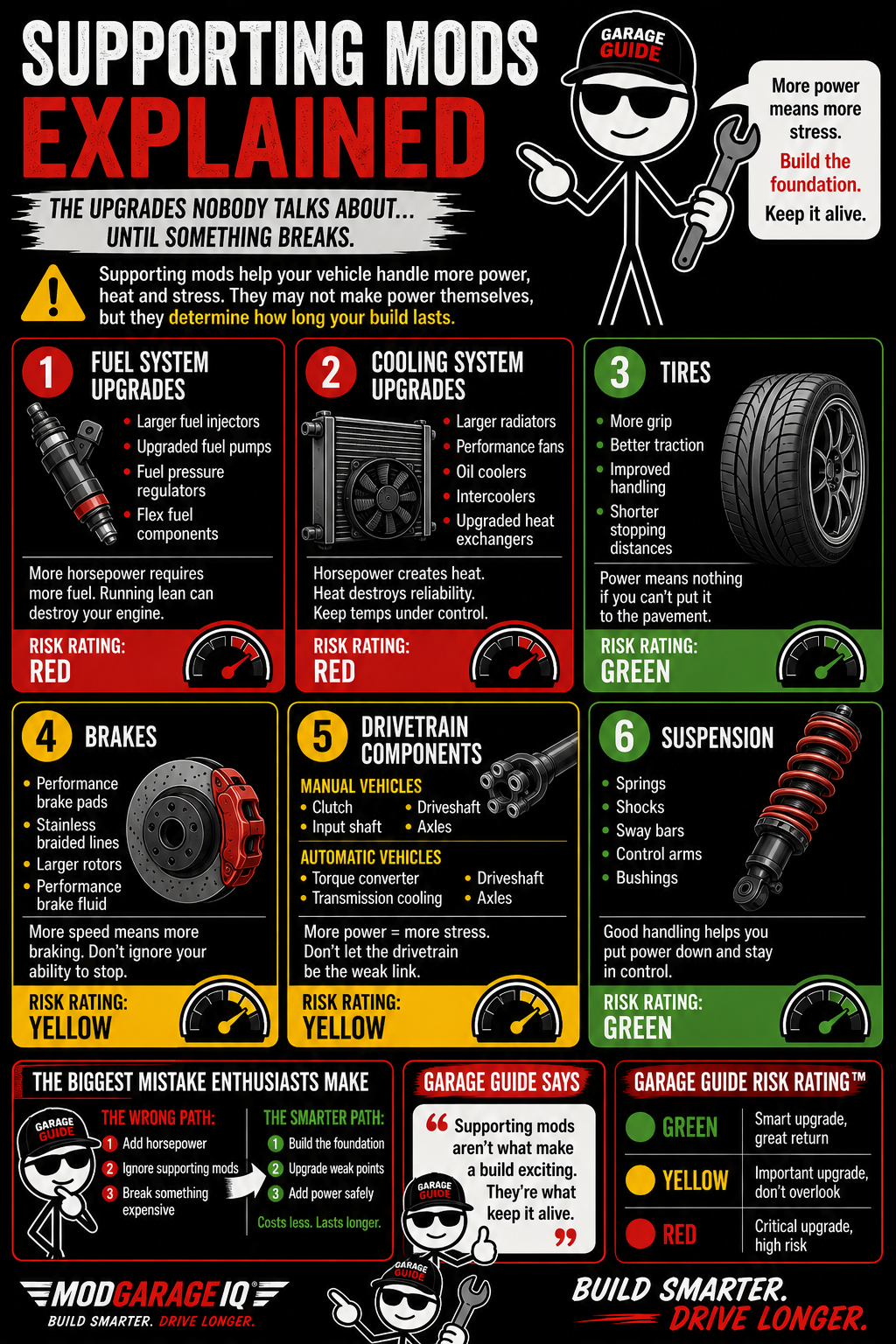
The Upgrades Nobody Talks About… Until Something Breaks
Everyone loves horsepower.
Big dyno numbers.
Fast quarter-mile times.
Aggressive exhaust notes.
What most enthusiasts don’t love are the upgrades that make those power gains reliable.
That’s where supporting mods come in.
Supporting mods aren’t flashy.
They won’t make your vehicle sound louder.
They usually don’t add horsepower by themselves.
But they often determine whether your build lasts 100,000 miles or 100 miles.
What Are Supporting Mods?
Supporting mods are upgrades that help your vehicle safely handle additional power, stress, and heat.
Think of them as the foundation beneath your performance modifications.
A house built on a weak foundation eventually cracks.
Performance builds work the same way.
Fuel System Upgrades
More horsepower requires more fuel.
Factory fuel systems are designed around factory power levels.
Once you increase airflow and boost, fuel demand increases significantly.
Common supporting fuel upgrades include:
• Larger fuel injectors
• Upgraded fuel pumps
• Fuel pressure regulators
• Flex fuel components
Without adequate fueling, engines can run lean and suffer catastrophic damage.
🔴 Garage Guide Risk Rating: RED
Never add significant power without verifying fuel capacity.
Cooling System Upgrades
Horsepower creates heat.
Heat destroys reliability.
Many factory cooling systems work perfectly at stock power levels but struggle once power increases.
Common cooling upgrades include:
• Larger radiators
• Performance fans
• Oil coolers
• Intercoolers
• Upgraded heat exchangers
🔴 Garage Guide Risk Rating: RED
Cooling is one of the most overlooked supporting modifications.
Tires
The first thing most people notice after adding power?
Wheel spin.
Power means nothing if it can’t reach the pavement.
Good tires improve:
• Traction
• Handling
• Braking
• Safety
🟢 Garage Guide Risk Rating: GREEN
One of the smartest upgrades for any vehicle.
Brakes
Making a vehicle faster is easy.
Stopping it repeatedly is harder.
More speed means more braking demand.
Supporting brake upgrades may include:
• Performance brake pads
• Stainless brake lines
• Larger rotors
• Performance brake fluid
🟡 Garage Guide Risk Rating: YELLOW
Often overlooked until it’s needed.
Drivetrain Components
As power increases, stress increases.
The drivetrain often becomes the next weak link.
Potential upgrades include:
Manual Vehicles
• Clutch
• Input shaft
• Driveshaft
• Axles
Automatic Vehicles
• Torque converter
• Transmission cooling
• Driveshaft
• Axles
🟡 Garage Guide Risk Rating: YELLOW
The required upgrades depend heavily on power level and platform.
Suspension
Many enthusiasts think horsepower equals performance.
It doesn’t.
A vehicle that handles poorly won’t put power down effectively.
Supporting suspension upgrades may include:
• Springs
• Shocks
• Sway bars
• Control arms
• Bushings
🟢 Garage Guide Risk Rating: GREEN
Improves confidence and drivability.
The Biggest Mistake Enthusiasts Make
Many builders follow this path:
- Add horsepower
- Ignore supporting mods
- Break something expensive
The smarter approach is:
- Build the foundation
- Upgrade weak points
- Add power safely
This usually costs less in the long run.
Garage Guide Says
“Supporting mods aren’t what make a build exciting. They’re what keep it alive.”
Garage Guide Risk Rating™
🟢 Tires & Suspension
🟡 Brakes & Drivetrain
🔴 Fuel System & Cooling
Bottom Line
The best builds aren’t the ones with the biggest dyno numbers.
They’re the ones that continue running reliably long after the excitement of adding horsepower wears off.
Before asking how much power you can make…
Ask whether your vehicle can support it.
Because horsepower is easy.
Reliability takes planning.
🏁 Build Smarter. Drive Longer.
#ModGarageIQ #GarageGuide #SupportingMods #PerformanceMods #CarMods #Horsepower #MustangLife #AutomotiveTips #BuildSmarterDriveLonger #PerformanceCars