Slotted Rotors, Drilled Rotors, Or Both?
Choosing The Right Brake Rotor Is About More Than Looks.
Brake rotors are one of the first upgrades many enthusiasts make.
Unfortunately, they’re also one of the most misunderstood.
Slotted.
Drilled.
Drilled & Slotted.
Each design has advantages—and each is built for a different purpose.
The best rotor isn’t the most aggressive-looking one.
It’s the one that matches how you actually drive.
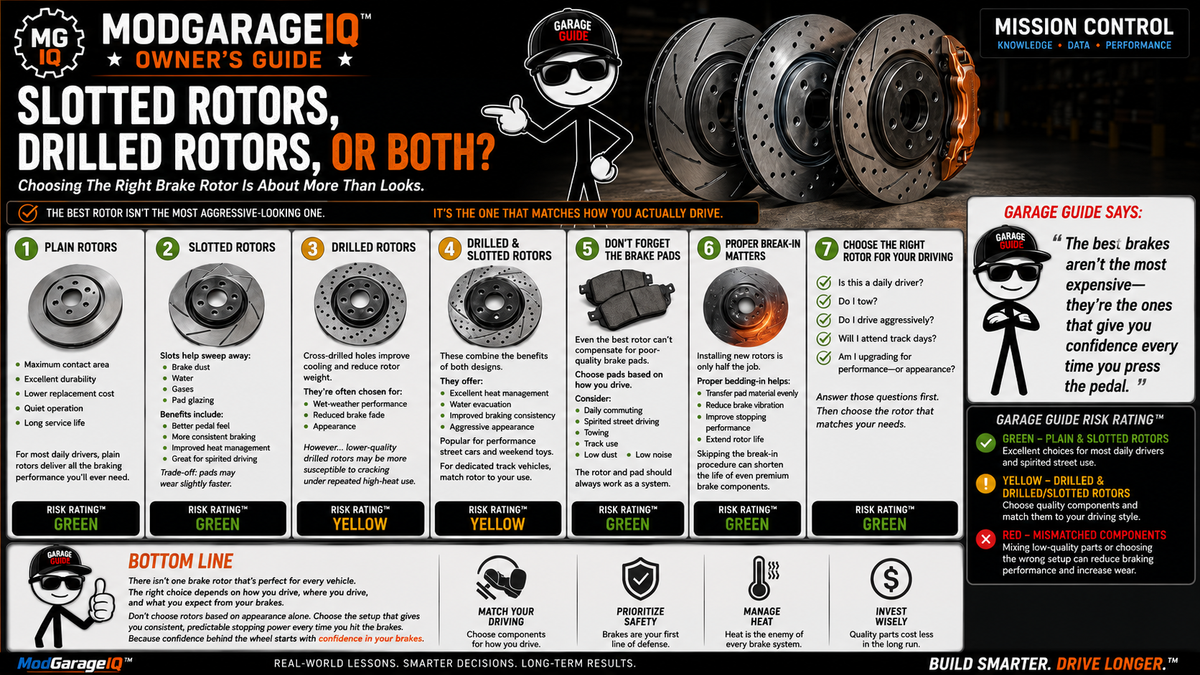
Plain Rotors
Sometimes, simple is best.
Plain rotors provide:
- Maximum contact area
- Excellent durability
- Lower replacement cost
- Quiet operation
- Long service life
For most daily drivers, plain rotors deliver all the braking performance you’ll ever need.
🟢 Garage Guide Risk Rating: GREEN
Simple doesn’t mean inferior.
Slotted Rotors
Slots help sweep away:
- Brake dust
- Water
- Gases
- Pad glazing
Benefits include:
- Better pedal feel
- More consistent braking
- Improved heat management
- Great for spirited driving
The trade-off?
Brake pads may wear slightly faster.
🟢 Garage Guide Risk Rating: GREEN
One of the best upgrades for enthusiastic street driving.
Drilled Rotors
Cross-drilled holes improve cooling and reduce rotor weight.
They’re often chosen for:
- Wet-weather performance
- Reduced brake fade
- Appearance
However…
Lower-quality drilled rotors may be more susceptible to cracking under repeated high-heat use.
🟡 Garage Guide Risk Rating: YELLOW
Quality matters more than the holes.
Drilled & Slotted Rotors
These combine the benefits of both designs.
They offer:
- Excellent heat management
- Water evacuation
- Improved braking consistency
- Aggressive appearance
They’re popular on performance street cars and weekend toys.
For dedicated track vehicles, rotor selection should always match the vehicle’s intended use.
🟡 Garage Guide Risk Rating: YELLOW
Buy for performance—not appearance.
Don’t Forget The Brake Pads
Even the best rotor can’t compensate for poor-quality brake pads.
Choose pads based on how you drive.
Consider:
- Daily commuting
- Spirited street driving
- Towing
- Track use
- Low dust
- Low noise
The rotor and pad should always work as a system.
🟢 Garage Guide Risk Rating: GREEN
Great brakes are built as a package.
Proper Break-In Matters
Installing new rotors is only half the job.
Proper bedding-in helps:
- Transfer pad material evenly
- Reduce brake vibration
- Improve stopping performance
- Extend rotor life
Skipping the break-in procedure can shorten the life of even premium brake components.
🟢 Garage Guide Risk Rating: GREEN
A five-minute procedure can add thousands of miles of performance.
Choose The Right Rotor For Your Driving
Before clicking “Buy Now,” ask yourself:
- Is this a daily driver?
- Do I tow?
- Do I drive aggressively?
- Will I attend track days?
- Am I upgrading for performance—or appearance?
Answer those questions first.
Then choose the rotor that matches your needs.
🟢 Garage Guide Risk Rating: GREEN
The best brake upgrade is the one that fits your driving style.
Garage Guide Says
“The best brakes aren’t the most expensive—they’re the ones that give you confidence every time you press the pedal.”
Garage Guide Risk Rating™
🟢 GREEN — Plain & Slotted Rotors
Excellent choices for most daily drivers and spirited street use.
🟡 YELLOW — Drilled & Drilled/Slotted Rotors
Choose quality components and match them to your driving style.
🔴 RED — Mismatched Brake Components
Mixing low-quality parts or choosing the wrong setup can reduce braking performance and increase wear.
Bottom Line
There isn’t one brake rotor that’s perfect for every vehicle.
The right choice depends on how you drive, where you drive, and what you expect from your brakes.
Don’t choose rotors based on appearance alone.
Choose the setup that gives you consistent, predictable stopping power every time you hit the brakes.
Because confidence behind the wheel starts with confidence in your brakes.
🏁 Build Smarter. Drive Longer.