Is Your Car Ready for Winter?
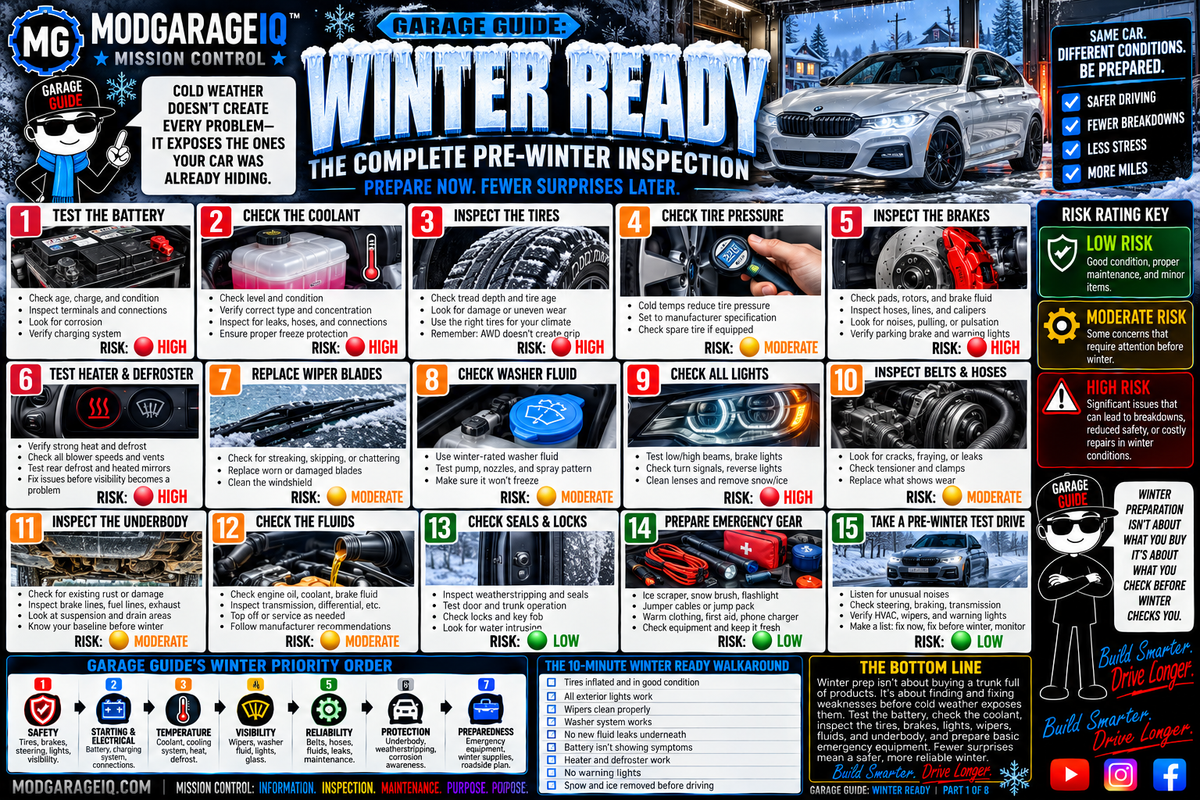
Cold Weather Doesn’t Create Every Problem—It Exposes the Ones Your Car Was Already Hiding.
Summer lets a lot of marginal components get away with things.
A battery that’s getting weak?
Still starts.
Coolant that’s been neglected?
Maybe nobody notices.
Tires that are borderline?
Dry pavement hides it.
Wipers that streak?
Annoying—but manageable.
Then the temperature drops.
And suddenly the car that seemed perfectly healthy in September starts telling a very different story.
That’s why winter preparation isn’t about waiting for snow.
It’s about finding weaknesses before cold weather finds them for you.
Welcome to:
GARAGE GUIDE: WINTER READY
Part 1 — The Complete Pre-Winter Inspection
Let’s get the car ready before winter gets here.
1. Test the Battery
Cold weather can expose a marginal battery quickly.
Starting the engine requires substantial electrical power, while colder conditions can reduce a battery’s available performance.
Before winter, check:
- Battery age
- State of charge
- Battery condition
- Terminal condition
- Cable connections
- Corrosion
- Charging-system performance
- Physical mounting
If the engine cranks slowly now?
Don’t wait for the first freezing morning to investigate.
And don’t automatically replace the battery because it’s old.
Test it.
A healthy older battery may still have useful life.
A weak newer battery may already have a problem.
🔴 Garage Guide Risk Rating: HIGH
A battery failure usually isn’t mechanically destructive—but being stranded in severe winter weather can become a safety issue.
Garage Guide Says:
“Winter doesn’t always kill the battery. Sometimes it just exposes the battery that was already dying.”
2. Check the Coolant
Yes.
We’re talking about cooling systems in a winter article. 😂
Engine coolant isn’t only responsible for carrying heat away from the engine.
Proper coolant also provides freeze protection and corrosion protection.
Before winter, inspect the system when safe and appropriate for:
- Coolant level
- Coolant condition
- Correct coolant specification
- Proper concentration/freeze protection
- Leaks
- Hoses
- Connections
- Reservoir condition
- Radiator area
- Operating-temperature problems
Don’t blindly add random coolant because the color looks similar.
Different vehicles have different requirements.
And never open a hot, pressurized cooling system.
🔴 Garage Guide Risk Rating: HIGH
Garage Guide Says:
“Coolant has a winter job and a summer job. Neglect either one and the engine gets the bill.”
3. Inspect the Tires
This becomes one of the most important winter checks on the entire vehicle.
Inspect:
- Tread depth
- Tire age
- Tire condition
- Inflation
- Sidewalls
- Uneven wear
- Correct sizing
- Matching tire setup
Then consider whether your tires actually match your winter conditions.
Depending on climate and driving environment, that may mean evaluating:
- Summer tires
- All-season tires
- All-weather tires
- Dedicated winter tires
And here’s the part Garage Guide wants printed in giant letters:
AWD DOES NOT CREATE TIRE GRIP.
AWD can help a vehicle accelerate.
It does not magically make worn or inappropriate tires brake and corner well.
We’ll go much deeper into winter tires later in this series.
🔴 Garage Guide Risk Rating: HIGH
Garage Guide Says:
“Four driven wheels don’t help much when four tires can’t grip.”
4. Check Tire Pressure
Temperature changes affect tire pressure.
So the pressure that looked fine during warmer weather may not remain where it should as temperatures fall.
Check pressures when appropriate and set them according to the vehicle manufacturer’s specification—not whatever maximum number happens to be molded into the tire sidewall.
Also inspect the spare tire if your vehicle has one.
Yes.
The spare.
The tire everyone remembers approximately eight seconds after they need it. 😂
🟡 Garage Guide Risk Rating: MODERATE
Garage Guide Says:
“Winter tire preparation includes the air inside them.”
5. Inspect the Brakes
Snow and ice already reduce available traction.
Winter is not when you want to discover a braking-system problem.
Inspect applicable:
- Pads
- Rotors
- Brake fluid
- Hoses
- Lines
- Calipers
- Parking brake
- Pedal feel
- Warning lights
Pay attention to:
- Pulling
- Grinding
- Pulsation
- Abnormal noises
- Soft or unusual pedal feel
And remember:
ABS and stability control can help manage available traction.
They cannot manufacture traction that isn’t there.
🔴 Garage Guide Risk Rating: HIGH
Garage Guide Says:
“Winter already makes stopping harder. Don’t make the brakes contribute to the problem.”
6. Test the Heater and Defroster
Don’t wait until the windshield fogs up during the first cold rain.
Test:
- Cabin heat
- Front defrost
- Rear defrost
- Blower speeds
- Vent operation
- HVAC controls
- Heated mirrors if equipped
- Heated seats if you simply refuse to suffer 😂
Cabin heat is about comfort.
But windshield clearing is about visibility.
If the vehicle isn’t producing adequate heat or clearing the windshield properly, investigate the cause.
🔴 Garage Guide Risk Rating: HIGH
Poor visibility can become a serious safety problem.
Garage Guide Says:
“A heater keeps you comfortable. A working defroster helps you see where you’re going.”
7. Replace Bad Wiper Blades
Turn them on.
If the windshield becomes:
Cleaner?
Good.
If it becomes an abstract watercolor painting?
Garage Guide has concerns. 😂
Look for:
- Streaking
- Chattering
- Skipping
- Torn rubber
- Poor contact
- Hardened blades
And make sure the windshield itself is clean.
A relatively inexpensive pair of wipers can make an enormous difference during bad weather.
🟡 Garage Guide Risk Rating: MODERATE
Garage Guide Says:
“If using the wipers makes visibility worse, they’re no longer wipers. They’re windshield decorations.”
8. Check the Washer Fluid
Make sure the reservoir is filled with a washer fluid appropriate for the expected temperatures and your vehicle’s requirements.
Don’t assume whatever is currently inside provides adequate freeze protection.
Also test:
- Washer pump
- Spray nozzles
- Hose operation
- Spray pattern
Winter roads can coat a windshield with:
Salt.
Slush.
Road grime.
Dirty spray.
And whatever mysterious gray substance winter creates. 😂
You want the washer system working when visibility suddenly disappears.
🟡 Garage Guide Risk Rating: MODERATE
Garage Guide Says:
“A full washer reservoir doesn’t help if what’s inside freezes when you need it.”
9. Check Every Exterior Light
Winter means more driving in darkness and poor weather.
Walk around the vehicle and inspect:
- Low beams
- High beams
- Brake lights
- Turn signals
- Tail lights
- Reverse lights
- Marker lights
- Fog lights where equipped
- License-plate lights where required
Also clean the lenses.
A functioning light buried beneath grime, snow, or road salt isn’t doing its best work.
🔴 Garage Guide Risk Rating: HIGH
Garage Guide Says:
“Winter visibility works both ways—you need to see, and everybody else needs to see you.”
10. Inspect Belts and Hoses
Cold weather can be unforgiving to already deteriorated components.
Inspect applicable:
- Accessory/serpentine belt
- Tensioner-related components
- Coolant hoses
- Clamps
- Connections
Look for:
- Cracking
- Fraying
- Contamination
- Leakage
- Bulging
- Deterioration
- Abnormal belt noise
Don’t replace parts simply because they’re on a winter checklist.
Inspect them.
Research the correct service requirements.
Replace what actually needs attention.
🟡 Garage Guide Risk Rating: MODERATE
Garage Guide Says:
“Winter preparation isn’t replacing everything. It’s finding the thing that won’t make it through winter.”
11. Inspect the Underbody
If you live where roads are treated during winter, this becomes especially important.
Before the season starts, look underneath the vehicle where safely possible.
Inspect:
- Existing corrosion
- Brake lines
- Fuel lines
- Exhaust
- Suspension mounting areas
- Subframes
- Body seams
- Wheel wells
- Drain areas
- Underbody panels
Why inspect before winter?
Because you need to know what’s already there.
That gives you a baseline before months of moisture, road debris, and deicing materials arrive.
We’ll dedicate an entire Winter Ready post to corrosion and road salt.
🟡 Garage Guide Risk Rating: MODERATE
Severe structural or brake-line corrosion can become high risk.
Garage Guide Says:
“Rust prevention works a lot better before you’re trying to prevent rust that’s already there.”
12. Check the Fluids
Winter prep is a good time for a general fluid review.
Depending on the vehicle, inspect applicable:
- Engine oil
- Coolant
- Brake fluid
- Transmission fluid
- Differential fluid
- Transfer-case fluid
- Power-steering fluid
- Washer fluid
But remember:
CHECK doesn’t mean CHANGE EVERYTHING.
Determine what’s due based on:
- Vehicle requirements
- Mileage
- Time
- Condition where applicable
- Service history
- Actual use
Create a known maintenance baseline.
🟡 Garage Guide Risk Rating: MODERATE
Garage Guide Says:
“Maintenance is smarter when the service schedule makes the decisions instead of the weather forecast.”
13. Check the Door Seals, Locks, and Weatherstripping
This is the little stuff nobody thinks about until it’s 18°F outside and the door has apparently joined the body permanently. 😂
Inspect:
- Door weatherstripping
- Trunk/hatch seals
- Window seals
- Door operation
- Locks
- Key fob
- Physical emergency key where applicable
Check for water intrusion now.
Moisture inside the vehicle can contribute to:
- Fogged windows
- Musty odors
- Damp carpets
- Electrical problems
- Ice formation
🟢 Garage Guide Risk Rating: LOW
Garage Guide Says:
“Winter finds every place water wasn’t supposed to be.”
14. Inspect Your Emergency Equipment
Here’s where people tend to either carry nothing…
or prepare as though they’re crossing Antarctica alone. 😂
Build a practical kit appropriate for your environment and travel.
Consider:
- Ice scraper
- Snow brush
- Flashlight
- Phone charging solution
- Warm clothing/blanket
- Gloves
- Basic first-aid supplies
- Reflective warning equipment
- Appropriate traction aid
- Jumper cables or suitable jump pack
- Basic tools
- Drinking water where practical
- Other supplies appropriate to your climate and trip
And periodically check the equipment.
A dead jump pack sitting in the trunk is just an expensive brick.
🟢 Garage Guide Risk Rating: LOW
Garage Guide Says:
“Emergency equipment only works if it’s in the car, functional, and you know how to use it.”
15. Give the Car a Pre-Winter Road Test
Now drive it.
Radio off.
Listen.
Feel.
Observe.
Pay attention to:
- Cold starting
- Idle
- Charging behavior
- Steering
- Braking
- Suspension
- Transmission
- Engine temperature
- HVAC
- Defrost
- Wipers
- Warning lights
- Unusual noises
- Vibrations
Then create a list.
Separate it into:
🔴
FIX NOW
Safety and serious reliability issues.
🟡
FIX BEFORE WINTER
Problems likely to become troublesome as conditions worsen.
🟢
MONITOR
Items that aren’t currently faults but deserve attention.
Now winter preparation becomes a plan instead of panic.
Garage Guide’s Winter Priority Order
🔴
1 — SAFETY
Tires.
Brakes.
Steering.
Lights.
Visibility.
🔵
2 — STARTING & ELECTRICAL
Battery.
Charging system.
Connections.
🟠
3 — TEMPERATURE
Coolant.
Cooling system.
Heat.
Defrost.
🟡
4 — VISIBILITY
Wipers.
Washer fluid.
Lights.
Glass.
🟢
5 — RELIABILITY
Belts.
Hoses.
Fluids.
Leaks.
Maintenance.
⚪
6 — PROTECTION
Underbody.
Weatherstripping.
Corrosion awareness.
🔵
7 — PREPAREDNESS
Emergency equipment.
Winter supplies.
Roadside plan.
The 10-Minute Winter Ready Walkaround
Before a major winter trip—or periodically throughout the season—check:
✓ Tires look properly inflated✓ Tread and sidewalls look healthy✓ Exterior lights work✓ Wipers clean properly✓ Washer system works✓ No new fluid leaks underneath✓ Battery isn’t showing obvious symptoms✓ Heater/defrost works✓ No warning lights requiring attention✓ Snow and ice are completely removed before driving
Ten minutes won’t diagnose the entire vehicle.
But it can catch something that changed since your last inspection.
Garage Guide Risk Rating
🟢 LOW RISKEmergency-kit preparation, weatherstrip inspection, documentation, and routine preventive checks.
🟡 MODERATE RISKWeak wipers, improper tire pressure, overdue maintenance, questionable belts/hoses, minor leaks, washer-system problems, or developing corrosion.
🔴 HIGH RISKUnsafe tires or brakes, cooling-system problems, serious battery/charging issues in severe weather, inadequate windshield clearing, critical lighting problems, or major steering/suspension defects.
The Bottom Line
Winter preparation isn’t about buying a trunk full of winter products.
It’s about reducing surprises.
Test the battery.
Check the coolant.
Inspect the tires.
Check the brakes.
Test the heater and defroster.
Replace bad wipers.
Verify the washer system.
Check the lights.
Inspect the belts and hoses.
Look underneath the car.
Review the fluids.
Prepare sensible emergency equipment.
Then drive the car and pay attention.
Because when that first genuinely cold morning arrives, you don’t want to discover what September was quietly hiding.
Prepare before the forecast forces you to.
Next Friday in Garage Guide: Winter Ready:
Your Battery vs. Winter
Why the First Cold Morning Can Turn “It Started Fine Yesterday” Into Click… Click… Nothing.
😂❄️🔋
Garage Guide Says:
“The best winter breakdown is the one you found in the driveway three weeks before winter.”
Build Smarter. Drive Longer.
#ModGarageIQ #GarageGuide #WinterReady #WinterCarCare #Winterization #CarMaintenance #VehicleMaintenance #WinterDriving #ColdWeather #Battery #WinterTires #CarSafety #MissionControl #AutomotiveEducation #BuildSmarterDriveLonger