I Just Bought a Toyota Camry… Now What?
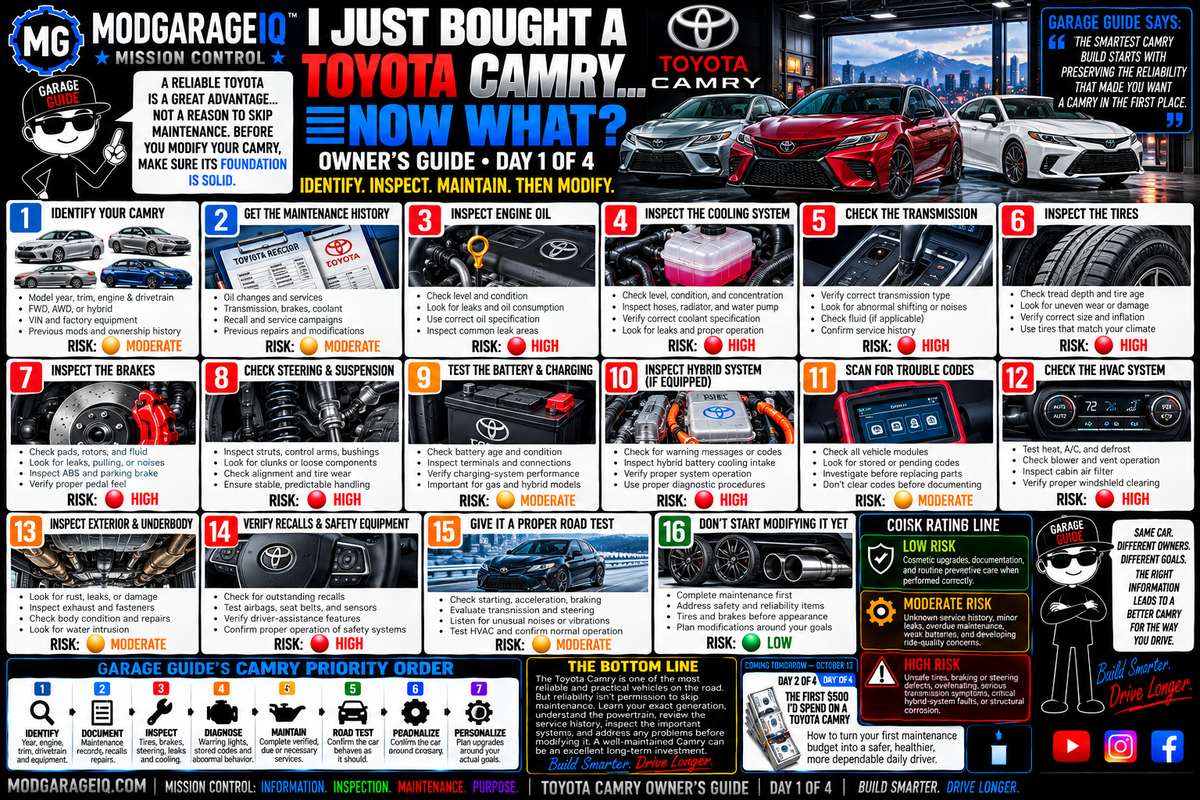
Before You Add Wheels, Tint, Exhaust, or Start Planning Modifications—Find Out Exactly Which Camry You Bought and Make Sure Its Foundation Is Solid.
MODGARAGEIQ OWNER’S GUIDE • TOYOTA CAMRY • DAY 1 OF 4
The Toyota Camry has built a reputation for being dependable, comfortable, practical, and relatively affordable to own.
And that reputation is deserved.
But here’s where some owners get themselves into trouble.
They hear “It’s a Toyota” and assume that means:
- Maintenance can wait.
- Every engine is equally reliable.
- Transmission service doesn’t matter.
- Warning lights aren’t urgent.
- Previous owners probably took care of everything.
- A Camry can’t become an expensive project.
Garage Guide has some news. 😂
Reliability is an advantage—not permission to neglect the vehicle.
A well-maintained Camry can be an excellent long-term investment.
A neglected Camry can still drain your wallet.
So before you start modifying your new ride, we’re going to establish exactly what you bought, what condition it’s in, and what deserves your attention first.
1. Identify Exactly Which Camry You Bought
Not all Camrys are created equal.
Depending on the generation and model year, you may have:
- A four-cylinder gasoline engine
- A V6
- A hybrid powertrain
- Front-wheel drive
- All-wheel drive
- A conventional automatic transmission
- An electronically controlled continuously variable transmission in a hybrid
- Different suspension, braking, and electronic systems
And beginning with the 2025 model year in the U.S., the Camry transitioned to a hybrid-only powertrain lineup.
Before purchasing parts or planning maintenance, document:
- Model year and trim
- Engine and powertrain
- Transmission
- FWD or AWD
- Mileage
- VIN
- Factory equipment
- Previous modifications
- Service history
Garage Guide Risk Rating: 🟡 MODERATE
Garage Guide Says:
“Buying parts for the wrong Camry is a surprisingly expensive way to learn what Camry you actually own.”
2. Get the Maintenance History
This is where the real ownership story begins.
A Camry with 140,000 miles and consistent maintenance may be a much better purchase than one with 70,000 miles and a completely unknown history.
Look for records of:
- Oil and filter changes
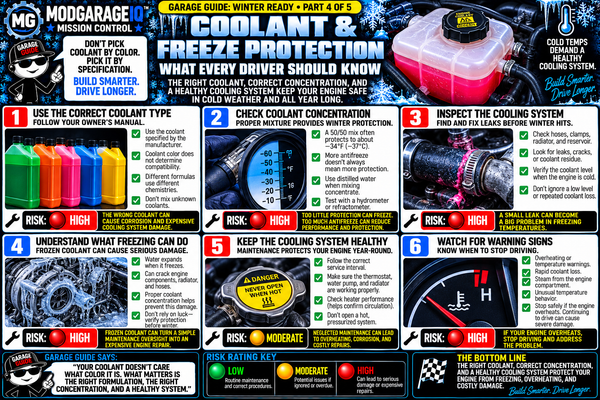
- Coolant service
- Transmission maintenance
- Brake-fluid service
- Spark-plug replacement
- Tire rotations
- Brake repairs
- Suspension work
- Hybrid-system inspections, if applicable
- Recalls and manufacturer service campaigns
Don’t assume an undocumented service happened.
And don’t automatically replace everything just because records are missing.
Inspect, verify, and prioritize.
Garage Guide Risk Rating: 🟡 MODERATE
Garage Guide Says:
“The odometer tells you how far the car traveled. The maintenance history tells you how it was treated.”
3. Inspect the Engine Oil and Look for Leaks
Toyota engines have a strong reputation, but they’re still mechanical systems.
And mechanical systems need lubrication.
Start with:
- Oil level
- Oil condition
- Correct oil specification
- Filter condition
- Evidence of leaks
- Oil consumption history
- Maintenance intervals
Depending on the engine and generation, inspect applicable areas around:
- Valve covers
- Timing covers
- Oil pan
- Oil filter housing
- Oil cooler connections
If you notice oil consumption, investigate rather than assuming it’s normal.
Some older Camry engine families have known oil-consumption concerns, but that doesn’t mean every Camry has the same issue.
Garage Guide Risk Rating: 🔴 HIGH
Garage Guide Says:
“Toyota reliability is impressive. Toyota engines running without enough oil? Not so impressive.” 😂
4. Inspect the Cooling System
Your Camry’s cooling system deserves attention whether you live in Arizona or Minnesota.
Check:
- Coolant level and condition
- Correct coolant specification
- Radiator
- Hoses
- Water pump
- Thermostat operation
- Cooling fans
- Reservoir
- Signs of leakage
- Operating temperature
For hybrids, identify the applicable engine and power-electronics cooling circuits and follow the correct service procedures.
Never open a hot, pressurized cooling system.
And don’t mix coolants based solely on color.
Garage Guide Risk Rating: 🔴 HIGH
Garage Guide Says:
“The Camry might be famous for lasting forever. The engine still expects the cooling system to do its job.”
5. Check the Transmission
This one deserves special attention.
Different Camry generations use different transmission designs, so the correct inspection and maintenance procedures depend on the exact vehicle.
Pay attention to:
- Delayed engagement
- Harsh shifting
- Slipping
- Unusual vibration
- Abnormal noises
- Fluid leaks
- Warning lights
- Previous transmission service
For a conventional automatic, investigate abnormal shift behavior.
For a hybrid, understand that its electronically controlled transmission system operates differently from a conventional automatic or belt-type CVT.
Do not assume that all Camry transmissions use the same fluid, service interval, or maintenance procedure.
And don’t perform an aggressive fluid flush simply because somebody on the internet said every used car needs one.
Garage Guide Risk Rating: 🔴 HIGH
Garage Guide Says:
“The right transmission service starts with knowing which transmission you have.”
6. Inspect the Tires
Your Camry might not be a track car.
That doesn’t make its tires less important.
Inspect:
- Tread depth
- Tire age
- Sidewall condition
- Uneven wear
- Correct size
- Proper inflation
- Matching tires
- Alignment symptoms
For AWD models, pay particular attention to manufacturer requirements regarding tire matching and circumference.
And if you’re preparing for winter, evaluate whether your tires suit your actual climate.
A Camry on quality tires can be a much better driving experience than a Camry with expensive wheels and bargain-bin rubber.
Garage Guide Risk Rating: 🔴 HIGH
Garage Guide Says:
“You don’t need 400 horsepower to appreciate four good tires.”
7. Inspect the Brakes
Before worrying about how your Camry looks, make sure it stops properly.
Check:
- Brake pads
- Rotors
- Calipers
- Brake hoses
- Brake lines
- Brake-fluid condition
- Parking brake
- ABS warning lights
- Pedal feel
On hybrid models, regenerative braking changes how braking is managed, but conventional friction brakes still require inspection and maintenance.
If the pedal feels abnormal, the car pulls under braking, or warning lights appear, investigate.
Garage Guide Risk Rating: 🔴 HIGH
Garage Guide Says:
“The most important performance modification is making sure the car stops when you ask it to.”
8. Check the Steering and Suspension
A Camry should feel controlled, predictable, and comfortable.
If yours feels loose, unstable, or unusually harsh, something may need attention.
Inspect applicable:
- Struts and shocks
- Control arms
- Ball joints
- Tie rods
- Bushings
- Sway-bar links
- Wheel bearings
- Steering components
- Alignment
Listen for clunks over bumps.
Watch for wandering on the highway.
Pay attention to uneven tire wear.
And remember that suspension designs and components vary by generation.
Garage Guide Risk Rating: 🔴 HIGH
Garage Guide Says:
“A Camry shouldn’t need three steering corrections to stay in one lane.”
9. Test the Battery and Charging System
This is especially important as we enter colder weather.
For gasoline-powered Camrys, inspect:
- 12-volt battery condition
- Battery terminals
- Cable connections
- Charging-system operation
- Starting performance
For hybrids, the 12-volt electrical system still matters, even though the vehicle uses a different starting and charging architecture.
Also check for electrical warning messages.
A hybrid’s high-voltage system should only be inspected or serviced using appropriate procedures and qualifications.
Garage Guide Risk Rating: 🟡 MODERATE
Potential safety consequences in severe weather can raise the urgency.
Garage Guide Says:
“A hybrid still needs its low-voltage electronics to cooperate. Electricity doesn’t care how reliable the badge is.” 😂
10. Inspect the Hybrid System, If Equipped
Hybrid Camrys deserve their own inspection category.
Check for:
- Hybrid-system warning messages
- Diagnostic trouble codes
- Battery cooling-air intake obstruction
- Cooling-fan cleanliness where applicable
- Cooling-system concerns
- Unusual operating behavior
- Relevant maintenance and inspection history
A high-voltage battery doesn’t automatically need replacement because the vehicle has high mileage.
But its condition shouldn’t be ignored either.
Use appropriate hybrid-capable diagnostics to evaluate concerns.
And never open or manipulate high-voltage components without proper training and equipment.
Garage Guide Risk Rating: 🔴 HIGH
Garage Guide Says:
“A hybrid Camry isn’t just a gasoline Camry with an extra battery. Learn the system before you work on it.”
11. Scan the Vehicle for Trouble Codes
A dashboard without warning lights is encouraging.
It is not a complete diagnostic report.
A capable scan tool may reveal stored or pending faults involving:
- Engine management
- Transmission
- ABS
- Stability control
- Airbags
- Hybrid systems
- Other vehicle modules
Don’t automatically replace whatever component appears in a code description.
A diagnostic code identifies a condition the system detected—not necessarily the failed part.
And don’t clear codes before documenting them.
Garage Guide Risk Rating: 🟡 MODERATE
Garage Guide Says:
“A trouble code is the beginning of the investigation, not the shopping list.”
12. Check the HVAC System
A comfortable cabin is nice.
A functioning defroster is essential.
Test:
- Air conditioning
- Cabin heat
- Front defrost
- Rear defrost
- Blower operation
- Cabin air filter
- Vent controls
- Unusual odors
- Water intrusion
For winter preparation, prioritize visibility.
If the windshield won’t clear properly, address the problem before bad weather.
Garage Guide Risk Rating: 🔴 HIGH when visibility is compromised.
Garage Guide Says:
“Heated seats are a luxury. Being able to see through the windshield is not.”
13. Inspect the Exterior and Underbody
Before spending money on appearance upgrades, inspect the actual condition of the vehicle.
Look for:
- Accident repairs
- Uneven panel gaps
- Paint inconsistencies
- Rust
- Damaged splash shields
- Missing fasteners
- Underbody corrosion
- Damaged exhaust components
- Fluid leaks
- Worn weatherstripping
- Water intrusion
Pay particular attention to vehicles that have spent years in regions where roads are treated with salt.
Severe corrosion affecting structural components, brake lines, or suspension mounts is a serious safety concern.
Garage Guide Risk Rating: 🟡 MODERATE, escalating to 🔴 HIGH for critical damage.
Garage Guide Says:
“Fresh paint can hide an ugly history. Get underneath the car before you fall in love with the shine.”
14. Verify Recalls and Safety Equipment
Check the VIN for outstanding safety recalls.
Confirm that applicable safety equipment is functioning properly, including:
- Airbags
- Seat belts
- ABS
- Stability control
- Tire-pressure monitoring
- Driver-assistance features, where equipped
- Cameras and sensors
Remember that Toyota Safety Sense equipment and capabilities vary by model year and trim.
Do not assume every Camry has the same safety technology.
Garage Guide Risk Rating: 🔴 HIGH
Garage Guide Says:
“A reliable car should also be a safe car. Check both.”
15. Give the Camry a Proper Road Test
Once the vehicle is safe to drive, take it through a variety of normal conditions.
Pay attention to:
- Cold starting
- Idle quality
- Acceleration
- Transmission operation
- Steering response
- Braking
- Suspension noises
- Highway stability
- Engine temperature
- HVAC performance
- Unusual vibrations
- Warning lights
For hybrids, understand normal transitions between electric and gasoline operation so you can distinguish expected behavior from actual problems.
Document anything unusual.
Then investigate.
Garage Guide Risk Rating: 🟡 MODERATE
Garage Guide Says:
“Turn the music down for ten minutes. Your Camry might be trying to tell you something.” 😂
16. Don’t Start Modifying It Yet
Yes, Garage Guide knows.
You’ve already looked at:
- Wheels
- Tint
- Suspension
- Exhaust
- Lighting
- Interior upgrades
- Audio systems
- Appearance packages
And depending on your Camry, maybe you’ve even started dreaming about a sporty OEM+ build.
Nothing wrong with that.
But here’s the order:
Maintenance before modifications.
Tires before appearance.
Brakes before horsepower.
Mechanical health before personalization.
You don’t need to transform the Camry into something it wasn’t designed to be.
A clean, well-maintained, thoughtfully upgraded Camry can be a fantastic daily driver.
Garage Guide Risk Rating: 🟢 LOW for carefully planned, appropriate upgrades after establishing a healthy baseline.
Garage Guide Says:
“Before you make the Camry look expensive, make sure it isn’t hiding expensive problems.”
Garage Guide’s Camry Priority Order
1
IDENTIFY
Year, engine, trim, drivetrain and equipment
2
DOCUMENT
Maintenance records, recalls and previous repairs
3
INSPECT
Tires, brakes, steering, leaks and cooling
4
DIAGNOSE
Warning lights, stored codes and abnormal behavior
5
MAINTAIN
Complete verified, due or necessary services
6
ROAD TEST
Confirm the car behaves as it should
7
PERSONALIZE
Plan upgrades around your actual goals
Garage Guide Risk Rating
🟢 LOW RISK
Cosmetic upgrades, documentation, and routine preventive care when performed correctly.
🟡 MODERATE RISK
Unknown service history, minor leaks, overdue routine maintenance, weak batteries, and developing ride-quality concerns.
🔴 HIGH RISK
Unsafe tires, braking or steering defects, overheating, serious transmission symptoms, critical hybrid-system faults, and structural corrosion.
The Bottom Line
The Toyota Camry is one of those vehicles that makes long-term ownership look easy.
But its reputation should motivate you to take care of it—not convince you that maintenance is optional.
Learn your exact generation.
Understand the powertrain.
Review the service history.
Inspect the important systems.
Diagnose the problems.
Address safety concerns.
Establish a maintenance baseline.
And only then start deciding how you want to build it.
Because the goal isn’t simply to own a Camry.
It’s to own a Camry that’s still doing its job years from now.
Garage Guide Says:
“The smartest Camry build starts with preserving the reliability that made you want a Camry in the first place.”
Build Smarter. Drive Longer.