I Just Bought a Ram 1500… Now What?
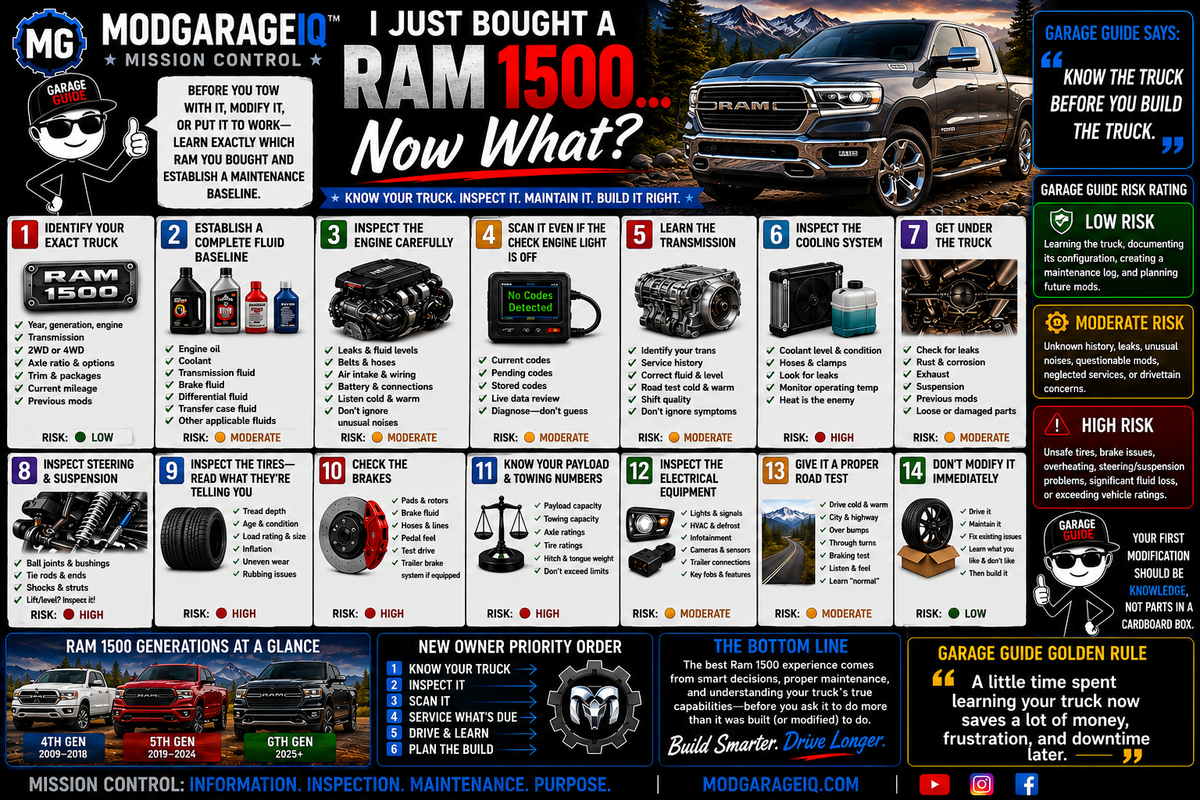
Before You Tow With It, Modify It, or Put It to Work—Learn Exactly Which Ram You Bought and Establish a Maintenance Baseline.
You bought a Ram 1500.
Maybe you wanted a comfortable daily driver that happens to have a bed.
Maybe you needed something for towing.
Maybe it’s going to work every day.
Or maybe you bought it because you looked at that truck and immediately started imagining:
Wheels. Tires. Level. Exhaust. Power. 😎
Not yet.
Your first job as a new Ram owner isn’t modification.
It’s information.
The Ram 1500 has been offered across multiple generations with different engines, transmissions, drivetrains, suspension configurations, towing packages, and technology.
Before we build the truck, we need to know the truck.
1. Identify Exactly Which Ram 1500 You Bought
Start here.
Know your:
- Model year
- Generation
- Engine
- Transmission
- 2WD or 4WD
- Axle ratio
- Trim
- Suspension configuration
- Factory tow equipment
- Payload information
- Current mileage
- Previous modifications
Depending on the truck, you may encounter very different powertrains and equipment.
That means generic advice like:
“Ram 1500s take this…”
isn’t good enough.
Parts, fluids, service procedures, capacities, towing capability, and common concerns can vary by configuration.
🟢 Garage Guide Risk Rating: LOW
This costs nothing and prevents a surprising number of bad decisions later.
Garage Guide Says:
“Know the truck before you build the truck.”
2. Establish a Complete Fluid Baseline
If the maintenance history is incomplete, start investigating.
Depending on your particular truck, that may include:
- Engine oil
- Coolant
- Transmission fluid
- Brake fluid
- Differential fluid
- Transfer-case fluid on applicable 4WD trucks
- Other serviceable fluids applicable to the configuration
Don’t automatically replace everything simply because you bought the truck yesterday.
First determine:
What has been serviced?
When?
With what?
What is actually due?
Then establish your own maintenance record.
🟡 Garage Guide Risk Rating: MODERATE
Unknown history isn’t automatically bad history.
But it shouldn’t be treated as good history either.
Garage Guide Says:
“If you can’t verify the maintenance, investigate it before you depend on it.”
3. Inspect the Engine Carefully
This is where knowing your exact powertrain becomes critical.
Different Ram engines have different characteristics and areas deserving attention.
Before worrying about performance, inspect the basics:
- Oil level
- Evidence of leakage
- Coolant level
- Belt condition
- Hoses
- Air intake
- Wiring
- Battery connections
- Unusual noises
- Previous modifications
Listen during a cold start.
Then listen again when the engine is fully warm.
Don’t immediately diagnose every tick, tap, or rattle from a sound alone.
But don’t ignore a new or unusual noise either.
🟡 Garage Guide Risk Rating: MODERATE
Garage Guide Says:
“A noise is a clue—not permission to fire the parts cannon.”
4. Scan It Even If the Check Engine Light Is Off
We’ve made this a standard part of the ModGarageIQ newly purchased vehicle inspection for a reason.
Connect an appropriate diagnostic scanner.
Depending on the truck and scan tool, look for:
- Current codes
- Pending codes
- Stored codes
- Relevant system information
- Available live data
A dashboard without warning lights doesn’t necessarily mean the vehicle has nothing stored.
And remember:
P-code ≠ automatically replace whatever part Google mentions first.
Diagnose.
🟡 Garage Guide Risk Rating: MODERATE
Garage Guide Says:
“The scan tells you where the conversation starts—not where the repair ends.”
5. Learn the Transmission
Your Ram’s transmission is one of the most important—and potentially expensive—components in the truck.
Identify exactly which transmission you have.
Then determine its:
- Service history
- Correct fluid requirements
- Appropriate service procedure
- Current behavior
During your road test, pay attention to:
- Engagement
- Shift quality
- Hesitation
- Shudder
- Unusual RPM changes
- Strange noises
- Behavior when cold versus warm
Don’t assume every unusual sensation means catastrophic transmission failure.
But don’t normalize something simply because the previous owner did.
🟡 Garage Guide Risk Rating: MODERATE
Garage Guide Says:
“The previous owner saying ‘it always did that’ isn’t a diagnosis.”
6. Inspect the Cooling System
A truck that may eventually tow, haul, idle, work, or operate in hot conditions needs a healthy cooling system.
With the engine cold and following proper safety precautions, inspect applicable areas for:
- Coolant level
- Coolant condition
- Hose condition
- Reservoir condition
- Visible leakage
- Dried coolant residue
- Radiator-area concerns
Then monitor operating temperature while driving.
If the truck begins overheating, investigate it.
Don’t keep asking an overheating engine to finish the trip.
🔴 Garage Guide Risk Rating: HIGH
Overheating can transform a relatively manageable cooling-system problem into major engine damage.
Garage Guide Says:
“The temperature gauge isn’t asking for your opinion.”
7. Get Under the Truck
Don’t let the shiny bodywork keep all your attention above eye level.
Get underneath it.
Inspect for:
- Engine leaks
- Transmission leaks
- Differential leaks
- Transfer-case leaks where applicable
- Damaged boots
- Loose components
- Rust or corrosion
- Exhaust damage
- Evidence of previous repairs
- Suspension wear
Also look for something extremely important on a used truck:
Evidence that it has been modified before.
Aftermarket parts aren’t automatically bad.
Poorly installed aftermarket parts can be.
🟡 Garage Guide Risk Rating: MODERATE
Garage Guide Says:
“The underside usually tells you more about a used truck than the freshly detailed paint.”
8. Inspect the Steering and Suspension
Ram 1500s can live very different lives.
One may have spent years commuting.
Another may have:
- Towed regularly
- Hauled heavy loads
- Driven rough roads
- Been lifted
- Been leveled
- Run oversized tires
Inspect applicable steering and suspension components for:
- Looseness
- Worn joints
- Damaged bushings
- Leaking shocks
- Broken or damaged components
- Uneven ride height
- Alignment issues
- Evidence of poor modification work
If the truck is already lifted or leveled, identify exactly what’s installed.
Don’t assume the previous owner did it correctly.
🔴 Garage Guide Risk Rating: HIGH
Significant steering or suspension problems can directly affect vehicle control.
Garage Guide Says:
“A lift kit doesn’t erase worn parts underneath it.”
9. Inspect the Tires—and Read What They’re Telling You
Don’t just check tread depth.
Look at the entire story.
Inspect:
- Tire size
- Load rating
- Tire age
- Inflation
- Sidewall condition
- Matching tires
- Tread condition
- Uneven wear
- Evidence of rubbing
If the truck has oversized tires, determine what else was changed to accommodate them.
Uneven wear may point toward:
- Alignment
- Suspension wear
- Steering issues
- Incorrect inflation
- Wheel/tire fitment problems
🔴 Garage Guide Risk Rating: HIGH
A truck’s capability still depends on four relatively small contact patches.
Garage Guide Says:
“Before you buy bigger tires, understand the tires already underneath you.”
10. Check the Brakes
Especially if you plan to tow.
Inspect:
- Pads
- Rotors
- Brake fluid
- Hoses and lines
- Parking brake
- Pedal feel
During the road test, pay attention to:
- Pulling
- Pulsation
- Grinding
- Squealing
- Vibration
- Abnormal pedal travel
If the truck has a trailer brake controller or towing equipment, verify that the applicable systems and equipment function properly before relying on them.
🔴 Garage Guide Risk Rating: HIGH
A truck’s ability to pull weight doesn’t matter if it can’t safely control and stop it.
Garage Guide Says:
“Towing starts with stopping.”
11. Know Your Payload and Towing Numbers
This is one of the most important things a new truck owner can learn.
Don’t rely solely on:
“Ram 1500s can tow up to…”
Your specific truck’s capability depends on its configuration.
Learn the ratings and information applicable to your truck, including relevant considerations such as:
- Payload
- Towing capacity
- Axle ratings
- Tire ratings
- Hitch equipment
- Occupants
- Cargo
- Trailer tongue weight
And remember:
Everything you put in or on the truck adds weight.
People.
Tools.
Cargo.
Accessories.
Equipment.
🔴 Garage Guide Risk Rating: HIGH
Garage Guide Says:
“The advertised maximum isn’t automatically your truck’s maximum.”
12. Inspect the Electrical Equipment
Modern trucks contain a lot of electronics.
Test them.
Check applicable equipment such as:
- Exterior lighting
- Power windows
- Locks
- Mirrors
- HVAC
- Infotainment
- Backup camera
- Parking sensors
- Driver-assistance features
- USB/power outlets
- Trailer connections
- Key fobs
Also inspect any aftermarket electrical work.
Look for:
- Loose wiring
- Poor connections
- Improvised splices
- Unsupported accessories
- Questionable routing
🟡 Garage Guide Risk Rating: MODERATE
Garage Guide Says:
“Aftermarket wiring should look engineered—not improvised.”
13. Give It a Proper Road Test
Now drive the truck with the radio off.
Drive it:
- Cold
- Fully warmed
- Around town
- At highway speed
- Over bumps
- Through turns
- During braking
- Under moderate acceleration
Listen.
Feel.
Observe.
You’re learning:
What does normal feel like in this particular Ram?
That knowledge becomes incredibly valuable later.
When something changes, you’ll recognize it faster.
🟡 Garage Guide Risk Rating: MODERATE
Garage Guide Says:
“You can’t recognize abnormal until you’ve learned normal.”
14. Don’t Modify It Immediately
This is the hard one. 😂
You’ve already looked at wheels.
I know.
Probably tires too.
Maybe a leveling kit.
Maybe exhaust.
Maybe you’ve already watched six videos about horsepower.
Give yourself some time.
Drive the truck.
Maintain it.
Fix existing issues.
Learn what you like.
Learn what annoys you.
Learn what you actually use it for.
Then build it.
Because the best Ram build won’t come from copying somebody else’s truck.
It’ll come from understanding yours.
🟢 Garage Guide Risk Rating: LOW
Garage Guide Says:
“Drive it long enough to discover the problem before buying the modification that’s supposed to solve it.”
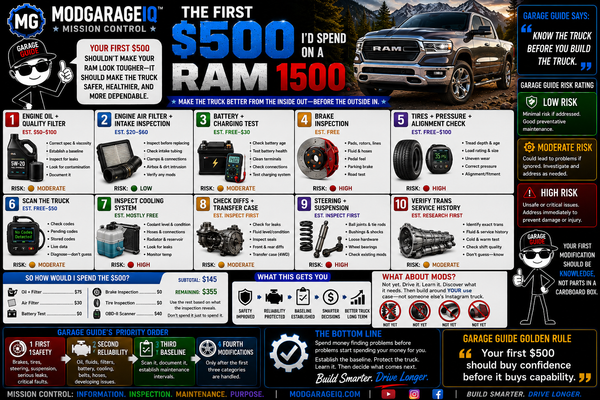
Garage Guide Risk Rating
🟢 LOW RISKLearning the truck, documenting its configuration, creating a maintenance log, and planning future modifications.
🟡 MODERATE RISKUnknown maintenance history, leaks, questionable modifications, unusual noises, drivetrain concerns, or neglected service.
🔴 HIGH RISKUnsafe tires, brake problems, serious steering or suspension faults, overheating, significant fluid loss, or exceeding vehicle ratings.
The Bottom Line
Your first weekend with a newly purchased Ram 1500 shouldn’t be spent installing parts.
It should be spent learning the truck.
Identify it.
Inspect it.
Scan it.
Service what’s due.
Check the tires.
Check the brakes.
Understand the drivetrain.
Know the towing and payload numbers.
Document what’s already been modified.
Then drive it.
Once you have a healthy, known baseline, every decision afterward becomes easier.
And when modification time finally comes?
We’ll know exactly what we’re building from.
Garage Guide Says:
“Your first modification shouldn’t come in a box. It should be knowledge.”
Build Smarter. Drive Longer.
#ModGarageIQ #GarageGuide #Ram1500 #RamTrucks #RamOwners #TruckMaintenance #TruckMods #OwnersGuide #MissionControl #AutomotiveEducation #BuildSmarterDriveLonger