I Just Bought a Honda CR-V… Now What?
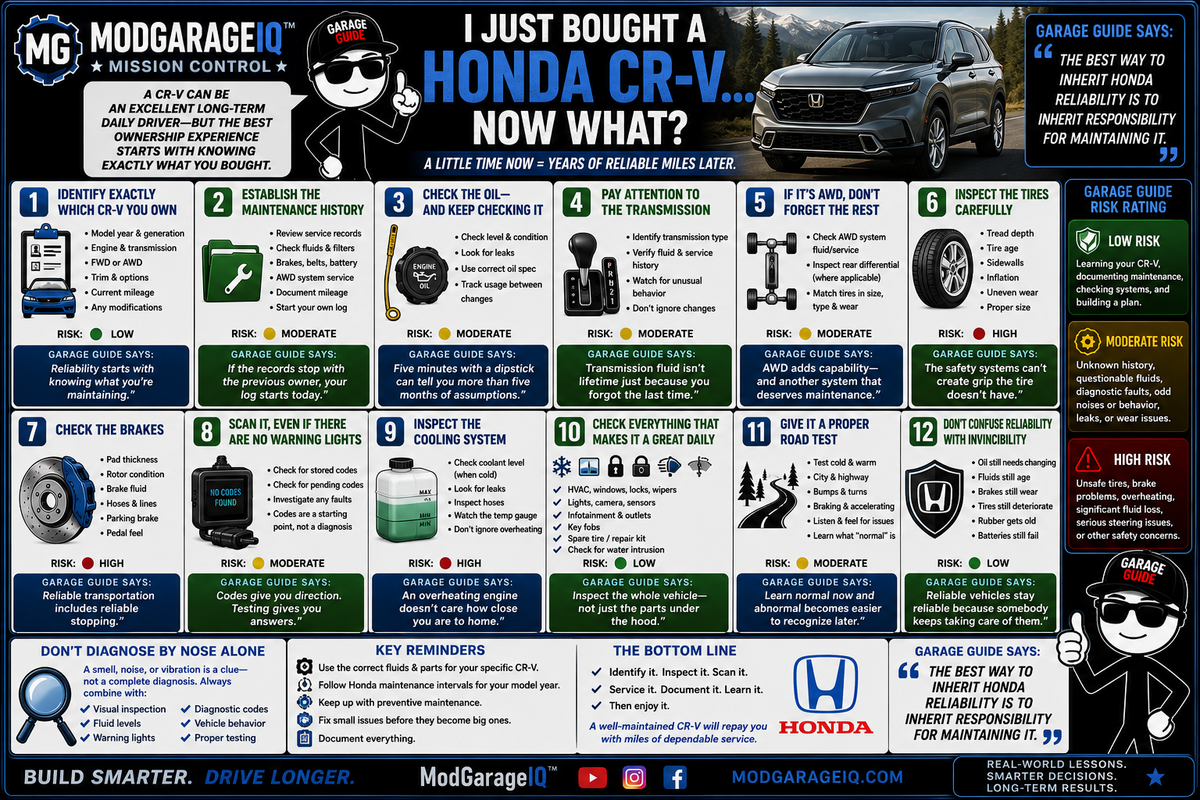
A CR-V Can Be an Excellent Long-Term Daily Driver—but the Best Ownership Experience Starts With Knowing Exactly What You Bought.
You bought a Honda CR-V.
Maybe it’s your first SUV.
Maybe you wanted something practical for commuting and family duty.
Maybe you found a used one with reasonable mileage and Honda’s reputation for longevity helped seal the deal.
Whatever brought it home, don’t let one word determine how you treat it:
Honda.
A reputation for reliability doesn’t eliminate maintenance.
And because the CR-V has existed across multiple generations, engines, transmissions, and drivetrains, there isn’t one universal maintenance checklist that applies identically to every CR-V ever built.
So before accessories, wheels, audio upgrades, or anything else:
Establish the baseline.
1. Identify Exactly Which CR-V You Own
Start with the fundamentals.
Know your:
- Model year
- Generation
- Engine
- Transmission
- Front-wheel drive or all-wheel drive
- Trim
- Current mileage
- Factory equipment
- Previous modifications
This matters because CR-V powertrains and maintenance requirements have changed substantially across generations.
Don’t search:
“What fluid does a Honda CR-V use?”
Search for information applicable to your specific year and configuration.
🟢 Garage Guide Risk Rating: LOW
Knowing the exact vehicle prevents incorrect parts, fluids, and maintenance decisions later.
Garage Guide Says:
“Reliability starts with knowing what you’re maintaining.”
2. Establish the Maintenance History
If you bought the CR-V used, ask for service records.
If they’re incomplete, don’t panic.
Start building your own.
Inspect or verify the condition and service history of applicable items such as:
- Engine oil and filter
- Engine coolant
- Transmission fluid
- Brake fluid
- Engine air filter
- Cabin air filter
- Spark plugs
- Drive belt
- Battery
- Brakes
- Tires
- AWD system fluids where applicable
The exact service requirements and intervals depend on the vehicle, so use the appropriate Honda maintenance information for your CR-V rather than relying on a generic internet schedule.
Then document the mileage.
That’s your new baseline.
🟡 Garage Guide Risk Rating: MODERATE
Unknown history isn’t proof of neglect—but it shouldn’t be treated as proof of maintenance either.
Garage Guide Says:
“If the records stop with the previous owner, your maintenance log starts today.”
3. Check the Oil—and Keep Checking It
Don’t make oil inspection something that only happens during an oil change.
Check:
- Oil level
- Oil condition
- Evidence of leakage
- Service history
- Correct oil specification for your engine
After buying a used vehicle, periodically checking the oil also helps you learn something important:
Does this particular engine maintain its oil level normally between services?
That’s useful information regardless of what badge is on the hood.
🟡 Garage Guide Risk Rating: MODERATE
Operating any engine with insufficient lubrication can turn an inexpensive habit into an expensive lesson.
Garage Guide Says:
“Five minutes with a dipstick can tell you more than five months of assumptions.”
4. Pay Attention to the Transmission
Your CR-V’s transmission deserves the same maintenance respect as its engine.
First, identify which transmission your vehicle actually has.
Then determine:
- Service history
- Correct fluid
- Appropriate maintenance procedure
- Whether any unusual behavior is present
During your road test, pay attention to:
- Hesitation
- Shudder
- Unusual noises
- Delayed engagement
- Abnormal RPM behavior
- Changes as the vehicle warms up
Don’t immediately assume every unusual sensation means transmission failure.
But don’t ignore changes either.
🟡 Garage Guide Risk Rating: MODERATE
Garage Guide Says:
“Transmission fluid isn’t lifetime just because you forgot the last time it was serviced.”
5. If It’s AWD, Don’t Forget the Rest of the Drivetrain
An AWD badge means there are additional components doing additional work.
Determine what drivetrain maintenance applies to your specific CR-V and whether it has been performed.
Also pay close attention to the tires.
AWD systems generally benefit from having tires that are appropriately matched in:
- Size
- Type
- Condition
- Wear
If one tire has been replaced recently while the others are heavily worn, investigate whether the resulting difference is acceptable for your vehicle.
🟡 Garage Guide Risk Rating: MODERATE
Garage Guide Says:
“AWD adds capability—and another system that deserves maintenance.”
6. Inspect the Tires Carefully
A CR-V is often purchased because it’s practical.
That makes tires easy to overlook until they need replacement.
Don’t wait.
Inspect:
- Tread depth
- Tire age
- Sidewall condition
- Correct size
- Matching tires
- Inflation
- Uneven wear
- Damage
Uneven wear can also provide clues about:
- Alignment
- Suspension
- Inflation
- Steering
- Previous neglect
Remember that tires affect far more than traction.
They influence braking, handling, ride quality, noise, and wet-weather performance.
🔴 Garage Guide Risk Rating: HIGH
Damaged, severely worn, or otherwise unsafe tires deserve immediate attention.
Garage Guide Says:
“The safety systems can’t create grip the tire doesn’t have.”
7. Check the Brakes
CR-Vs frequently live lives filled with:
Commutes.
School runs.
Traffic.
Groceries.
Road trips.
Stop-and-go driving.
That’s a lot of braking.
Inspect:
- Pad thickness
- Rotor condition
- Brake-fluid condition
- Hoses and lines
- Parking brake operation where applicable
- Pedal feel
During the road test, watch for:
- Pulsation
- Grinding
- Squealing
- Pulling
- Vibration
- Excessive pedal travel
🔴 Garage Guide Risk Rating: HIGH
Brake problems belong at the top of the repair list—not behind cosmetic improvements.
Garage Guide Says:
“Reliable transportation includes reliable stopping.”
8. Scan It Even If There Are No Warning Lights
A basic diagnostic scan is worthwhile on a newly purchased used vehicle.
Depending on the vehicle and scan tool, you may uncover:
- Stored codes
- Pending codes
- Relevant system information
If something appears, remember:
A diagnostic trouble code is a starting point, not automatic proof that a particular component needs replacement.
Research and diagnose before buying parts.
🟡 Garage Guide Risk Rating: MODERATE
Garage Guide Says:
“Codes give you direction. Testing gives you answers.”
9. Inspect the Cooling System
Cooling-system health matters on every vehicle.
With the engine cold and using proper safety precautions, inspect applicable areas for:
- Correct coolant level
- Visible leakage
- Damaged hoses
- Staining or residue
- Reservoir condition
- Radiator-area concerns
Then watch the temperature indication during normal operation.
If the vehicle begins overheating, don’t keep driving simply because you’re “almost home.”
🔴 Garage Guide Risk Rating: HIGH
Overheating can turn a manageable cooling-system repair into major engine damage.
Garage Guide Says:
“An overheating engine doesn’t care how close you are to home.”
10. Check Everything That Makes a CR-V a Good Daily Driver
Mechanical reliability is only part of ownership.
Test the systems you’re going to use constantly.
Check:
- HVAC operation
- Power windows
- Locks
- Mirrors
- Wipers and washers
- Exterior lighting
- Backup camera where equipped
- Driver-assistance systems where equipped
- Infotainment
- USB/power outlets
- Key fobs
- Spare tire or tire-repair equipment, depending on configuration
Also look for water intrusion.
Check:
- Carpeting
- Cargo area
- Spare-tire well where applicable
- Headliner
- Door seals
- Sunroof area if equipped
A small convenience problem today can become an irritating ownership problem tomorrow.
🟢 Garage Guide Risk Rating: LOW
Most convenience issues aren’t immediately dangerous, but discovering them early gives you a complete picture of the vehicle.
Garage Guide Says:
“Inspect the whole vehicle—not just the parts under the hood.”
11. Give It a Proper Road Test
Turn the music off and learn your CR-V.
Drive it:
- Cold
- Fully warmed up
- At neighborhood speeds
- At highway speeds
- Over bumps
- Through turns
- During braking
- Under moderate acceleration
Pay attention to:
- Steering feel
- Vibration
- Wheel-bearing-like humming
- Suspension clunks
- Brake behavior
- Drivetrain noises
- Transmission behavior
- Wind noise
- Warning messages
You’re establishing what normal feels and sounds like.
That’s one of the most valuable things a new owner can learn.
🟡 Garage Guide Risk Rating: MODERATE
Garage Guide Says:
“Learn normal now and abnormal becomes easier to recognize later.”
12. Don’t Confuse Reliability With Invincibility
This is perhaps the biggest lesson for a new CR-V owner.
Honda has built a strong reputation for practical, durable vehicles.
That’s a reason to maintain one.
Not a reason to neglect one.
Oil still needs attention.
Fluids still age.
Brakes still wear.
Tires still deteriorate.
Rubber components still get old.
Batteries still fail.
Mechanical components still wear.
The vehicle’s reputation doesn’t maintain the vehicle.
You do.
🟢 Garage Guide Risk Rating: LOW
Garage Guide Says:
“Reliable vehicles stay reliable because somebody keeps taking care of them.”
Garage Guide Risk Rating
🟢 LOW RISKLearning your CR-V, documenting maintenance, checking convenience equipment, and establishing a long-term plan.
🟡 MODERATE RISKUnknown maintenance history, questionable fluid history, diagnostic faults, unusual drivetrain behavior, leaks, or abnormal noises.
🔴 HIGH RISKUnsafe tires, brake problems, overheating, significant fluid loss, serious steering problems, or other immediate safety concerns.
The Bottom Line
A used Honda CR-V can make an excellent everyday vehicle.
But don’t let a reputation for reliability replace an inspection.
Your first days of ownership should be about answering questions:
What exactly did I buy?
What has already been maintained?
What hasn’t?
What needs attention now?
What can wait?
Once you know those answers, ownership gets much easier.
So before accessories and upgrades:
Identify it.Inspect it.
Scan it.
Service it.
Document it.
Learn it.
Then enjoy it.
Garage Guide Says:
“The best way to inherit Honda reliability is to inherit responsibility for maintaining it.”
Build Smarter. Drive Longer.
#ModGarageIQ #GarageGuide #HondaCRV #CRV #HondaOwners #SUVMaintenance #UsedCar #CarMaintenance #OwnersGuide #AutomotiveEducation #MissionControl #BuildSmarterDriveLonger