I Just Bought a Honda Civic… Now What?
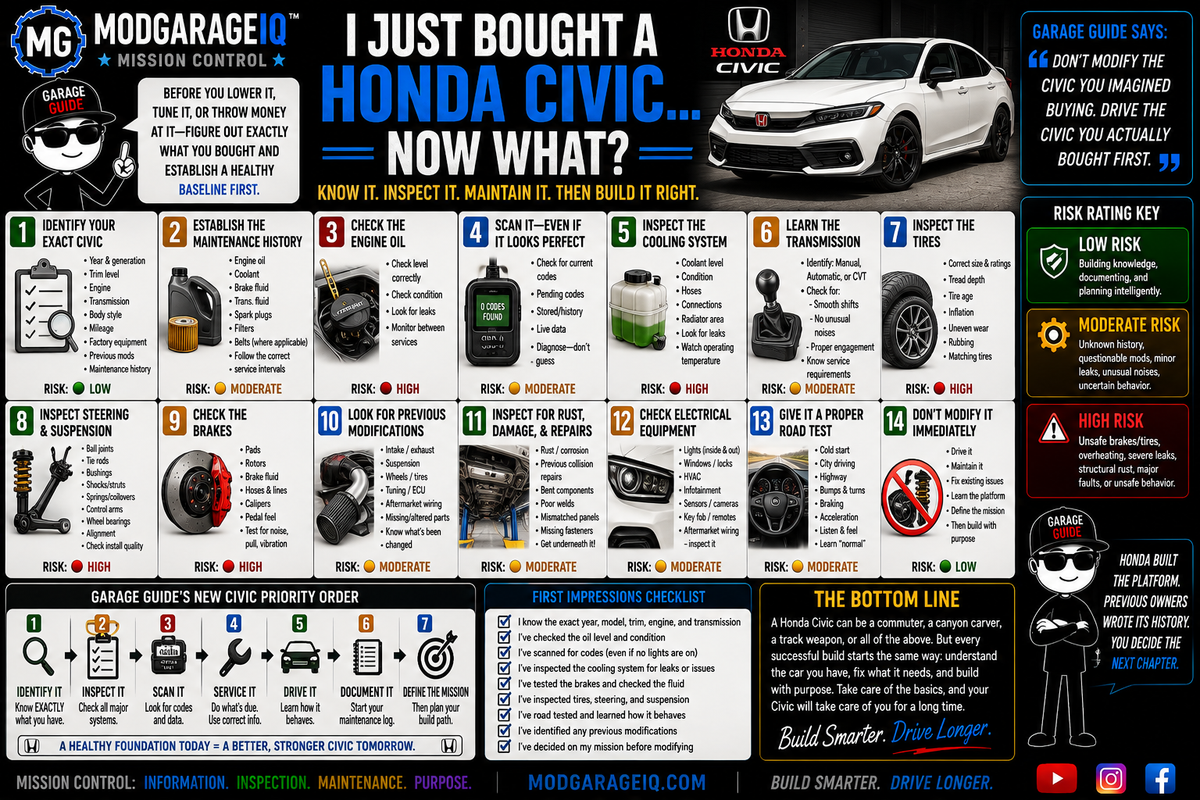
Before You Lower It, Tune It, Throw Wheels on It, or Start Chasing Horsepower—Figure Out Exactly Which Civic You Bought and Establish a Healthy Baseline.
You bought a Honda Civic.
Congratulations.
You now own one of the most versatile automotive platforms on the planet.
It can be:
A dependable commuter.
A first car.
A fuel-efficient daily.
A canyon carver.
An autocross build.
A track car.
A show car.
Or a legitimately quick street machine.
And somewhere on the internet right now, someone is preparing to explain why your completely stock Civic urgently needs coilovers. 😂
Ignore them for a minute.
Because before we ask:
“What should I modify?”
Garage Guide wants to answer something much more important:
“What exactly did you buy?”
Let’s establish the baseline.
1. Identify Your Exact Civic
This matters enormously with the Civic.
Honda has produced the platform across numerous generations with different:
- Engines
- Transmissions
- Body styles
- Trim levels
- Suspension designs
- Factory performance levels
- Features
A Civic LX and Civic Si aren’t interchangeable simply because they share the Civic name.
And a Type R?
That’s another conversation entirely. 😂
Know your:
- Model year
- Generation
- Trim
- Engine
- Transmission
- Current mileage
- Factory equipment
- Previous modifications
- Maintenance history
If you’re planning modifications, determine exactly which components and procedures apply to your particular Civic.
🟢 Garage Guide Risk Rating: LOW
Garage Guide Says:
“Before learning what fits your Civic, learn which Civic is sitting in your driveway.”
2. Establish the Maintenance History
Honda reliability has created one unfortunate side effect.
Some owners interpret:
“Honda Civics are reliable”
as:
“Honda Civics don’t need maintenance.”
Those are very different statements. 😂
If you have documented maintenance history, study it.
If you don’t, begin establishing your own.
Determine the condition and applicable service requirements for things such as:
- Engine oil
- Coolant
- Brake fluid
- Transmission fluid
- Engine air filter
- Cabin air filter
- Spark plugs
- Belts where applicable
- Other generation-specific maintenance items
Don’t replace everything blindly.
Inspect.
Research the correct service requirements.
Then address what’s actually due.
🟡 Garage Guide Risk Rating: MODERATE
Garage Guide Says:
“Reliability isn’t permission to skip maintenance. Maintenance is part of why reliable cars stay reliable.”
3. Check the Engine Oil
Simple?
Yes.
Important?
Absolutely.
Check the oil correctly and establish:
- Proper level
- General condition
- Evidence of leakage
- Known service interval
Then continue monitoring it periodically.
Especially on an unfamiliar used vehicle, knowing whether the oil level changes between services can tell you something important about the engine.
And if you’re planning performance modifications?
Engine health matters even more.
🔴 Garage Guide Risk Rating: HIGH
Operating with insufficient oil can lead to serious engine damage.
Garage Guide Says:
“Horsepower can wait five minutes. Check the dipstick.”
4. Scan It—Even if the Dashboard Looks Perfect
No check engine light?
Great.
Scan it anyway.
Depending on the Civic and diagnostic equipment available, check for:
- Current codes
- Pending codes
- Stored/history information where available
- Relevant live data
- Other accessible vehicle modules
A previous owner may have cleared a warning light shortly before selling the car.
Or a developing issue may not yet have illuminated one.
Scanning gives us information.
But remember:
A trouble code isn’t a parts order.
Diagnose before replacing anything.
🟡 Garage Guide Risk Rating: MODERATE
Garage Guide Says:
“A scanner helps you ask better questions. It doesn’t automatically give you the answer.”
5. Inspect the Cooling System
A Civic may be economical.
It may be reliable.
It may run forever.
It still doesn’t enjoy overheating. 😂
With the engine cold and following appropriate safety procedures, inspect applicable:
- Coolant level
- Coolant condition
- Reservoir
- Hoses
- Connections
- Radiator area
- Evidence of leakage
- Dried coolant residue
Then watch operating temperature during your road test.
If the temperature begins behaving abnormally, investigate immediately.
🔴 Garage Guide Risk Rating: HIGH
Garage Guide Says:
“The reputation for reliability doesn’t make an engine immune to heat.”
6. Learn the Transmission
Manual?
Automatic?
CVT?
Identify exactly what your Civic uses.
Then learn its maintenance requirements and how it behaves when healthy.
For an automatic or CVT-equipped vehicle, pay attention to:
- Engagement
- Smoothness
- Hesitation
- Shudder
- Unusual RPM behavior
- Abnormal noises
- Cold versus warm behavior
For a manual, pay attention to:
- Clutch engagement
- Slipping
- Gear engagement
- Grinding
- Shifter feel
- Unusual noises
And find out whether the transmission has been serviced correctly.
🟡 Garage Guide Risk Rating: MODERATE
Garage Guide Says:
“Don’t wait until the transmission feels different to learn what normal was supposed to feel like.”
7. Inspect the Tires
Civics often live long enough to experience several completely different owners.
And several completely different wheel-and-tire ideas. 😂
Check:
- Tire size
- Load/speed rating as applicable
- Tread depth
- Tire age
- Inflation
- Sidewall condition
- Matching tires
- Uneven wear
- Evidence of rubbing
Uneven wear can provide clues about:
- Alignment
- Suspension wear
- Incorrect inflation
- Poor wheel fitment
- Previous ride-height changes
Don’t replace the evidence before understanding what created it.
🔴 Garage Guide Risk Rating: HIGH
Garage Guide Says:
“The tires aren’t just touching the road. They’re telling you a story about the car.”
8. Inspect the Steering and Suspension
Especially if the Civic has already been modified.
Look for applicable:
- Ball joints
- Tie rods
- Bushings
- Control arms
- Shocks/struts
- Springs
- Wheel bearings
- Aftermarket coilovers
- Lowering springs
- Adjustable components
If it’s lowered, don’t automatically celebrate. 😂
First determine:
What parts were used?
Were they installed correctly?
Is the alignment reasonable?
Are the tires rubbing?
Is anything damaged?
Does the car actually drive properly?
Modification quality matters more than modification quantity.
🔴 Garage Guide Risk Rating: HIGH
Garage Guide Says:
“Lower isn’t automatically better. Better is better.”
9. Check the Brakes
A Civic doesn’t need to be a performance model for brakes to matter.
Inspect applicable:
- Pads
- Rotors
- Brake fluid
- Hoses
- Lines
- Calipers
- Parking brake
- Pedal feel
During your road test, watch for:
- Pulling
- Pulsation
- Grinding
- Squealing
- Vibration
- Abnormal pedal behavior
And if this Civic is eventually becoming a spirited street or track-oriented build?
Brakes become part of the performance plan.
🔴 Garage Guide Risk Rating: HIGH
Garage Guide Says:
“Stopping better is a performance modification too.”
10. Look for Previous Modifications
This is where Civic ownership gets interesting. 😂
Look carefully for:
- Intake modifications
- Exhaust changes
- Suspension components
- Aftermarket wheels
- Lighting
- Stereo wiring
- Engine-bay wiring
- Removed or altered components
- Evidence of tuning
- Cosmetic modifications hiding previous work
Don’t assume aftermarket means bad.
Plenty of modifications are installed correctly.
The point is:
Identify them.
You need to know what changed before deciding what should change next.
🟡 Garage Guide Risk Rating: MODERATE
Garage Guide Says:
“You inherited the previous owner’s build sheet—even if they forgot to give you a copy.”
11. Inspect for Rust, Damage, and Previous Repairs
Get underneath it.
Look around the body.
Inspect areas appropriate to the generation and vehicle history for:
- Corrosion
- Damaged underbody components
- Poor repairs
- Missing fasteners
- Bent components
- Questionable welds
- Mismatched panels
- Overspray
- Evidence of previous collision repair
A vehicle doesn’t have to be perfect to be a good purchase.
But you should know what you’re working with.
🟡 Garage Guide Risk Rating: MODERATE
Serious structural corrosion or poorly repaired collision damage can become high risk.
Garage Guide Says:
“A clean Carfax isn’t an inspection—and an inspection isn’t just looking at the paint.”
12. Check the Electrical Equipment
Test everything.
Depending on generation and trim:
- Exterior lights
- Interior lights
- Windows
- Locks
- Mirrors
- HVAC
- Infotainment
- Cameras
- Sensors
- Driver-assistance equipment
- Charging ports
- Key fobs
And pay special attention to aftermarket wiring.
Civics are frequently modified with:
- Audio systems
- Lighting
- Alarms
- Remote starts
- Gauges
- Accessories
If the wiring looks questionable, investigate it.
🟡 Garage Guide Risk Rating: MODERATE
Garage Guide Says:
“Electrical tape isn’t automatically evidence of electrical engineering.” 😂
13. Give It a Proper Road Test
Radio off.
Windows up initially.
Garage Guide listening mode:
Activated. 😎
Drive it:
- Cold
- Fully warmed
- Around town
- At highway speed
- Over bumps
- Through turns
- Under braking
- During acceleration
Pay attention to:
Engine behavior.
Transmission behavior.
Steering.
Brakes.
Suspension.
Vibration.
Temperature.
Noises.
Then learn what normal feels like.
Because this becomes your baseline for every future diagnosis.
🟡 Garage Guide Risk Rating: MODERATE
Garage Guide Says:
“The first road test isn’t about seeing how fast it is. It’s about learning how healthy it is.”
14. Don’t Modify It Immediately
And here we are.
The section half the Civic community was hoping Garage Guide would forget. 😂😂
I know.
The wheels would look incredible.
The coilovers are on sale.
The intake makes cool noises.
The exhaust video has 800,000 views.
And somebody has already told you that you need a tune.
Wait.
Drive the Civic.
Maintain it.
Fix existing problems.
Learn the platform.
Then determine the mission.
Are you building a:
Reliable daily?
OEM+ commuter?
Si-inspired street car?
Canyon carver?
Autocross car?
Track car?
Show build?
Performance build?
The answer determines what comes next.
🟢 Garage Guide Risk Rating: LOW
Garage Guide Says:
“Don’t modify the Civic you imagined buying. Drive the Civic you actually bought first.”
Garage Guide’s New Civic Priority Order
🔵
1 — IDENTIFY IT
Year.
Generation.
Trim.
Engine.
Transmission.
Previous modifications.
🟢
2 — INSPECT IT
Engine.
Cooling.
Transmission.
Brakes.
Tires.
Steering.
Suspension.
Electrical.
Underbody.
🟡
3 — SCAN IT
Current codes.
Pending codes.
Available vehicle data.
Diagnose abnormalities.
🟠
4 — SERVICE WHAT’S DUE
Use the correct maintenance information for your exact Civic.
🔵
5 — DRIVE IT
Learn what normal feels like.
🟢
6 — DOCUMENT IT
Start your maintenance log.
Now you control the history.
🔵
7 — DEFINE THE MISSION
Only then do we start building.
Garage Guide Risk Rating
🟢 LOW RISKIdentifying the exact Civic, documenting it, learning its behavior, and planning intelligently.
🟡 MODERATE RISKUnknown maintenance history, questionable previous modifications, minor leaks, unusual noises, or uncertain transmission behavior.
🔴 HIGH RISKUnsafe brakes or tires, overheating, severe steering/suspension problems, dangerously low fluids, serious structural corrosion, or major mechanical faults.
The Bottom Line
The Honda Civic earned its reputation because it’s a remarkably versatile platform.
But don’t let that reputation make you complacent.
A used Civic is still a used car with a history.
Learn which one you bought.
Inspect it.
Scan it.
Establish the maintenance baseline.
Learn the transmission.
Read the tires.
Check the brakes.
Inspect previous modifications.
Road-test it properly.
Then drive it long enough to understand what you actually want to improve.
Because whether your Civic eventually becomes a 300,000-mile commuter or a serious enthusiast build…
The smartest version starts exactly the same way:
With a healthy foundation.
Garage Guide Says:
“Honda built the platform. The previous owners wrote its history. Your job is to understand both before writing the next chapter.”
Build Smarter. Drive Longer.
#ModGarageIQ #GarageGuide #HondaCivic #Civic #Honda #CivicNation #HondaOwners #CivicBuild #CarMaintenance #CarMods #OwnersGuide #MissionControl #AutomotiveEducation #BuildSmarterDriveLonger