I Just Bought a Ford F-150… Now What?
You bought an F-150. Maybe it’s your first truck. Maybe it’s replacing one that finally gave up after 200,000 miles. Or maybe you bought it because you wanted something that could commute Monday through Friday, haul on Saturday, and still take the family somewhere Sunday.
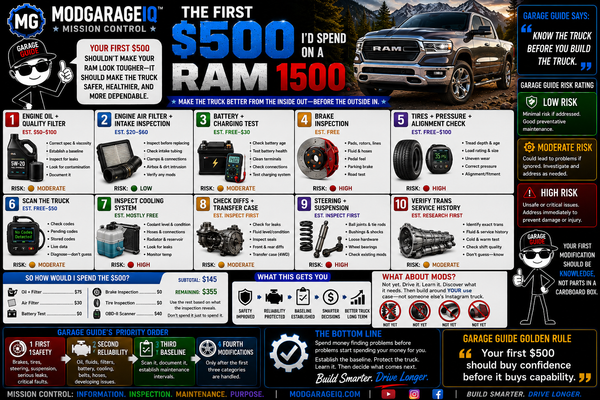
Whatever brought it home, there’s one thing I’d recommend before ordering wheels, a leveling kit, exhaust, tune, lights, or anything else:
Figure out exactly what you bought.
The F-150 has been offered with multiple engines, transmissions, drivetrains, axle ratios, towing configurations, and option packages. Two trucks that look almost identical can have very different maintenance needs and capabilities.
Your first job as the new owner isn’t modification.
It’s establishing a baseline.
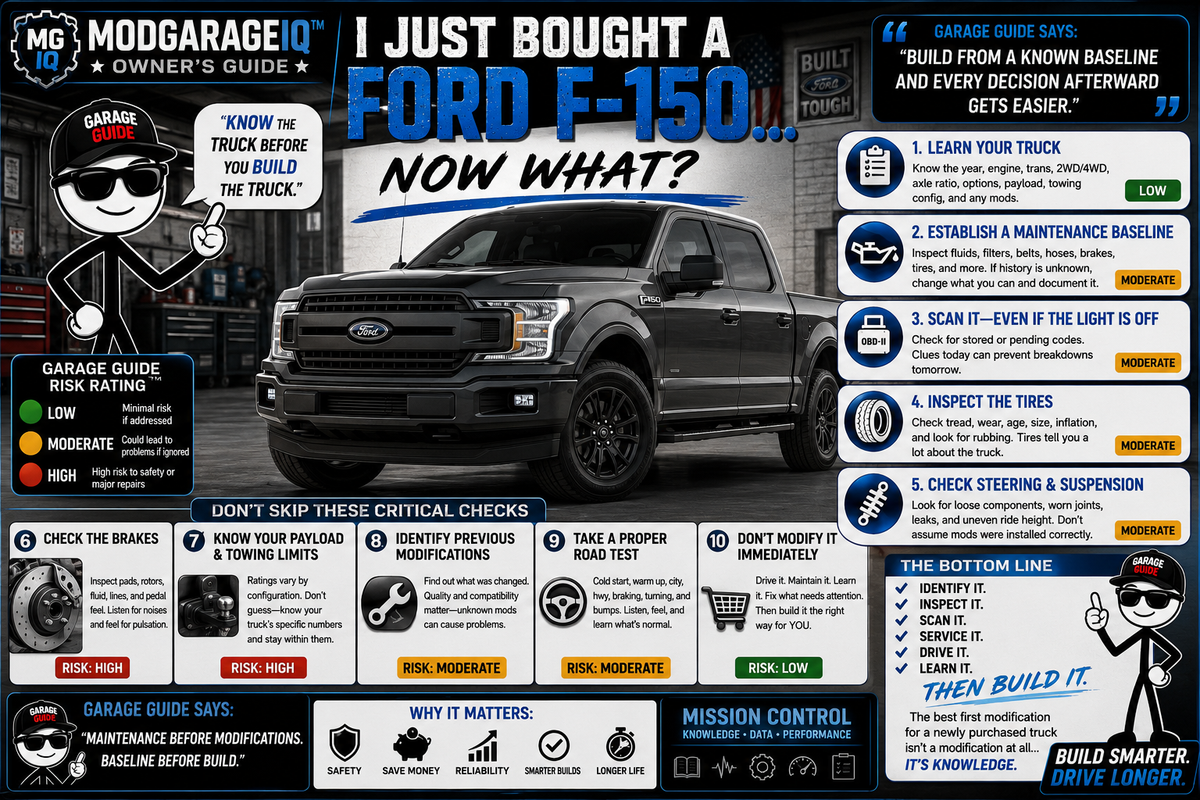
1. Learn Your Truck
Start with the basics.
Know your:
- Model year
- Engine
- Transmission
- 2WD or 4WD
- Axle ratio
- Cab and bed configuration
- Payload rating
- Towing configuration
- Factory options
- Previous modifications
Don’t assume your truck can tow or carry something simply because another F-150 can.
The badge tells you what family the truck belongs to. The configuration tells you what it can actually do.
🟢 Garage Guide Risk Rating: LOW
There’s nothing dangerous about not memorizing your option sheet—but understanding the truck prevents bad maintenance, towing, and modification decisions later.
Garage Guide Says:
“Know the truck before you build the truck.”
2. Establish a Maintenance Baseline
Unless you have trustworthy service records, treat the maintenance history as unknown.
That doesn’t mean immediately replacing everything.
It means inspecting everything and establishing your own starting point.
Check:
- Engine oil and filter
- Coolant condition and level
- Brake fluid
- Transmission service history
- Front and rear differential fluid where applicable
- Transfer-case fluid on 4WD models
- Air filter
- Spark plugs/service history
- Battery condition and age
- Serpentine belt
- Hoses
- Wipers
- Tires
- Brakes
Also inspect underneath the truck for leaks, damaged shields, corrosion, and evidence of previous repairs.
Once that’s done, document the mileage.
That becomes Day One of your maintenance history.
🟡 Garage Guide Risk Rating: MODERATE
Unknown maintenance doesn’t automatically mean neglected maintenance. But assuming something was serviced because the previous owner said, “Yeah, I think they did that,” isn’t much of a maintenance plan.
Garage Guide Says:
“A fresh baseline turns somebody else’s maintenance history into yours.”
3. Scan It—Even If There Isn’t a Check Engine Light
An OBD-II scanner should be one of the first tools used on a newly purchased vehicle.
Don’t wait for the dashboard to light up.
Depending on the scanner and truck, you may be able to identify stored or pending trouble codes and other information that can point toward developing problems.
You’re looking for clues.
A recently cleared code, recurring fault, or pending issue doesn’t automatically mean something catastrophic is happening—but it deserves investigation.
🟡 Garage Guide Risk Rating: MODERATE
Ignoring a warning because the truck currently drives normally can allow a manageable issue to become an expensive one.
Garage Guide Says:
“The truck doesn’t have to be broken to tell you something.”
4. Inspect the Tires Before You Judge the Ride
Trucks are particularly sensitive to tire condition because tires affect far more than appearance.
Inspect:
- Tread depth
- Uneven wear
- Cracking
- Tire age
- Correct size
- Matching tires
- Proper inflation
- Evidence of rubbing
- Oversized aftermarket tires
Uneven wear can also provide clues about alignment, suspension, steering, or inflation problems.
And if the previous owner installed substantially larger tires, remember that the change may affect ride quality, braking, gearing feel, fuel economy, and other aspects of how the truck behaves.
🟡 Garage Guide Risk Rating: MODERATE
Garage Guide Says:
“Before blaming the suspension, look at the four things touching the road.”
5. Inspect the Steering and Suspension
An F-150 may have spent its previous life commuting gently—or towing, hauling, driving rough roads, visiting job sites, or running oversized wheels and tires.
Inspect for:
- Loose steering components
- Worn suspension joints or bushings
- Leaking shocks
- Uneven ride height
- Abnormal tire wear
- Clunks over bumps
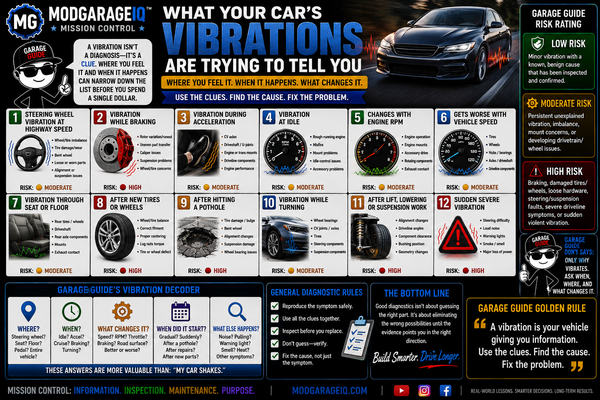
- Steering vibration
- Pulling
- Previous suspension modifications
If the truck has a leveling or lift kit, identify what was installed and whether the supporting geometry and components were addressed appropriately.
Don’t assume an aftermarket suspension modification was installed correctly just because it has been on the truck for years.
🟡 Garage Guide Risk Rating: MODERATE
Steering or suspension looseness deserves attention before performance or appearance modifications.
Garage Guide Says:
“A lift doesn’t fix worn parts. It usually makes them easier to notice.”
6. Check the Brakes
A heavy vehicle asks a lot from its braking system.
Inspect:
- Pad thickness
- Rotor condition
- Brake-fluid condition
- Brake hoses and lines
- Parking brake operation
- Pedal feel
During a road test, pay attention to:
- Pulsation
- Grinding
- Squealing
- Pulling under braking
- Excessive pedal travel
- Steering-wheel vibration
If you plan to tow, haul, or add larger/heavier wheels and tires, brake condition becomes even more important.
🔴 Garage Guide Risk Rating: HIGH
Brake problems aren’t something to put on the “eventually” list.
Garage Guide Says:
“Horsepower gets attention. Brakes get you home.”
7. Understand Your Payload and Towing Limits
This is one of the most important things a new truck owner can learn.
Don’t determine towing capability from:
- An advertisement
- A forum post
- Another F-150
- The hitch receiver
- A generic maximum-tow number
Your specific truck’s configuration matters.
Before towing or carrying a significant load, understand the applicable ratings for your truck and how passengers, cargo, accessories, and trailer tongue weight affect the available capacity.
🔴 Garage Guide Risk Rating: HIGH
Exceeding vehicle ratings can affect handling, braking, stability, and component life.
Garage Guide Says:
“Just because the truck can move it doesn’t mean the truck should move it.”
8. Find Out What the Previous Owner Changed
Used trucks are frequently modified.
Look for:
- Tune or programmer
- Intake
- Exhaust
- Leveling kit
- Lift kit
- Oversized tires
- Aftermarket wheels
- Lighting modifications
- Trailer wiring
- Suspension components
- Aftermarket electronics
Modifications aren’t automatically bad.
Unknown modifications are the problem.
Identify the manufacturer, part, installation quality, and—where applicable—whether other components or calibration changes were required to support it.
🟡 Garage Guide Risk Rating: MODERATE
Garage Guide Says:
“Never build on top of a modification you don’t understand.”
9. Give It a Proper Road Test
Turn the radio off.
Seriously.
Drive the truck:
- Cold
- Fully warmed up
- At neighborhood speeds
- At highway speeds
- Under moderate acceleration
- During braking
- Through turns
- Over imperfect pavement
Listen and feel.
Pay attention to:
- Vibration
- Clunks
- Humming
- Whining
- Hesitation
- Harsh or unusual shifting
- Steering wander
- Brake pulsation
- Driveline noises
You’re learning what normal feels like for your truck.
That knowledge becomes incredibly valuable later.
🟡 Garage Guide Risk Rating: MODERATE
Garage Guide Says:
“The sooner you learn normal, the sooner you’ll recognize abnormal.”
10. Don’t Modify It Immediately
This may be the hardest advice to follow.
You bought an F-150.
Of course you’re already looking at parts.
But give yourself some time with the truck first.
Drive it.
Maintain it.
Learn what you like.
Learn what you don’t.
Fix existing problems.
Then decide what the truck actually needs.
A truck built around how you genuinely use it will almost always turn out better than one built from an online shopping cart during the first weekend of ownership.
🟢 Garage Guide Risk Rating: LOW
Garage Guide Says:
“Maintenance before modifications. Baseline before build.”
Garage Guide Risk Rating
🟢 LOWLearning the truck, documenting it, and planning future modifications.
🟡 MODERATEUnknown maintenance, questionable modifications, worn tires, suspension issues, stored faults, or uncertain service history.
🔴 HIGHBrake problems, serious steering issues, overheating, unsafe tires, significant mechanical faults, or operating beyond the truck’s rated capabilities.
The Bottom Line
Buying the F-150 is only the beginning.
Before you worry about making it faster, taller, louder, or more capable, make sure you understand the truck sitting in your driveway.
Identify it.Inspect it.
Scan it.
Service it.
Drive it.
Learn it.
Then build it.
Because the best first modification for a newly purchased truck isn’t a modification at all.
It’s knowledge.
Garage Guide Says:
“Build from a known baseline and every decision afterward gets easier.”
Build Smarter. Drive Longer.
#ModGarageIQ #GarageGuide #FordF150 #F150 #TruckOwnership #UsedTruck #TruckMaintenance #MissionControl #AutomotiveEducation #BuildSmarterDriveLonger