I Just Bought a Chevrolet Silverado 1500… Now What?
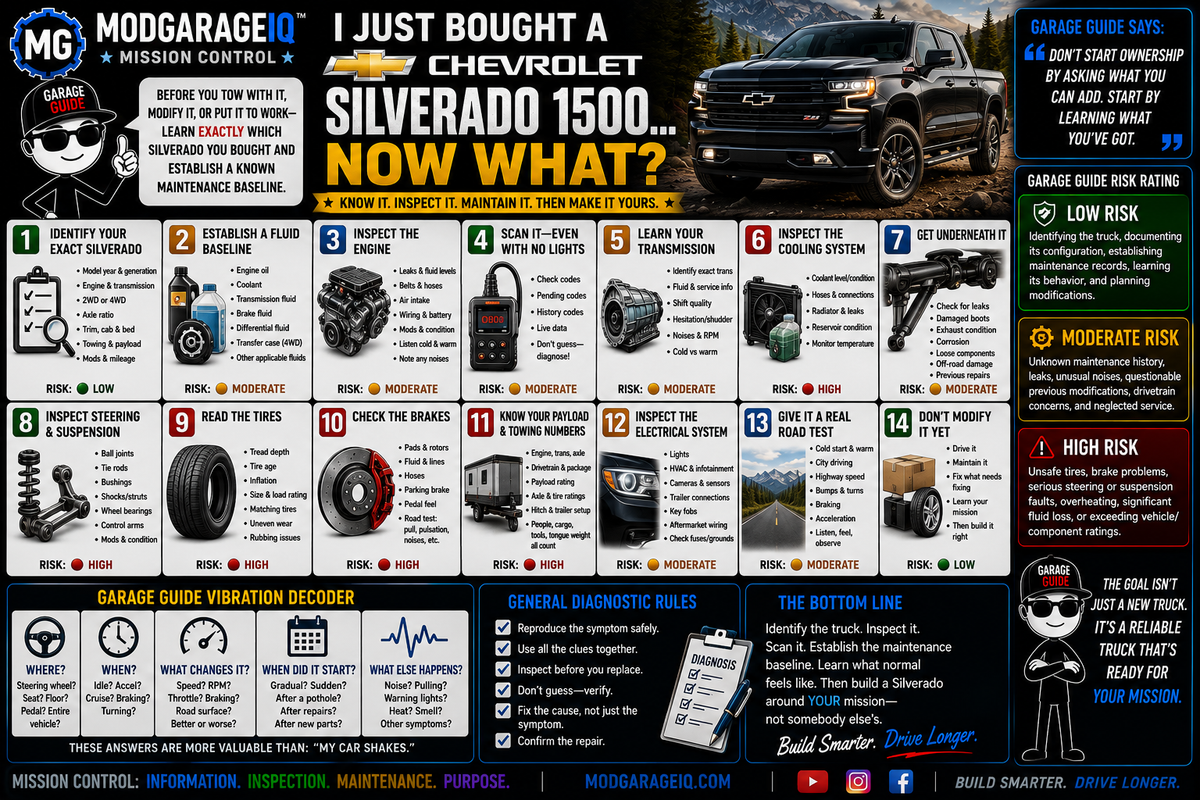
Before You Tow With It, Modify It, or Put It to Work—Learn Exactly Which Silverado You Bought and Establish a Known Maintenance Baseline.
You bought a Silverado 1500.
Congratulations.
Now resist the urge. 😂
Because somewhere right now, a new Silverado owner is already shopping for:
Wheels.
Bigger tires.
A leveling kit.
Exhaust.
Lighting.
And probably something advertised as adding horsepower in approximately eleven minutes.
We’re not doing that yet.
Your first job isn’t changing the truck.
Your first job is figuring out exactly what you bought.
Because “Silverado 1500” describes an enormous family of trucks spanning different generations, engines, transmissions, drivetrains, axle configurations, suspension setups, towing packages, and previous-owner histories.
So before we build it…
Let’s learn it.
1. Identify Your Exact Silverado
This is step one for a reason.
Know your:
- Model year
- Generation
- Engine
- Transmission
- 2WD or 4WD
- Axle ratio
- Trim
- Cab and bed configuration
- Factory towing equipment
- Payload information
- Current mileage
- Previous modifications
Don’t assume that advice for one Silverado automatically applies to another.
Even two trucks sitting beside each other can have substantially different capabilities and maintenance requirements.
🟢 Garage Guide Risk Rating: LOW
Knowing the exact configuration costs nothing and makes nearly every decision afterward easier.
Garage Guide Says:
“Know the truck you own—not just the badge on the tailgate.”
2. Establish a Fluid Baseline
If you have trustworthy maintenance records, excellent.
Use them.
If you don’t?
Start investigating.
Depending on the exact truck and configuration, that may mean checking the condition, history, and applicable service requirements for:
- Engine oil
- Coolant
- Transmission fluid
- Brake fluid
- Differential fluid
- Transfer-case fluid on applicable 4WD trucks
- Other serviceable fluids specific to the vehicle
Notice what I didn’t say:
Drain everything immediately.
We don’t perform maintenance simply because we don’t know what else to do.
Identify what the truck requires.
Determine what has already been done.
Then service what’s actually due using the correct specifications and procedures.
🟡 Garage Guide Risk Rating: MODERATE
Garage Guide Says:
“Unknown history isn’t permission to guess. It’s a reason to investigate.”
3. Inspect the Engine Before You Modify It
Silverado 1500s have been offered with multiple engine families and configurations.
So first:
Identify yours.
Then inspect it.
Look for:
- Oil leakage
- Coolant leakage
- Fluid levels
- Belt condition
- Hose condition
- Intake condition
- Wiring issues
- Battery connections
- Previous modifications
- Unusual noises
Start the engine cold.
Listen.
Let it reach operating temperature.
Listen again.
Then observe how it behaves during the road test.
If you hear a tick, knock, rattle, squeal, or other unusual sound, don’t immediately diagnose it from a video.
Document when the sound occurs.
🟡 Garage Guide Risk Rating: MODERATE
Garage Guide Says:
“A strange noise is evidence. It isn’t a parts order.”
4. Scan It—Even With No Warning Lights
The dashboard looks perfect.
Excellent.
Scan it anyway.
Depending on the truck and your diagnostic equipment, look for:
- Current trouble codes
- Pending codes
- Stored/history codes where available
- Relevant live data
- Other accessible module information
A scan can sometimes reveal clues before a problem becomes obvious from the driver’s seat.
But remember our Mission Control rule:
A trouble code is not a diagnosis.
It tells you what the vehicle detected.
Your job is determining why it detected it.
🟡 Garage Guide Risk Rating: MODERATE
Garage Guide Says:
“Scan for information. Diagnose before buying parts.”
5. Learn Your Transmission
Don’t wait until the transmission starts behaving differently to become interested in it.
Identify the exact transmission installed in your Silverado.
Then determine:
- Correct service information
- Correct fluid specification
- Previous service history
- Current operating behavior
During your road test, pay attention to:
- Initial engagement
- Shift quality
- Hesitation
- Shudder
- Unusual RPM behavior
- Abnormal noises
- Cold versus warm operation
And don’t automatically assume every odd shift means the transmission is dying.
Diagnose the symptom.
🟡 Garage Guide Risk Rating: MODERATE
Garage Guide Says:
“Learn how the transmission behaves while it’s healthy. Changes become easier to recognize later.”
6. Inspect the Cooling System
Trucks work.
They tow.
They haul.
They idle.
They sit in traffic.
They operate in heat.
And heat is not something we play games with.
With the engine cold and following proper safety procedures, inspect applicable cooling-system components for:
- Correct coolant level
- Coolant condition
- Hose condition
- Reservoir condition
- Radiator-area leakage
- Dried coolant residue
- Damaged connections
Then monitor operating temperature during normal driving.
If the truck begins overheating, investigate the problem.
Don’t keep driving an overheating engine hoping it’ll negotiate with you.
🔴 Garage Guide Risk Rating: HIGH
Garage Guide Says:
“Overheating isn’t something you schedule for next weekend.”
7. Get Underneath It
This is one of the most valuable inspections you can perform on a newly purchased used truck.
Look underneath.
Inspect for:
- Engine leaks
- Transmission leaks
- Differential leaks
- Transfer-case leaks where applicable
- Damaged boots
- Exhaust damage
- Corrosion
- Loose components
- Suspension wear
- Evidence of previous repairs
- Evidence of off-road damage
And pay particular attention to previous modifications.
A truck may look stock from ten feet away and tell a completely different story underneath.
🟡 Garage Guide Risk Rating: MODERATE
Garage Guide Says:
“The paint tells you how the truck was detailed. The underside helps tell you how it lived.”
8. Inspect Steering and Suspension
Used trucks can have very different histories.
Your Silverado may have spent its life commuting.
Or it may have spent years:
Towing.
Hauling.
Driving construction sites.
Running oversized tires.
Driving rough roads.
Or wearing suspension modifications that were removed before it was sold.
Inspect applicable components such as:
- Ball joints
- Tie rods
- Bushings
- Shocks
- Springs
- Wheel bearings
- Control arms
- Steering components
- Existing lift or leveling components
Look for looseness, damage, leakage, uneven wear, or questionable installation work.
🔴 Garage Guide Risk Rating: HIGH
Steering and suspension directly affect your ability to control the truck.
Garage Guide Says:
“Before changing the suspension, make sure the suspension you already have is healthy.”
9. Read the Tires
Don’t just ask:
“How much tread is left?”
Ask:
“What are these tires telling me?”
Inspect:
- Tread depth
- Tire age
- Inflation
- Sidewall condition
- Tire size
- Load rating
- Matching tires
- Uneven wear
- Evidence of rubbing
Uneven wear can be a clue pointing toward:
- Alignment problems
- Worn suspension
- Worn steering components
- Incorrect inflation
- Poor wheel/tire fitment
If oversized tires are installed, identify what else was changed.
🔴 Garage Guide Risk Rating: HIGH
Garage Guide Says:
“Read the wear pattern before you replace the evidence.”
10. Check the Brakes
This is a truck.
Maybe you’ll never tow anything.
Maybe you’ll tow every weekend.
Either way:
Stopping comes first.
Inspect:
- Brake pads
- Rotors
- Fluid
- Lines
- Hoses
- Parking brake
- Pedal feel
During the road test, watch for:
- Pulling
- Pulsation
- Grinding
- Squealing
- Vibration
- Abnormal pedal travel
If something feels wrong, investigate it before asking the truck to carry or tow additional weight.
🔴 Garage Guide Risk Rating: HIGH
Garage Guide Says:
“Capability starts with control—and control starts with stopping.”
11. Know Your Payload and Towing Numbers
Don’t search:
“How much can a Silverado 1500 tow?”
That’s not specific enough.
The capability of your truck depends on its actual configuration.
Learn the applicable ratings and specifications for your Silverado, considering things such as:
- Engine
- Transmission
- Axle ratio
- Drivetrain
- Factory equipment
- Payload rating
- Axle ratings
- Tire ratings
- Hitch equipment
- Trailer configuration
And remember:
People weigh something.
Cargo weighs something.
Tools weigh something.
Accessories weigh something.
Trailer tongue weight matters.
🔴 Garage Guide Risk Rating: HIGH
Garage Guide Says:
“The biggest number in the brochure isn’t automatically the number for your truck.”
12. Inspect the Electrical System
Modern trucks are rolling electrical networks.
Test the equipment.
Depending on your Silverado, inspect applicable:
- Exterior lighting
- Power windows
- Locks
- Mirrors
- HVAC
- Infotainment
- Cameras
- Parking sensors
- Driver-assistance equipment
- USB/power outlets
- Trailer connections
- Key fobs
Then look for aftermarket wiring.
Previous owners love adding:
Lights.
Audio equipment.
Trailer accessories.
Switches.
And sometimes wiring that looks like spaghetti wearing electrical tape. 😂
Questionable aftermarket wiring deserves investigation.
🟡 Garage Guide Risk Rating: MODERATE
Garage Guide Says:
“If the wiring looks improvised, don’t assume the fuse box agrees with the creativity.”
13. Give It a Real Road Test
Turn the radio off.
Yes.
Off. 😂
Drive the truck:
- From a cold start
- Fully warmed
- Around town
- At highway speed
- Over bumps
- Through turns
- During braking
- Under moderate acceleration
Pay attention to:
Sound.
Vibration.
Steering feel.
Shift behavior.
Braking.
Temperature.
You’re creating a mental baseline for what normal feels like.
That becomes extremely valuable later.
🟡 Garage Guide Risk Rating: MODERATE
Garage Guide Says:
“You can’t recognize a change until you’ve learned the baseline.”
14. Don’t Modify It Yet
I know.
We’ve reached the painful part. 😂
The wheels are already in your shopping cart.
The leveling kit has free shipping.
The exhaust video sounded amazing through your phone speakers.
Wait.
Drive the truck.
Maintain it.
Fix what needs fixing.
Learn what you actually use it for.
Then ask:
Do I tow?
Do I haul?
Do I commute?
Do I go off-road?
Do I care more about comfort, appearance, performance, or capability?
Now we can build a Silverado around your mission instead of somebody else’s social-media truck.
🟢 Garage Guide Risk Rating: LOW
Garage Guide Says:
“Your first modification should solve something you’ve actually experienced.”
Garage Guide Risk Rating
🟢 LOW RISKIdentifying the truck, documenting its configuration, establishing maintenance records, learning its behavior, and planning modifications.
🟡 MODERATE RISKUnknown maintenance history, leaks, unusual noises, questionable previous modifications, drivetrain concerns, and neglected service.
🔴 HIGH RISKUnsafe tires, brake problems, serious steering or suspension faults, overheating, significant fluid loss, or exceeding vehicle/component ratings.
The Bottom Line
The first few days with your Silverado shouldn’t be about transforming it.
They should be about understanding it.
Identify the truck.
Inspect it.
Scan it.
Establish the maintenance baseline.
Check the drivetrain.
Read the tires.
Inspect the brakes.
Know the payload.
Know the towing numbers.
Learn what normal feels like.
Then drive it long enough to discover what you actually want the truck to do better.
Because once you understand the truck underneath you…
Building the right truck becomes a whole lot easier.
Garage Guide Says:
“Don’t start ownership by asking what you can add. Start by learning what you’ve got.”
Build Smarter. Drive Longer.
#ModGarageIQ #GarageGuide #ChevroletSilverado #Silverado1500 #Silverado #ChevyTrucks #TruckMaintenance #TruckMods #OwnersGuide #MissionControl #AutomotiveEducation #BuildSmarterDriveLonger