How Often Should You Change Transmission Fluid?
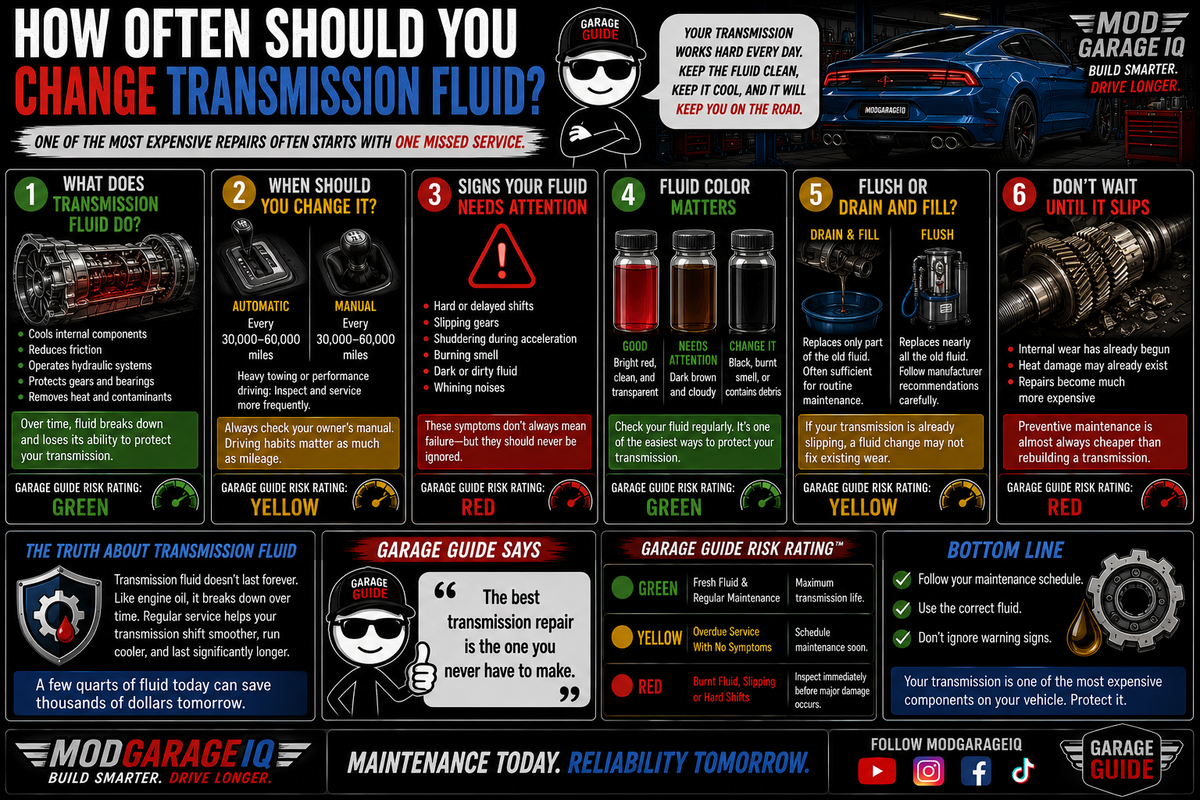
One Of The Most Expensive Repairs Often Starts With One Missed Service.
Your engine gets all the attention.
Fresh oil.
New spark plugs.
Air filters.
But one of the most neglected maintenance items on any vehicle is the transmission.
Whether you drive an automatic or manual, clean transmission fluid is critical for smooth shifting, cooling, lubrication, and long-term reliability.
Ignoring it can turn a simple maintenance service into a multi-thousand-dollar repair.
What Does Transmission Fluid Do?
Transmission fluid does much more than lubricate moving parts.
It also:
• Cools internal components
• Reduces friction
• Operates hydraulic systems
• Protects gears and bearings
• Removes heat and contaminants
Over time, that fluid breaks down and loses its ability to protect the transmission.
🟢 Garage Guide Risk Rating: GREEN
Fresh fluid equals longer transmission life.
When Should You Change It?
There’s no one-size-fits-all answer.
Always start with your owner’s manual, but as a general guideline:
• Automatic transmissions: Every 30,000–60,000 miles (depending on driving conditions and manufacturer recommendations)
• Manual transmissions: Every 30,000–60,000 miles
• Heavy towing or performance driving: Inspect and service more frequently.
If your vehicle sees severe service, don’t wait until problems appear.
🟡 Garage Guide Risk Rating: YELLOW
Driving habits matter as much as mileage.
Signs Your Fluid Needs Attention
Old transmission fluid often gives plenty of warning.
Watch for:
• Hard or delayed shifts
• Slipping gears
• Shuddering during acceleration
• Burning smell
• Dark or dirty fluid
• Whining noises
These symptoms don’t always mean the transmission has failed—but they should never be ignored.
🔴 Garage Guide Risk Rating: RED
The longer you wait, the more expensive it usually becomes.
Fluid Color Matters
Healthy transmission fluid is typically:
• Bright red
• Pink
• Clean and transparent
Fluid that appears:
• Dark brown
• Black
• Burnt
• Full of debris
…is telling you it’s time for service.
Checking fluid condition regularly is one of the easiest ways to protect your transmission.
🟢 Garage Guide Risk Rating: GREEN
Clean fluid is cheap insurance.
Flush Or Drain And Fill?
Many owners ask which service is better.
A drain and fill replaces only part of the old fluid and is often sufficient for routine maintenance.
A transmission flush replaces nearly all the old fluid but should be performed carefully and according to manufacturer recommendations.
If a neglected transmission is already slipping, simply changing the fluid may not fix the underlying wear.
🟡 Garage Guide Risk Rating: YELLOW
Follow manufacturer recommendations—not internet myths.
Don’t Wait Until It Slips
One of the biggest mistakes owners make is waiting until the transmission starts acting up.
By then:
• Internal wear has already begun.
• Heat damage may already exist.
• Repairs become much more expensive.
Preventive maintenance is almost always cheaper than rebuilding a transmission.
🔴 Garage Guide Risk Rating: RED
Maintenance costs hundreds.
Replacements cost thousands.
The Truth About Transmission Fluid
Transmission fluid doesn’t last forever.
Like engine oil, it breaks down over time.
Regular service helps your transmission shift smoother, run cooler, and last significantly longer.
Garage Guide Says
“The best transmission repair is the one you never have to make.”
Garage Guide Risk Rating™
🟢 Fresh Fluid & Regular Maintenance
Maximum transmission life.
🟡 Overdue Service With No Symptoms
Schedule maintenance soon.
🔴 Burnt Fluid, Slipping or Hard Shifts
Inspect immediately before major damage occurs.
Bottom Line
Your transmission is one of the most expensive components on your vehicle.
Fortunately, protecting it is relatively inexpensive.
Follow your maintenance schedule.
Use the correct fluid.
Don’t ignore warning signs.
Because a few quarts of fresh fluid today can save thousands of dollars tomorrow.
🏁 Build Smarter. Drive Longer.
#ModGarageIQ #GarageGuide #TransmissionFluid #TransmissionMaintenance #CarMaintenance #AutomotiveTips #BuildSmarterDriveLonger #PreventiveMaintenance