How Much Power Is Too Much?
More Horsepower Isn’t Always A Better Build.
Every enthusiast has a horsepower number in mind.
500 HP.
700 HP.
1,000 HP.
But here’s the question that rarely gets asked:
How much power can your vehicle actually use?
Horsepower is exciting.
Control, reliability, and drivability are what make a vehicle enjoyable every day.
Sometimes, the smartest upgrade isn’t making more power…
It’s making better use of the power you already have.
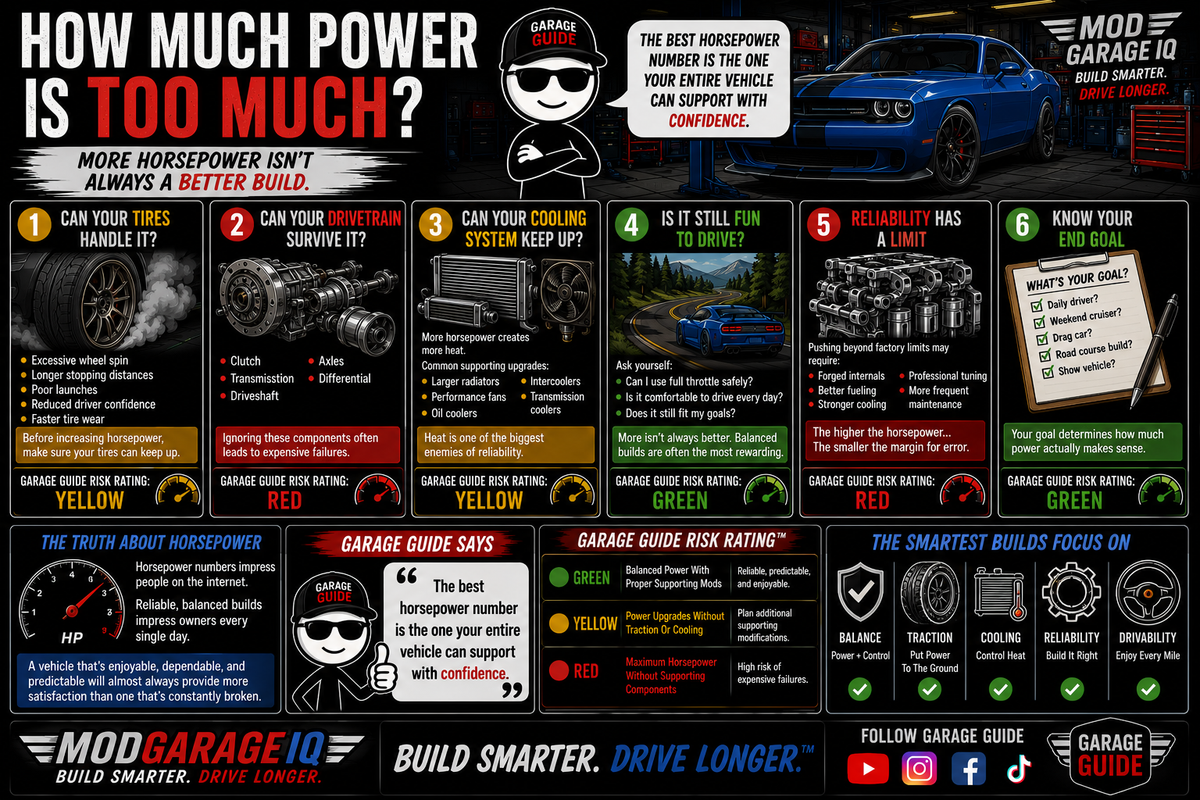
Can Your Tires Handle It?
Horsepower is useless if it can’t reach the pavement.
Adding power without improving traction often results in:
• Excessive wheel spin
• Longer stopping distances
• Poor launches
• Reduced driver confidence
• Faster tire wear
Before increasing horsepower, make sure your tires can keep up.
🟡 Garage Guide Risk Rating: YELLOW
Traction is the first performance upgrade.
Can Your Drivetrain Survive It?
Factory drivetrains are engineered around factory power.
Adding significant horsepower places additional stress on:
• Clutch
• Transmission
• Driveshaft
• Axles
• Differential
Ignoring these components often leads to expensive failures.
🔴 Garage Guide Risk Rating: RED
Horsepower exposes weak links.
Can Your Cooling System Keep Up?
More horsepower creates more heat.
Without proper cooling, temperatures climb quickly.
Common supporting upgrades include:
• Larger radiators
• Performance fans
• Oil coolers
• Intercoolers
• Transmission coolers
Heat is one of the biggest enemies of reliability.
🟡 Garage Guide Risk Rating: YELLOW
Control the temperature before chasing more boost.
Is It Still Fun To Drive?
Many owners eventually discover something surprising.
A 500-horsepower street car can often be more enjoyable than an 800-horsepower car that’s difficult to control.
Ask yourself:
• Can I use full throttle safely?
• Is it comfortable to drive every day?
• Does it still fit my goals?
More isn’t always better.
Balanced builds are often the most rewarding.
🟢 Garage Guide Risk Rating: GREEN
Build for how you actually drive.
Reliability Has A Limit
Every engine has a point where reliability begins to decrease.
Pushing beyond factory limits may require:
• Forged internals
• Better fueling
• Stronger cooling
• Professional tuning
• More frequent maintenance
The higher the horsepower…
The smaller the margin for error.
🔴 Garage Guide Risk Rating: RED
Power without preparation becomes expensive.
Know Your End Goal
Before buying another performance part, ask yourself:
• Daily driver?
• Weekend cruiser?
• Drag car?
• Road course build?
• Show vehicle?
Your goal determines how much power actually makes sense.
The fastest car isn’t always the best build.
The smartest car usually is.
🟢 Garage Guide Risk Rating: GREEN
A clear plan always beats chasing numbers.
The Truth About Horsepower
Horsepower numbers impress people on the internet.
Reliable, balanced builds impress owners every single day.
A vehicle that’s enjoyable, dependable, and predictable will almost always provide more satisfaction than one that’s constantly broken.
Garage Guide Says
“The best horsepower number is the one your entire vehicle can support with confidence.”
Garage Guide Risk Rating™
🟢 Balanced Power With Proper Supporting Mods
Reliable, predictable, and enjoyable.
🟡 Power Upgrades Without Traction Or Cooling
Plan additional supporting modifications.
🔴 Maximum Horsepower Without Supporting Components
High risk of expensive failures.
Bottom Line
Don’t chase horsepower.
Chase balance.
Upgrade your entire vehicle—not just the engine.
Because the fastest builds aren’t always the ones with the biggest dyno numbers.
They’re the ones that start every morning, put the power to the ground, and keep putting a smile on your face.
🏁 Build Smarter. Drive Longer.
#ModGarageIQ #GarageGuide #Horsepower #PerformanceMods #CarBuilds #AutomotiveTips #BuildSmarterDriveLonger #CarEnthusiast