How Much Horsepower Can a Stock Engine Really Handle?
The answer isn’t as simple as a single number.
One of the most common questions in the automotive world is:
“How much horsepower can my stock engine handle?”
Whether you’re planning a turbocharger upgrade, installing a supercharger, or considering a more aggressive tune, understanding your engine’s limitations can save you thousands of dollars and countless headaches.
The truth is that horsepower doesn’t kill engines. Poor planning, excessive heat, detonation, and weak components do.
Let’s break down what really determines how much power a stock engine can survive.
Why There Isn’t a Universal Answer
Two identical engines can have completely different outcomes at the same horsepower level.
One owner may drive a stock-bottom-end engine for years at 500 horsepower, while another destroys theirs within weeks.
Why?
Because engine longevity depends on several factors:
- Tuning quality
- Fuel quality
- Air-fuel ratios
- Cooling efficiency
- Driving habits
- Torque levels
- Maintenance
Horsepower is only one piece of the equation.
The Real Weak Links
Most modern engines don’t fail because the block cracks.
Instead, failures typically occur in:
Connecting Rods
Connecting rods are often the first major limitation.
Factory rods are designed around expected power levels and safety margins. Once boost pressure and cylinder pressures increase significantly, rods can bend or break.
Pistons
Cast pistons found in many factory engines can become vulnerable under high boost or poor tuning conditions.
Detonation is especially dangerous because it creates shock loads that pistons were never designed to withstand.
Head Gaskets
As cylinder pressure rises, head gaskets become more likely to fail.
A blown head gasket may not destroy the engine immediately, but it can lead to severe damage if ignored.
Transmission Components
Many enthusiasts focus only on the engine while forgetting that transmissions, clutches, axles, and differentials also have limits.
Sometimes the drivetrain fails before the engine does.
Common Power Levels Enthusiasts Consider Safe
While every engine family is different, these are general guidelines many builders follow:
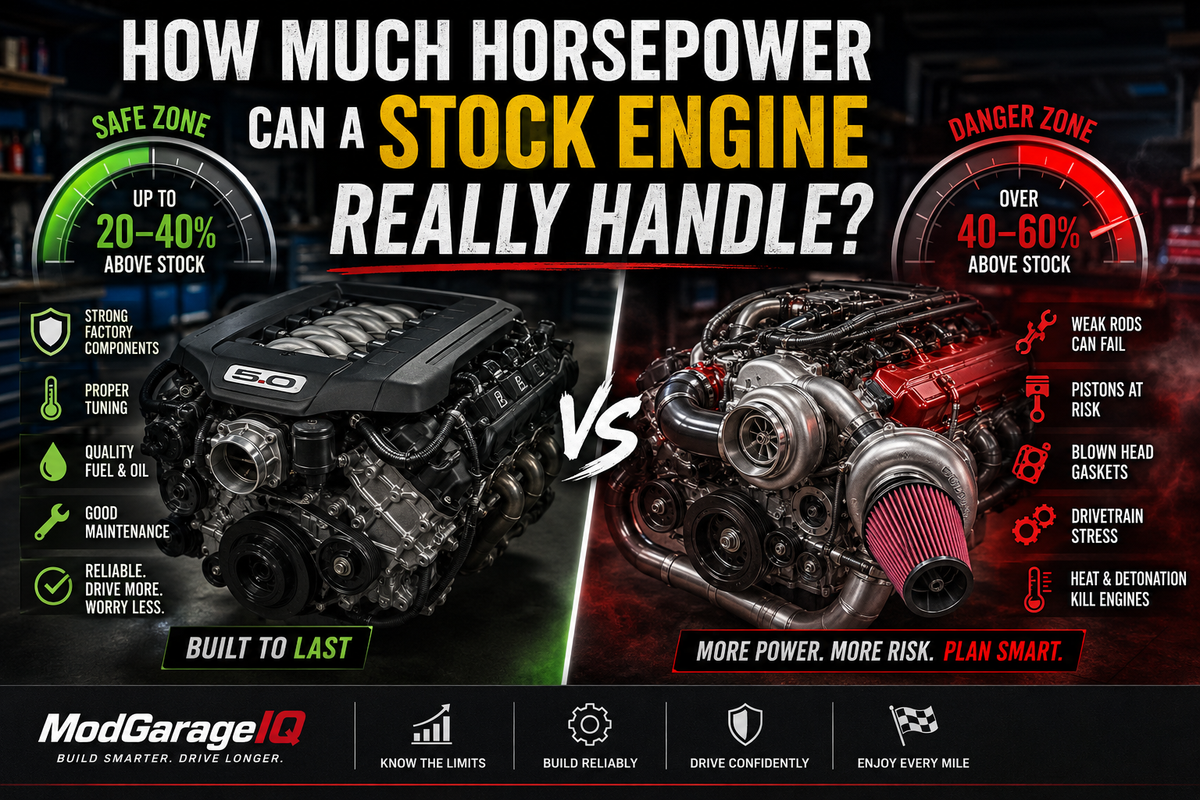
Up to 20% Above Factory Power
Typically low risk when supported by proper tuning and maintenance.
Most modern naturally aspirated engines can comfortably handle this increase.
20% to 40% Above Factory Power
This is where tuning quality becomes extremely important.
Cooling upgrades, premium fuel, and regular monitoring become increasingly valuable.
40% to 60% Above Factory Power
At this level, many engines begin approaching the limits of factory rods, pistons, or fuel systems.
Reliability becomes highly dependent on the specific platform.
More Than 60% Above Factory Power
You’re entering territory where upgraded internal components are often recommended.
This doesn’t mean failure is guaranteed, but risk increases substantially.
Horsepower vs Torque
Many enthusiasts focus on horsepower because it’s the headline number.
However, torque often creates more stress on engine components.
A turbocharged setup producing massive low-end torque can place enormous loads on rods, pistons, transmissions, and axles.
Two engines making identical horsepower can experience very different levels of mechanical stress depending on how that power is delivered.
The Importance of Tuning
A conservative tune is often the difference between an engine lasting 100,000 miles and failing after a few months.
Good tuning helps manage:
- Air-fuel ratios
- Ignition timing
- Boost pressure
- Knock control
- Engine temperatures
The cheapest tune frequently becomes the most expensive modification.
Supporting Mods Matter
Adding power without supporting modifications is one of the fastest ways to create reliability problems.
Before increasing horsepower, consider:
- Performance cooling systems
- Better intercoolers
- Higher-flow fuel systems
- Quality spark plugs
- Proper maintenance schedules
- High-quality engine oil
Supporting modifications don’t generate exciting dyno numbers, but they often determine whether an engine survives.
The Smart Approach
Instead of asking:
“What’s the most power my stock engine can make?”
Ask:
“What’s the most power my stock engine can make reliably?”
Those are very different questions.
A build that produces slightly less horsepower but remains dependable for years is usually more enjoyable than a build that constantly breaks.
Final Thoughts
The strongest engines aren’t always the ones making the biggest numbers.
They’re the ones that balance performance, reliability, and practicality.
Before chasing maximum horsepower, understand your engine’s limitations, invest in quality tuning, and support your modifications with the proper components.
Your future self—and your wallet—will thank you.
This one is newsletter-ready and fits perfectly after your first article. For the featured image, I’d suggest a dramatic split-screen concept:
Left Side: Stock engine with a green “Safe Zone” gauge.
Right Side: Modified turbocharged engine with a red “Danger Zone” gauge.