Dyno Numbers vs Real Performance
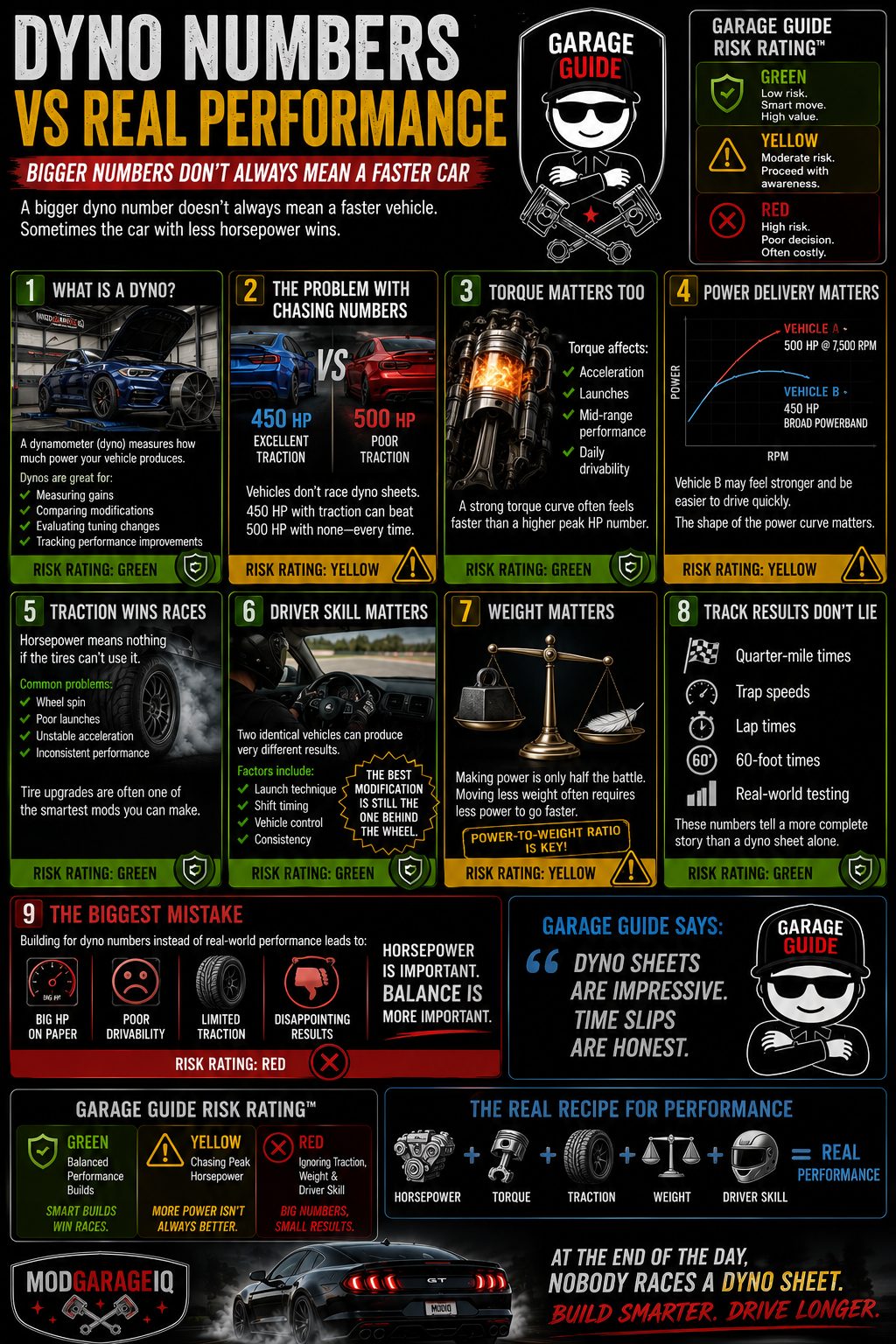
Bigger Numbers Don’t Always Mean A Faster Car
Every enthusiast loves horsepower numbers.
It’s easy to understand why.
A dyno sheet gives you a clear number to brag about.
But here’s the truth:
A bigger dyno number doesn’t always mean a faster vehicle.
Sometimes the car with less horsepower wins.
Let’s talk about why.
What Is A Dyno?
A dynamometer (dyno) measures how much power your vehicle produces.
Most enthusiasts use dyno results to evaluate modifications and tuning changes.
Dynos are great tools for:
• Measuring gains
• Comparing modifications
• Evaluating tuning changes
• Tracking performance improvements
🟢 Garage Guide Risk Rating: GREEN
Dynos provide valuable data.
The Problem With Chasing Numbers
Many enthusiasts become obsessed with peak horsepower.
The problem?
Vehicles don’t race dyno sheets.
They race on streets, tracks, and drag strips.
A car making:
• 450 horsepower with excellent traction
may outperform
• 500 horsepower with poor traction
every single time.
🟡 Garage Guide Risk Rating: YELLOW
Power is only part of the equation.
Torque Matters Too
Horsepower gets all the attention.
Torque does the work.
Torque affects:
• Acceleration
• Launches
• Mid-range performance
• Daily drivability
A vehicle with a strong torque curve often feels faster than one with a higher peak horsepower number.
Power Delivery Matters
Not all horsepower is created equal.
Consider two vehicles:
Vehicle A:
• 500 HP at 7,500 RPM
Vehicle B:
• 450 HP with a broad powerband
In real-world driving, Vehicle B may feel stronger and be easier to drive quickly.
The shape of the power curve matters.
Traction Wins Races
Horsepower means nothing if the tires can’t use it.
Common problems include:
• Wheel spin
• Poor launches
• Unstable acceleration
• Inconsistent performance
This is why tire upgrades are often one of the smartest modifications available.
🟢 Garage Guide Risk Rating: GREEN
Traction creates usable performance.
Driver Skill Matters
This part hurts some feelings.
🤣
Two identical vehicles can produce very different results depending on the driver.
Factors include:
• Launch technique
• Shift timing
• Vehicle control
• Consistency
The best modification is still the one behind the steering wheel.
🟢 Garage Guide Risk Rating: GREEN
Skill beats horsepower more often than people admit.
Weight Matters
Making power is only half the battle.
Moving weight matters too.
A lighter vehicle often requires less power to achieve similar performance.
This is why power-to-weight ratio is such an important measurement.
Track Results Don’t Lie
If you really want to measure performance, look at:
• Quarter-mile times
• Trap speeds
• Lap times
• 60-foot times
• Real-world testing
These numbers often tell a more complete story than a dyno sheet alone.
🟢 Garage Guide Risk Rating: GREEN
Performance happens on the road and track.
The Biggest Mistake
Many enthusiasts build vehicles for dyno numbers instead of real-world performance.
The result?
Big horsepower.
Poor drivability.
Limited traction.
Disappointing results.
Horsepower is important.
Balance is more important.
Garage Guide Says
“Dyno sheets are impressive. Time slips are honest.”
Garage Guide Risk Rating™
🟢 Balanced Performance Builds
🟡 Chasing Peak Horsepower
🔴 Ignoring Traction, Weight & Driver Skill
Bottom Line
Dyno numbers are useful tools, but they don’t tell the entire story.
Real performance comes from a combination of:
✅ Horsepower
✅ Torque
✅ Traction
✅ Weight
✅ Driver skill
Because at the end of the day, nobody races a dyno sheet.
🏁 Build Smarter. Drive Longer.
#ModGarageIQ #GarageGuide #Dyno #Horsepower #PerformanceMods #CarMods #MustangLife #AutomotiveTips #TrackDay #BuildSmarterDriveLonger #PerformanceCars