Best Build Paths for the Ram 1500
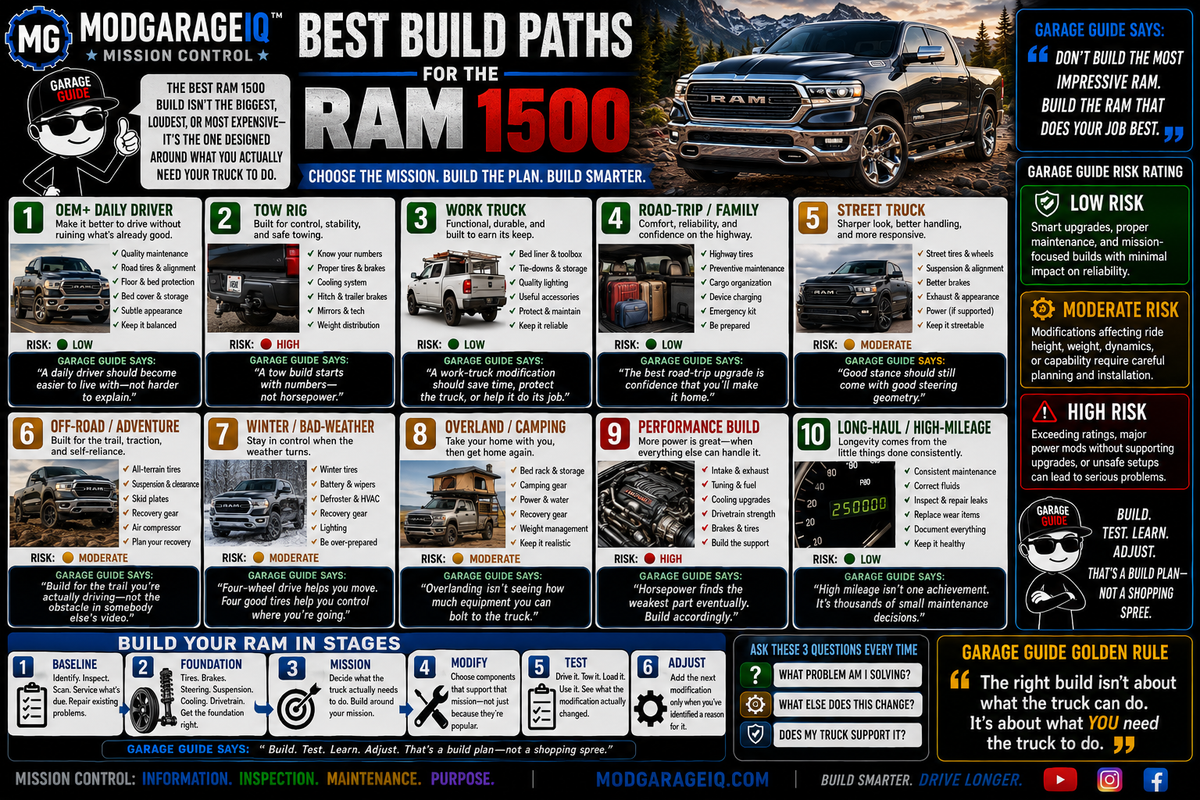
The Best Ram 1500 Build Isn’t the Biggest, Loudest, or Most Expensive—It’s the One Designed Around What You Actually Need Your Truck to Do.
This is what we’ve been waiting for.
For the last three posts, Garage Guide has basically been standing between you and the aftermarket catalog saying:
“Not yet.” 😂
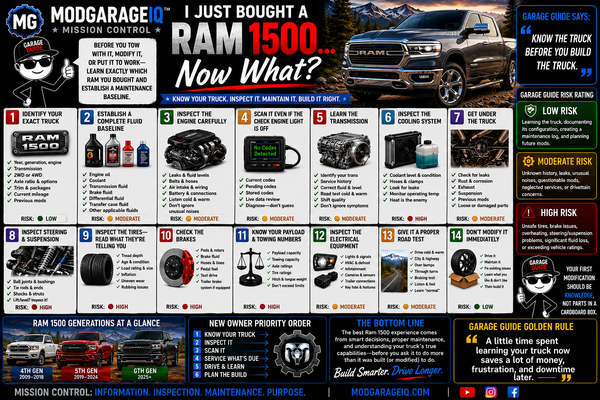
First, we learned the truck.
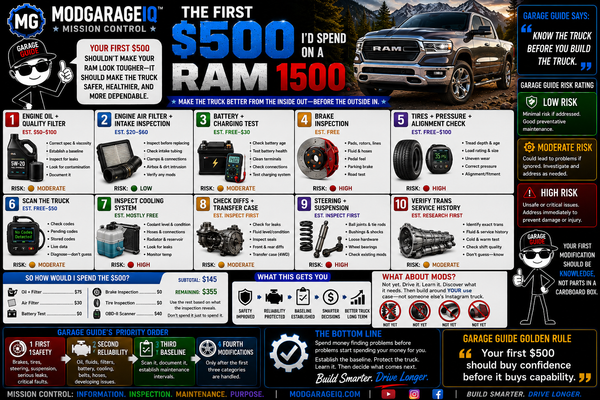
Then we established where the first $500 should go.
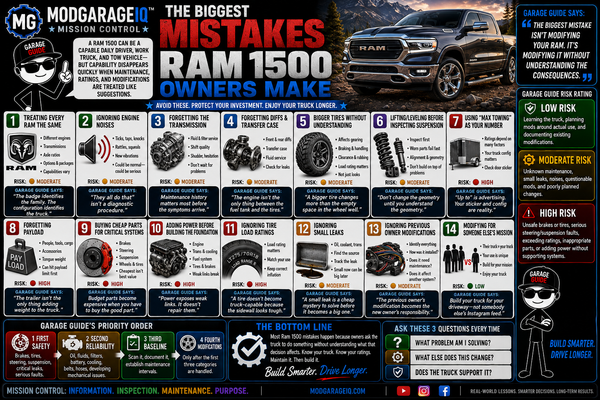
Then we covered the mistakes that can turn a good Ram into an expensive project.
Now?
We can build it.
But we’re not starting with parts.
We’re starting with a question:
What’s the mission?
Because a Ram built to commute every day shouldn’t necessarily look like one built to tow.
A tow rig shouldn’t automatically be built like an off-road truck.
And a weekend adventure truck doesn’t need the same equipment as a work truck.
So let’s choose the mission first.
Then we’ll choose the parts.
1. The OEM+ Daily Driver
For a huge number of Ram owners, this is probably the smartest build.
The mission:
Make the truck nicer to drive without ruining what already makes it good.
Start with the foundation:
- Complete maintenance baseline
- Quality road-oriented tires
- Healthy brakes
- Proper alignment
- Fresh suspension components where needed
- Correct fluids
- Healthy battery
- Quality wipers
- Proper lighting
Then consider subtle improvements based on what you actually want from the truck:
- Quality floor protection
- Bed protection
- Bed cover
- Useful storage
- Phone/device integration
- Mild appearance changes
- Carefully selected wheels
- Quality replacement lighting where appropriate
The key word is:
Balance.
You don’t need giant tires.
You don’t need extreme suspension.
You don’t need to make the exhaust wake up the neighborhood.
You need a truck that starts every morning, rides well, looks good, and does truck things when asked.
🟢 Garage Guide Risk Rating: LOW
OEM+ generally preserves the truck’s original strengths while improving condition and usability.
Garage Guide Says:
“A daily driver should become easier to live with—not harder to explain.”
2. The Tow Rig
If you bought your Ram primarily to tow, the build changes completely.
And here’s the first modification:
Know your numbers.
Before buying anything, determine the ratings applicable to your specific truck and trailer setup.
Then focus on the foundation.
Consider:
- Properly rated tires
- Excellent brakes
- Healthy cooling system
- Proper drivetrain maintenance
- Correct hitch equipment
- Trailer brake equipment where applicable
- Trailer electrical connections
- Appropriate mirrors where needed
- Tire-pressure monitoring strategy
- Weight-distribution equipment where appropriate for the setup
- Quality suspension maintenance
And don’t forget:
Payload.
Passengers, cargo, tools, accessories, hitch equipment, and trailer tongue weight can all matter when determining how much capacity remains.
The goal isn’t making the truck look ready to tow.
It’s making the entire combination properly equipped and operated.
🔴 Garage Guide Risk Rating: HIGH
Towing involves vehicle ratings, trailer setup, loading, braking, tires, and driver behavior. Mistakes can have serious consequences.
Garage Guide Says:
“A tow build starts with numbers—not horsepower.”
3. The Work Truck
This is the build where Instagram matters the least.
Because every modification needs to answer one question:
Does this make the truck better at earning its keep?
Useful additions may include:
- Bed liner or bed mat
- Secure toolbox
- Cargo organization
- Proper tie-down equipment
- Bed lighting
- Quality all-weather floor protection
- Seat protection
- Appropriate tires
- Mud flaps where useful
- Trailer equipment where needed
- Additional storage
- Properly installed auxiliary electrical equipment
Then protect reliability.
A working truck may accumulate:
- Idle hours
- Short trips
- Heavy loads
- Towing miles
- Dust
- Mud
- Job-site abuse
Maintenance should reflect how the truck is actually being used.
🟢 Garage Guide Risk Rating: LOW
Purpose-built work accessories can be extremely useful when properly installed and vehicle ratings are respected.
Garage Guide Says:
“A work-truck modification should either save time, protect the truck, or help the truck do its job.”
4. The Road-Trip / Family Truck
Ram 1500s can be surprisingly comfortable highway vehicles.
That makes them excellent candidates for a long-distance build.
Focus on:
- Quality highway tires
- Preventive maintenance
- Quiet ride
- Cargo organization
- Bed cover
- Secure luggage storage
- Device charging
- Phone integration
- Emergency kit
- First-aid kit
- Portable tire inflator
- Appropriate tire-repair equipment
- Roadside tools
- Comfortable interior organization
If you’re carrying substantial cargo or using roof, hitch, or bed-mounted accessories, account for their weight.
And don’t overlook the simplest upgrade of all:
Preventive maintenance before the trip.
🟢 Garage Guide Risk Rating: LOW
Garage Guide Says:
“The best road-trip upgrade is confidence that you’ll make it home.”
5. The Street Truck
Now we’re having some fun. 😎
The goal here isn’t pretending the Ram is a sports car.
It’s creating a sharper, cleaner, more responsive street-oriented truck while respecting the fact that it’s still a truck.
Possible directions include:
- Quality street tires
- Proper wheel fitment
- Carefully selected suspension changes
- Improved brake components where appropriate
- Exhaust changes
- Appearance upgrades
- Handling-oriented improvements
- Powertrain modifications where appropriate
- Proper calibration when required
But here’s the rule:
Don’t sacrifice the foundation for the stance.
A truck that looks incredible but:
Rubs tires.
Drives poorly.
Has terrible alignment.
Bottoms out.
Can’t carry what you need.
Or wears tires every few thousand miles…
Isn’t finished.
It’s compromised.
🟡 Garage Guide Risk Rating: MODERATE
Changes to ride height, wheel/tire fitment, handling, and powertrain systems require careful component selection and installation.
Garage Guide Says:
“Good stance should still come with good steering geometry.”
6. The Off-Road / Adventure Build
This is probably the build most people picture when someone says:
“Modified Ram.”
But let’s build it intelligently.
Start with the actual terrain you expect to encounter.
Forest roads?
Camping?
Mud?
Rocky trails?
Snow?
Desert?
The mission determines the equipment.
Depending on your needs, consider:
- Appropriate all-terrain tires
- Suitable wheels
- Quality suspension
- Additional ground clearance where justified
- Underbody protection
- Recovery points
- Recovery equipment
- Portable air compressor
- Tire-repair equipment
- Full-size spare where appropriate
- Additional lighting where legal and useful
- Navigation/communication equipment
- Cargo organization
And remember:
A lift doesn’t automatically make a truck good off-road.
Neither do huge tires.
Traction, clearance, articulation, recovery planning, driver judgment, and reliability all matter.
🟡 Garage Guide Risk Rating: MODERATE
More aggressive terrain and significant suspension/tire changes increase mechanical and operational risk.
Garage Guide Says:
“Build for the trail you’re actually driving—not the obstacle in somebody else’s video.”
7. The Winter / Bad-Weather Build
If your Ram lives somewhere that gets serious winter weather, this build may provide more real-world value than almost anything else on this list.
Start with:
Tires.
Depending on climate and use, quality winter tires may provide a substantial improvement in cold-weather traction.
Then inspect or add:
- Battery appropriate for conditions
- Wipers
- Climate-appropriate washer fluid
- Defroster operation
- HVAC performance
- Exterior lighting
- Recovery equipment
- Tow strap appropriate to your use
- Snow brush
- Ice scraper
- Portable inflator
- Emergency supplies
And remember:
4WD can help you accelerate.
It cannot rewrite the laws of physics when you need to stop.
🟡 Garage Guide Risk Rating: MODERATE
Garage Guide Says:
“Four-wheel drive helps you move. Four good tires help you control where you’re going.”
8. The Overland / Camping Build
This is where the adventure build becomes more about living from the truck than conquering obstacles.
Possible additions include:
- Bed rack
- Bed storage
- Camping equipment
- Awning
- Appropriate lighting
- Power solutions
- Refrigerator/cooler setup
- Water storage
- Recovery equipment
- Communication equipment
- Navigation
- All-terrain tires
- Suspension appropriate for actual load
But here’s the trap:
Weight.
Every accessory adds something.
Rack.
Tent.
Tools.
Water.
Fuel.
Food.
Recovery equipment.
Passengers.
Camping gear.
Before long, a truck covered in “overland” equipment may be carrying hundreds of pounds before the trip even begins.
Track the weight and understand the truck’s ratings.
🟡 Garage Guide Risk Rating: MODERATE
Garage Guide Says:
“Overlanding isn’t seeing how much equipment you can bolt to the truck.”
9. The Performance Build
All right.
You waited patiently. 😂
Now we can talk horsepower.
A performance-oriented Ram build might involve, depending on the specific engine, generation, goals, and applicable laws:
- Intake changes
- Exhaust changes
- Calibration
- Fuel considerations
- Cooling improvements
- Power-adders where appropriate
- Drivetrain upgrades
- Brake upgrades
- Better tires
But we’re going to follow one rule:
Build the supporting systems with the power.
More power can create more:
- Heat
- Drivetrain load
- Traction demand
- Braking demand
- Mechanical stress
Before chasing a number, establish:
- Engine health
- Transmission health
- Cooling capacity
- Fuel-system capability
- Drivetrain condition
- Brake condition
- Tire capability
Then decide how much power actually makes sense for the truck’s mission.
🔴 Garage Guide Risk Rating: HIGH
Major performance modifications increase mechanical complexity and can affect reliability, emissions compliance, drivability, and supporting systems.
Garage Guide Says:
“Horsepower finds the weakest part eventually. Build accordingly.”
10. The Long-Haul / High-Mileage Build
Here’s the sleeper build.
No giant tires.
No flashy suspension.
No horsepower goal.
The objective is:
Keep the truck healthy for as long as reasonably possible.
Focus on:
- Consistent oil maintenance
- Correct fluids
- Transmission maintenance
- Differential maintenance
- Transfer-case maintenance where applicable
- Cooling-system health
- Brake-fluid maintenance
- Belts and hoses
- Leak repair
- Steering and suspension wear
- Wheel bearings
- Battery and charging system
- Rust prevention where appropriate
- Maintenance documentation
The modification isn’t necessarily something bolted to the truck.
It’s the ownership system you’ve built around it.
🟢 Garage Guide Risk Rating: LOW
Garage Guide Says:
“High mileage isn’t one achievement. It’s thousands of small maintenance decisions.”
Build Your Ram in Stages
Whatever mission you choose, don’t build everything at once.
STAGE 1 — BASELINE
Identify it.
Inspect it.
Scan it.
Service what’s due.
Repair existing problems.
STAGE 2 — FOUNDATION
Tires.
Brakes.
Steering.
Suspension.
Cooling.
Drivetrain.
STAGE 3 — MISSION
Decide what the truck actually needs to do.
Daily driver?
Tow?
Work?
Street?
Adventure?
Camping?
Performance?
STAGE 4 — MODIFY
Now choose components that support that mission.
Not because they’re popular.
Because they have a purpose.
STAGE 5 — TEST
Drive it.
Tow with it where appropriate.
Load it.
Travel with it.
Use it.
See what the modification actually changed.
STAGE 6 — ADJUST
Only add the next modification when you’ve identified a reason for it.
Garage Guide Says:
“Build. Test. Learn. Adjust. That’s a build plan—not a shopping spree.”
Garage Guide Risk Rating
🟢 LOW RISKOEM+, work-truck organization, road-trip improvements, longevity builds, and carefully selected utility upgrades.
🟡 MODERATE RISKStreet suspension changes, larger wheels/tires, off-road builds, overlanding equipment, and modifications affecting weight or vehicle dynamics.
🔴 HIGH RISKMajor performance modifications, unsafe towing setups, exceeding payload or component ratings, extreme suspension changes, or builds that exceed supporting-system capability.
The Bottom Line
There is no single best Ram 1500 build.
There’s only the best build for your Ram’s mission.
A daily driver needs balance.
A tow rig needs control and capacity.
A work truck needs durability.
An adventure truck needs traction and recovery.
An overland truck needs smart weight management.
A performance truck needs supporting systems.
And a longevity build needs discipline.
So before ordering another part, ask the same three questions we established yesterday:
What problem am I solving?
What else does this change?
Does my truck support it?
If the answers make sense?
Build it.
Garage Guide Says:
“Don’t build the most impressive Ram. Build the Ram that does your job best.”
Build Smarter. Drive Longer.
#ModGarageIQ #GarageGuide #Ram1500 #RamTrucks #RamBuild #TruckBuild #TruckMods #Towing #OffRoad #Overland #StreetTruck #OwnersGuide #MissionControl #AutomotiveEducation #BuildSmarterDriveLonger