Best Build Paths for the Ford F-150
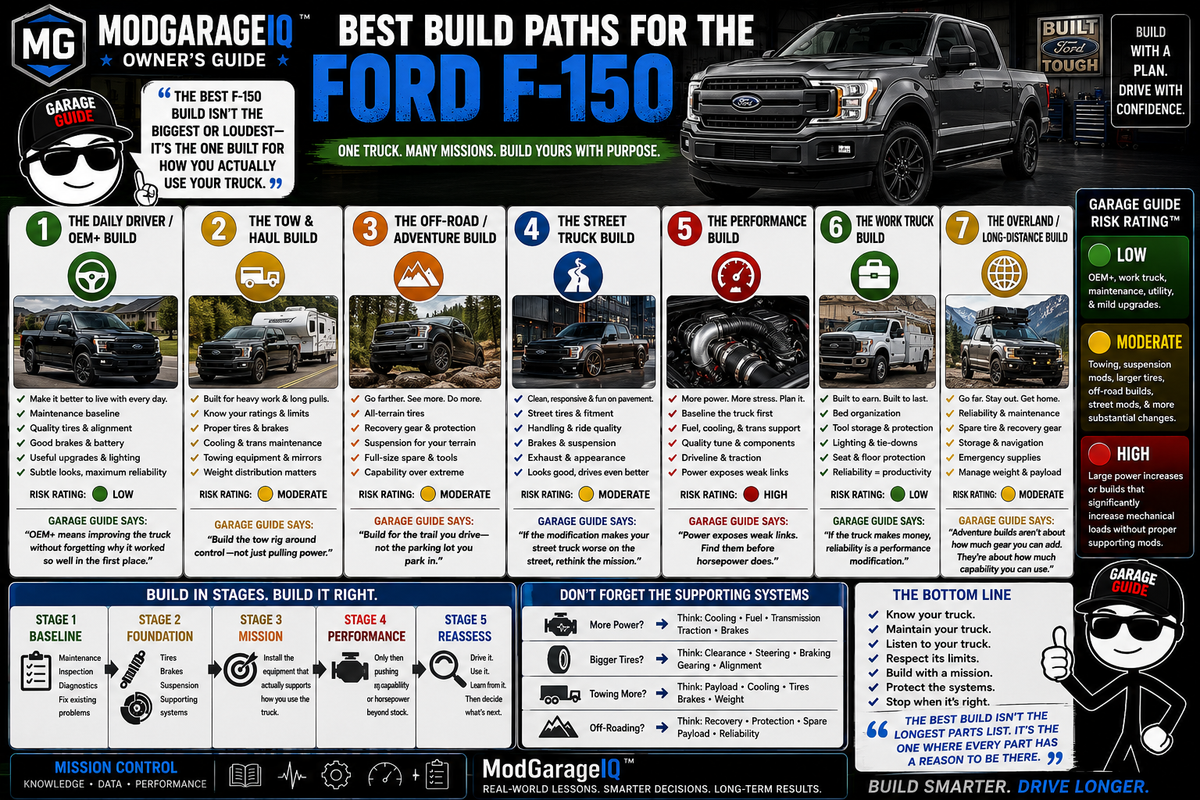
The Best F-150 Build Isn’t the Biggest or Loudest—It’s the One Built for How You Actually Use Your Truck.
The Ford F-150 might be one of the most versatile platforms on the road.
One owner uses theirs to commute every day.
Another pulls a camper every weekend.
Another spends Saturday on trails.
Another wants a clean street truck.
And somebody else sees an F-150 and immediately starts thinking about horsepower.
All of those builds can make sense.
The mistake is assuming one build path works for every F-150 owner.
Before buying parts, answer one question:
What mission does your truck need to accomplish?
Then build around that.
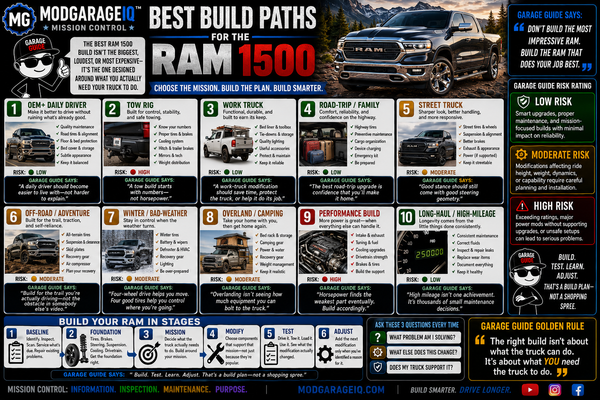
1. The Daily Driver / OEM+ Build
For most F-150 owners, this is probably the smartest build of all.
The goal isn’t dramatically changing the truck.
It’s making an already useful truck better to live with every day.
Start with:
- Complete maintenance baseline
- Quality tires appropriate for your climate
- Fresh fluids where needed
- Healthy brakes
- Proper alignment
- Good battery
- Quality replacement suspension components when needed
- Useful interior/storage upgrades
- Improved lighting where appropriate
- Bed protection or organization
You can also make subtle appearance changes without sacrificing the qualities that made the truck useful in the first place.
The result?
A truck that starts every morning, rides properly, handles predictably, and remains easy to maintain.
🟢 Garage Guide Risk Rating: LOW
This is generally the lowest-risk build because reliability and usability remain the priority.
Garage Guide Says:
“OEM+ means improving the truck without forgetting why it worked so well in the first place.”
2. The Tow & Haul Build
If your F-150 earns its keep by pulling or carrying things, horsepower shouldn’t automatically be your first concern.
Start with the fundamentals.
Know your truck’s applicable:
- Payload rating
- Towing capacity
- Axle ratings
- Tire ratings
- Hitch configuration
Then concentrate on the systems that matter when the truck is working.
Priorities may include:
- Proper tires
- Healthy brakes
- Cooling-system maintenance
- Transmission maintenance
- Differential service
- Trailer brake equipment where required/applicable
- Proper weight distribution where appropriate
- Quality towing mirrors
- Trailer and hitch inspection
- Suspension condition
And remember:
Accessories don’t magically increase the ratings assigned to the truck.
🟡 Garage Guide Risk Rating: MODERATE
Towing introduces additional load, heat, braking demand, and responsibility.
Garage Guide Says:
“Build the tow rig around control—not just pulling power.”
3. The Off-Road / Adventure Build
This is where F-150 builds can get fun quickly.
But resist the temptation to start with the tallest lift and largest tire you can fit.
Build capability in stages.
Consider:
- All-terrain tires
- Appropriate recovery points
- Recovery equipment
- Underbody protection
- Suspension suited to your terrain
- Additional clearance where genuinely needed
- Full-size spare
- Useful lighting
- Onboard tools
- Tire repair equipment
Then evaluate whether you actually need more ride height or tire.
Large lifts and oversized tires can affect:
- Steering
- Braking
- Alignment
- Ride quality
- Fuel economy
- Effective gearing
- Suspension geometry
- Component wear
More extreme doesn’t automatically mean more capable.
🟡 Garage Guide Risk Rating: MODERATE
Garage Guide Says:
“Build for the trail you drive—not the parking lot you park in.”
4. The Street Truck Build
Maybe your F-150 isn’t going off-road.
Maybe you want something clean, responsive, comfortable, and fun on pavement.
That’s a completely legitimate build.
Focus on the truck as a complete package.
Potential priorities include:
- Quality street tires
- Thoughtful wheel fitment
- Healthy suspension
- Improved handling
- Brake maintenance or upgrades appropriate to the build
- Mild ride-height changes
- Exhaust for the sound you actually want
- Appearance upgrades
- Performance improvements appropriate to your specific powertrain
Be careful about extreme wheel sizes or suspension setups that sacrifice ride quality and usable tire sidewall purely for appearance.
A good street truck should still be enjoyable on the street.
🟡 Garage Guide Risk Rating: MODERATE
Garage Guide Says:
“If the modification makes your street truck worse on the street, rethink the mission.”
5. The Performance Build
Yes.
Eventually we get to horsepower. 😎
But this is where knowing which F-150 you own becomes especially important.
Different engines and model years have different strengths, limitations, supporting requirements, and modification paths.
Before increasing power:
Baseline the truck.
Confirm:
- Engine health
- Cooling-system health
- Transmission condition
- Fuel-system condition
- Ignition-system condition
- Driveline condition
- Tires
- Brakes
- Existing modifications
- Proper calibration strategy
Then choose modifications that work together rather than collecting random parts.
Depending on the specific platform, the path might eventually involve:
- Calibration/tuning
- Intake improvements
- Exhaust changes
- Forced-induction-related upgrades
- Cooling improvements
- Fuel-system support
- Transmission considerations
- Driveline upgrades
- Better traction
But the faster the truck becomes, the more important everything surrounding the engine becomes.
🔴 Garage Guide Risk Rating: HIGH
Higher-output builds increase mechanical stress and reduce your margin for poor maintenance, poor calibration, or mismatched components.
Garage Guide Says:
“Power exposes weak links. Find them before horsepower does.”
6. The Work Truck Build
This one doesn’t get enough attention.
Sometimes the best modification isn’t horsepower, wheels, or suspension.
It’s making the truck better at earning money.
Think:
- Bed organization
- Tool storage
- Bed protection
- Proper tie-down equipment
- Lighting
- Floor protection
- Seat protection
- Charging/power solutions
- Security
- Quality tires
- Preventive maintenance
Reliability matters enormously here.
A recreational truck breaking down ruins a weekend.
A work truck breaking down can ruin a paycheck.
🟢 Garage Guide Risk Rating: LOW
Provided payload and vehicle ratings are respected, practical upgrades can improve the truck without dramatically changing its mechanical systems.
Garage Guide Says:
“If the truck makes money, reliability is a performance modification.”
7. The Overland / Long-Distance Build
This differs slightly from an aggressive off-road build.
The priority isn’t conquering the hardest obstacle.
It’s getting far away and getting home again.
Focus on:
- Reliability
- Appropriate tires
- Full-size spare
- Recovery equipment
- Tire repair kit
- Basic tools
- Storage
- Navigation
- Emergency supplies
- Lighting
- Payload management
- Preventive maintenance
And watch weight.
It’s surprisingly easy to add:
Roof equipment.
Storage.
Recovery gear.
Camping equipment.
Tools.
Water.
Fuel.
Passengers.
Cargo.
One individually reasonable accessory after another can eventually create a very heavy truck.
🟡 Garage Guide Risk Rating: MODERATE
Garage Guide Says:
“Adventure builds aren’t about how much gear you can add. They’re about how much capability you can use.”
Build in Stages
No matter which path you choose, I recommend the same progression.
Stage 1 — BASELINE
Maintenance.
Inspection.
Diagnostics.
Fix existing problems.
Stage 2 — FOUNDATION
Tires.
Brakes.
Suspension.
Supporting systems.
Stage 3 — MISSION
Install the equipment that actually supports how you use the truck.
Stage 4 — PERFORMANCE
Only then start pushing capability or horsepower substantially beyond stock.
Stage 5 — REASSESS
Drive it.
Use it.
Learn from it.
Then decide what it needs next.
Don’t modify five systems simultaneously and hope everything works together.
Garage Guide Says:
“Build. Drive. Learn. Adjust. That’s how good trucks get built.”
Don’t Forget the Supporting Systems
The exciting modification usually gets the attention.
The supporting modifications keep the build working.
If you add power, think about:
Cooling. Fuel. Transmission. Traction. Brakes.
If you add tire size, think about:
Clearance. Steering. Braking. Gearing. Alignment.
If you add towing equipment, think about:
Payload. Cooling. Tires. Brakes. Weight.
If you add off-road equipment, think about:
Recovery. Protection. Spare tire. Payload. Reliability.
Every modification belongs to a system.
Treat it that way.
Garage Guide Risk Rating
🟢 LOW RISKOEM+, work-truck, maintenance, utility, and mild quality-of-life improvements.
🟡 MODERATE RISKTowing-focused changes, suspension modifications, larger tires, off-road builds, and more substantial street modifications.
🔴 HIGH RISKLarge power increases or builds that significantly increase mechanical loads without appropriate supporting modifications.
The Bottom Line
There is no single best F-150 build.
There’s only the best build for your F-150 and your mission.
Maybe that’s:
Daily Driver.
Tow Rig.
Adventure Truck.
Street Truck.
Performance Truck.
Work Truck.
Overland Rig.
All seven can be great builds.
Just don’t confuse having more modifications with having a better truck.
Start with a healthy platform.
Choose a mission.
Build in stages.
Protect the supporting systems.
And stop when the truck does what you wanted it to do.
Garage Guide Says:
“The best build isn’t the one with the longest parts list. It’s the one where every part has a reason to be there.”
Build Smarter. Drive Longer.
#ModGarageIQ #GarageGuide #FordF150 #F150 #F150Build #TruckBuild #TruckMods #F150Owners #OwnersGuide #MissionControl #AutomotiveEducation #BuildSmarterDriveLonger