7 Sounds Your Car Should Never Make
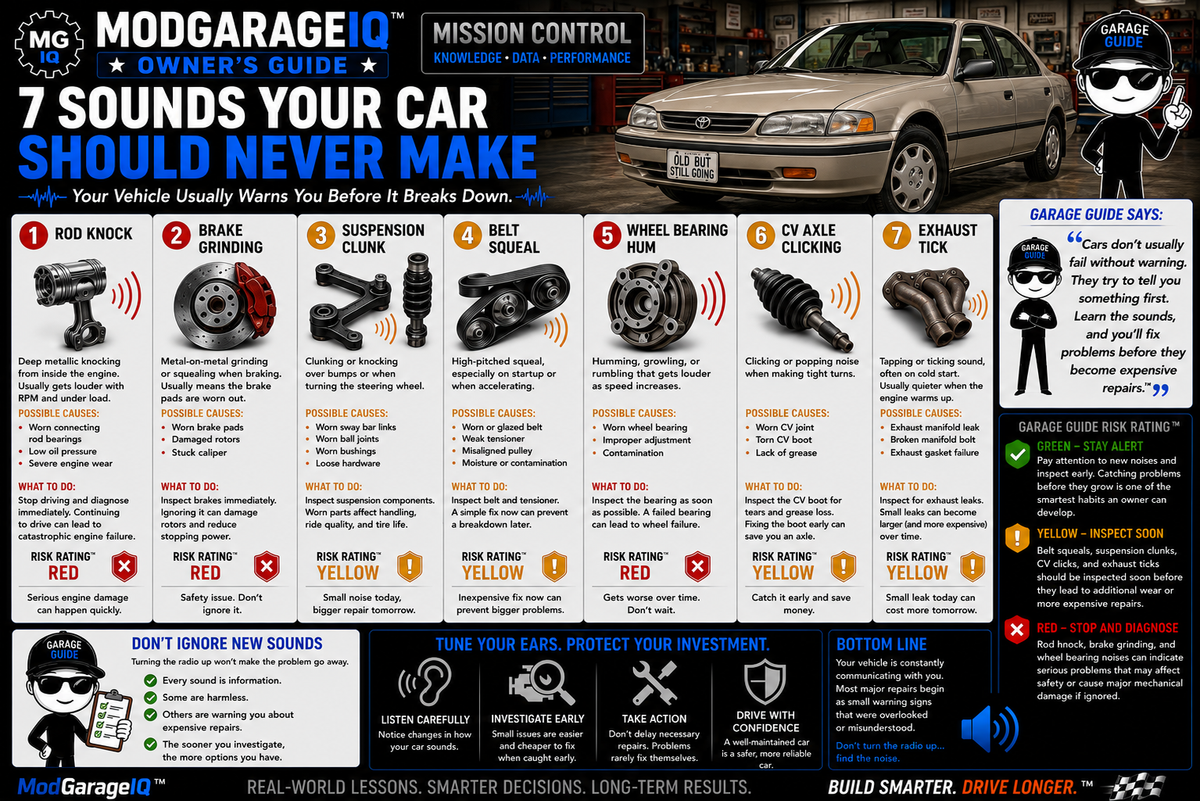
Your Vehicle Usually Warns You Before It Breaks Down.
Cars rarely fail without warning.
Long before a major repair leaves you stranded, your vehicle often starts communicating through new noises, vibrations, or unusual sounds.
The challenge isn’t hearing them…
It’s knowing what they mean.
Learning to recognize these sounds can help you catch problems early, reduce repair costs, and avoid unexpected breakdowns.
When your car starts talking…
It’s worth listening.
Rod Knock
One of the most serious sounds you’ll ever hear.
Rod knock usually sounds like a deep metallic tapping or knocking coming from inside the engine.
The sound often:
- Gets louder with RPM
- Becomes more noticeable under acceleration
- Continues after the engine warms up
Possible causes include:
- Worn connecting rod bearings
- Low oil pressure
- Severe engine wear
Driving with rod knock can quickly lead to catastrophic engine failure.
🔴 Garage Guide Risk Rating: RED
If you hear rod knock, stop driving and diagnose the problem immediately.
Brake Grinding
Brakes should stop your vehicle…
Not make grinding noises.
A grinding sound usually means the brake pad friction material has worn away, allowing the metal backing plate to contact the rotor.
Ignoring it can lead to:
- Damaged brake rotors
- Reduced stopping power
- More expensive repairs
Brakes are one repair you should never postpone.
🔴 Garage Guide Risk Rating: RED
Stopping safely is always more important than going faster.
Suspension Clunks
A clunk over bumps isn’t normal.
It often means something in the suspension has developed excessive play.
Common causes include:
- Worn sway bar links
- Ball joints
- Control arm bushings
- Loose suspension hardware
Besides affecting ride quality, worn suspension parts can reduce steering precision and tire life.
🟡 Garage Guide Risk Rating: YELLOW
Small suspension noises often become larger suspension repairs.
Belt Squeal
A loud squeal during startup—or while accelerating—usually points to a slipping serpentine belt.
Possible causes:
- Worn belt
- Weak belt tensioner
- Misaligned pulley
- Moisture contamination
Although the repair is often inexpensive, ignoring it can eventually leave you without charging, cooling, or power steering assistance.
🟡 Garage Guide Risk Rating: YELLOW
A simple belt today is much cheaper than a roadside breakdown tomorrow.
Wheel Bearing Hum
Unlike a squeak or knock…
Wheel bearings usually produce a steady humming or growling sound that increases with vehicle speed.
Many drivers notice the sound changes while turning.
Symptoms may include:
- Road-speed-related humming
- Steering vibration
- Loose wheel feel
If ignored, a worn bearing can eventually fail and affect vehicle safety.
🔴 Garage Guide Risk Rating: RED
Wheel bearings rarely repair themselves—they only become louder.
CV Axle Clicking
A clicking noise while making tight turns is one of the classic signs of a worn CV joint.
The problem usually begins when a torn CV boot allows grease to escape and dirt to enter.
Look for:
- Grease around the inside of the wheel
- Torn rubber boots
- Clicking during left or right turns
Catching a damaged boot early may prevent replacing the entire axle.
🟡 Garage Guide Risk Rating: YELLOW
Inspect the boot before the joint fails.
Exhaust Tick
Many owners mistake an exhaust tick for normal engine noise.
It isn’t always.
A ticking sound—especially during a cold start—can indicate:
- Exhaust manifold leaks
- Broken manifold bolts
- Exhaust gasket failure
The sound often becomes quieter as the engine reaches operating temperature.
Early repairs are usually much simpler than waiting until the leak becomes severe.
🟡 Garage Guide Risk Rating: YELLOW
Not every tick comes from inside the engine.
Don’t Ignore New Sounds
One of the worst habits drivers develop is simply turning the radio up.
Every unusual sound is information.
Some are harmless.
Others are warning you about a repair that becomes significantly more expensive the longer it’s ignored.
The sooner you investigate…
The more options you usually have.
🟢 Garage Guide Risk Rating: GREEN
Listening carefully can save thousands of dollars.
Garage Guide Says
“Cars don’t usually fail without warning. They try to tell you something first. Learn the sounds, and you’ll fix problems before they become expensive repairs.”
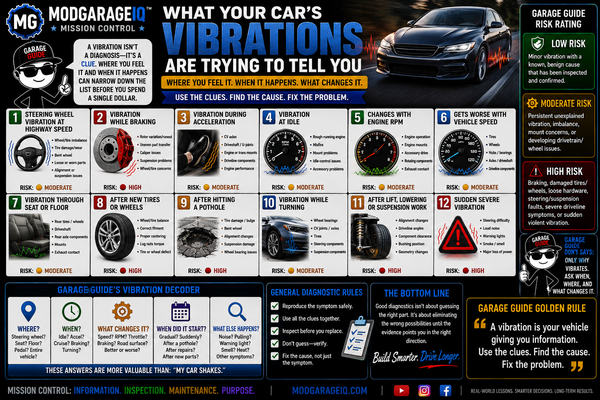
Garage Guide Risk Rating™
🟢 GREEN — Stay Alert
Pay attention to new noises and inspect them early. Catching problems before they grow is one of the smartest habits an owner can develop.
🟡 YELLOW — Schedule An Inspection
Belt squeals, suspension clunks, CV axle clicks, and exhaust ticks should be inspected soon before they lead to additional wear or more expensive repairs.
🔴 RED — Stop And Diagnose
Rod knock, brake grinding, and wheel bearing noises can indicate serious problems that may affect safety or cause major mechanical damage if ignored.
Bottom Line
Your vehicle is constantly communicating with you.
Most major repairs begin as small warning signs that were overlooked or misunderstood.
The next time your car makes a noise it didn’t make yesterday…
Don’t ignore it.
Listen.
Investigate it.
Fix it early.
Because the smartest drivers don’t wait for a breakdown to tell them something is wrong.
🏁 Build Smarter. Drive Longer.