Why Most Vehicle Builds Fail
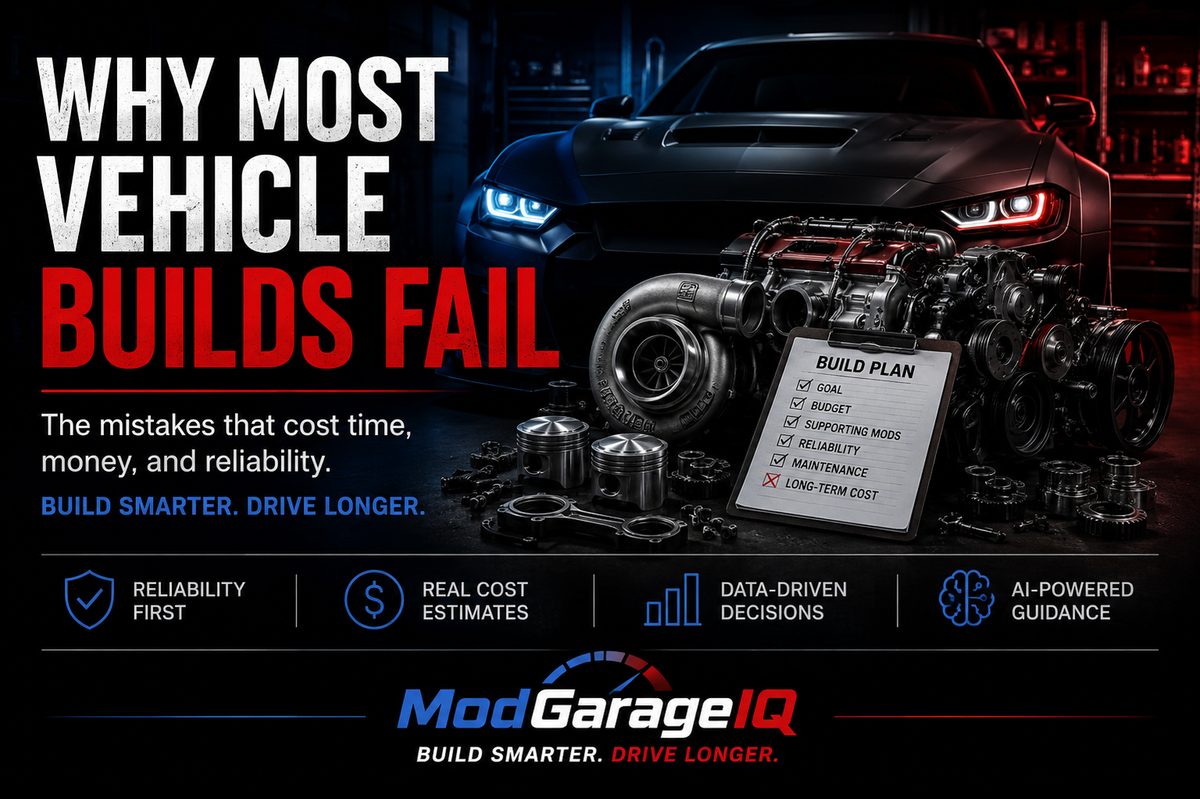
And how to avoid becoming another expensive cautionary tale.
Walk through any automotive forum and you'll find the same story repeated over and over.
Someone starts with a reliable daily driver and a simple goal: a little more power, better handling, or a more aggressive look.
Six months later, the project is sitting in a garage with a blown transmission, constant check-engine lights, a drained bank account, and an owner wondering where everything went wrong.
The truth is that most vehicle builds don't fail because enthusiasts lack passion.
They fail because they lack a plan.
The Problem With Modification Culture
The modern aftermarket industry is built around selling parts, not building complete vehicles.
Every company promotes its product as the next upgrade you need:
- Bigger turbochargers
- More aggressive tunes
- Larger injectors
- Stiffer suspension
- Higher boost levels
- Larger wheels and tires
Individually, many of these upgrades work exactly as advertised.
The problem occurs when modifications are installed without considering how they affect the entire vehicle system.
A vehicle is a collection of interconnected systems. When one component changes, everything around it changes too.
Adding horsepower impacts cooling.
Increasing torque affects drivetrain longevity.
Larger wheels influence ride quality, braking performance, and fuel economy.
What begins as a simple modification often creates a chain reaction of new requirements.
The Three Reasons Most Builds Fail
1. Chasing Peak Numbers
Many enthusiasts focus exclusively on horsepower figures.
More horsepower sounds exciting. It creates impressive dyno charts and social media posts.
However, peak horsepower rarely determines how enjoyable a vehicle is to own.
A build producing 450 reliable horsepower for 150,000 miles will almost always provide a better ownership experience than a 700-horsepower build that constantly breaks parts.
Reliability is performance.
A vehicle that cannot consistently operate at its intended capability isn't truly high performance.
2. Ignoring Total Cost
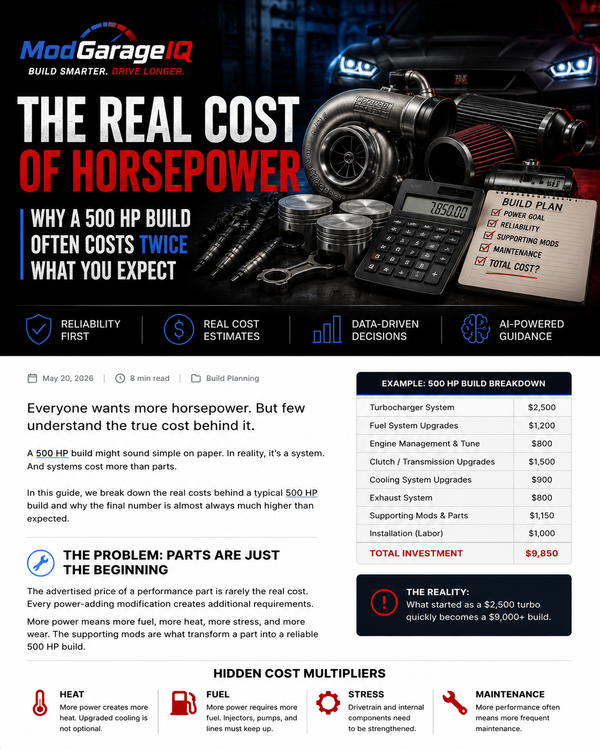
The advertised price of a modification is rarely the real cost.
A turbocharger upgrade may cost $2,500.
What often follows:
- Supporting fuel system upgrades
- Engine tuning
- Clutch upgrades
- Cooling improvements
- Transmission reinforcement
- Additional maintenance
Suddenly, a $2,500 upgrade becomes a $7,500 project.
Many builds fail because owners budget for the first purchase but not the complete ecosystem required to support it.
3. Modifying Without a Goal
One month it's a daily driver.
The next month it's a drag car.
A few months later it's being prepared for road course events.
Eventually it becomes a vehicle trying to accomplish five different missions at once.
The most successful builds begin with a clearly defined purpose.
Examples include:
- Reliable daily driver
- Weekend canyon car
- Track-focused performance build
- Overland adventure vehicle
- Tow rig
- Show car
Every modification should move the vehicle closer to that goal.
If it doesn't, it probably doesn't belong on the build sheet.
Reliability First
At ModGarageIQ, we believe reliability should be the foundation of every modification decision.
Before asking:
"How much power can I make?"
Ask:
"How much power can I reliably support?"
Before buying a new performance part, ask:
- What additional stress will this create?
- What supporting modifications are required?
- How will maintenance requirements change?
- What are the long-term ownership costs?
These questions aren't exciting.
They are also the difference between successful builds and unfinished projects.
The Smarter Approach
A successful vehicle build follows a simple progression:
Stage 1: Maintenance
Address known issues first.
Fluids, belts, cooling components, suspension wear items, and preventive maintenance should always come before performance modifications.
Stage 2: Reliability Upgrades
Strengthen weak points before increasing performance.
Reliable foundations allow future upgrades to succeed.
Stage 3: Supporting Systems
Upgrade cooling, fueling, braking, and drivetrain components as needed.
Supporting modifications often provide more value than headline-grabbing power parts.
Stage 4: Performance
Only after the vehicle is prepared should significant performance modifications be introduced.
This approach may feel slower.
It is also significantly less expensive than rebuilding a failed project.
Build Smarter. Drive Longer.
The best vehicle builds aren't always the fastest.
They aren't always the most expensive.
And they rarely generate the biggest dyno numbers.
The best builds achieve their intended purpose reliably, predictably, and consistently over the long term.
That philosophy is the foundation of ModGarageIQ.
Because the goal isn't simply to modify your vehicle.
The goal is to enjoy it for years to come.
Build smarter. Drive longer.